“Progressive Breath Awareness Booster” Course Now Available On Insight Timer (App)


December 13, 2023 UPDATE: Now on Thinkific: https://integratingpresence.thinkific.com/courses/ProgressiveBreathAwarenessBooster

September 19/20, 2023 UPDATE: This course is now available on Udemy.com: https://www.udemy.com/course/progressive-breath-awareness-booster. Even though in a way I got the option I requested of them, I’ve decided since Insight Timer didn’t give notice or choice but made all their courses available only to Plus Members I’ve put the course on Udemy to reach a wider audience of those wanting one off purchases. If anyone wants to do the course outside of these platforms please contact me.

August 8, 2023 UPDATE: While testing functionality for the new blog post Insight Timer Premium Tracks: Energy Work, Still Point, Somatic Subtlety, Breath Awareness Course Bonus it seems the option to buy Insight Timer courses without an active “MemberPlus” subscription is no longer possible

June 27, 2023 UPDATE: Progressive Breath Awareness Booster – New Bonus Mini Course now available as an Insight Timer Plus audio free for members. From what I remember, under the older rules, before opening up to all teachers, this mini bonus course is essentially stuff I couldn’t include in the main course because I was limited to 15 minutes per day and had to pitch a detailed plan before starting piecing together production.


After a few years in the making the five-day Progressive Breath Awareness Booster course (aka Part 2 of Breath: Questions for Contemplation; Perceptions and Practice Ideas) is now available on Insight Timer. Free for Plus members ($60/year which includes a 7-day free trial), and/or via: https://www.udemy.com/course/progressive-breath-awareness-booster (see below for explanation). Each day is no longer than 15 minutes yet jam packed for many, many listens.

The course description:

The Progressive Breath Awareness Booster course primarily addresses the breath through approaches, observations, perceptions, practice ideas, and with inquiries ranging from simple, commonplace, practical and broad overviews to the bizarre, obscure, esoteric, and minutia. This aim of this course is not to overwhelm, for overthinking, for comparison, or judgement; rather, it primarily intends leveraging cutting edge material to increase and enhance the likelihood of maintaining and prolonging bare awareness of breath for and during breath practices as well as in everyday life.

Since I find being aware of breath (for longer periods) very helpful, yet at the same time quite challenging, the intent to discover new and better ways to deepen and prolong breath awareness brought through most everything in this course to contemplate, meditate with and experience each part piece by piece.

The decision to initially keep private much of the material in this course came when assembling 2020’s Breath: Questions for Contemplation; Perceptions and Practice Ideas which is highly recommended as prerequisite. Since Part One wasn’t designed for Insight Timer’s course format it didn’t make since to use the same title and then tack on a “Part Two” hence the rename Progressive Breath Awareness Booster while also siding with releasing as a course for wider adoption and benefit.

The writeup for Breath: Questions for Contemplation; Perceptions and Practice Ideas states:

In addition to this public presentation the private portion may be given if working with me, or may be released later. Much of what’s public is aggregated from other public sources while the private includes material I’m unsure of what portion is public and what portion is not.

“Being unsure of what portion is public and what portion is not” mostly means there’s really no simple way to verify what’s considered as new and original for this course hasn’t already been put out there in some shape, form or manner and to what degree of (dis)similarity.

The choice for this type of release also brought up and includes the classic question of whether or not it’s OK to charge for meditation instructions. Below is a portion of my email response to this very consideration (with additions and edits in brackets for retrospective clarity):

. . . I thought and pondered this long and hard while making this course. I even reached out to Insight Timer to request an option for this course to not be sold individually while still making it available to plus members who [more or less] donate to the platform (to support all the free users) and then [plus] members get access to all the courses (amongst other features) and then insight timer in turn more or less donates to teachers if I’m getting all this right.

I made sure nothing included in the course, to my current knowledge, came directly from any Buddhist canon nor directly from any Buddhist teachers (other than a handful of descriptive word choices) as it’s obvious Buddhist teachings are provided freely in the spirit of generosity.

As soon as Insight Timer offers the option to only make this course available to [donating] members I’ll choose that and even better if I will be allowed to mention that anyone interested in this course can contact me directly and get it freely. I surely plan to mention this on my website for the announcement write up for this course too.

. . .

I invite further thoughts, feelings and advice about all this


The female barefoot in the desert image above, as well as the windblown male silhouette for this blog post’s main image were both rejected by Insight Timer. They write, “for courses, we recommend using, clean, warmer, minimalistic, bold, and compelling images that generate positive emotions in our audience.”


Again, the suggested free prerequisite:

And (then) check out the course entirely free for Insight Timer Plus members (currently $60/year which includes a 7-day free trial), or the easy to remember: tinyurl.com/breathcourse. There’s a multiple choice reflective question at the end of each of the five days on Insight Timer with no right or wrong answer as well as a virtual classroom for students to ask (me) questions.

As a bonus, after finishing the course listen to Progressive Breath Awareness Booster – New Bonus Mini Course an Insight Timer Plus Premium Track free for members. From what I remember, under the older rules, before opening up course creation to all teachers, this mini bonus course is essentially stuff I couldn’t include in the main course because I was limited to 15 minutes per day and had to pitch a detailed plan before starting piecing together production.

It’s also currently $19.99 via: https://www.udemy.com/course/progressive-breath-awareness-booster. Even though in a way I got the option I requested of them, I’ve decided since Insight Timer didn’t give notice or choice but made all their courses available only to Plus Members I’ve put the course on Udemy to reach a wider audience of those wanting one off purchases. If anyone wants to do the course outside of these platforms please contact me

Born of necessity for more optimal breath meditation and almost even just being able to use breath as a meditation object nearly at all, I wish the best optimal outcomes to all who come across this course.

Awakening: A Two Part Series With Randi Green And Alex Manning — (Part 1:) Definition, Purpose & Probability And (Part 2:) On Tools & Teachers

(Note: If listening to this as/in a podcast (app) please visit the episode page for part two)

In February 2023, Randi Green and I were joined by Alex Manning to discuss awakening. In the first of this two part series we talk about the definition, purpose and probability of awakening as well as the processes, psychological maturing and some of the steps needed to begin the journey towards expanded perception and higher order awareness.

What is the higher order awareness? And what does this mean? Is it the same as awakening or activation? We also go into dreams, the astral, dark awakenings, the two truths, self-responsibility, bliss, crisis, stress, etc.

Audio: Awakening: Definition, Purpose & Probability With Randi Green and Alex Manning (Part 1)

Or listen via Insight Timer (app or website)


In part two we talk about how some tools can be stepping stones as well as distortions and hinderances like tarot, astrology, crystals, healing systems, etc. Also mentioned: redefining terminology, zen training and teachers.

Or listen via Insight Timer (app or website)


Audio: Awakening: On Tools & Teachers With Randi Green and Alex Manning (Part 2)

For more information regarding the work of Randi Green visit the HAL Academy Website https://toveje.dk

The Activation & Awakening Process | THE HAL ACADEMY BY RANDI GREEN https://toveje.dk/hal-new-reality/hal-5th-cycle-podcasts/hal-approach-to-the-activation-awakening-process

And the HAL Future Humanities Channel: https://YouTube.com/@thehalfuturehumanities or https://www.youtube.com/channel/UCTxfpHiGxSSnvm_mL7i9T0g

https://randigreen.one


Continue reading “Awakening: A Two Part Series With Randi Green And Alex Manning — (Part 1:) Definition, Purpose & Probability And (Part 2:) On Tools & Teachers”

Questions And Points Put To Leigh Brasington On “Psychic Powers” In The Suttas


March 23, 2023 Update: See below for Leigh’s responses via email. I may or may not give some future response to Leigh’s responses


Honor and respect to Leigh Brasington, not only for his extensive teachings on the jhanas, but for all the thoughts, teachings and practices surrounding the Sāmaññaphala Sutta (DN 2) during the February 11, 2023 event Gradual Training on the Buddhist Path with Leigh Brasington: part 1 and part 2.

That day I left early during the second part before my statements about “psychic powers” were addressed which is OK because it seems a bulk of the audience questions and comments then came around these topics which I’m interested in. (The edited clip above from this daylong event includes these).

I, like Leigh, have little to no traditional formal credentials on these matters and agree it is better not to get too sidetracked on these so-called “psychic powers.” I also agree the miracle of instruction outweighs “psychic powers” yet I here below share some thoughts and musing (in the form of questions) that arose to the way Leigh currently sees these “powers” and what arose when listening to the audience questions and answers.

Maybe some of these powers are literal. Maybe they aren’t. Maybe it’s a mix, and yes maybe they’re something else entirely. Since I can’t prove Leigh’s takes aren’t wrong in any ways or forms it would not be wise to say they are inaccurate in any ways or forms. Much encouragement actually for science and meditators to investigate ESP and lucid dreaming — two of Leigh’s interpretations that I find interesting — as long as doing so leads toward cessation of dukkha not away from it. At the end of the day it seems kind of
a waste of time, energy and wisdom to believe or disbelieve psychic powers

Before reading my questions it may be helpful to check out:


Here are the points I briefly raised to Leigh in the start of the clip above during the first part of the event hopefully made more clearly now:

  • Reports of modern practitioners preforming acts of psychic powers
  • “Powers” laughed off in academia and academic careers not really allowed to explore these as credible possibilities
  • My grandmother when she died could barely recognize the time she found at her end with smart phones since she started growing up with no electricity, cars, indoor plumbing, etc. Such rapid change was only within around a 100 years. How much has life changed in thousands of years?
  • Pursuit of power and psychic power can also tempt and/or lead one astray from the path of liberation, nibbana, arhatship like some say happened with Devadatta
  • Many in very credible places of our current society know the importance of, highly value and relate many of the Buddha’s teachings but seem to ignore, dismiss, disregard, gloss over, and lambast other teachings of the Buddha

Finally, my questions in bullet points surrounding the above video clip, which can be taken as rhetorical and/or traditional questions seeking an answer, and Leigh’s email responses in quote formatting:

  • If I’m getting this right Leigh mentioned during the portion of recalling past lives on the night of the Buddha’s awakening involved one past life recall detail every 1/56th of a second.

No, every 1/7 of a second. And in the 1/7 of a second he recalled 8 different items. So each item got 1/56 of a second.

  • How many mind moments are, or can be contained within a second according to Abhidhamma teachings? [Maybe I ought to do more research to answer this question myself]

The Abhidhamma is like taking your bicycle apart, laying all the pieces, and looking for what it’s like to coast down a hill effortlessly. I don’t trust the Abhidhamma for Anything.

But according to Ayya Khema, it says 1000 mind-moments in the blink of an eye (which is about 1/5 of a second). So 5000 mind-moments a second. Modern neuroscience says around 40 a second.

  • The night of the Buddha’s awakening was a time when there was a going beyond human, or at least other-than-human as later exclaimed (if I’m remembering right). How accurate or inaccurate might any of our guesses, assessments, understandings and commentaries be since we’re viewing this from a post-modern 21st Century Western scholastic human perspective?

The remembering past lives takes place 4 to 8 hours before awakening. The awakening would be what is other-than-human.

As for how accurate our guesses are – who knows? Only a fully awakened one and we seem to be in very short supply.

  • (How) could the terms/notions of Servitor and Eidolon apply to “having been one he [a monk] becomes many; having been many he becomes one”?

In my opinion – not at all. That’s just another lucid dream trick.

  • How much can, or does doubt hinder development of these “powers”?

Probably totally.

  • What would be the psychological fall out and/or psychological implications for some individuals if any of these “powers” were actually preformed or witnessed? After beholding such “powers” how much then would such individuals let go of, or continue clinging to what they consider is and isn’t possible around this subject — perhaps even clinging tighter to defend their views because of the amount of time, money, energy, friends and social structures involved?

No idea. But the Buddha definitely is said to have forbade the monks from exhibiting any of these powers to lay people. Now was that just a convenient way to explain away the fact that no lay person ever saw a monk performing any of these powers? Was that added later. There certainly are suttas where the Buddha expresses disdain for these powers (e.g. DN 11, AN 3.60).

  • How much, and to what extent do self-esteem, lack of self-esteem, failure, success, and other comparisons come into play when one considers developing, or not developing these powers along the path of awakening?

The less powerful one feels, the more likely one would want to resort to these powers to make up for that feeling of powerlessness.

  • What all are and aren’t psychological defense mechanisms when attempting to interpret these “powers” with what one currently understands as possible and not possible within today’s consensus reality? How much could what one thought was real and/or was led to believe was real then be upended and cause (temporary) psychological distress when one finds out at least part of the reality they once knew was not real?

Hey, I don’t want to write psych book as an answer to your questions!

  • How much, and to what extent do self-esteem, lack of self-esteem, failure, success, and other comparisons come into play when one considers developing, or not developing these powers along the path of awakening?

A lot. But it would depend on how tightly one was clinging to whatever was upended.

  • For Leigh’s quote: “Do look at it in the mythic language of the time to situate human experience in a much bigger picture than your own self-interested existence”: Since one wasn’t there how does one know for certain what was or was not myth in ancient times?

Physics

  • For Leigh’s quote: “Do look at it in the mythic language of the time to situate human experience in a much bigger picture than your own self-interested existence”: Do developing these “powers” have to (always) be considered in one’s own self-interest (especially in the light of the Buddha saying of the related Iddhipāda, “this is how these four bases of power, when developed & pursued, are of great fruit & great benefit”)?

No – they don’t have to be. But they probably are going to be unless one is fully awakened (and then highly unlikely one would bother pursuing these powers).

  • Could (comic book movies and/or) the general lack of consciousness (development) among current humanity (have) contribute(d) to any causes and/or conditions for Western humanity’s status quo perception that these “powers” don’t really exist and are not possible?

Of course. But more likely would be an understanding of the limitation imposed on the physical world (this is called physics, etc).

  • In regard to comments about Devadatta, and excuse the lack of research, but didn’t the “evilest man in the world” Aleister Crowley (also) practice Dhyana or types of intense concentration practices?

I don’t know. But practicing concentration is said to lead to these powers. But I have seen no evidence it does – other than enhancing ESP (whatever ESP actually is).

  • (Why) would the Buddha engage in falsehoods, or misrepresentations, or (gross) inaccuracies, i.e. mention “psychic powers” to impress King Ajātasattu? What other instances in the suttas are there of the Buddha doing this?

Check out Ud 2.1. Check out Kisagotami (first story in the introduction).

  • Is it possible that instances of these “powers” could have been removed from some versions of the Pali cannon instead of, or in addition to mentions of these “powers” being a later insertion into some versions of the Pali cannon? Why or why not?

Of course. We have no idea what really went on 2500 years ago.

But it is certain that suttas were modified and created showing the Buddha as a more and more powerful being as time went on. This was “needed” for early Buddhism to compete with all the other many Indian religions at that time. If your guy was the real deal, then he had to have walked on water, flown thru the air, etc. So it makes far more sense to assume insertions rather than deletions.

  • Is there any requirement and/or importance for having to believe or not believe in any of these “powers” [in order for this topic to be in accordance with one’s current understanding of what one perceives as (consensus) reality?]

There is no single consensus reality! Look at all the realities of the various political factions and religious factions in the US today! So if you want to believe in the scientific consensus reality, you will need to question these claims very seriously. If you are a literalist Christian, you have to believe Jesus walked on water. If you are a literalist Buddhist, you have to believe all these claims. But if you really want to know what the Buddha taught, you can ignore all that and just do the practices he recommends over and over again.

  • (For Leigh’s last comment/response) how does getting from point a to point a twice by going twice around the world prove the Earth is any particular shape or lack of shape?

You only have to go once around the world to do that. And while you are doing it, there are tons of other things you will see that confirm the earth is sphere. Did you know that a new moon seen from the equator has the ‘horns’ pointing straight up? Not like they are pointing to the side in temperate climates. [you are not a flat earther are you? I hope not!]

  • (Ultimately,) do conclusions need to be drawn about these things?

No.

And about flat earth I then replied to Leigh:

At the moment I lean more as a earth-shape agnostic and look at that whole thing as more distraction and division than anything else. Whatever shape this earth is and/or isn’t is OK with me now

Along similar lines, how much do collective belief systems play into the efficacy of certain psychic power development or lack thereof?


Leigh mentioned this sutta with a brahmin about demonstration of psychic power, a demonstration of revealing, and a demonstration of instruction:

Then Saṅgārava the brahmin went up to the Buddha, and exchanged greetings with him. When the greetings and polite conversation were over, he sat down to one side and said to the Buddha:

“Master Gotama, we who are called brahmins make sacrifices and encourage others to make sacrifices. Now, Master Gotama, both of these people—the one who sacrifices and the one who encourages others to sacrifice—are doing good for many people on account of that sacrifice. But, Master Gotama, when someone has gone forth from the lay life to homelessness, they tame, calm, and extinguish themselves alone. That being so, they are doing good for just one person on account of that going forth.”

“Well then, brahmin, I’ll ask you about this in return, and you can answer as you like. What do you think, brahmin? A Realized One arises in the world, perfected, a fully awakened Buddha, accomplished in knowledge and conduct, holy, knower of the world, supreme guide for those who wish to train, teacher of gods and humans, awakened, blessed. He says, ‘Come, this is the path, this is the practice. Practicing like this, I realized the supreme culmination of the spiritual life with my own insight, and I make it known. Please, all of you, practice like this, and you too will realize the supreme culmination of the spiritual life, and will live having realized it with your own insight.’ So the teacher teaches Dhamma, and others practice accordingly, in their hundreds and thousands, and hundreds of thousands.

What do you think, brahmin? This being so, are they doing good for just one person or for many people on account of going forth?”

“This being so, Master Gotama, they are doing good for many people on account of going forth.”

When he said this, Venerable Ānanda said to Saṅgārava, “Brahmin, which of these two practices do you believe has fewer requirements and undertakings, yet is more fruitful and beneficial?”

Saṅgārava said to Ānanda, “Those such as the masters Gotama and Ānanda are honored and praised by me!”

For a second time, Ānanda said to Saṅgārava, “Brahmin, I didn’t ask you who you honor and praise. I asked you which of these two practices do you believe has fewer requirements and undertakings, yet is more fruitful and beneficial?”

For a second time Saṅgārava said to Ānanda, “Those such as the masters Gotama and Ānanda are honored and praised by me!”

For a third time, Ānanda said to Saṅgārava, “Brahmin, I didn’t ask you who you honor and praise. I asked you which of these two practices do you believe has fewer requirements and undertakings, yet is more fruitful and beneficial?”

For a third time Saṅgārava said to Ānanda, “Those such as the masters Gotama and Ānanda are honored and praised by me!”

Then it occurred to the Buddha, “Though Ānanda asked him a sensible question three times, Saṅgārava falters without answering. Why don’t I give him a way out?”

So the Buddha said to Saṅgārava, “Brahmin, what came up in the conversation among the king’s retinue today, sitting together in the royal compound?”

“Master Gotama, this came up: ‘Formerly, it seems, there were fewer mendicants, but more of them displayed superhuman demonstrations of psychic power; while these days, there are more mendicants, but fewer display superhuman demonstrations of psychic power.’ This is what came up in the conversation among the king’s retinue today, while sitting together in the royal compound.”

“Brahmin, there are three kinds of demonstration. What three? A demonstration of psychic power, a demonstration of revealing, and a demonstration of instruction.

And what is the demonstration of psychic power? It’s when someone wields the many kinds of psychic power: multiplying themselves and becoming one again; appearing and disappearing; going unimpeded through a wall, a rampart, or a mountain as if through space; diving in and out of the earth as if it were water; walking on water as if it were earth; flying cross-legged through the sky like a bird; touching and stroking with the hand the sun and moon, so mighty and powerful. They control the body as far as the Brahmā realm. This is called the demonstration of psychic power.

And what is the demonstration of revealing? In one case, someone reveals by means of a sign: ‘This is what you’re thinking, such is your thought, and thus is your state of mind.’ And even if they reveal this many times, it turns out exactly so, not otherwise.

In another case, someone reveals after hearing it from humans or non-humans or deities: ‘This is what you’re thinking, such is your thought, and thus is your state of mind.’ And even if they reveal this many times, it turns out exactly so, not otherwise.

In another case, someone reveals by hearing the sound of thought spreading as someone thinks and considers: ‘This is what you’re thinking, such is your thought, and thus is your state of mind.’ And even if they reveal this many times, it turns out exactly so, not otherwise.

In another case, someone comprehends the mind of a person who has attained the immersion that’s free of placing the mind and keeping it connected. They understand: ‘Judging by the way this person’s intentions are directed, immediately after this mind state, they’ll think this thought.’ And even if they reveal this many times, it turns out exactly so, not otherwise. This is called the demonstration of revealing.

And what is a demonstration of instruction? It’s when someone instructs others like this: ‘Think like this, not like that. Focus your mind like this, not like that. Give up this, and live having achieved that.’ This is called a demonstration of instruction.

These are the three kinds of demonstration. Of these three kinds of demonstration, which do you consider to be the finest?”

“Regarding this, Master Gotama, a demonstration of psychic power is experienced only by the one who performs it, occurring only to them. This seems to me like a magic trick.

And the demonstration where someone reveals something by means of a sign, or after hearing it from humans, non-humans, or deities, or by hearing the sound of thought spreading as someone thinks and considers, or by comprehending the mind of another person, is also experienced only by the one who performs it, occurring only to them. This also seems to me like a magic trick.

But as to the demonstration where someone instructs others: ‘Think like this, not like that. Focus your mind like this, not like that. Give up this, and live having achieved that.’ I prefer this demonstration, Master Gotama. It’s the finest of the three kinds of demonstration.

It’s incredible, Master Gotama, it’s amazing, how well this was said by Master Gotama. We regard Master Gotama as someone who possesses these three kinds of demonstration. For Master Gotama wields the many kinds of psychic power … controlling the body as far as the Brahmā realm. And Master Gotama comprehends the mind of another person who has attained the immersion that is free of placing the mind and keeping it connected. He understands: ‘Judging by the way this person’s intentions are directed, immediately after this mind state they’ll think this thought.’ And Master Gotama instructs others like this: ‘Think like this, not like that. Focus your mind like this, not like that. Give up this, and live having achieved that.’”

“Your words are clearly invasive and intrusive, brahmin. Nevertheless, I will answer you. For I do wield the many kinds of psychic power … controlling the body as far as the Brahmā realm. And I do comprehend the mind of another person who has attained the immersion that is free of placing the mind and keeping it connected. I understand: ‘Judging by the way this person’s intentions are directed, immediately after this mind state they’ll think this thought.’ And I do instruct others like this: ‘Think like this, not like that. Focus your mind like this, not like that. Give up this, and live having achieved that.’”

“But Master Gotama, is there even one other mendicant who possesses these three kinds of demonstration, apart from Master Gotama?”

“There’s not just one hundred mendicants, brahmin, who possess these three kinds of demonstration, nor two, three, four, or five hundred, but many more than that.”

“But where are these mendicants now staying?”

“Right here, brahmin, in this Saṅgha of mendicants.”

“Excellent, Master Gotama! Excellent! As if he were righting the overturned, or revealing the hidden, or pointing out the path to the lost, or lighting a lamp in the dark so people with good eyes can see what’s there, Master Gotama has made the teaching clear in many ways. I go for refuge to Master Gotama, to the teaching, and to the mendicant Saṅgha. From this day forth, may Master Gotama remember me as a lay follower who has gone for refuge for life.”

Numbered Discourses 3.60
6. Brahmins
With Saṅgārava
Continue reading “Questions And Points Put To Leigh Brasington On “Psychic Powers” In The Suttas”

Heart Practices | February 23, 2023 “Meditation Q & A With Wendy Nash” #06


This is the sixth installment of the ongoing live series with Wendy Nash inquiring into meditation practice on and off the cushion. Due to no Q & A in January we did two in February. And since February is often associated with love and Valentines day we did one on Love & Brahmaviharas and for this one we dove into heart based (meditative) practices by asking and answering questions of each others’ practices along with touching on inheritance, challenges, capacity, depth, giving, emotions, family, etc.


Join these Q & A’s when they happen live:


*There’s naturally an ongoing open call for meditation (related) questions for the (roughly) monthly “Meditation Q & A” either by the various social media means listed; integratingpresence[at]protonmail.com or just showing up on Insight Timer live or Wisdom App to type/ask live.*


Background

Regular, current and past visitors to Integrating Presence may recall the monthly series “Ask Us Anything” I did with Denny K Miu from August 2020 until January 2022 — partially including and continuing on with Lydia Grace as co-host for awhile until March 2022.

For a few months thereafter I did various Insight Timer live events exploring potential new directions and/or a continuation of the Ask Us Anything format while weaving in other related teachings to these events.

Then, after chats with meditation coach Wendy Nash, it became clear to start a new collaboration similar to “Ask Us Anything” simply and clearly called “Meditation Q & A” especially due to the original intent of the Ask Us Anything’s being “discussions about meditation and related topics.”


Audio: Heart Practices | Feb 23, 2023 “Meditation Q & A With Wendy Nash” #06

Or listen via Insight Timer (app or website)


Past chats with Wendy:


Continue reading “Heart Practices | February 23, 2023 “Meditation Q & A With Wendy Nash” #06”

Travel And Moving To Expand Perception And Awareness

Shortcut: https://tinyurl.com/travelforexpansion


The pitch for this minimally edited February 16, 2023 Insight Timer live event:

I invite participants and expats to share travel wisdom while I share what I’ve noticed about Denmark so far comparing and contrasting with the United States where I’ve lived my whole life. Then using all this to explore how to leverage such external noticing to meditation practice

At this time I’ve only been in Denmark a month and haven’t been to Copenhagen yet other than leaving the airport. I haven’t been to other parts of Europe other than Iceland.

These are little details; not representative of whole. I welcome corrections.

Some of this stuff will likely seem bigger in the beginning then more common as time goes on


Note: I’ve added stuff since the talk

Noticings about DenmarkMediation applications
Roadssome with no middle line; one side walk and bikeway; (dividing) sidewalk brickwork; some city steps include small bike ramp on edgesvarious types, styles, techniques, practices and approaches of meditation
Landpublic/private mixing — example of sharing a private lane; three large nature parks; lots of farm ground close to houses; similar to US eastern woodland, Western aspen areas and old growth forests (sections of northern US?); clean; minimal street/road lighting (in my neighborhood)solo/group practice; internal terrain: what’s coming up
Language[too soon to say much]; Swedish chef; English/German/Swedish; most speak English; some signs only in DanishPali/Sanskrit/Tibetan practice words; Talking with meditation teachers and friends; labeling practice
Weatherconsistent in temperature and dampness (in winter at least)conditions (what’s required and what’s more of (clinging to) preferences
Peoplekind; reserve; polite; quiet; low population density; unified; (more graffiti sprayed on trains seemed out of place with everything else though); seeming smelling more cologne than in the states meditation teachers and friends; meditative stereotypes; boldness vs conformity in practice, groups and relationships
(Grocery) Storessmaller; Euro club music; roll baskets; lots of coffee without origins; food preference types; non-GMO; 25% tax built-in to prices; black cloth with velcro hide cigs behind the checkout Four nutriments; what’s needed from what’s available and how to go about it (via communication and behavior)
Recyclingvery big; several types of bins: drink cartons, paper, glass, metal, plastic, etc; food waste burned for country wide hot water; Byproducts: become a teacher(?); containment; right sharing; what’s left to heal; what does and doesn’t need to be brought up again
DesignScandinavian; IKEA; sink drain in cardioid / torus flow; door handles; 2 metal clasps on jars; fridge off when open; removable air and oven trays instead of grates/racks; loop on hand towels to hang them; some same windows hinge out from top and from side; TP sections may be slightly longerForm and function: fits what’s needs addressing in various ways depending on conditions, e.g. compassion, samatha
Architecture[assessment premature]; very old “eco” roofs; Scandinavian, similar to Iceland but distinctly different; large plain church; more natural, less cut gravestones shrine-like surrounded by hedgesclassification and grouping of practices: e.g., six-fold mindfulness of the body; samatha; vipassana
——————
Culture:Danish Culture and Tidbits:Honoring origins of practices
Bikesno locks even when parked in public at train stations where there’s lots of racks and covered area for them *correction: many have a small rear tire lock I hadn’t seen beforesafety; trust; ease
No consumer culturevery few strip malls, ads and convenience storesless distractions
Movies and productsbefore internet fewer American movies and productsstick to meditation object
Laundry DayWord Saturday includes Danish word for laundry learn specialized, original terminology before translations
Spouse visaprove 18 months together; financial requirementrelationship(s) to meditation object, to practice and beyond
Cozy culturemaybe due to colder, damper conditions and a distinction from Germany?capitalize on conducive conditions, not get lazy or put off

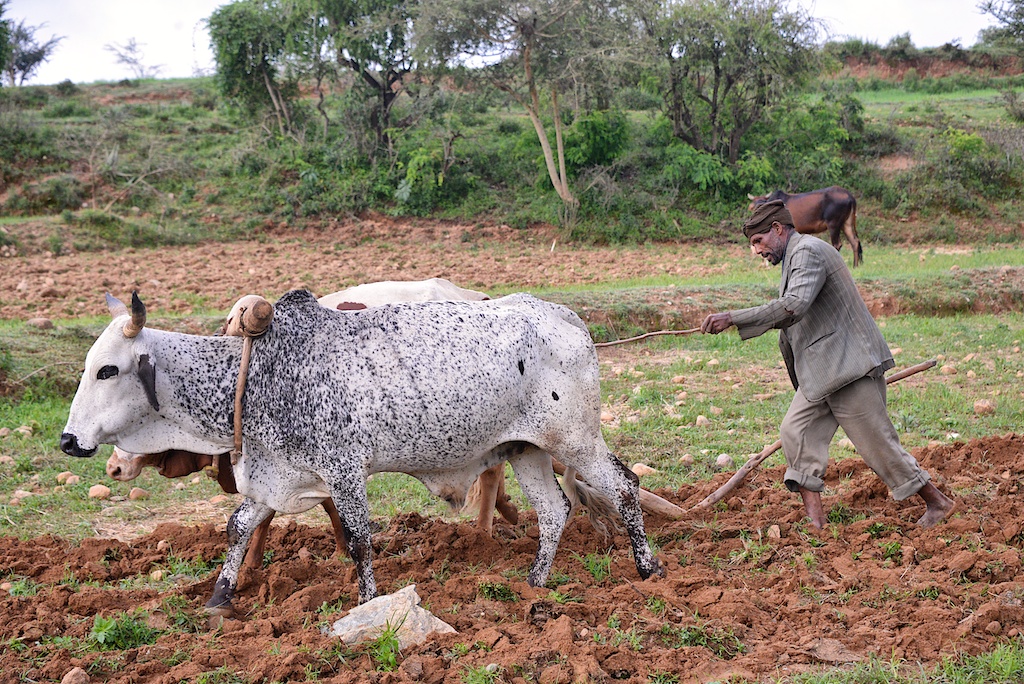
A few translations of an excerpt from the Kasi Bharadvaja Sutta: To the Plowing Bharadvaja

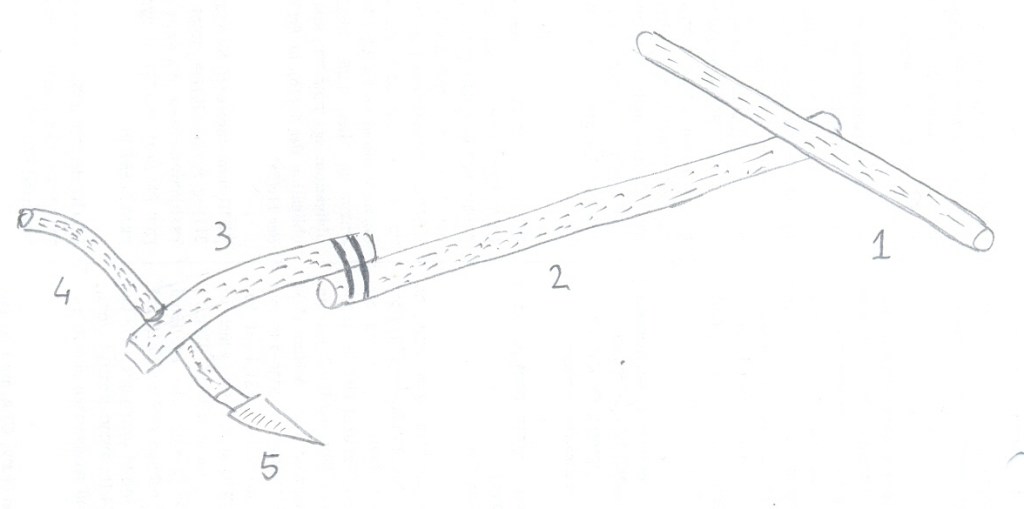
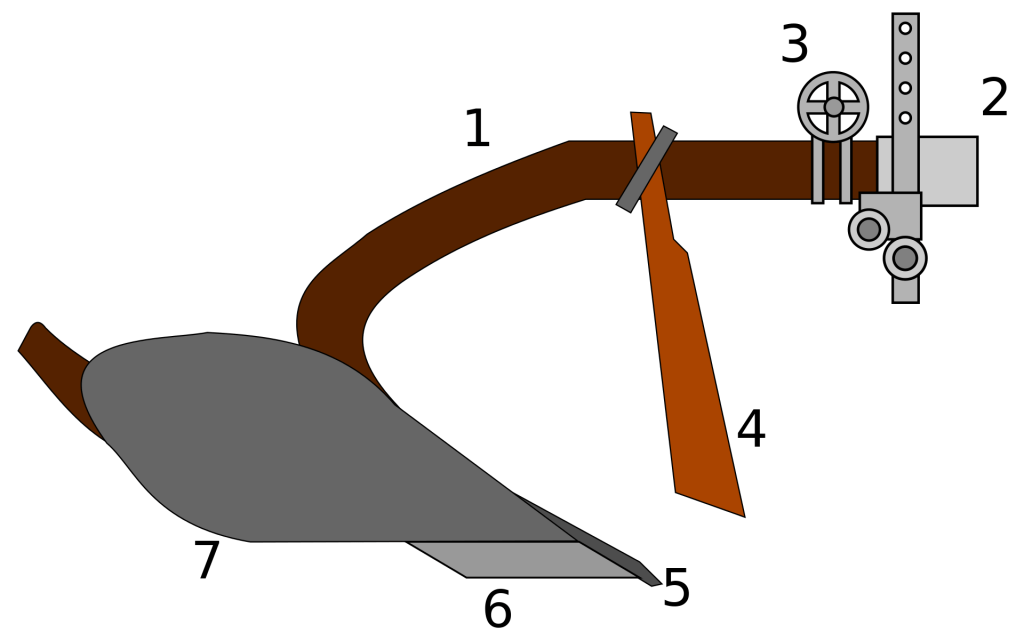
Some images and links below about ancient ploughs to get the beauty of the antiquated language here. This is just the nuts and bolts crux of the sutta; please read in its brief entirety for the story and context which is quite heartwarming.

[The Buddha replies:]

Faith is the seed, practice the rain,

And wisdom is my yoke and plow.

Modesty’s the pole, mind the strap,

Mindfulness my plowshare and goad.

Body and speech are guarded well,

And food and drink have been restrained.

Truthfulness I use for weeding,

And gentleness urges me on.

Effort is my beast of burden,

Pulling me onward to safety.

On it goes without returning,

Where, having gone, one does not grieve.

This is how I plow my plowing —

The crop it yields is deathlessness!

And when one has plowed this plowing,

One is released from all suffering.

https://www.accesstoinsight.org/tipitaka/kn/snp/snp.1.04.olen.html

Goad

noun

1.  a spiked stick used for driving cattle.

Single-handled bow ard: (1) yoke, (2) draft-pole, (3) draft-beam, (4) stilt, (5) share
Components of a simple drawn plow: 1) beam; 2) three point hitch; 3) height regulator; 4) coulter (or knife) 5) chisel 6) plowshare 7) moldboard

[The Buddha:]

Conviction is my seed,

austerity   my rain,

discernment my yoke & plow,

conscience  my pole,

mind        my yoke-tie,

mindfulness my plowshare & goad.

Guarded in body,

guarded in speech,

restrained in terms of belly & food,

I make truth a weeding-hook,

and composure my unyoking.

Persistence, my beast of burden,

bearing me toward rest from the yoke,

takes me, without turning back,

to where, having gone,

one doesn’t grieve.

That’s how my plowing is plowed.

It has

as its fruit

the deathless.

Having plowed this plowing

one is unyoked

from all suffering

& stress.

https://www.dhammatalks.org/suttas/KN/StNp/StNp1_4.html

https://en.wikipedia.org/wiki/File:Field_Ploughing,Tigray(14424613203).jpg

Another translation:

Conviction (śraddhā) is the seed,

Austerity (tapas) the rain,

Wisdom (prajñā) my yoke and plow,
Shame (hrī) the pole, mind (manas) the strap,

Mindfulness (smrti) my plowshare and goad.
Guarding the body, guarding the speech,

Restrained in food and belly,
Truthfully (satyam) I dig out weeds,

And gently, I cast them away.
Heroic effort (vīrya) is the ox carrying the yoke,

Pulling  to Absolute Wellbeing (yogakṣema),
Going without turning back.

Having gone, there is no grief.
Thus I plough.

The harvest is deathlessness. Having farmed,
There is the release from all suffering!

– the Buddha in Kasībhāradvāja-sutta (The sutra instructing the farmer Bharadvaja)

Last one:

[The Buddha:]

2. “Faith is my seed, austerity the rain, wisdom my yoke and plow, modesty is the pole, mind the strap, mindfulness is my plowshare and goad.

3. “Controlled in speech and conduct, guarded in deed and speech, abstemious in food,[1] I make truth my weed cutter; arahantship, my deliverance complete.

4. “Exertion, my team in yoke, draws me to Nibbana’s security, and on it goes without stopping, wither gone one does not suffer.

5. “Thuswise is this plowing plowed which bears the fruit of Deathlessness; having plowed this plowing one is freed from every ill.”

https://www.accesstoinsight.org/tipitaka/sn/sn07/sn07.011.piya.html

Audio: Travel And Moving To Expand Perception And Awareness

Open Wisdom Wednesdays


Easy to remember shortcut to this resource: https://tinyurl.com/OpenWisdomWednesdays


Mid February 2022 saw the start of “Open Wisdom Wednesdays” an irregular Insight Timer Live series with the current description:

Mutual office hours for wisdom. I ask unplanned general and specific questions for your wisdom. And you ask me. In the meantime we share openly — likely from whatever is going on currently — to get at our wisdom

The public YouTube playlist below collects the minimally (if at all) edited YouTube videos for the “Open Wisdom Wednesdays” events.

Follow me at https://insighttimer.com/integratingpresence to find out when the next one is. Or check https://insighttimer.com/live

The Noble Truth Of Dukkha: Buddhism And Beyond With Randi Green (Part 2)

“Now this, monks, is the Noble Truth of dukkhaBirth is dukkha, aging is dukkha, death is dukkha; sorrow, lamentation, pain, grief, & despair are dukkha; association with the unbeloved is dukkha; separation from the loved is dukkha; not getting what is wanted is dukkha. In short, the five clinging-aggregates are dukkha.”

— SN 56.11

In part one Randi and I talked about various Buddhist related topics and in this part two we expand on dukkha which is often translated as:

  • suffering
  • stress
  • unsatisfactoriness
  • Also depicted as:
    • as a raging fire — SN 35.28
    • in terms of the senses:
      • “And what is the noble truth of dukkha? ‘The six internal sense media,’ should be the reply. Which six? The medium of the eye… the ear… the nose… the tongue… the body… the intellect. This is called the noble truth of dukkha.” — SN 56.14
    • should be known:
      • . . . The cause by which dukkha comes into play should be known. The diversity in dukkha should be known. The result of dukkha should be known. The cessation of dukkha should be known. The path of practice for the cessation of dukkha should be known.’ . . . — AN 6.63
  • chariot where the wheel base is unstable resulting in a bumpy, jolting and shaky ride
  • duk = negative / kha = no essence contrasted with sukha or happiness as su = positive / kha = no essence


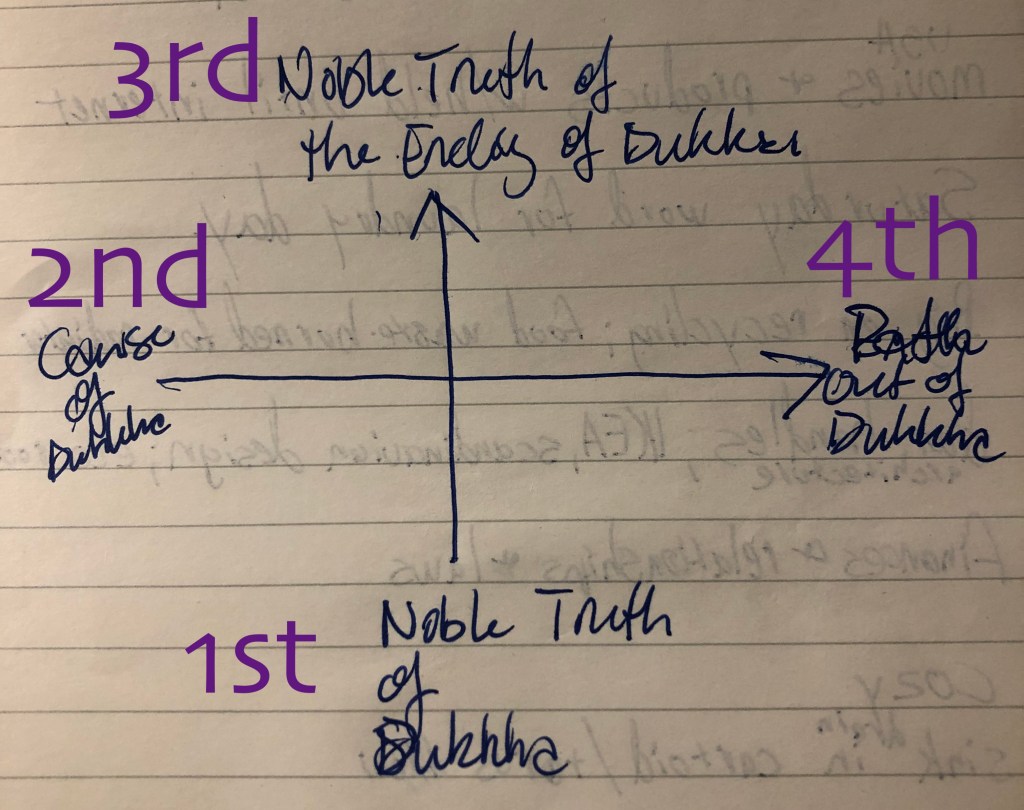
Randi’s illustration of the Four Noble Truths in a cross pattern alluding to the programs of the cross. (To learn about such programs look into her material to learn more)

Our talk also touches on:

  • (My) various disclaimers and approaches
  • party poopers Buddhists with (over) emphasis on suffering
  • why addressing suffering is important
  • acknowledgement within (almost all) Buddhist schools on the Four Noble Truths
  • the Two Truths
  • Buddha as pragmatist, realist, humanist
  • expectations of being able to maintain longterm control over external conditions as setting the stage for dukkha
  • current day therapeutic parallels
  • narratives
  • past life influences
  • (deriving) meaning
  • the role intent plays
  • turning the fire of indignation into one of transformation
  • emotional pain turning into physical pain
  • healing
  • rebirth
  • wise/whole/right view
  • types of pain and frustration
  • cognitive therapy
  • expectations
  • wisdom
  • enslavement (during the time of the Buddha) and as a metaphor and throughout all levels of society
  • kamma, past actions and the overriding importance of how our thoughts, speech and actions right now matter most
  • cultural and time period differences
  • different approaches and levels of teachings for different classes of folks
  • how one views and works with the circumstances they find them in
  • equanimity
  • various ways of working with and applying compassion
  • repetitive pattering and repeats
  • kamma [12 types of kamma], actions, applying to existence and humans
  • leveraging dukkha for awakening
  • past lives:
    • Buddha recalling myriad past lives on night of awakening
    • benefits and dangers of past life recall and sharing
    • (consciousness) mechanics of collapsing timelines and fields during past life recall and work
    • Randi´s past life of being tortured to death as a Tibetan buddhist monk in 1959 by a Chinese solider; how techniques of compassion and voidness failed; the challenges and dangers of (sharing) this today so sharing only what’s relevant to the group
    • I ask if past lives before this could inform this one?
    • I allude to my past post Wisdom Snippets: The Murkiness, Blocks And Obstructions Of Past Life Discernment
    • how ought we access, recall, view, experience, and clear past lives
  • levels (or rings) of various teachers and the Buddha’s entourage and followers
  • exoteric/esoteric teachings and the Buddha limiting teachings to dukkha and the end of dukkha
  • my Last Words of the Buddha blog post
  • [Also check out Randi’s YouTube series My Take on Buddhism]
  • teachings foretold to die out
  • not turning all this into a religion
Buddhist Cosmology YouTube series

Also check out our other chat where we talk about Randi’s own material:


Text selection briefly alluded to but not explored:

Chapter XII – Examination of Suffering from The Fundamental Wisdom of the Middle Way — Nagarjuna’s MulamadhyamakakarikaTRANSLATION BY JAY L. GARFIELD

  1. Some say suffering is self-produced, Or produced from another or from both. Or that it arises without a cause.
    It is not the kind of thing to be produced.
  2. If suffering came from itself,
    Then it would not arise dependently.
    For those aggregates
    Arise in dependence on these aggregates.
  3. If those were different from these, Or if these were different from those, Suffering could arise from another. These would arise from those others.
  4. If suffering were caused by a person himself, Then who is that person—
    By whom suffering is caused—
    Who exists distinct from suffering?
  5. If suffering comes from another person, Then who is that person—
    When suffering is given by another— Who exists distinct from suffering?
  6. If another person causes suffering, Who is that other one
    Who bestowed that suffering, Distinct from suffering?
  7. When self-caused is not established, How could suffering be caused by another? Whoever caused the suffering of anotherMust have caused his own suffering.
  8. No suffering is self-caused.
    Nothing causes itself.
    If another is not self-made,
    How could suffering be caused by another?
  9. If suffering were caused by each, Suffering could be caused by both. Not caused by self or by other, How could suffering be uncaused?
  10. Not only does suffering not exist In any of the fourfold ways:
    No external entity exists
    In any of the fourfold ways.

For more information regarding the work of Randi Green visit the HAL Academy Website https://toveje.dk

And the HAL Future Humanities Channel: https://YouTube.com/@thehalfuturehumanities or https://www.youtube.com/channel/UCTxfpHiGxSSnvm_mL7i9T0g

Also, the Higher Order DE1 Work Institute: https://randigreen.one and its YouTube Channel https://YouTube.com/@halsystemicenergeticawareness or https://www.youtube.com/channel/UCIpMgVp0-43oYjaTwo_O_sw

Some of Randi’s YouTube series:


Audio: The Noble Truth Of Dukkha: Buddhism And Beyond With Randi Green (Part 2)

Or listen via Insight Timer (app or website)

Continue reading “The Noble Truth Of Dukkha: Buddhism And Beyond With Randi Green (Part 2)”

Trauma, Teachings And Textual Interpretations: Buddhism And Beyond With Randi Green (Part 1)

At the beginning of February 2023 Randi Green and I did a couple more recordings on somewhat Buddhist related topics in addition to our chat New Inner Domain Races and New Intervention Protocol. Besides the topics listed in the title this first one starts off addressing dukkha, but we really wait until the second chat (part 2) to dive into dukkha more deeply and from more angles. In this one, amongst other things there’s also (mentions of):

  • (My) various disclaimers and approaches including inviting corrections
  • Parallels and comparisons to the Christian gospels
  • Rajas
  • Nagas
  • Essence
  • Importance of and methods for studying texts including:
    • etymology
    • word roots
    • syntax
    • context
    • various meanings
    • cross-referencing
    • changing definitions
  • being turned into an “-ism”
  • truth and reality
  • avoidance and non-avoidance
  • various facets of trauma and those qualifications for working with it
  • poem Autobiography in Five Short Chapters by Portia Nelson:

Chapter I

I walk down the street.
There is a deep hole in the sidewalk.
I fall in.
I am lost… I am hopeless.
It isn’t my fault.
It takes forever to find a way out.

Chapter II

I walk down the same street.
There is a deep hole in the sidewalk.
I pretend I don’t see it.
I fall in again.
I can’t believe I am in this same place.
But it isn’t my fault.
It still takes a long time to get out.

Chapter III

I walk down the same street.
There is a deep hole in the sidewalk.
I see it there.
I still fall in… it’s a habit… but,
my eyes are open.
I know where I am.
It is my fault.
I get out immediately.

Chapter IV

I walk down the same street.
There is a deep hole in the sidewalk.
I walk around it.

Chapter V

I walk down another street.

poem Autobiography in Five Short Chapters by Portia Nelson
  • Buddha leaving his wife and child
  • The Buddha’s teachers and (fellow) practitioners
  • Who the Buddha taught and how he did it
  • Mendicant lifestyle
  • Authenticity of the Buddhist texts including accuracy, errors when copying texts
  • Oral teaching traditions
  • No native Pali speakers
  • Lack of consensus of meaning on some Pali words
  • Time period differences
  • Kamma, (fruits of) past actions [12 types of kamma]
  • Randi’s YouTube series My Take on Buddhism
  • Value of meditation, contemplation, loving-kindness, compassion, equanimity and other Buddhist practices
  • Call to directly investigate Buddhist cosmos today
  • A specific symbol appearing in the light in the center of the head
  • Various Buddhist cosmological beings
  • Where and how did the Buddha gain all his knowledge and wisdom?
  • Levels (or rings) of the Buddha’s entourage and followers: his attendant, chief disciples, monks of the order, lay practitioners and commoners

For more information regarding the work of Randi Green visit the HAL Academy Website https://toveje.dk

And the HAL Future Humanities Channel: https://YouTube.com/@thehalfuturehumanities or https://www.youtube.com/channel/UCTxfpHiGxSSnvm_mL7i9T0g

Also, the Higher Order DE1 Work Institute: https://randigreen.one and its YouTube Channel https://YouTube.com/@halsystemicenergeticawareness or https://www.youtube.com/channel/UCIpMgVp0-43oYjaTwo_O_sw

Some of Randi’s YouTube series:


Audio: Trauma, Teachings And Textual Interpretations: Buddhism And Beyond With Randi Green (Part 1)

Or listen via Insight Timer (app or website)


Continue reading “Trauma, Teachings And Textual Interpretations: Buddhism And Beyond With Randi Green (Part 1)”

Love And Brahmaviharas | Feb 9, 2023 “Meditation Q & A With Wendy Nash” #05


In this fifth installment of the ongoing live series with Wendy Nash inquiring into meditation practice on and off the cushion we explored some of what can skillfully be conveyed about love, and/or more specifically, the four sublime expression of love aka the Brahmaviharas. It is after all February which is often associated with love (or at least the current day commercial holiday Valentines Day). And due to no Q & A in January we’re doing two in February.

We chat about what we’ve picked up from others in addition to our own current understandings, views, practices, and application of these four immeasurables — loving-kindness, compassion, joy/rejoicing/vicarious joy, and equanimity/peace. We also explore related avenues like how the Buddha is said to have taught forrest dwelling monks loving-kindness for protection, (non-)forgiveness, gratitude, hardness, armoring, pitfalls of Valentines Day, how noticing things in others can unveil blindspots in how we view loved ones, etc.


Wendy mentions this movie

*There’s naturally an ongoing open call for meditation (related) questions for the (roughly) monthly “Meditation Q & A” either by the various social media means listed; integratingpresence[at]protonmail.com or Wisdom App to type/ask live.*


(Or other ways to) join these Q & A’s when they happen live:


Background

Regular, current and past visitors to Integrating Presence may recall the monthly series “Ask Us Anything” I did with Denny K Miu from August 2020 until January 2022 — partially including and continuing on with Lydia Grace as co-host for awhile until March 2022.

For a few months thereafter I did various Insight Timer live events exploring potential new directions and/or a continuation of the Ask Us Anything format while weaving in other related teachings to these events.

Then, after chats with meditation coach Wendy Nash, it became clear to start a new collaboration similar to “Ask Us Anything” simply and clearly called “Meditation Q & A” especially due to the original intent of the Ask Us Anything’s being “discussions about meditation and related topics.”


Past chats with Wendy:


Audio: Love & Brahmaviharas | Feb 9, 2023 “Meditation Q & A With Wendy Nash” #05

Or listen via Insight Timer (app or website)


Continue reading “Love And Brahmaviharas | Feb 9, 2023 “Meditation Q & A With Wendy Nash” #05”

Translations And Musings On The Last Words Of The Buddha

Not due to its prevalence of distortion, but due to the number of misattributed Buddha quotes (to name one reason in particular) it seems prudent to take a closer look at perhaps one of the most important utterances of the historical Buddha: the Tathāgata’s last words passed down in Pali as:

“vayadhammā saṅkhārā appamādena sampādethā”

Collected here are various translations, similar utterances, suttas, passages, articles and the like exploring what is my own hobbled together translation at the moment:

“Conditions and all compounded things break apart and disappoint. Reach successful consummation through care and heedfulness”


Translations of ‘vayadhammā saṅkhārā appamādena sampādethā

“Conditions are subject to decay. Work out your salvation with care.” (A slight yet significant change from “Work out your salvation with diligence.”  — Rhys Davids)

The Buddha’s Last Word: Care (appamāda)

“All compounded things, all experiences (mental and physical), all phenomena by their very nature decay and die, and are disappointing: it is through being not-blind-drunk on, obsessed by, or infatuated with, the objects of the senses that you succeed in awakening, or obtain liberation.”

Or more succinctly:

“All things are disappointing, [it is] through vigilance [that] you succeed.”

https://www.jayarava.org/buddhas-last-words.html

‘His final sentence was appamadena sampadetha: Reach consummation through heedfulness’

https://www.dhammatalks.org/Archive/Writings/CrossIndexed/Uncollected/MiscEssays/TheBuddha’sLastWord.pdf

Then the Buddha said to the mendicants:
Atha kho bhagavā bhikkhū āmantesi:

“Come now, mendicants, I say to you all:
“handa dāni, bhikkhave, āmantayāmi vo,

‘Conditions fall apart. Persist with diligence.’”
vayadhammā saṅkhārā appamādena sampādethā”ti.

These were the Realized One’s last words.
Ayaṁ tathāgatassa pacchimā vācā.

Long Discourses 16
Dīgha Nikāya 16
The Great Discourse on the Buddha’s Extinguishment
Mahāparinibbānasutta

Confusions with: lamp, light, truth, island, refuge?

Maybe it is just me, but until I looked all this up I was unsure whether the general notion above were the last words or there were somehow (also) mentions of lamp, light, truth, island and/or refuge as some of the quotes below show up from time to time in spiritual circles.

Turns out most of these translated word choices actually seem to be derived from the same textural source the Mahā-Parinibbāna Sutta (Dīgha Nikāya 16) but are spoken to Ananda before the last words:

So Ānanda, live as your own island, your own refuge, with no other refuge. Let the teaching be your island and your refuge, with no other refuge. Tasmātihānanda, attadīpā viharatha attasaraṇā anaññasaraṇā, dhammadīpā dhammasaraṇā anaññasaraṇā.

And how does a mendicant do this Kathañcānanda, bhikkhu attadīpo viharati attasaraṇo anaññasaraṇo, dhammadīpo dhammasaraṇo anaññasaraṇo?

It’s when a mendicant meditates by observing an aspect of the body—keen, aware, and mindful, rid of desire and aversion for the world. Idhānanda, bhikkhu kāye kāyānupassī viharati atāpī sampajāno satimā, vineyya loke abhijjhādomanassaṁ.

They meditate observing an aspect of feelings
Vedanāsu …pe…
mind …
citte …pe…
principles—keen, aware, and mindful, rid of desire and aversion for the world. dhammesu dhammānupassī viharati ātāpī sampajāno satimā, vineyya loke abhijjhādomanassaṁ.

That’s how a mendicant is their own island, their own refuge, with no other refuge. That’s how the teaching is their island and their refuge, with no other refuge.
Evaṁ kho, ānanda, bhikkhu attadīpo viharati attasaraṇo anaññasaraṇo, dhammadīpo dhammasaraṇo anaññasaraṇo.

Whether now or after I have passed, any who shall live as their own island, their own refuge, with no other refuge; with the teaching as their island and their refuge, with no other refuge—those mendicants of mine who want to train shall be among the best of the best.” Ye hi keci, ānanda, etarahi vā mama vā accayena attadīpā viharissanti attasaraṇā anaññasaraṇā, dhammadīpā dhammasaraṇā anaññasaraṇā, tamatagge me te, ānanda, bhikkhū bhavissanti ye keci sikkhākāmā”ti.


[definition(s) for the compounded dhamma saraṇa:]

dhamma masculine (& neuter)

  1. how the world of experience works, the processes by which it works and is explained (especially as formulated in cattāri ariyasaccānī and paṭiccasamuppāda), and the possibility and way of transcending it, as understood by the Buddha and taught by him (so that knowledge and understanding of it might bring awakening, arhantship, to others)
  2. the (stages to) freedom from the world of experience, culminating in nibbāna
  3. (singular) the behavior, conduct, practice required to realize and understand the way the world of experience works; the way to arahatship
  4. (plural) a quality or element of behavior or practice according to the Buddha’s dhamma; a constituent of prescribed practice; an element of the teaching; a doctrine; appropriate and beneficial practice
  5. the substance of the teaching of the Buddha; the teaching as collected in the canon; the texts
  6. a constituent of experience; an aspect or quality of existence; physical sensation; a mental state or quality (good or bad); (sometimes merely) thing, phenomenon, matter; the nonindependent, conditioned constituents of processes and events, progressively more and more minutely analyzed into fundamental types of event or fundamental regularities
  7. mental constructs, concepts, ideas, what is to be cognized by the mind, that which is the object of mental activity
  8. for the sangha: a rule; the offense against that rule; the punishment or reparation for that offense; a procedure; ~ especially the special requirements (garudhammā) imposed on bhikkhunis
  9. an interpretation of reality of other religious teachers or philosophers; their teaching; a non-buddhist doctrine; a theory
  10. the way things are; a natural law, custom, tradition; the essential nature, the way, of men or animals
  11. the way things ought to be; the way one should act (depending on who one is); right, appropriate conduct; duty; what is right; law, justice
  12. good practice; a good quality or characteristic or attainment
  13. a quality or characteristic; any element of behavior or practice or attainment

saraṇa neuter

  1. protection; help; refuge; a shelter
Selection (with Suttacentral.net definitions) from:
Long Discourses 16
Dīgha Nikāya 16
The Great Discourse on the Buddha’s Extinguishment
Mahāparinibbānasutta

Another translation of the key part:

Tasmātihānanda, attadīpā viharatha attasaraṇā anaññasaraṇā, dhammadīpā dhammasaraṇā anaññasaraṇā.

Dwell making yourself your island (support), making yourself your refuge, and not anyone else your refuge.

Literal translation by Walpola Sri Rahula from ‘What The Buddha Taught’

But then the following translations seems, at least to me, to add on the words truth, light, lamp, shelter and/or mix both the last words and what was told to Ānanda:

“Make an island of yourself, make yourself your refuge; there is no other refuge. Make truth your island, make truth your refuge; there is no other refuge.”

via https://www.beliefnet.com/columnists/healingandtransformation/2018/09/3-universal-truths-buddhism.html

via Crazy Wisdom: The Controversial Way To Enlightenment https://www.youtube.com/watch?v=sFUDdcmwqWg

“Be your own light, be your own refuge, the Dharma is your light and refuge. Things naturally decay: win through by mindfulness!”

https://ratnaprabha.net/2015/11/29/the-buddhas-last-words

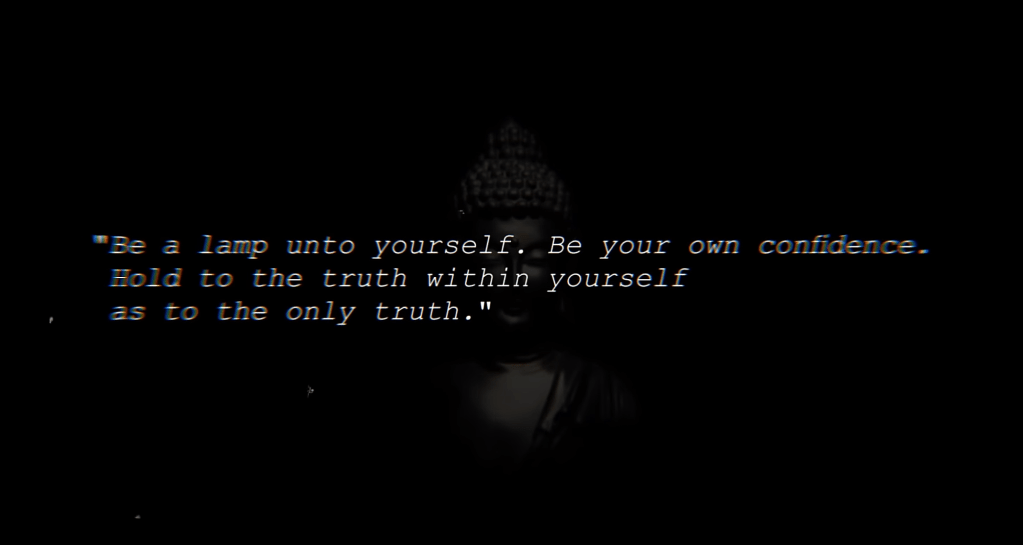
Be your own lamps. Be your own shelters. Hang on to the truth as a lamp. Hang on to the truth as a refuge.

https://rare-gallery.com/686910-buddha-quote.html

On the positive side these three kind of combine helpful elements to get the most bang for the buck. Conversely though they may cause confusion if and when used for deeper study, accuracy and context. (Also “hang on” seems a bit too clingy.)


Then there’s the more common occurrence throughout the pali cannon itself — multiple similar utterances throughout different texts, sometimes exact, sometimes with differences:

So karohi dīpamattano!
Khippaṃ vāyama paṇḍito bhava!
Niddhantamalo anaṅgaṇo,
na punaṃ jātijaraṃ upehisi.

Make an island unto yourself!
Strive hard and become wise!
Rid of impurities and cleansed of stain,
you shall not come again to birth and decay.

Dhammapada 18.238 via pariyatti.org [mp3]

Finally a poem to get more to the heart and spirit of all this:

The Buddha’s Last Instruction
by Mary Oliver

“Make of yourself a light,”
said the Buddha,
before he died.
I think of this every morning
as the east begins
to tear off its many clouds
of darkness, to send up the first
signal — a white fan
streaked with pink and violet,
even green.
An old man, he lay down
between two sala trees,
and he might have said anything,
knowing it was his final hour.
The light burns upward,
it thickens and settles over the fields.
Around him, the villagers gathered
and stretched forward to listen.
Even before the sun itself
hangs, disattached, in the blue air,
I am touched everywhere
by its ocean of yellow waves.
No doubt he thought of everything
that had happened in his difficult life.
And then I feel the sun itself
as it blazes over the hills,
like a million flowers on fire —
clearly I’m not needed,
yet I feel myself turning
into something of inexplicable value.
Slowly, beneath the branches,
he raised his head.
He looked into the faces of that frightened crowd.

From: House of Light

Copyright ©: Mary Oliver