Ambiguity And Uncomfortable Truths | 11/30/2022 “Meditation Q & A With Wendy Nash” #03


Before recording this third installment of this ongoing live series inquiring into meditation practice on and off the cushion Wendy said, and I agreed, unless there are live questions we perhaps ought to chat about “how to practice with ambiguity, uncomfortable truths, people we love but don’t like their ways or words, navigating guilt, shame, humiliation, privilege. . . The problem of wanting to be good, right, ethical, when these are all one side of the coin, how to include the crappy stuff without avoiding it or being overwhelmed. How to rise to the challenge rather than rise above it to avoid the challenge.”

I replied, “the only thing amongst what you’ve mentioned I see and feel has been mostly hijacked for political purposes on both sides is “privilege” so while I can still obviously address, this comes as low preference. All the others are all engines go with preferences weighted to meditative contexts.”

We talk about some of what Wendy laid out prior along with live questions about the two truths teaching and if playing saxophone can be meditation. Amongst many angles of approaching our primary topics of (real life) ambiguity and uncomfortable truths, we also touch on flow state(s) as well as the importance of delivery, tone and body language when communicating.


*There’s naturally an ongoing open call for meditation (related) questions for the (roughly) monthly “Meditation Q & A” either by the various social media means listed; integratingpresence[at]protonmail.com or just showing up on Insight Timer live or Wisdom App to type/ask live.*


Join these Q & A’s when they happen live:


Background

Regular, current and past visitors to Integrating Presence may recall the monthly series “Ask Us Anything” I did with Denny K Miu from August 2020 until January 2022 — partially including and continuing on with Lydia Grace as co-host for awhile until March 2022.

For a few months thereafter I did various Insight Timer live events exploring potential new directions and/or a continuation of the Ask Us Anything format while weaving in other related teachings to these events.

Then, after chats with meditation coach Wendy Nash, it became clear to start a new collaboration similar to “Ask Us Anything” simply and clearly called “Meditation Q & A” especially due to the original intent of the Ask Us Anything’s being “discussions about meditation and related topics.”



Past chats with Wendy:


Audio: Ambiguity & Uncomfortable Truths | 11/30/2022 “Meditation Q & A With Wendy Nash” #03

Or listen via Insight Timer (app or website)


We didn’t get to gratitude but here’s some links to the science behind its benefits (via the show above https://www.corbettreport.com/solutionswatch-givingthanks/):

Gratitude is positively related to increased subjective well-being

Robert Emmons: Benefits of Gratitude

Thanks! How the new science of gratitude can make you happier by Robert Emmons

2008 study: “Gratitude predicted greater subjective sleep quality and sleep duration, and less sleep latency and daytime dysfunction.”

2015 study: benefits of gratitude for heart failure patients
2016 study: relationship between gratitude intervention and reduced blood pressure

2017 study: relationship between gratitude and hemoglobin A1c

Is Gratitude Good for Your Health?

Stuff To Blow Your Mind podcast – From the Vault: Thankful: The Science of Gratitude

Continue reading “Ambiguity And Uncomfortable Truths | 11/30/2022 “Meditation Q & A With Wendy Nash” #03”

An Integrating Presence Meditation: Awareness And Sublime Abidings — December 15, 2022 At Rootbound

This is an edited recording from the guided meditation at Rootbound [https://facebook.com/rootboundstl / https://www.facebook.com/events/3375947952683181] on Main Street in St Charles, Missouri on Thursday, December 15th.

We did not start with brief instructions along with a discussion beforehand as I mentioned on this blog post earlier, but we did hold a discussion afterwards even though it’s not on the recording.

The recording starts off with a body scan then we get into awareness practices of mindfulness of body, feeling, mind, mind objects, and awareness itself followed by the sublime abidings of loving-kindness, compassion, vicarious joy and equanimity.

Not included in the recording are the Five Qi Breathing exercises and the Yi Jin Jing we did before sitting meditation.

And for completeness sake, for a description, I edited in a starting mediation bell as well as doing significant noise removal, loudness normalization and equalization.

Although it is now somewhat listenable, it still leaves a lot to be desired. For reference, one can hear the unedited persistent hiss of background noise after the ending bell, but that’s only one version of it as it changed significantly a few times as these noises can when recording live in a public space not specifically designed for audio.

Anyway what I guess I’m getting at is if any professional audio engineers would like to donate their time and expertise to cleaning up the audio please reach out at integratingpresence [at] protonmail [dot] com and I’ll send the source file.

Overall though the meditation was well received in real life and on Insight Timer live. I have even been invited back right away even though I may not return to do so for quite awhile due to other positive life circumstances.


Audio: An Integrating Presence Meditation: Awareness And Sublime Abidings — December 15, 2022, At Rootbound

Or listen via Insight Timer (app or website)


Thursday, December 15th 2022 — 6:00pm – 7:00pm

Cost: generosity inspired donation


Irregular Inquires — ‘Let None Deceive Another’

Let none deceive another, or despise any being in any state.’

from the metta sutta

Does this line in the metta Sutta — ‘Let none deceive another, or despise any being in any state.’ — mean action should be taken (to prevent deception)? If so, how and to what extent? (Deception often happens as protection or retribution, btw)

To further muddy the waters even some truthful statements can mislead, or can at least contribute to being misleading. Further, being (partially) truthful in certain ways, and in certain contexts — like combining misinformation and/or omitting other truths — can even shroud, coverup and/or obscure other truthfulness.

And what ought to be done if witnessing some being fooled without the conscious intent to fool? Here’s an possible example: someone’s zoom background image looking like it might be the actual real life background of what’s behind one in relation to one’s camera but it’s actually a custom chosen zoom background without any conscious awareness of potential deception. Or, I’ve been in the woods on zoom before and someone asked if I was using a zoom background image and I said no, and moved around to show it wasn’t.

I’ve also asked a few I suspected of being fools, “how do you deal with fools?” Is this a wise approach since I was ambiguous to whether or not I was accusing them of being a fool? It may have been more clear that I was trying to find this out though and/or glean wisdom from them.


See also the blog posts and podcasts:

https://integratingpresence.com/2022/04/04/dont-associate-with-fools/
https://integratingpresence.com/2022/09/19/podcast-discerning-deception/


Metta / Loving-Kindness Sutta

This is what should be done

By one who is skilled in goodness,

And who knows the path of peace:

Let them be able and upright,

Straightforward and gentle in speech,

Humble and not conceited,

Contented and easily satisfied,

Unburdened with duties and frugal in their ways.

Peaceful and calm and wise and skillful,

Not proud or demanding in nature.

Let them not do the slightest thing

That the wise would later reprove.

Wishing: In gladness and in safety,

May all beings be at ease.

Whatever living beings there may be;

Whether they are weak or strong, omitting none,

The great or the mighty, medium, short or small,

The seen and the unseen,

Those living near and far away,

Those born and to-be-born —

May all beings be at ease!

Let none deceive another,

Or despise any being in any state.

Let none through anger or ill-will

Wish harm upon another.

Even as a mother protects with her life

Her child, her only child,

So with a boundless heart

Should one cherish all living beings;

Radiating kindness over the entire world:

Spreading upwards to the skies,

And downwards to the depths;

Outwards and unbounded,

Freed from hatred and ill-will.

Whether standing or walking, seated or lying down

Free from drowsiness,

One should sustain this recollection.

This is said to be the sublime abiding.

By not holding to fixed views,

The pure-hearted one, having clarity of vision,

Being freed from all sense desires,

Is not born again into this world.

Karaniya Metta Sutta: The Buddha’s Words on Loving-Kindness
translated from the Pali by The Amaravati Sangha

What Is Meditation? | 11/2/2022 “Meditation Q & A With Wendy Nash” #02


Two zoom videos spliced together, largely unedited. The hemming and hawing about unfavorable conditions in the podcast audio version is edited out to save listeners time

Listen to the unedited recording: https://join.wisdom.audio/i9PN


In the second installment of the ongoing live series with Wendy Nash inquiring into meditation practice on and off the cushion we primarily address what meditation actually is while spiraling up, around and back on this topic to also include:

  • Examples of what is and isn’t meditation
  • Mind training
  • Intention
  • Stop being aware exercise
  • Consciousness
  • Awareness
  • Focus
  • Familiarity with the mind
  • Heart qualities
  • Wisdom
  • Aspiration
  • Development
  • Self-help
  • Addressing ego’s yearning for control
  • Vipassana
    • Investigation and inquiry
  • Samatha
    • Con-CENTration
    • Stillness in the eye of the storm vs excluding
    • Western notion of concentration being tight with a lot of effort
    • Jhana
    • Mind spaciousness
    • Pros and Cons of goals and attainments
  • Wendy’s practicing with viewing and responding to retreat organizers canceling and not returning all the deposit
  • Ego:
    • Positive ego
    • Negative ego
    • Superior ego
    • Inferier ego
    • Spiritual ego
  • Responses to the statement “Emotions are thoughts” in Wendy’s discussions with a meditator:
    • Dogs crying tears of joys for their owners after long separation
    • The human animal
    • Labeling emotions vs the actual emotion
    • Overly identifying with thoughts
    • Is hurt and pain a thought?
    • Yogācāra or Chittamatra school of Buddhism
    • Blindspots
    • Theory vs lived experience
    • Involvement of perception
    • Heart quality balancing
  • Wisdom:
    • as capacity to see interrelatedness of everything
    • Everything empty of any inherent quality in and of itself
    • Qualities arise interdependently
  • The ultimate unhappiness of materialism
  • Chögyam Trungpa
    • Spiritual materialism
  • Scoundrels and charlatans in spirituality
  • Conceit
  • Foolishness
  • Social connection and belonging
  • Emotional mirroring

Join these Q & A’s when they happen live:


*There’s naturally an ongoing open call for meditation (related) questions for the (roughly) monthly “Meditation Q & A” either by the various social media means listed on the site; integratingpresence[at]protonmail.com or just showing up on Insight Timer live or Wisdom App to type/ask live. It’s cliché but there really are no dumb questions.*


Meditation Q & A Series Background

Regular, current and past visitors to Integrating Presence may recall the monthly series “Ask Us Anything” I did with Denny K Miu from August 2020 until January 2022 — partially including and continuing on with Lydia Grace as co-host for awhile until March 2022.

For a few months thereafter I did various Insight Timer live events exploring potential new directions and/or a continuation of the Ask Us Anything format while weaving in other related teachings to these events.

Then, after chats with meditation coach Wendy Nash, it became clear to start a new collaboration similar to “Ask Us Anything” simply and clearly called “Meditation Q & A” especially due to the original intent of the Ask Us Anything’s being “discussions about meditation and related topics.”


Past chats with Wendy:


Audio: What Is Meditation? | 11/2/2022 “Meditation Q & A With Wendy Nash” #02

Or listen via Insight Timer (app or website)


Continue reading “What Is Meditation? | 11/2/2022 “Meditation Q & A With Wendy Nash” #02”

Negligence and Misdeeds for Sagacity

This October 10th, 2022 Insight Timer live event addressed verse 50 of the Dhammapada as wisdom for potential clearing, activation and advancement:

Not the perversities of others, not their sins of commission or omission, but his own misdeeds and negligences should a sage take notice of

VERSE 50 OF THE DHAMMAPADA

Thanks to Ellen for the great comments prompting some spontaneous teachings of sorts. I initially recommend a related podcast called “Ghosted, Ignored, Canceled?”:


Some of the (other) topics touched on include:

  • he said / she said
  • getting upset
  • mistreatment
  • clinging
  • (perceived) expectations
  • what others think
  • dismissal
  • self-responsibility
  • connection
  • society
  • challenge
  • righteousness
  • control
  • change
  • imposing
  • advice
  • frustration
  • care
  • allowing others to live their lives
  • emotion charge
  • absorbing into other
  • pulling back
  • self-monitoring
  • energy
  • entanglement
  • expansion
  • healing
  • memory
  • behavior
  • self-pity
  • self-hatred
  • what’s needed now
  • comfort zone
  • existence and nonexistence
  • love
  • wisdom
  • neglect and abuse
  • desperation
  • giving one’s heart away
  • innocence
  • belonging
  • worry as fantasy
  • letting go of friends and making new friends
  • feeling alone
  • escape
  • interconnection
  • being in relationship to everything
  • pain
  • (experimentally) intending to be rejected
  • indifference
  • putting oneself in another’s shoes
  • empathy
  • victimization
  • aspiring to sagehood even if not practical
  • seeing fruits of skillfulness
  • review and hindsight of meditation practice
  • negligence in meditation
  • amplification
  • vulnerability
  • opening the heart

Audio: Negligence and Misdeeds for Sagacity

Or listen via Insight Timer (app or website)


Continue reading “Negligence and Misdeeds for Sagacity”

Wisdom Snippets: The Four Brahmaviharas For Each Of The Four Noble Truths

I’ve seen and heard various other Buddhist teachings matching up with the Four Noble Truths [and if I remember any to significant degree and/or come across them again perhaps I’ll add them here] but it occurred to me the Four Sublime Abidings might also pair up with the Four Noble Truths:

  • Truth of Dukkha/Suffering/Stress/Unsatisfactoriness = Compassion
    • The wise response to suffering is compassion
  • Truth of the Cause of Dukkha (“thirst”, craving, and clinging) = Equanimity
    • Equanimity, the crème de la crème of the Brahmaviharas, and one of the highest, most complete, whole and total of the conditioned states of development is what’s called for overall when seeing, going into, knowing and eradicating craving, clinging and even the unwholesome roots of greed, ill-will and delusion/ignorance
  • Truth of Cessation of Dukkha = Vicarious/Empathic Joy, Rejoicing
    • Suffering’s final end, and even that this possibility is very real — with study, training and practice — evokes joy and rejoicing in oneself and to and from others
  • Truth of the Eightfold Nobel Path Leading to the Cessation of Dukkha = Metta (Loving-kindness)
    • Lots of loving-kindness — towards self, those we encounter and all beings — helps us better gain the capacity to abide well on a conditioned path progressing towards the unconditioned

Dharma Questions: Miscellany — Part 7

This irregular “Dharma Questions” series deals with “dharma” meaning both the truth of the nature of reality and some Buddhist teachings. Please see this post on the intensions for questioning and not questioning. Amongst other things these questions can be, but not necessarily:

  • thought experiments
  • borderline musings not meant to be answered
  • from laziness of not contemplating or researching them yet

Buddhist Cosmology Series
  1. Questions from Buddhist Cosmology Series:
    • Could Asuras under the ocean, yet not water beings, be due to being below the water table, or could they be in the astral realm (as astral is often related to “water” and/or SEE/SEAing?
    • Could the Northern Continent be Venus?
      • Could polarity — or again, maybe referencing the astral aka distortion planes — help explain the stark contrast of the two versions of the Northern Continent: one being a paradise, the other about yakas taking humans from the southern continent with wrong view and making them slaves?
  2. What does the “Nāga Sutta: The Bull Elephant” — about the Buddha and a Bull Elephant finding peace in a spacious forest — have to do with nagas?
  3. If there are three characteristics of existence, what are the characteristics of non-existence, if any?
  4. What is light and how is it known?
  5. Could and ought various psionic/psychic research (teams) employing different methods and abilities be double-blind tasked to investigate some of the mysteries in the Sutras/suttas? Why or why not?
  6. From whatever place on the wheel of dependent origination can the direction of movement only go one way? Can it go the other way, or be forked? Why or why not?
    • From one place on the wheel can its neighbors be seen and known? How many of its neighbors?
      • For example, from craving can feeling and contact be seen and explored in one direction and at the same time attachment and becoming be seen and explored in the other direction?
  7. If remembering correctly the Buddha said something along the lines of using regular language without being fooled by it; what else, if anything, did the Buddha say about language itself, especially in the context of meditation practice?
  8. In as much detail as possible, where (all) did the lineage of Buddhist nuns continue and where did it die out?
  9. While there seems some shame in (popular) Christianity around original sin, in Buddhism is there (some unskillful) denial of a type of underlying shame in regards to ignorance (being one of the unwholesome roots to the cause of dukkha)? And if so, how ought this shame of ignorance be skillfully addressed without approving of ignorance?
  10. What is the Śāriputra back story for this: ‘Now I consider that we must guard temple property even more closely than our eyes [It is said that Śāriputra] formerly gave his eyes to a Brahman and was greatly retarded [in his progress on the path].’ –from (p.15ish in one version) of Instructions for the Tenzo –Dogen)
  11. Does samphappalāpa support papañca and/or vice versa? If so, how?
    • samphappalāpa: [sampha+palāpa] frivolous talk. It is one of the four verbal akusala·kamma·pathasSamphappalāpa is defined by the Buddha at AN 10.176. Its unpleasant consequences are described at AN 8.40.
    • papañca: mental proliferation, intellectualism, (excessive) mental fabrication, obsessive mental construction. This obstacle often takes the form of excessive mental activity and reflection over matters which do not deserve particular attention.
  12. Could the importance placed on mindfulness of the four main postures — sitting, standing, walking, lying down — be in response to many humans being dumbed down in consciousness and more or less trapped in a physical body?
    • If so, does this kind of play along with, and comply with, how such a seemingly simpleton activity mindfulness of the four postures is? All the while not fighting such a downsized limitation but using mindfulness of the four postures to master awareness while not upsetting the apple cart of those in power who benefit from dumbing down the masses?
  13. What are the origin(s) of Chi/Qi/Life Force energy and when was this first written down? As far as I know, why is there very little mention of how Chi operates and functions in Early Buddhist Texts/Teachings?
  14. Wouldn’t/Couldn’t the Dzogchen practice of prostrations encourage exhaustion leading to sleep and then the later instructions of “just relax” lead to an inclination of lethargy?
  15. With, or without polarity (dynamics) is there any kind of relationship between (various states of) pain and (the highest bliss of) Nibbāna?
    • Further to consider: (how) would this question be answered differently if only merely tasting Nibbāna compared to all the various stages on through to full attainment of Nibbāna?
  16. What are the roots, the causes and conditions of the dukkha of non-becoming (and the same for the dukkha of being and becoming)?
    • (Do these differ from the three (poisons/)roots of greed, ill-will and delusion/ignorance? Why or why not?)
  17. Did beings responsible for (Earth’s) human origins [as put forth in the Aggaññasutta https://suttacentral.net/dn27/en/sujato] realize that a human birth is necessary for Buddhahood? What was/is the karma involved for either realizing this or not?
  18. How do/does Āyatana(s) — “sense base”, “sense-media” or “sense sphere;” (defined internally as “organs”, “gates”, “doors”, “powers” or “roots” — defined externally as “sense objects” or “domains”) — relate to modern “scientific” notions of dimensions as well as the notions of densities and dimensions in some other spiritual teachings?
  19. How does the perceptual process work?
    • How do some seem to have diminished and expanded perceptions?
    • How all can perception be engaged and discarded?
    • What is wise perception?
  20. What are some of what psychologists would consider “triggers” within — and more specifically applying to — Buddhist communities? If any, how ought such tiggers be viewed and addressed?
  21. How might it be skillful and wise to consider extrapolating and applying the four right efforts to not only the present moment but also notions of future and past?
    • Can one, and ought one if one could, remove and prevent probable unskillful states in the future that would likely be in the way of maintaining and generating skillful states?
    • What about generating and maintaining certain skillful states to more expediently remove and prevent (foreseen and/or likely) unskillful future states?
    • How can the four right efforts be applied, perhaps via imagination, to the past as a whole and/or for particular past times and situations/occurrences?
  22. Could there actually be an immediate rebirth with(in) the (so called) (Tibetan) bardo period with such a rebirth being like a sort of temporary being with a short lifespan (and/or a super critical stage of consciousness) before the next more substantial rebirth?
    • By “critical stage of consciousness” I mean: what happens to consciousness after shedding the body?
  23. What are some other potential translations for Satipaṭṭhāna? How about [with “awareness” also swappable for “mindfulness”]:
    • “The Four Foundational Grounds for Establishing Mindfulness”
    • “The Four Establishments For Attending With Mindfulness”
    • “Establishing the Four Foundations for Attending with Mindfulness”
    • “The Four Foundational Ways(/Means/Methods/Modes) for Attending with Mindfulness”
    • “Establishing the Foundational Ways(/Means/Methods/Modes) for Attending with Mindfulness”
    • Establishing the Four Frames of Reference for Attending With Mindfulness
    • “The Four Essentials To Mindfully Attend To(/From)”
    • “The Four Essentials Of Mindfulness”
  24. For the 7th consciousness in Mahayana Buddhism “defiled mental consciousness” or kliṣṭamanovijñāna does not polarity exist for this consciousness as in various gradations of amounts, levels and proficiency in/with/to/of discernment and selfing? Examples: very little defiled mental consciousness and quite a lot. Very little sense of a (defiled) self and quite a lot.
    • If so, and with widespread adoption — especially if mixed into governments — could this potentially become something like an IQ test where those deemed professionals with high levels of mastery over “defiled mental consciousness” become placed in charge of controlling those deemed needing help with “defiled mental consciousness” thus potentially resulting in a dividing, compartmentalizing, and hierarchical control structure that essentially works against emancipation of dukkha / stress / suffering?
      • How would such professionals with mastery be determined? By whom?
      • How does/would this fit in with non-dualism?
  25. Is The Heart of Prajna Paramita Sutra the same or similar to 7/8th jhana? If not, how?
The Heart 1 of Prajna 3 Paramita Sutra 2

Bodhisattva 5 Avalokiteshvara 6,

while deeply immersed 7 in prajna paramita,

clearly perceived the empty nature 8 of the five skandhas 9,

and transcended all suffering.

Shariputra 10! Form is not different from emptiness,

emptiness is not different from form.

Form is emptiness, emptiness is form.

So it is with feeling, conception, volition, and consciousness.

Shariputra! All dharmas 11 are empty in character;

neither arising nor ceasing 12,

neither impure nor pure,

neither increasing nor decreasing.

Therefore, in emptiness, there is no form;

there is no feeling, conception, volition, or consciousness 13;

no eye, ear, nose, tongue, body, or mind;

no form, sound, smell, taste, touch, or dharmas 14;

no realm of vision, and so forth,

up to no realm of mind-consciousness 15;

no ignorance or ending of ignorance, and so forth,

up to no aging and death or ending of aging and death 16.

There is no suffering, no cause, no extinction, no path 17.

There is no wisdom and no attainment 18.

There is nothing to be attained.

By way of prajna paramita 19,

the bodhisattva’s mind is free from hindrances.

With no hindrances, there is no fear 20;

freed from all distortion and delusion,

ultimate nirvana is reached.

By way of prajna paramita,

Buddhas 21 of the past, present, and future

attain anuttara-samyak-sambodhi 22.

Therefore, prajna paramita

is the great powerful mantra,

the great enlightening 23 mantra 24,

the supreme and peerless mantra.

It can remove all suffering.

This is the truth beyond all doubt.

And the prajna paramita mantra is spoken thus:

Gate gate paragate parasamgate bodhi svaha 25

via https://web.archive.org/web/20151009135304/http://middleland.org/teachings/the-heart-of-prajna-paramita-sutra/

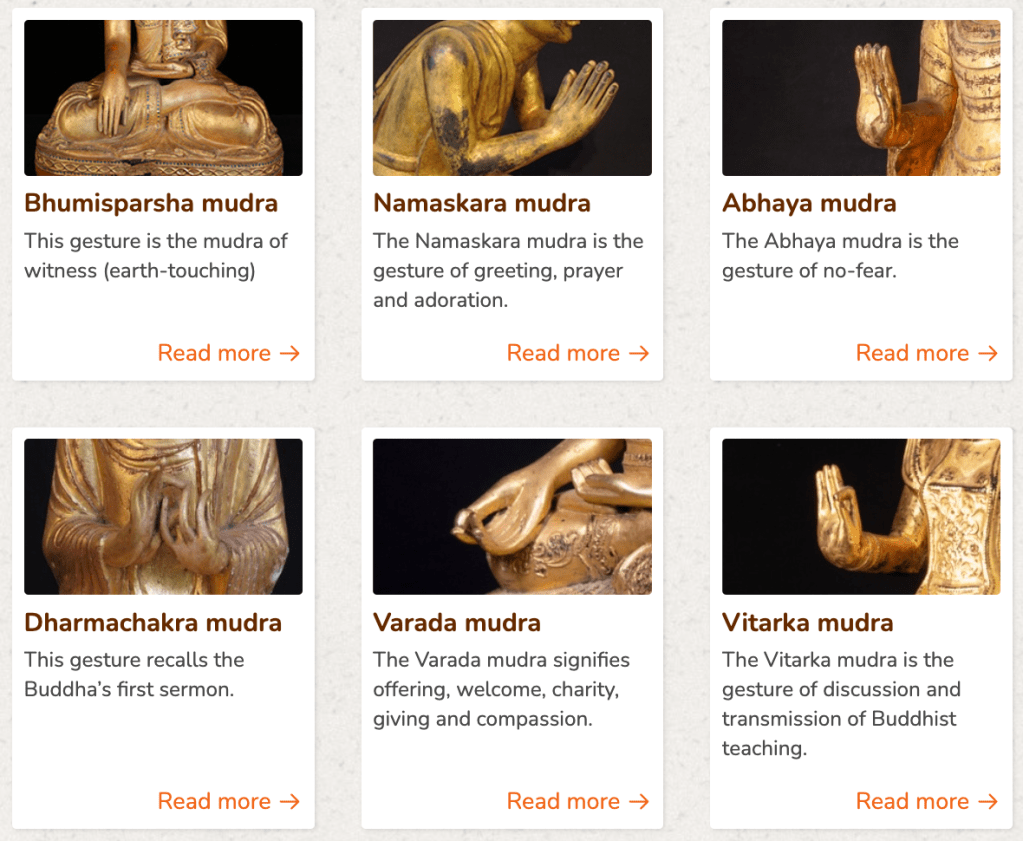
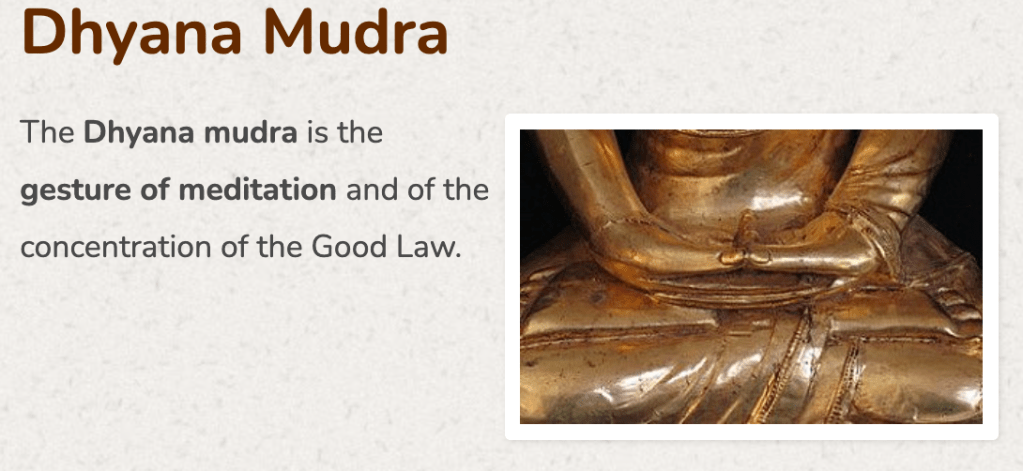
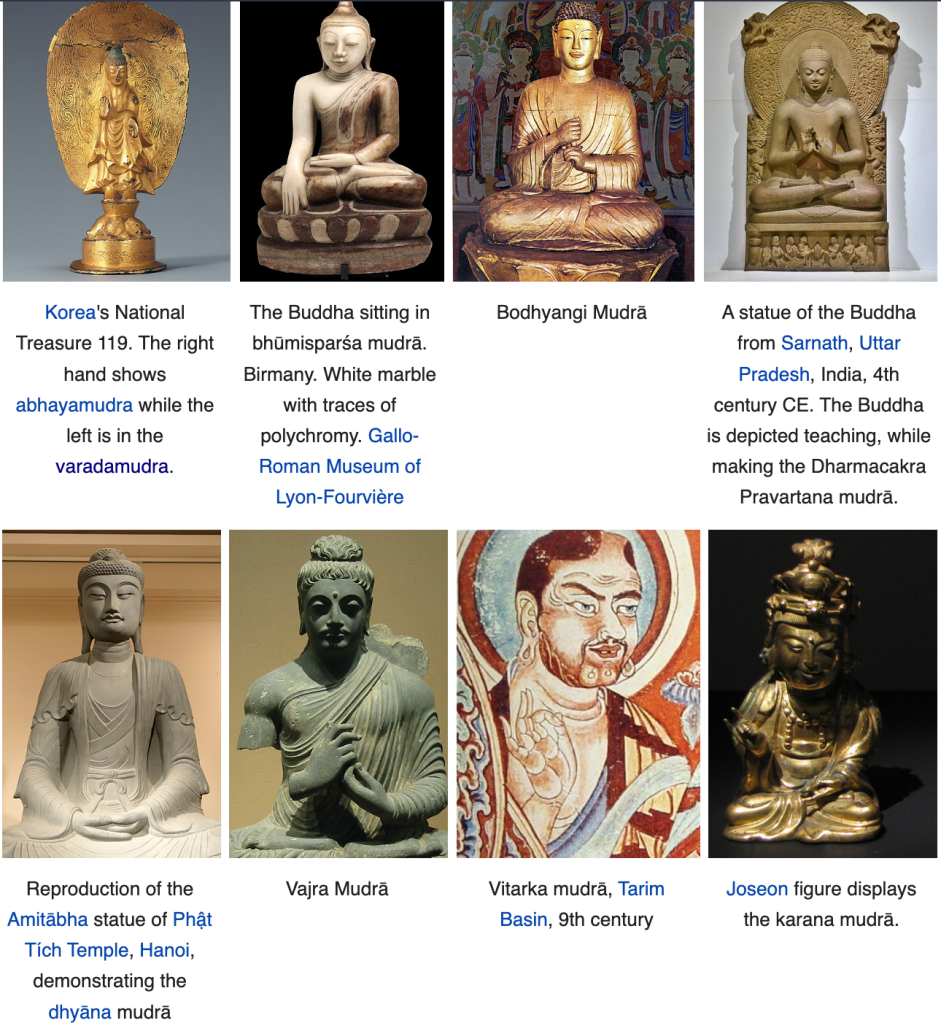
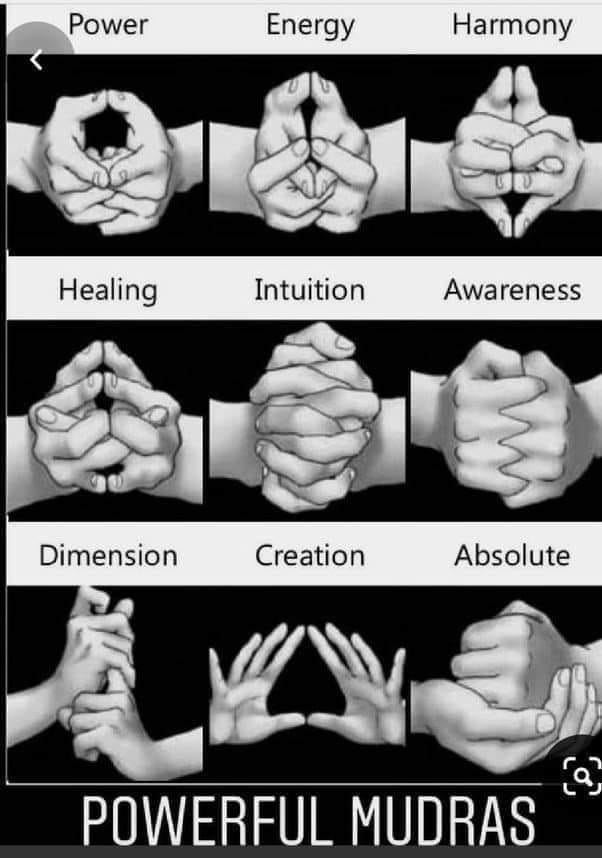
(Buddhist) Mudras

Wikipedia calls Mudras — or hand positions — symbolic or ritual gestures. For serious meditators I would suggest going beyond this and investigate the energetic properties and effects of such hand positioning, especially noticeable in meditation.

We already know it’s instinctual to place a hand to the injured area when one gets physically hurt. Why? Hands can heal.

Hands, and particularly opposable thumbs, distinguish humans from many other life forms.

What else is noticed about mudras and/or the locations of the hands? How does intent associated with mudras affect experience?

The images below link to the mudra page they come from, the wonderful originalbuddhas.com site where I’ve bought a Buddha rupa (statue) before. Even if not ordering it’s at least worth pursuing for physical representations of Buddhist history, and (might I claim) experiencing energetically beneficial art


And from the Wikipedia mudra article:


Low res bonus image; source unknown

From the book Buddhist Images (March 1970) . Paperback – January 1, 1970 by Taikichi Irie (Author), Shigeru Aoyama (Author)

There’s also stuff like this which I’ll spare readers and viewer my opinions about for now:

Wisdom Snippets: (Do It Yourself Buddhadharma) Encouragements And Empowerments

For a moment put aside the notion party poopers Buddhists focus way too much on suffering, perhaps even more noticeably affectatious as soon as they get up from sitting around on meditation cushions. For now even shelf the more recent “socially engaged Buddhism” and turn toward some notions the historical Buddha put forth as empowerment and encouragements:


The Pernicious English Language

I’ve been collecting and scribing English language peculiarities and observations for well over a year. After recently seeing the video below on twitter I feel it’s now time to publish and we’ll see how much material I tack on here later

The Bigger Questions:

Where does language even come from anyway? How are our word choices formulated, and sentences put together — most of the time effortlessly — especially when speaking?

Sevan Bomar of secretenergy.com addresses some of the bigger language picture in his freely released a book Code to the Matrix where he, amongst many other reveals, addresses the English language in an unconventional yet enlightening way which is well worth perusing.

Of even higher import is when just the right wisdom language is conveyed. I know for me I can feel and think I may know something well, or well enough until coming across some adamantine, sometimes poignant and exquisitely phrased wisdom then the game is changed opening up (new) vistas of insight, hindsight, connections, and realizations.

Not the perversities of others, not their sins of commission or omission, but his own misdeeds and negligences should a sage take notice of

Dhammapada verse 50

https://online.flowpaper.com/76e5074f/TheCodetotheMatrixBomar

Silly word play or revelatory decodings?

Depending on one’s deeper background into language; innerstanding how language is used; what comes out of specific ways of usage; etc there may be varying degrees interest and dismissal as I riff on words — whimsically and perhaps revelatory — in the following hodgepodge of ways:

  • English’s prominent emphasis on using “I”, “me”, “mine” and division with “me”, “you”, “us”, “them”
  • Many words ending in “er” sound like something being done to her — heal-er [heal her], bak-er [bake her], faker [fake her], maker [make her], letter [let her], etc
  • In pool/billiards “english” means a certain spin placed on the balls
  • Today — two day(s); to (as in towards) the day (when in fact it is already day)
  • Days — daze
  • Posture and posturing — physical posture can’t be faked while posturing is pretending
  • Weekly — weakly
  • Weekend — weak end or weakened?
  • Prayer — prey or
  • Axes — Plural of an ax and of axis
  • Amaze — in a maze
  • Absolutes and exaggerations built into common expressions — as in saying “always” and “absolutely”
  • Common phrases that may not indicate other usages of the words like “I bet he will” to express likelihood when one may not engage in gambling
  • Halve/half/have — division, possession/owning
  • Recovery — to cover/hide again (re-cover)
  • Course, coarse
  • Rely – to lie again (re-lie)
  • In balance; imbalance
  • Dozy: feeling drowsy and lazy — Doozy: something outstanding or unique of its kind
  • A little while (sort time) vs quite awhile (no so short)
  • Content — being OK as well as meaning consuming content as in reading, listening, watching
  • Constraint, restraint
  • Cannon — weapon of death and also a collection of works or teachings that can help and liberate and heal
  • Pirate —- pie rat
  • Print — pie rent
  • Bible — by bulls, bi-bulls: Saturn and Jupiter — starting at 34:12: https://youtu.be/6gK-GgOj5Ao?t=2052
Continue reading “The Pernicious English Language”