




(Buddhist) Mudras

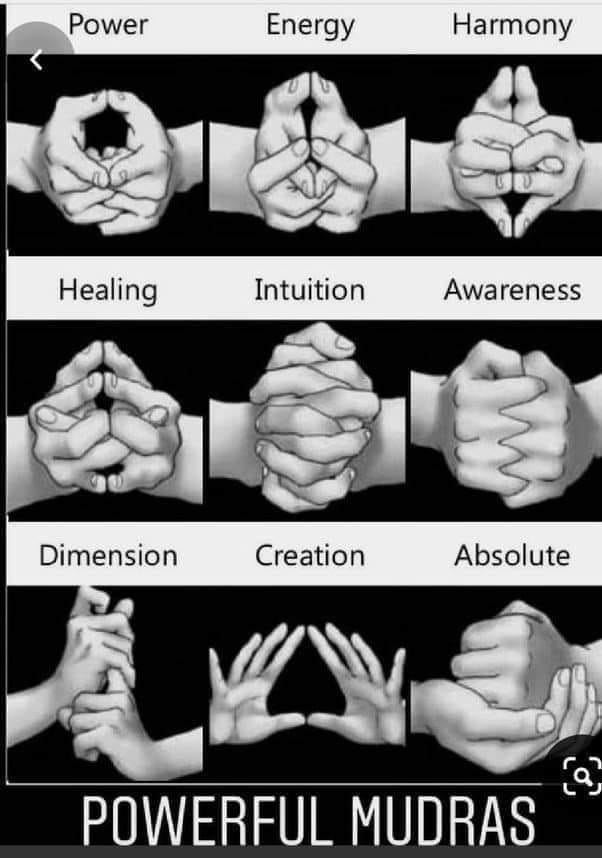
Wikipedia calls Mudras — or hand positions — symbolic or ritual gestures. For serious meditators I would suggest going beyond this and investigate the energetic properties and effects of such hand positioning, especially noticeable in meditation.

We already know it’s instinctual to place a hand to the injured area when one gets physically hurt. Why? Hands can heal.

Hands, and particularly opposable thumbs, distinguish humans from many other life forms.

What else is noticed about mudras and/or the locations of the hands? How does intent associated with mudras affect experience?

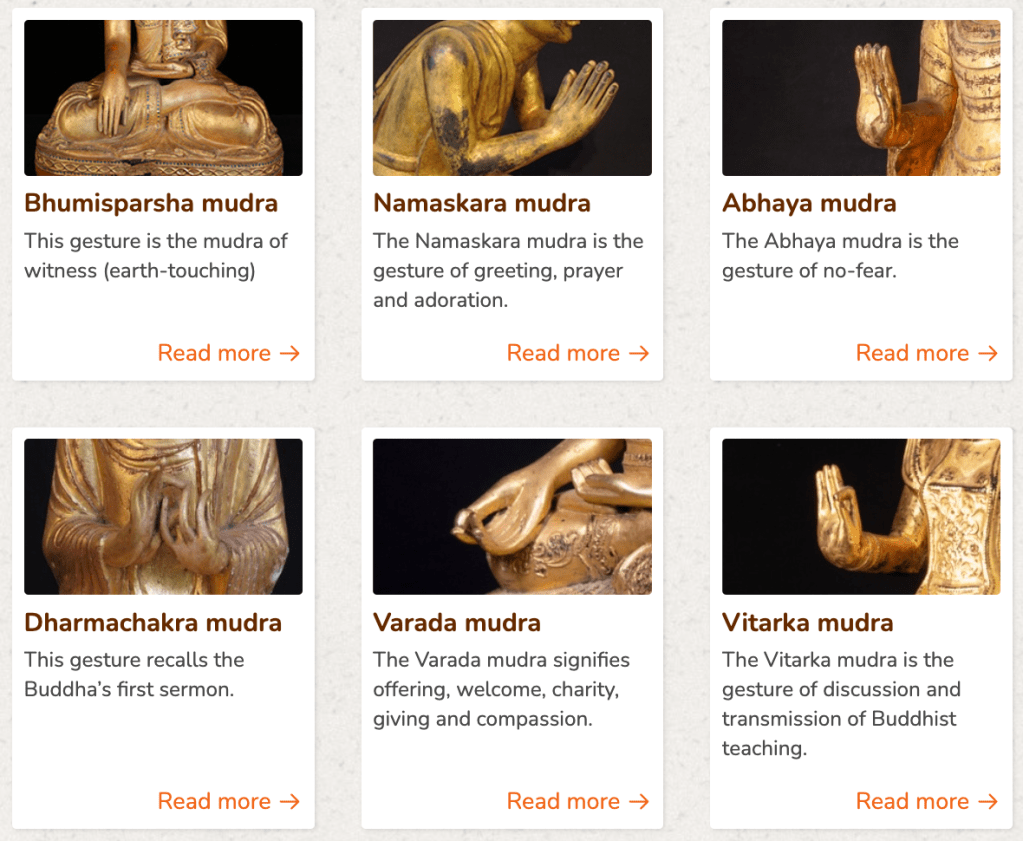
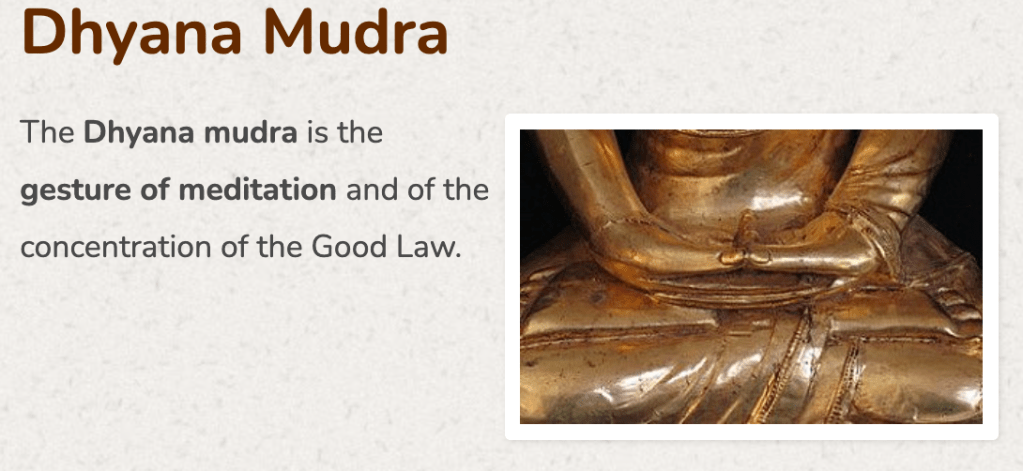
The images below link to the mudra page they come from, the wonderful originalbuddhas.com site where I’ve bought a Buddha rupa (statue) before. Even if not ordering it’s at least worth pursuing for physical representations of Buddhist history, and (might I claim) experiencing energetically beneficial art


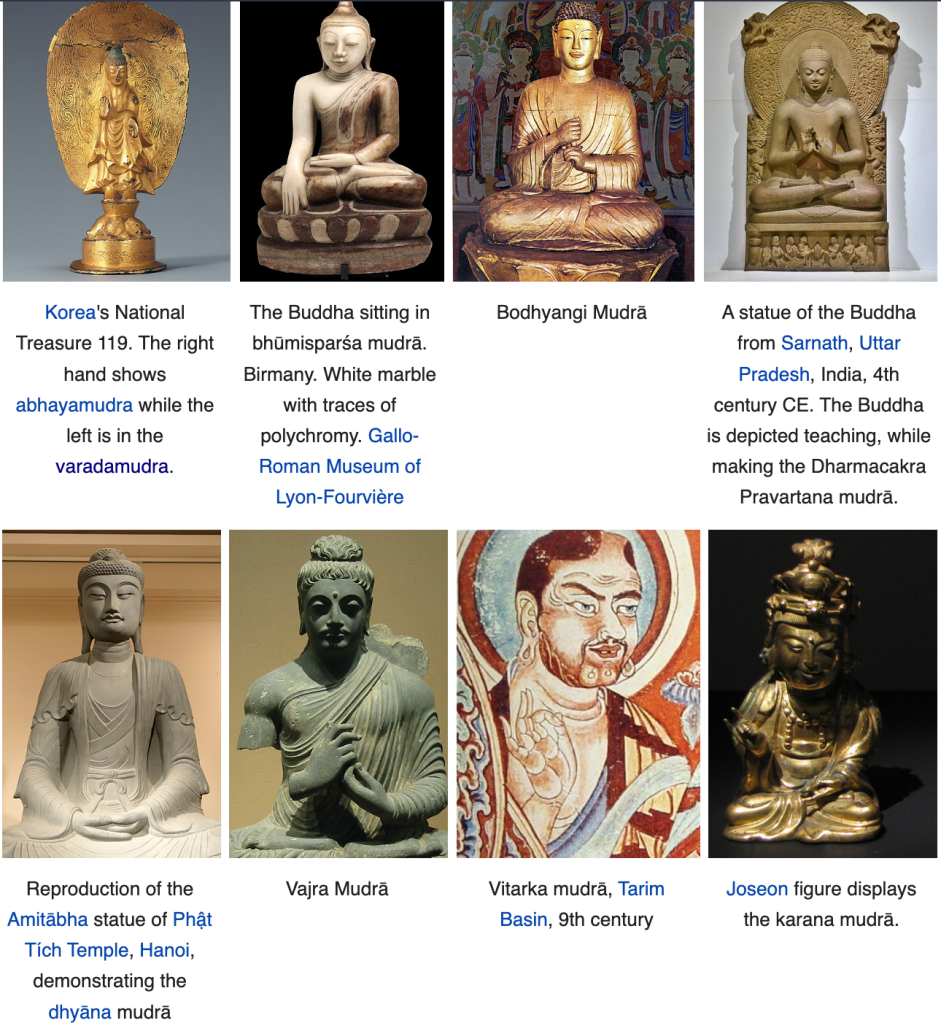
And from the Wikipedia mudra article:


Low res bonus image; source unknown

From the book Buddhist Images (March 1970) . Paperback – January 1, 1970 by Taikichi Irie (Author), Shigeru Aoyama (Author)

There’s also stuff like this which I’ll spare readers and viewer my opinions about for now:

Wisdom Snippets: (Do It Yourself Buddhadharma) Encouragements And Empowerments

For a moment put aside the notion party poopers Buddhists focus way too much on suffering, perhaps even more noticeably affectatious as soon as they get up from sitting around on meditation cushions. For now even shelf the more recent “socially engaged Buddhism” and turn toward some notions the historical Buddha put forth as empowerment and encouragements:


The Pernicious English Language

I’ve been collecting and scribing English language peculiarities and observations for well over a year. After recently seeing the video below on twitter I feel it’s now time to publish and we’ll see how much material I tack on here later

The Bigger Questions:

Where does language even come from anyway? How are our word choices formulated, and sentences put together — most of the time effortlessly — especially when speaking?

Sevan Bomar of secretenergy.com addresses some of the bigger language picture in his freely released a book Code to the Matrix where he, amongst many other reveals, addresses the English language in an unconventional yet enlightening way which is well worth perusing.

Of even higher import is when just the right wisdom language is conveyed. I know for me I can feel and think I may know something well, or well enough until coming across some adamantine, sometimes poignant and exquisitely phrased wisdom then the game is changed opening up (new) vistas of insight, hindsight, connections, and realizations.

Not the perversities of others, not their sins of commission or omission, but his own misdeeds and negligences should a sage take notice of

Dhammapada verse 50

https://online.flowpaper.com/76e5074f/TheCodetotheMatrixBomar

Silly word play or revelatory decodings?

Depending on one’s deeper background into language; innerstanding how language is used; what comes out of specific ways of usage; etc there may be varying degrees interest and dismissal as I riff on words — whimsically and perhaps revelatory — in the following hodgepodge of ways:

  • English’s prominent emphasis on using “I”, “me”, “mine” and division with “me”, “you”, “us”, “them”
  • Many words ending in “er” sound like something being done to her — heal-er [heal her], bak-er [bake her], faker [fake her], maker [make her], letter [let her], etc
  • In pool/billiards “english” means a certain spin placed on the balls
  • Today — two day(s); to (as in towards) the day (when in fact it is already day)
  • Days — daze
  • Posture and posturing — physical posture can’t be faked while posturing is pretending
  • Weekly — weakly
  • Weekend — weak end or weakened?
  • Prayer — prey or
  • Axes — Plural of an ax and of axis
  • Amaze — in a maze
  • Absolutes and exaggerations built into common expressions — as in saying “always” and “absolutely”
  • Common phrases that may not indicate other usages of the words like “I bet he will” to express likelihood when one may not engage in gambling
  • Halve/half/have — division, possession/owning
  • Recovery — to cover/hide again (re-cover)
  • Course, coarse
  • Rely – to lie again (re-lie)
  • In balance; imbalance
  • Dozy: feeling drowsy and lazy — Doozy: something outstanding or unique of its kind
  • A little while (sort time) vs quite awhile (no so short)
  • Content — being OK as well as meaning consuming content as in reading, listening, watching
  • Constraint, restraint
  • Cannon — weapon of death and also a collection of works or teachings that can help and liberate and heal
  • Pirate —- pie rat
  • Print — pie rent
  • Bible — by bulls, bi-bulls: Saturn and Jupiter — starting at 34:12: https://youtu.be/6gK-GgOj5Ao?t=2052
Continue reading “The Pernicious English Language”

Dharma Questions: Abhidhamma (With Beth Upton)


[10/3/22 UPDATE: This post was originally published on 8/4/2022. Since then I decided to ask Beth Upton back to address some of these questions and had to change the blog post publishing date in order for WordPress to push this out as a new podcast. I told Beth beforehand I’d do an extra audio intro afterwards due to limited time, but I’ve changed my mind, and we didn’t even get to all the questions. For more of her background please see her website BethUpton.com and our previous talks and checkout her latest project sanditthika.org a fledgling community in rural Spain for dedicated meditators]


The following questions arose while listening to what appears to be seven published videos from a 2006 (or 2016?) lecture series on Abhidhamma from Pa Auk Sayadaw [see end of post for all these videos]:

  • describe visual details of various kalapas
  • how can there be essence (as in nutritive essence, or is this maybe an inaccurate translation?)
  • What’s on the inside of Pa auk Sayadaw’s right arm?
  • Did Buddha teach (specific) kasina meditations?
    • Why no extended teachings on kasina meditation in the suttas?
      • [More specifically I meant why no mention (that I know of) in the suttas of using colored discs for kasina mediation as put forth in the Visuddhimagga]
    • Beth references suttas on emptiness that mention kasina
  • What is the supportive nature of air element or how is the air element considered supportive?
  • Is it possible to discern pre- and post-kalapa phenomena as in being able to discern the causes and conditions leading up to the arising of a single kalapa and/or how the perishing of a single kalapa could influence, condition and/or be a cause to/of subsequent phenomena?
  • Could reality be significantly shifted/altered by/with different perceptual modes such as by variations in how of kalaps are perceived by meditators?
    • [While I did not mention this to Beth I wanted to emphasize: Let’s say Meditator B receives misleading Abhidhamma instruction with specific intent — deliberate or not — that differs significantly from Meditator A who receives right and proper Abhidhamma instruction taught with its true intent. Due to such high levels teachings and high levels of skill required to see and know Abhidhamma — and without discouraging (aspiring) practitioners — what could be some of the unforeseen negative consequences for Meditator B?]
  • What determines a kalapa’s location? How does this work?
  • How does Adhimokkha, decision work?

We did not get to the follow questions:

  • How does impingement happen, such as color impinging on eye base/sensitivity?
  • (If I’m getting this right) why is water not (considered) a tangible object (in these abhidhamma teachings)?
  • Is (the perception of) nonexistence conditioned? Why or why not and how?
  • How does fire element produce generations (of kalapas)? And why?
  • Is it (initially) easier for some to discern kalapas in fine/subtle material realms / deva realms / Brahmā realms? Why or why not?
  • Is there any significance(s) in (the) kalapas constituting DNA and/or various subatomic particles in establishment science?
  • What’s materiality/mentality like on boundary of form and the formless and what is the relationship of this, if any, to Nibbana?

Other Abhidhamma questions:

  • How much can kalapa (creation or) arising, assemblage, and perishing (or destruction) be (volitionally) influenced (and how much kamma is, or would be involved in such influencing)?
  • How do kalapas assemble, organize, construct, or appear to constitute form(s) on the level of consensus reality and beyond?

May 18, 2023 Update:

After watching Beth’s video Practicing to See the Kalapas here are some questions while watching, pausing and rewatching:

  • Does mastering the light kasina (beforehand) have any effect on (discerning) these processes? If so how?
  • What do the individual fragments of light look like?
  • Why does the light fragment?
  • Is intention involved in fragmenting the light?
  • Is there another way to discern the kalapas without light fragmenting? Why or why not?
  • Are there different types and classes of light? If so, what are they and how do they come to be?
  • What are the causes and conditions for light (in various locations and settings) to fragment as well as for the rate of light fragmentation?
  • How are kalapas linked to light?
  • Roughly how many kalapas constitute a grain of sand?
  • related questions:
    • Would it be possible to double-blind test multiple meditators to investigate the same single kalapa and/or group of kalapas (in location/time) reporting on all the elements / qualities / properties / characteristics in order to see if they come up with the same or similar accounts to describe each (or group of) kalapa(s)?
    • How close is modern physics and science to seeing, knowing and describing ultimate materiality as it really is?
    • Does ultimate materiality in subtle realms differ from ultimate materiality in the gross matter realms (like earth) and elsewhere?


And a few questions arising on a somewhat related video:

If I’m remembering right prior instructions where that involvement with jhana didn’t allow for jhana discernment. If that’s the case then how can jhana processes be discerned because either there’s jhana absorption or not right? And then there couldn’t be jhana outside of absorption in jhana to observe and discern right?

How do the mental processes of each jhana differ from jhana to jhana?Using intent and resolve and/or other means, how possible is it to play with bhavaṅga, e.g. rapidly switching between bhavaṅga and (most any of the other) mental factors and/or states? Or (choosing) staying in bhavaṅga (for long periods of time)?


Image sources:

https://rukkhamula.wordpress.com/add-ons/abhidhamma-add-ons/a-pictorial-representation-of-rupa-kalapas-for-visual-learners/

https://buddhism.stackexchange.com/questions/31157/does-vi%C3%B1%C3%B1%C4%81%E1%B9%87a-generate-n%C4%81mar%C5%ABpa-in-the-sense-that-would-make-uploading-concsciou

https://www.advancedvipassana.com/fol-vol-3/on-rupa-materiality


Parts 2 – 7 of the aforementioned series:


Audio: Dharma Questions: Abhidhamma (With Beth Upton)

Or listen via Insight Timer (app or website)


Continue reading “Dharma Questions: Abhidhamma (With Beth Upton)”

(Discerning) Deception

The short description for this August 29th, 2022 Insight Timer live event, also listenable unedited in full at https://join.wisdom.audio/HhKz:

Not so much specifics on how to directly discern deception but looking at the importance of doing so then going deeper and broader than the surface manifestations of deception along with a blast of categories and techniques to illustrate ubiquity while providing reference points for further study

My notes:

  • Zero consent for using this information for harmful and/or deceitful purpose(s). Stop listening now if even a shred of thought that you may at some point use this info for deception
  • Intent to lead to true knowledge and liberation
  • Spurring this talk: Why do people say one thing, mean another, and act in a different way entirely?
  • also voted most gullible in high school
  • foolishness [transmuting and leveraging and committing to (associating with) the wise]
  • important why?
  • can lead to and cultivate wisdom

having the power of discerning and judging properly as to what is true or right; possessing discernment, judgment, or discretion.

definition of “wisdom”
  • identify these tactics in more everyday life to build discernment skills for higher level challenges on your path, religion, spiritual endeavors, etc. eg. mentioned sexual scandals in spiritual communities; maybe overblown; hierarchy sleeping amongst each other telling others to remain celibate then selecting certain others
  • study of archetypes to go deeper and broader than surface manifestation
    • knowing how specific archetypes are custom targeted for maximum effects and results
    • maybe this is kind of a let down but not really qualified to go into archetypes nor the time here anyway. I suggest also putting aside time to pay attention to the insights arising when studying and practicing with discerning deception and how such insights can apply to real life
  • purposes of deception: revenge and protection and pleasure for psychopaths . . . but guess I’m not entirely beyond deriving some pleasure from calling out deception yet.
  • my last borderline deception story dealing with sales
  • Also to go deeper and broader than the surface manifestations of deception look into these three things: psychopathy, revenge and protection

BTW, a definition of mine of psychopathy:


Intro and build up to list:

  • Nondisclosure Agreements (NDAs) for income
  • get really bizarre when going beyond these mostly public techniques to look up mostly available on wikipedia I’d imagine
  • worked in marketing, know some of these directly, via observation, study and of course from mostly popular media like spy movies
  • some of these are direct deception techniques but some can act as supportive and some are defensive
  • and some are deployed differently in different mediums and given certain conditions
  • just as some folks are inclined to honesty with lying being foreign there’s the polarity
  • line from the metta sutta: “let none deceive another nor despise anyone in any state”
    • uncovering deception, at least for me can lead to despising and despising can lead to, or cause a deceptive response. And wanting to be despised so they can deceive and/or be validated in doing so. Destructive Twin flames

List of deceit, trickery, and manipulation methods

  • tired old lies
  • repeating lies so often they seem true
  • Big lie: ‘the use of a lie so colossal that no one would believe that someone “could have the impudence to distort the truth so infamously.”‘
  • lie and deny, deny, deny
  • broad sweeping flat denials: deny, deny, deny
  • basing various things — programs, stories, ideals, actions, etc — on a foundation of lies
  • avoidance
  • reward and punishment
  • lying and deceptions is taught, gamed, revered, lauded, and perpetuated by mass media to get ahead — it’s an inverted proving of superiority and uplifting service to self
  • catch phrases
  • trigger words
  • fronting (sometime for others) and pretending to be what one is not to varying degrees (in order to maintain some credibility) and with varying degrees of consciousness and unconsciousness
  • deliberately appearing to be a certain way to conceal intentions to deceive [watch for “tells” and give away to indicate this like Freudian slips, body language, gestures, etc. I refer to the show Lie To Me]
  • gaslighting
  • narcism
  • double speak
  • narrowing subject matter down to an (selfish) opportunistic aspect, sometimes distorted or twisted, then ignoring, writing off, and/or distracting from other facets of the subject, then applying other means mentioned here
  • inverting and using pretty much everything said and done against perceived opponents by claiming allowances and counter-allowances (and upheld as valid with and within their jurisdictional rules)
  • tacit consent and harvesting consent
  • influencing and indoctrinating certain morals, values, valuations, importance and intent not always in the ways one believes or is led to believe
  • leveraging (social) norms and peer pressure
  • corporate, private, governmental and military “intelligence” industries
  • hoaxes
  • stockholm syndrome
  • Factitious disorder imposed on another (FDIA), also called Munchausen syndrome by proxy (MSbP)
  • questions that are “leading”
  • leading / bread crumbing
  • language control:
    • Neurolinguistic Programing (NLP) for ill
    • placing people in camps by different terminology choices for same notion eg. Indians, Indigenous, Native Americans, American Indians, etc
  • cognitive dissonance
  • repetition
  • false sense of urgency
  • false sense of belonging: inclusion / exclusion dynamics
  • plausible deniability
  • (non-disclosure or lack of sufficient notification(s) and explanation(s)) then giving a cherry-picked depiction, spin, vital information glossed over, not given context, or used out of context. Potential example: reporting on public drills and simulations
  • carrot and stick
  • boiling frog effect
  • Pavlovian conditioning
  • sheep dipping
  • spinning outcome to defend or look benevolent
  • admitting to some (more minor) wrongdoing especially when confronted with some bigger wrongdoing
  • conditioning and re-looping/repeating
  • divide and conquer
  • influencing another to make one’s preferred choice and make it seem like one didn’t influence it including prior knowing of another’s disposition, personality type, ideals, habits, patterns, usual choices then using ambiguity and suggestion to lead the other to make the choice one wants
  • illusion of something has to stop before something else can start
  • illusion of you have to have this or be this way or your life won’t get better
  • distraction aka look over here not over there
  • overshadowing
  • Brownstone operations / honeypot / glamor / dazzling / seduction / traps / femme fatale
  • compromise
  • compartmentalization
  • passing the buck
  • (illusion of) appropriation / special access, treatment
  • turncoat
  • calling out / protecting (like handlers & masters saying what someone could do to someone and what protection they’re offering)
  • information and contact rates for various purposes: drip, steady, flood
  • appealing to one’s defenses
  • hiding (temporary) alliances / “sleepers” / sleeper cells / (de/re)activating network (nodes)
  • paid actors and provocateurs
  • enlisting personalities like actors who primarily can only find their/an identity in (relation to) others
  • not disclosing that one action or program has little to do with what’s said but is actually addressing, and/or is part of something else / different
  • mole / infiltration
  • playing both sides, or double or triple agents
  • controlled opposition
  • capitalizing / leveraging weaknesses / using weakness against
  • fear
  • appealing to emotion over critical thinking
  • manipulating emotions
  • appealing to intellect
  • appealing to — and adoption of — certain lifestyles
  • fraud
  • chaos creation / discord(ianism) / confusion / disharmony
  • resignation
  • dog eat dog to get ahead (mentality)
  • appeal to survivalism
  • using certain judgments for justifications and false justifications
  • blackmail
  • discrediting
  • character assassination
  • dismissal
  • dumbing down
  • (promoting) self-censorship
  • defaming
  • inciting harsh, divisive, derisive speech normally unbecoming
  • ignoring
  • making light of
  • veiled threats
  • shifting attention to something else
  • bait and switch
  • limited hangout
  • plant
  • handlers and masters
  • (hierarchal) groups (running stuff like gang stalking)
  • false flags
  • ostracizing
  • blacklisting
  • shadow banning
  • con games
  • coverups
  • greenwashing and whitewashing
  • accusing others of what one is doing
  • victim / victimizer
  • victim shaming
  • sexual misery programming
  • Stockholm syndrome
  • narrative(s)
  • custom tailored narratives
  • counter-narrative(s)
  • perception / image / reputation / reality / narrative management
  • psyops and other intel operations
  • giving some truth / partial truth
  • MK ULTRA and Project Monarch in mass media
  • advertising and marketing tactics
  • (ritual) abuse
  • shame, blame and guilt
  • extremes of nihilism and eternalism
  • transference / countertransference / projection dynamic (or at least knowledge of)
  • dumping
  • twisting words
  • blackmail
  • rope-a-dope
  • contracts
  • randsom
  • copy(cat) tactics
  • gatekeeping

Conclusion:

How do we skillfully and wisely view and respond to those who deceive?

Can we find dignity?

I’ve tested waters by asking some “how do you deal with fools“?

If those engaging in these types of activity had more joy there would be less incentive to engage in these. When distortions, defilements, and hindrances are at least held at bay joy arises naturally.

Innerstanding some use deception for revenge and protection but there’s better ways of protection such as the Four Protective Meditations including Death Contemplation

[I kept in a question about deception seemingly being everywhere. I mention selective attention but forgot to mention confirmation bias.]

May we all come to know true joy in all our hearts!

Did the Buddha teach how to discern deception?

Good article about subtle deceptions on the path — https://www.winthuwun.com/post/deceptions-part-1 the two part blog post starts:

The Buddha said: “Pāpasmiṃ ramati mano — the minds of people delight in what is unwholesome.” Pāpa does not only mean unwholesome deeds; it can also mean the mind delights in the unwholesome qualities that arise within it. 

If you look honestly, you will notice this in yourself. The mind delights in lobha, but not in alobha. It delights in dosa, but not in adosa. It delights in moha, but not in amoha. These are all unwholesome qualities. And when māna (conceit), issā (envy) and macchariya (stinginess) arise, the mind enjoys them too. That is why people sometimes say, “Don’t push me, you’ll see my anger.” or “No one is better than me.” and so on, and secretly enjoy these states. When the mind joins with such unwholesome qualities, it actually feels satisfied.


Audio: (Discerning) Deception

Or listen via Insight Timer (app or website)


links to https://theintercept.com/document/2014/02/24/art-deception-training-new-generation-online-covert-operations
via https://theintercept.com/document/2014/02/24/art-deception-training-new-generation-online-covert-operations

An only slightly related study into the depth of deception https://rumble.com/v1hcfo7-anneke-lucas-memoir-of-a-child-sex-slave.html

Continue reading “(Discerning) Deception”

On Relics, Design, Wealth And Merit Of The Shwedagon Pagoda In Myanmar Burma

I was invited to read and share comments on academia.edu paper / presentation Myanmar people’s belief system of the Shwedagon Pagoda by panhtwa myosein

My comment:

Learned a lot from this work, thanks. In the introduction I’m unclear on the meaning of “as well as the living in the view of reality.” Other questions: How are the relics enshrined inside the temple? How was the design chosen or conceived especially the portions distinguishing it from other stupas and pagodas in the country? What are the symbolic meanings/significance of each unique feature on the pagoda? Are there and/or were there places at the pagoda to meditate that are socially acceptable? Why or why not?


And a reply:

Hi! Please accept my late reply to my presentation.Your questions improve my knowledge. Thank you. 

People are chanting, meditating at the Shwedagon pagoda; it is a freedom of religious practice on the social space at the tangible and intangible cultural heritage of Myanmar. 

Relics were excavated by labourers when building barracks on the site of an old pagoda east of the Shwedagon Pagoda in 1855 and is now in the Victoria and Albert Museum. 

I would like to answer the meaning of reality – either living in what appears to be or living in an emptiness from the Buddha’s perspective. If you don’t accept both, it’s up to you.  

For your other questions (I couldn’t spot what you want to know exactly – How was the design chosen or conceived, especially the portions distinguishing it from other stupas and pagodas in the country? What are the symbolic meanings/significance of each unique feature on the pagoda?

However, I can answer only that is – the design of Shwedagon Pagoda is unique and it includes an umbrella crown, banana bud and the belled-shape stupa is covered with over 20,000 gold bars.

Best Regards,

Pa Htwa


What’s also interesting is the pagoda’s massive public display of wealth:

  • Shwedagon is very rich in one of the wonderful religious world. The belled-shape stupa is covered with over 20,000 gold bars.
  • The top of the stupa is encrusted with approximately 5,500 diamonds, 2,300 rubies, 4,000 golden bells and other precious gemstones;
  • At the very top of the crown, the diamond bud which is tipped with a 72 carat (15 g) diamond. The asset of its diamond crown is estimated at more than US$ 3 billion.

Now consider the Buddhist prohibition of public display of psychic powers, which if I remember right was instated after a monk levitated to the top of a pole in a contest to retrieve a sandalwood bowl

How might such displays of material and spiritual abundance factor into the the political situations in Myanmar Burma?

Somewhat related by mere means of its popularity, in regards to the coup situation in Myanmar Burma, even if it is heavy propaganda, why don’t Westerners seem to ever see and hear about any reasoning behind why the coup happened in popular corporate, governmental and social media?

Also, please see the subsection Another Shutdown from the prior post Another Buddhist forum post shutdown: (Buddhist) origin of tobacco and its relation to Native American use(?) to learn about my potential censorship surrounding Burma Myanmar related topics.


See also: https://integratingpresence.com/2023/12/10/how-to-investigate-relics/

Thoughts, Emotions & Trauma | 9/29/2022 “Meditation Q & A With Wendy Nash” #01


Regular, current and past visitors to Integrating Presence may recall the monthly series “Ask Us Anything” I did with Denny K Miu from August 2020 until January 2022 — partially including and continuing on with Lydia Grace as co-host for awhile until March 2022.

For a few months thereafter I did various Insight Timer live events exploring potential new directions and/or a continuation of the Ask Us Anything format while weaving in other related teachings to these events.

Then, after chats with meditation coach Wendy Nash, it became clear to start a new collaboration similar to “Ask Us Anything” simply and clearly called “Meditation Q & A” especially due to the original intent of the Ask Us Anything’s being “discussions about meditation and related topics.”

As of the time of writing this I’m compromising with Wendy’s request for no editing — since so much of our media diet is contrived — by leaving the video version untouched while doing minimal editing for the audio/podcast versions. Being unedited gives viewers a real time peek into varying skill ranges on how meditators handle technical difficulties (at least in this first session) while editing some of these moments out for the audio versions will save listeners time and better befit Insight Timer.


Join these Q & A’s when they happen live:


To calendar add and directly join the next live “Meditation Q & A” on November 2, 2022 at 7pm Central: https://insig.ht/e/jxvolUs8zub or join via downloading the free Wisdom app in your app store or via: https://wisdom.audio where I’m @integratingpresence

*There’s naturally an ongoing open call for meditation (related) questions for the (roughly) monthly “Meditation Q & A” either by the various social media means listed; integratingpresence[at]protonmail.com or just showing up on Insight Timer live or Wisdom App to type/ask live.*


Past chat with Wendy:


Audio: Thoughts, Emotions & Trauma | 9/29/2022 “Meditation Q & A With Wendy Nash”

Or listen via Insight Timer (app or website)

Continue reading “Thoughts, Emotions & Trauma | 9/29/2022 “Meditation Q & A With Wendy Nash” #01″

Studying And Practicing With “The Iddhipāda-Vibhaṅga Sutta — An Analysis Of The Bases Of Power”: Summary, Findings, Observations And Comparisons (7 of 7)


Article shortcut: https://tinyurl.com/basesofpower


Series introduction:

While I reference some non-Buddhist material most everything in the notes and podcasts for this series on The Iddhipāda-Vibhaṅga Sutta are solely my effort to relate considerations, questions, experiences, explorations, suggestions, interpretations and practices involved and associated with this sutta.

This series comes via seven categories/blog posts/podcasts:

  1. Introduction; the key encapsulation/encoding/summary paragraph of the whole sutta which includes and weaves in the four powers; and a reading of one of two translations for the sutta
  2. Unpacking of the hindrances and the other of two translations for the sutta
  3. A (type of) situational awareness
  4. 32 parts of the body
  5. Perceptions of night, daytime and light
  6. “Psychic Powers,” practice combinations and miscellany
  7. Summary, findings, observations and comparisons

In more detail, the four Iddhipāda — sometimes translated as bases of psychic power, basis of psychic power, bases of power, base of spiritual power, wings to success, paths of accomplishment, accomplishments, or roads to power — are:

  1. chanda: desire; enthusiasm; purpose; wish
  2. viriya: persistence; energy; effort; will
  3. citta: intent; consciousness; knowing mind; mental development; devoting mind to; heart-mind
  4. vīmaṃsā: investigation; inquiry; discernment; discrimination; reason; interest; intelligent curiosity; [(perhaps a new contribution, or for chanda:) balanced and helpful enthrallment, fascination]; feedback and fine tuning, adjustment; learn from doing; circumspection

Along with aiding our even mundane accomplishments and mastery, perhaps the Iddhipāda play a significant role in approaching will — the way one decides on and initiates action — and at the core of The Iddhipāda-Vibhaṅga Sutta is an analysis of will along with instructions for its training, development, and use.


Summary, Findings, Observations And Comparisons

  • If “The Iddhipāda-Vibhaṅga Sutta — An Analysis Of The Bases Of Power” is (mostly) for monastics, what would be any significant difference(s) for a lay version?

Iddhipāda development instructions left out of the “The Iddhipāda-Vibhaṅga Sutta — An Analysis Of The Bases Of Power”

I also discovered towards the end of producing this series the “the practice that leads to the development of the bases of psychic power”:

And what is the practice that leads to the development of the bases of psychic power?

It is simply this noble eightfold path, that is:

right view, right thought, right speech, right action, right livelihood, right effort, right mindfulness, and right immersion.

This is called the practice that leads to the development of the bases of psychic power.”

Selection from Linked Discourses 51, 2. Shaking the Stilt Longhouse, 19. A Teaching on Psychic Power, Etc.

A fulcrum for knowing Anicca, inconstancy?

For the section:

“…perceiving what is in front and behind so that what is in front is the same as what is behind, and what is behind is the same as what is in front.”

Or translated:

“…perceiving continuity: as before, so after; as after, so before”

Could this also be somehow related to helping with seeing, knowing and discerning the arising and passing nature of phenomena and/or (a type of pivot point between) past and future, aka the present moment due to keeping a “. . . perception of what is in front & behind … well in hand, well-attended to, well-considered, well-tuned [‘penetrated’] by means of discernment,” or “the perception of continuity is properly grasped, attended, borne in mind, and comprehended with wisdom”?


Extrapolating a take on encrypted Esoteric instructions and teachings (in the subtext)

“There is the case where a monk develops the base of power endowed with concentration founded on desire & the fabrications of exertion, thinking, ‘This desire of mine will be neither overly sluggish nor overly active, neither inwardly constricted nor outwardly scattered.’ He keeps perceiving what is in front & behind so that what is in front is the same as what is behind, what is behind is the same as what is in front. What is below is the same as what is above, what is above is the same as what is below. (He dwells) by night as by day, and by day as by night. By means of an awareness thus open & unhampered, he develops a brightened mind.

Woo woo and run on sentence alert:

Why would the Buddha initially give somewhat cryptic instructions in “An Analysis of the Bases of Power — Iddhipāda-Vibhaṅga Sutta” then go on to explain them in ways where some don’t seem immediately obvious and/or related to the initial cryptic instructions? Could this be a nod to various occult(ed) means to power using some of the same kind of imagery while at the same time decrypting in a manner that could be critical to/of established occult systems (for those with eyes to see and ears to hear)? And/or even going so far as to the initial cryptic instructions actually being what is only taught secretly to some occult initiates then saying there’s deeper layers of decoding while critically commenting — by reading between the lines and in the subtext — on (the) existing occult schools and systems, ie. not with some kind of reformulated, recreated, homogenized, special 360 vision for “perceiving what is in front & behind so that what is in front is the same as what is behind, what is behind is the same as what is in front”; nor by (somehow) purifying the body by rituals (because internally it’s “full of various kinds of unclean things”); and by dwelling so “what is below is the same as what is above, and what is above is the same as what is below,” means not something such as combining heaven, hell and earth, or emphasizing ((symbolic) spats over) various hierarchies, but by mindfulness to/of/for — in a kind of way — the immediate everyday human reality of being trapped in/with a meat suit body composed of foul things.

[In the podcast I say the Buddha was critical of other teachings. I don’t know if this is a fair stand-alone statement as I’ve heard he also praised some of the Jain stuff and also points out flaws in others criticizing and quarreling with others over teachings]


Inversions and contradictions?

Why would the Buddha draw attention to, and give instruction to invert something, anything — in this instance to dwell or “meditate as by day, so by night; as by night, so by day. . . [by developing] the basis of psychic power that has immersion due to enthusiasm [ /energy/ mental development/ inquiry], and active effort, with the same features, attributes, and signs by day as by night. And they develop it with the same features, attributes, and signs by night as by day.” Are there other instances where the Buddha specifically instructs inversions this explicitly?

Are these the proper translations? If so then is following passage from https://www.dhammatalks.org/suttas/MN/MN4.html a paradox in need of resolving?

“There are some contemplatives & brahmans, brahman, who have the perception of ‘day’ when it is night, and of ‘night’ when it is day. This, I tell you, is their being in a dwelling of delusion. As for me, I have the perception of ‘day’ when it is day, and of ‘night’ when it is night. . .”

Or translated:

“There are some ascetics and brahmins who perceive that it’s day when in fact it’s night, or perceive that it’s night when in fact it’s day. This meditation of theirs is delusional, I say. I perceive that it’s night when in fact it is night, and perceive that it’s day when in fact it is day. . .”

https://suttacentral.net/mn4/en/sujato

If this is an inversion though could the subtext involve (inversions on) how day and night came to be (altered) in this world (thus could such a type of instruction help invert an inversion for restoration)? [see: https://ascensionglossary.com/index.php/Earth%27s_Axial_Tilt]

To me the phrase “turning upright what had been overthrown” or “righting the overturned” from a popular refrain ending plenty of suttas is pretty close to inverting an inversion.

“Magnificent, Master Gotama! Magnificent, Master Gotama! Master Gotama has made the Dhamma clear in many ways, as though he were turning upright what had been overthrown, revealing what was hidden, showing the way to one who was lost, or holding up a lamp in the dark for those with eyesight to see forms. I go to Master Gotama for refuge and to the Dhamma and to the Sangha of bhikkhus. From today let Master Gotama remember me as a lay follower who has gone to him for refuge for life.”

Or translated:

“Excellent, Master Gotama! Excellent, Master Gotama! As if he were righting the overturned, or revealing the hidden, or pointing out the path to the lost, or lighting a lamp in the dark so people with good eyes can see what’s there, Master Gotama has made the teaching clear in many ways. I go for refuge to Master Gotama, to the teaching, and to the mendicant Saṅgha. From this day forth, may Master Gotama remember me as a lay follower who has gone for refuge for life.”

https://suttacentral.net/mn4/en/sujato

Implications of light

Also, could doing practices or developing perceptions as mentioned in this sutta like “the perception of light, the perception of daytime [at any hour of the day] well in hand & well-established” make one a very bright light (so to speak) and so maybe dwelling by day as by night is helpful to not draw so much attention to oneself?


Out of this placement of King and Priest as the highest offices of this world emerged the restatement of the ancient ritual of establishing two pillars at the entrance of every temple, oriented to the rising sun (rising son = Horus Rising or Horizon) coming over the horizon on the first day of spring on the vernal equinox. These two pillars represent the Line of the King and the Line of the Priest, who established their lineages to control the Land and the Law throughout history to the present time.

The storyline of the Isis and Osiris mystery cult is simple and quite instructive. There are nine godheads in the primary Egyptian Pantheon known as the Ennead. Anu sits at the top of the Council of Nine (the Ennead). Below him are two sets of brother/sister twins (husband and wife) that embody the physical Earth in its primordial elements: Earth, Air, Fire and Water. Out of these emerge another two sets of brother/sister twins (husband and wife), representing the polarity of dark and light in the false light matrix of the hologram containment field. These are Isis and Osiris on the light side, from who emerges the prodigal Sun/Son Horus, who rises in the east at the Horizon (Horus Rising). Set and Nephthys counter the light as it is extinguished on the western horizon by Set as he removes the light of the day at Sun-Set and gives it over to his sister/wife to cover the Night. Light and Dark, Black and White, the never-ending polarity, displayed for all to see on every Masonic temple floor, in Westminster Abbey and many more.

from p.43 and p.104 of An Overview of the World System of Bondage and Separation from Life

Maybe having “the perception of light, the perception of daytime [at any hour of the day] well in hand & well-established” is a boosted illumination of consciousness to neutralize forces of “light and darkness” especially when added to the sort of swapping of perceptions for day and night. Such day and night perception swapping, coupled with the perception of light allows for light to prevail amongst what some say are now unnatural/manipulated periods of sunlight and no sunlight on earth where others say in a far ancient time the earth had two suns and no darkness. And perhaps this also lends skillful perceptions of night, unlike some symbolic representations of night like a nuclear winter or dark ages or a worldwide virus.


BTW, 10 perceptions helpful to some who are ill:

  • inconstancy
  • not-self
  • unattractiveness
  • drawbacks
  • abandoning
  • dispassion
  • cessation
  • distaste for every world
  • undesirability of all fabrications
  • mindfulness of in-and-out breathing

Not mentioned in the podcast:

Protection strategies

Perhaps the four protective meditations on foulness, death, loving-kindness and the Buddha are helpful to address non-benevolent powerful forces not so keen on the rise in power of those whom align with more benevolent intents.

Meditation on death could perhaps deter those who threaten with death to invoke (and feed on the subsequent) fear. Death meditation could also deter those who would like to keep on and on with tactic after tactic to block progress with the faulty reasoning that one’s current existence is eternal so what’s the big deal with messing around with someone if doing so is only a blip in the grand scheme of things.

Loving-kindness can protect against mischievous beings only crying out for kindness (and not really realizing it); for those who still have a conscience but have temporarily forgotten it; and towards those who seek to provoke anger, violence, ill-will and retaliation (as fuel).

Meditation on death and loving-kindness may protect against any harmful actions of nihilists since they resonate with death and the energy of loving-kindness may be a reprieve from their bleakness.

And of course meditation on the Buddha — and the true pinnacle of awareness represented thereby — appeals as a deterrent for more seemingly middle of the road, non-benevolent forces, especially those who seek to connive using (false) knowledge, deception, distractions, deterrents, tricks, foolery, games, etc.

Finally meditation on foulness can deter (those forces appealing to) lust, seduction and misuse of sexual energy.


Much of this series seems to present the four Iddhipāda as objects. However, perhaps perceiving the Iddhipāda more as features, aspects, and/or characteristics will help add further vistas and dimensions of the Iddhipāda for greater meaning and inner/over/understanding.


Audio: Studying And Practicing With “The Iddhipāda-Vibhaṅga Sutta — An Analysis Of The Bases Of Power”: Summary, Findings, Observations And Comparisons (7 of 7)

Or listen via Insight Timer (app or website)


Continue reading “Studying And Practicing With “The Iddhipāda-Vibhaṅga Sutta — An Analysis Of The Bases Of Power”: Summary, Findings, Observations And Comparisons (7 of 7)”

1/4 Day St Louis Area Meditation Retreat 10/15/2022

[10/15/2022 UPDATE: Big thanks to the host and participant for allowing me the opportunity, training and experience to lead and facilitate my first (outdoor) (mini) retreat. Possible future retreats include: this spot; at friends’ newly acquired southern central Illinois property of Eastern woodlands; as well as at other locations as arrangements are made]

Wholeness Integrating Presence readers! I’ve come across a small outdoor retreat space at a private residence in a neighborhood in the greater St Louis, Missouri area somewhat close to the city itself.

This is an open call to join my first (micro) donation-based sitting and walking meditation retreat as of now limited to five meditators from 10am to noon on Saturday October 15, 2022. Chairs are provided and I have a few extra blankets and meditation cushions if needed/requested.


Tentative schedule:

10:00am – 10:10 — Greetings, introduction, brief orientation and instructions

10:10 – 10:40 — Establishing one’s retreat intention and minimally guided sitting meditation

10:40 – 10:50 — Silent walking meditation

10:50 – 11:00 — Break or continue walking or sitting meditation

11:00 – 11:40 — Silent sitting meditation

11:40 – 11:50 — Silent walking meditation

11:50 – 11:55 — Silent standing meditation

11:55 – noon — Closing and optional sharing of merit


This retreat is also listed on retreat.guru and RetreatFinder.com


For details and to get on the participant list please reach out via any social media and contact means listed, fill out the contact form or email integratingpresence@protonmail.com

Full Of Love


The description for this August 26th Insight Timer live event followed by my notes:

Not full of cr*p. For those (interested in) practicing the Four Sublime Abidings of loving-kindness, compassion, vicarious joy/rejoicing & equanimity join this Mettāsahagata Sutta (SN 46.54) sharing where we penetrate into even higher release by examining various modes of repugnance & lack thereof


The three translations referenced for this talk:


This talk bounces back and forth between:

  • technical
  • comparative
  • practical

Want to say the Pali word translated as “repulsive”, and my translation/use of “repugnant” is from:

  • appaṭikūle
  • appaṭikūlasaññī

With the “appa” defined as:

adjective & neuter
small, little; trifling; few; rare; iic: very little, next to nothing (almost equivalent to a negative) (neuter) a little, a small amount; a trifling thing

I didn’t immediately find translations for the rest of that Pali word


In practical daily life for greater and greater freedom of heart:

  • Will come back to some of these at end again:
    • “repugnant” seems more extreme may really get our attention, Ṭhānissaro Bhikkhu uses “(not) loathsome,” but “repulsive” and “unrepulsive” in daily life:
      • people, groups, food, feelings, thoughts
      • perception level
        • David Lynch photos example
      • seeing buddha nature and/or divinity in the characters in our lives
      • respecting power in blasting noise pollution example
      • in relationships noticing strong likes and dislikes in same person

From the Visuddhimaga:

  1. (vi) That which consists in dwelling perceiving the unrepulsive in the repulsive, etc., is called Noble Ones’ success, according as it is said: “What is Noble Ones’ success? Here, if a bhikkhu should wish, “May I dwell perceiving the unrepulsive in the repulsive,” he dwells perceiving the unrepulsive in that … he dwells in equanimity towards that, mindful and fully aware” (Paþis II 212). [382] This is called “Noble Ones’ success” because it is only produced in Noble Ones who have reached mind mastery.
  2. For if a bhikkhu with cankers destroyed possesses this kind of success, then when in the case of a disagreeable object he is practicing pervasion with loving-kindness or giving attention to it as elements, he dwells perceiving the unrepulsive; or when in the case of an agreeable object he is practicing pervasion with foulness or giving attention to it as impermanent, he dwells perceiving the repulsive. Likewise, when in the case of the repulsive and unrepulsive he is practicing that same pervasion with loving-kindness or giving attention to it as elements, he dwells perceiving the unrepulsive; and when in the case of the unrepulsive and repulsive he is practicing that same pervasion with foulness or giving attention to it as impermanent, he dwells perceiving the repulsive. But when he is exercising the six-factored equanimity in the following way, “On seeing a visible object with the eye, he is neither glad nor …” (Paþis II 213), etc., then rejecting both the repulsive and the unrepulsive, he dwells in equanimity, mindful and fully aware.
  3. For the meaning of this is expounded in the Paþisambhidá in the way beginning: “How does he dwell perceiving the unrepulsive in the repulsive? In the case of a disagreeable object he pervades it with loving-kindness or he treats it as elements” (Paþis II 212). Thus it is called, “Noble Ones’ success” because it is only produced in Noble Ones who have reached mind mastery.

Key translation differences

  • “And how, monks, is awareness-release through goodwill developed, what is its destination, what is its excellence, its fruit, & its consummation?
  • And how, bhikkhus, is the liberation of the mind by lovingkindness developed? What does it have as its destination, its culmination, its fruit, its final goal?
  • ‘But reverends, how is the heart’s release by love developed? What is its destination, apex, fruit, and end?

Comparative paragraphs

“And how, monks, is awareness-release through goodwill developed, what is its destination, what is its excellence, its fruit, & its consummation?

“There is the case where a monk develops mindfulness as a factor for awakening accompanied by goodwill, dependent on seclusion, dependent on dispassion, dependent on cessation, resulting in letting go. He develops analysis of qualities as a factor for awakening… persistence as a factor for awakening… rapture as a factor for awakening… calm as a factor for awakening… concentration as a factor for awakening… equanimity as a factor for awakening accompanied by goodwill, dependent on seclusion, dependent on dispassion, dependent on cessation, resulting in letting go. If he wants, he remains percipient of loathsomeness in the presence of what is not loathsome. If he wants, he remains percipient of unloathsomeness in the presence of what is loathsome. If he wants, he remains percipient of loathsomeness in the presence of what is not loathsome & what is. If he wants, he remains percipient of unloathsomeness in the presence of what is loathsome & what is not. If he wants—in the presence of what is loathsome & what is not—cutting himself off from both, he remains equanimous, alert, & mindful. Or he may enter & remain in the beautiful liberation. I tell you, monks, awareness-release through goodwill has the beautiful as its excellence—in the case of one who has penetrated to no higher release.

Selection from https://dharmatalks.org/suttas/SN/SN46_54.html

“And how, bhikkhus, is the liberation of the mind by lovingkindness developed? What does it have as its destination, its culmination, its fruit, its final goal? Here, bhikkhus, a bhikkhu develops the enlightenment factor of mindfulness accompanied by lovingkindness … the enlightenment factor of equanimity accompanied by lovingkindness, based upon seclusion, dispassion, and cessation, maturing in release. If he wishes: ‘May I dwell perceiving the repulsive in the unrepulsive,’ he dwells perceiving the repulsive therein. If he wishes: ‘May I dwell perceiving the unrepulsive in the repulsive,’ he dwells perceiving the unrepulsive therein. If he wishes: ‘May I dwell perceiving the repulsive in the unrepulsive and in the repulsive,’ he dwells perceiving the repulsive therein. If he wishes: ‘May I dwell perceiving the unrepulsive in the repulsive and in the unrepulsive,’ he dwells perceiving the unrepulsive therein. If he wishes: ‘Avoiding both the unrepulsive and the repulsive, may I dwell equanimously, mindful and clearly comprehending,’ then he dwells therein equanimously, mindful and clearly comprehending. Or else he enters and dwells in the deliverance of the beautiful. Bhikkhus, the liberation of mind by lovingkindness has the beautiful as its culmination, I say, for a wise bhikkhu here who has not penetrated to a superior liberation.

Selection from https://suttacentral.net/sn46.54/en/bodhi


  • I remember hearing somewhere in the Visuddhimaga practicing metta, compassion, and rejoicing for jhana can only result as high as the first three jhanas. If so, this doesn’t seem to add up with this sutta. What am I missing and/or getting wrong?
  • How can we better identify and be mindful of repulsive and unrepulsive in daily life? How can we then work with these dynamics of repulsive/repugnant and unrepulsive/not repugnant / loathsomeness and what’s not loathsome?
    • Everyday live areas for exploration and practice: people, groups, food, feelings, thoughts, public bathrooms, bad neighborhoods, politicians

May I, you and all of us come to know the true heart’s release


Some comments from the event:

  • “A stressful work situation has many hidden beautiful moments” . . . . “I celebrate a win when I remain calm and easy in my mind when I’m stretched too thin. To see challenging coworkers as a being who is also learning and deciphering information. I can connect with my patients in small ways even when they present upset, angry.”
  • “How do you deal with “repulsive” things that you cannot get away from? For example, when you have very toxic relationships with people you love? Can you become more tolerant towards repulsive things at some point? Is that healthy?”

Audio: Full of Love

listen via Insight Timer (app or website)


Also, listen to the full unedited version of Full of Love with or without the Wisdom App — https://join.wisdom.audio/H6r5


Continue reading “Full Of Love”