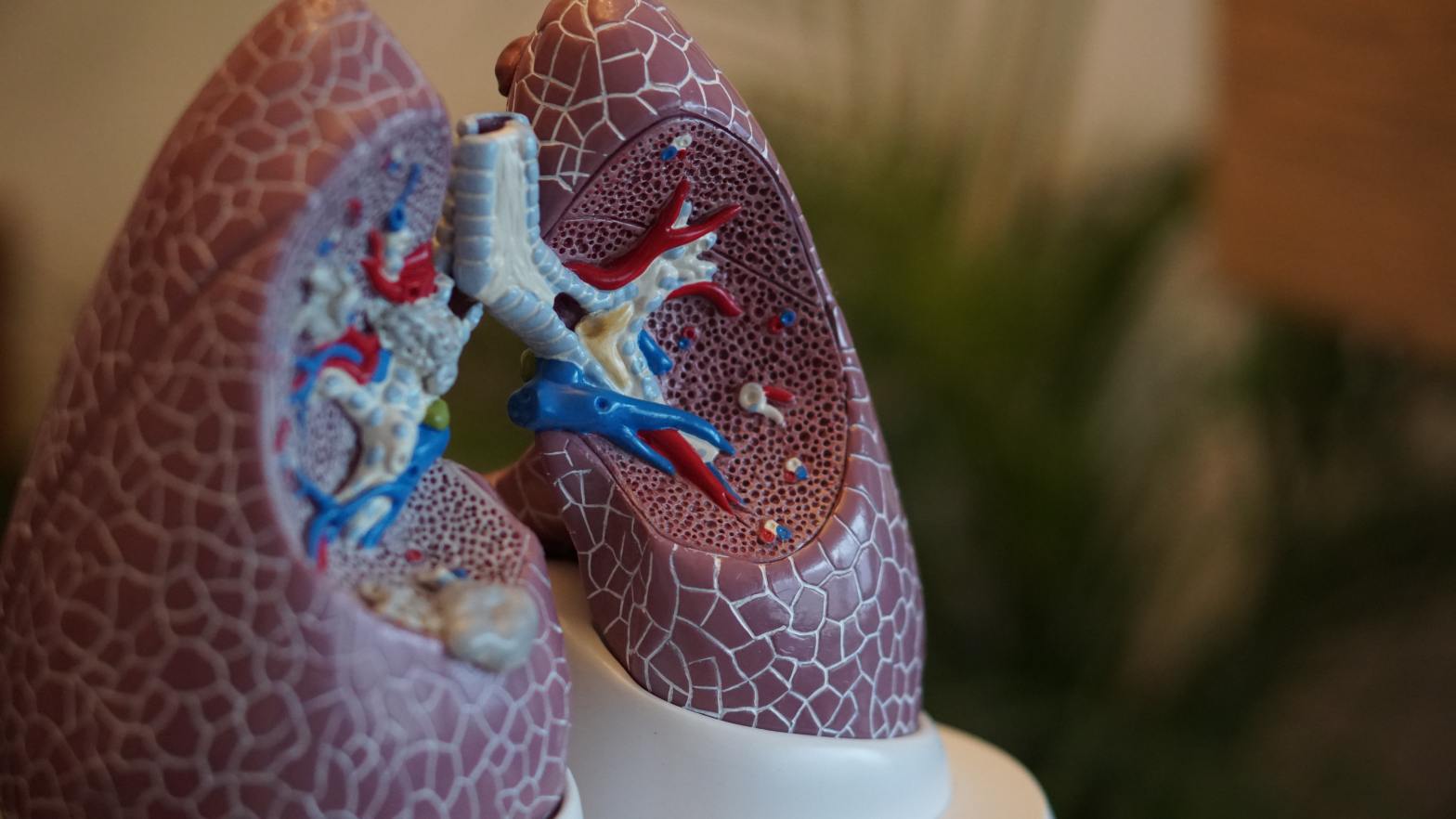
Article shortcut: https://tinyurl.com/basesofpower
Series introduction:
While I reference some non-Buddhist material most everything in the notes and podcasts for this series on The Iddhipāda-Vibhaṅga Sutta are solely my effort to relate considerations, questions, experiences, explorations, suggestions, interpretations and practices involved and associated with this sutta.
This series comes via seven categories/blog posts/podcasts:
- Introduction; the key encapsulation/encoding/summary paragraph of the whole sutta which includes and weaves in the four powers; and a reading of one of two translations for the sutta
- Unpacking of the hindrances and the other of two translations for the sutta
- A (type of) situational awareness
- 32 parts of the body
- Perceptions of night, daytime and light
- “Psychic Powers,” practice combinations and miscellany
- Summary, findings, observations and comparisons
In more detail, the four Iddhipāda — sometimes translated as bases of psychic power, basis of psychic power, bases of power, base of spiritual power, wings to success, paths of accomplishment, accomplishments, or roads to power — are:
- chanda: desire; enthusiasm; purpose; wish
- viriya: persistence; energy; effort; will
- citta: intent; consciousness; knowing mind; mental development; devoting mind to; heart-mind
- vīmaṃsā: investigation; inquiry; discernment; discrimination; reason; interest; intelligent curiosity; [(perhaps a new contribution, or for chanda:) balanced and helpful enthrallment, fascination]; feedback and fine tuning, adjustment; learn from doing; circumspection
Along with aiding our even mundane accomplishments and mastery, perhaps the Iddhipāda play a significant role in approaching will — the way one decides on and initiates action — and at the core of The Iddhipāda-Vibhaṅga Sutta is an analysis of will along with instructions for its training, development, and use.
32 Parts Of The Body

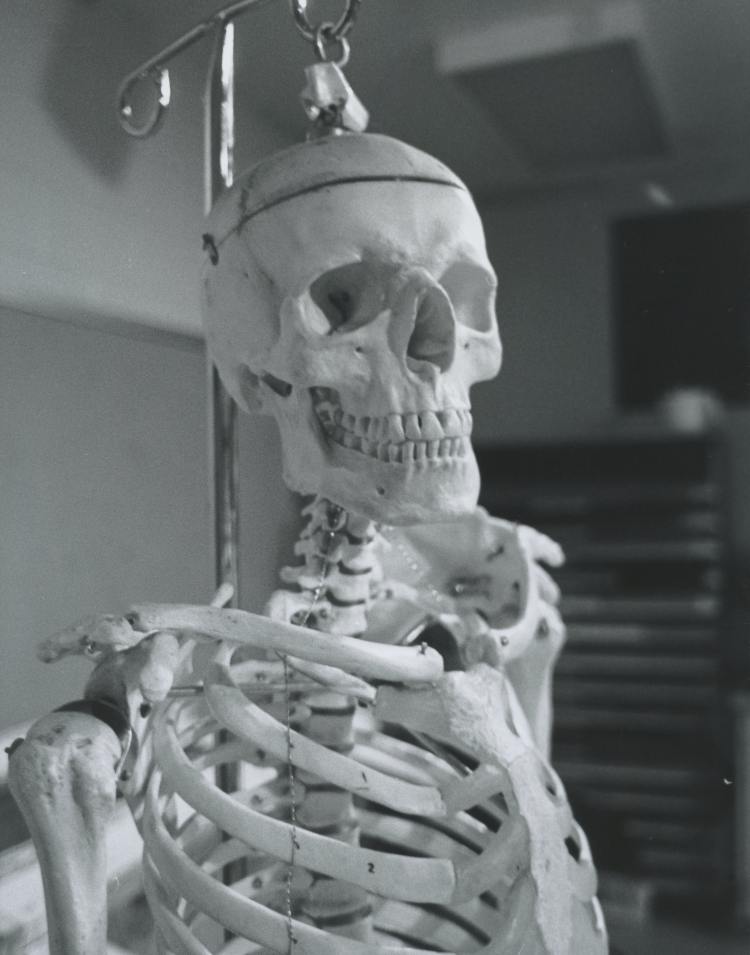

Practice Warning Disclaimer: There are ‘accounts of a mass suicide by monks disgusted with their own bodies, which reportedly happened after the Buddha had praised seeing the body as bereft of beauty.’ If you’re getting a clear “no” when considering these practices please don’t do them for now. Also please look into this topic more deeply if there’s any doubt before engaging in these practices as I take zero responsibility for anyones actions (other than my own).
Part four of the series addresses the 32 parts of the body mentioned within the sutta. In the first portion I speak without notes while I reference the notes below in the other portion.
Regarding the portion:
“And how does a monk dwell so that what is below is the same as what is above, and what is above is the same as what is below? There is the case where a monk reflects on this very body, from the soles of the feet on up, from the crown of the head on down, surrounded by skin, & full of various kinds of unclean things: ‘In this body there are head hairs,…..
or translated:
“And how does a mendicant meditate as below, so above; as above, so below? It’s when a mendicant examines their own body up from the soles of the feet and down from the tips of the hairs, wrapped in skin and full of many kinds of filth. ‘In this body there is head hair, ……
Expanded version with metaphor from the Satipatthana Sutta:
4. The Reflection on the Repulsiveness of the Body
And further, monks, a monk reflects on this very body enveloped by the skin and full of manifold impurity, from the soles up, and from the top of the head-hairs down, thinking thus: “There are in this body hair of the head, hair of the body, nails, teeth, skin, flesh, sinews, bones, marrow, kidney, heart, liver, *midriff*, spleen, lungs, intestines, mesentery, gorge, feces, bile, phlegm, pus, blood, sweat, fat, tears, grease, saliva, nasal mucus, synovial fluid, urine.”
Just as if there were a double-mouthed provision bag full of various kinds of grain such as hill paddy, paddy, green gram, cow-peas, sesamum, and husked rice, and a man with sound eyes, having opened that bag, were to take stock of the contents thus: “This is hill paddy, this is paddy, this is green gram, this is cow-pea, this is sesamum, this is husked rice.” Just so, monks, a monk reflects on this very body enveloped by the skin and full of manifold impurity, from the soles up, and from the top of the head-hairs down, thinking thus: “There are in this body hair of the head, hair of the body, nails, teeth, skin, flesh, sinews, bones, marrow, kidney, heart, liver, *midriff*, spleen, lungs, intestines, mesentery, gorge, feces, bile, phlegm, pus, blood, sweat, fat, tears, grease, saliva, nasal mucus, synovial fluid, urine.”
Thus he lives contemplating the body in the body internally, or he lives contemplating the body in the body externally, or he lives contemplating the body in the body internally and externally. He lives contemplating origination factors in the body, or he lives contemplating dissolution factors in the body, or he lives contemplating origination-and-dissolution factors in the body. Or his mindfulness is established with the thought: “The body exists,” to the extent necessary just for knowledge and mindfulness, and he lives detached, and clings to nothing in the world. Thus also, monks, a monk lives contemplating the body in the body.
The Foundations of Mindfulness
Satipatthana Sutta
translated by
Nyanasatta Thera

Podcast notes:
- Is there a skillful, wholesome, wise counterpart to the provisions bag metaphor? Could going through a provisions bag be a means for identifying the aspect of nourishment too? These unclean things need care and maintaining so knowing them in order to also how to relate to them internally and external?
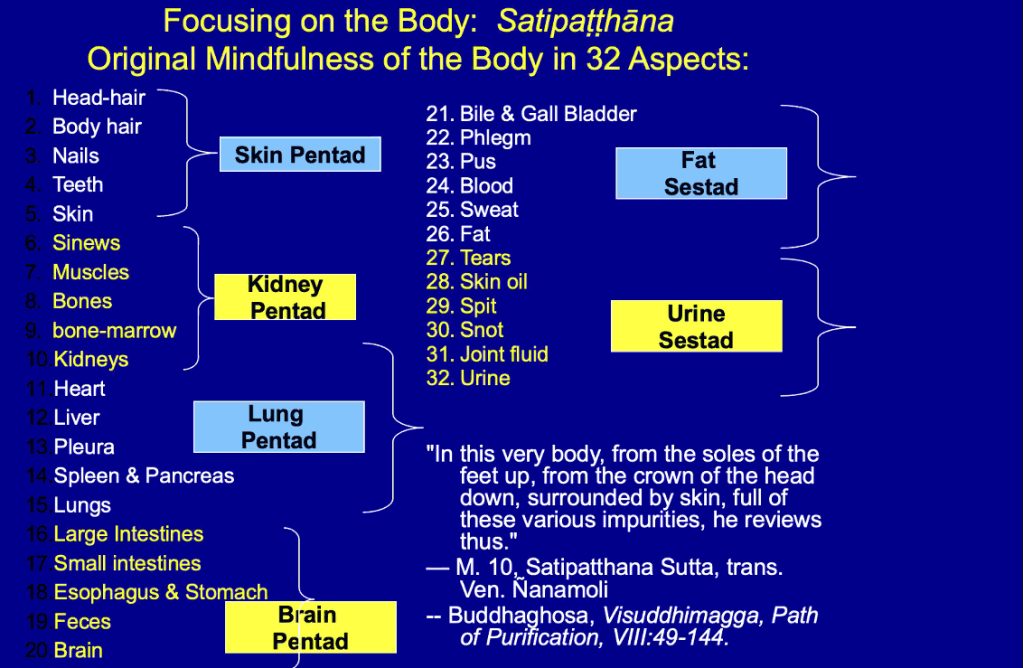
- Why this order for the 32 parts?
- Also divided into 5 mostly external parts, 13 internal parts, 13 bodily substances and (then) you’re in, I mean urine . . .
- why no sexual organs or sexual fluids?
- joint fluid’s similarity to sexual fluids?
- urine’s involvement with sex organs?
- joint fluid and urine are listed last
- sex organs covered/included indirectly in skin and body hair
A note that’s not directly in the audio:
Pretty sure Kilomakam is the Pali word with garnering the different translations of midriff, pleura, diaphragm, membranes, maybe even fascia
Techniques, Avenues of Approach and Considerations for Development

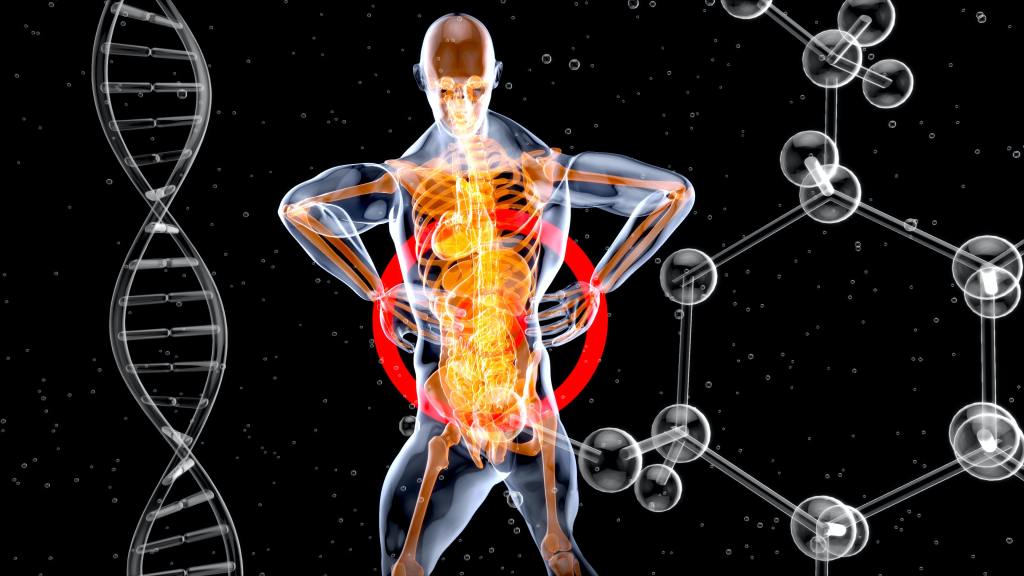
- Head hair, body hair, nails, teeth, and skin as entry point. ([These are meditation objects for newly ordained in some of the Thai Forrest traditions] These are visible so we can notice internally and externally as reference points for parts not so noticeable externally)
- If one has familiarity with Chinese medicine, meridians and five element system — Denny and I did shows on this — it may be helpful to look for comparisons of the 32 parts (order) to Chinese pairing and tripling of organs in regards to masculine/feminine and treasure organs and protector organs like liver and gall bladder
- visual image vs. word labels as guiding (instructions) for practicing with the 32 parts
- How are external images of body parts different from living version we can’t physically see the same way? How would one know?
- technique of scanning through and around the 32 parts without naming or labeling, just seeing and knowing them
- include the energy interactions with each part while each part remains the primary object of meditation (if addressing the 32 parts individually as well as variations on this) or vice versa where observing (each of the) 32 parts’s energy is the primary object and the physical components are included
- technique of using whole, entire, total and complete (physical) body awareness at once for the 32 parts; each part individually; and/or other ways of approaching the 32 parts (and how would such a technique be used for samatha?)
- What are the (four) elemental natures — earth, water, wind and fire — for each part and combinations of parts? Chinese relegate certain organs for certain elements. How predominate is one element in an organ? What constitutes a balance of the elements in each organ? How might this be different through various times and places?
- (natural) breath to feel and discern what parts are being noticed and how. Also deliberately breathing into and out of each of the 32 parts
- How is each part (inter)connected with other parts, the whole body and the external?
- Can the whole body and each of the 32 parts be meditated on like the given “double-mouthed provision bag full of various kinds of grain” — like if invisible hands of awareness went through the skin sack of the body. And then on increasingly micro levels can contents within be meditated on again in like manner?
- What are the causes and conditions internally and externally affecting/effecting the 32 parts? Similarly, reflect on when and how various parts are more fully and completely penetrated and noticed
- death contemplations for each and/or combos of 32 parts to make them less abstract and more immediate. What would the heart look like due to certain causes of death; after certain durations of decay; and given various environments?
- More esoteric but some reference beings/entities involved with/for each and/or combos of 32 parts and how bhramavihara practice may relate to this
- It’s interesting to practice returning again and again to one part. Also interesting to switch between 32 parts randomly or upon distraction (and/with mental labeling of part and/or when theres’s distraction).
- What is the relationship of nervous system with the 32 parts?
- 32 parts condensed down (for easier access) into: 1) skin level, 2) bone and joint/synovial fluid level and 3) everything else in between
Findings, Insights and Noticings


- Body as convergence point:
- Human experience is tethered to body
- Midgard — other realms accessible here
- Discarding hierarchy, perhaps, in a way, in regards to discarding the type of sameness reflected in the esoteric saying “as above so below” vis-à-vis how this sutta somatically expresses “what is below is the same as what is above, and what is above is the same as what is below” [perhaps to add more immediacy to the practice instead of the attention going off into higher and lower gods, spirits, other beings, entities, etc.]
- Possession? Body as a temple
- Epigenetics and DNA’s role
- just like many areas of study if we inquire deeply enough into the functions of the 32 parts to where modern science’s understanding halts we then get into metaphysics, or science beyond our current public understanding; particularly what beings, forces, processes, and energies are involved at these levels, as well as the causes and conditions that come into play and how all this functions
- what is going on in the unseen realms in the immediate environment that’s influencing and/or “crossing over” into the physicality of each of the 32 parts? How is this happening and why?
- Could such a deep, immersive, intimate, visceral relationship with the shape and form of physical matter, its design and function — with mastery of the four great elements — then be applied to pretty much all matter (leading to the physical powers mentioned in this sutta)?
- Naturally that’s speculation from me but in my experience with the 32 parts I spent extra time on the liver and noticing the (possible) benefits on gall bladder (meridian) which is said to protect liver and how blockages along gall bladder meridian seemed to unclog. Liver seemed to (energetically) detox then I noticed how much toxicity there is on many layers: gross and subtle, emotions, moods, attitudes, noises, projections, and all the dukkha or suffering/ stress/ unsatisfactoriness inherent in this current consensual reality
More resources

- Practice resources:
- https://en.wikipedia.org/wiki/Patikulamanasikara — ‘Paṭikkūlamanasikāra (variant: paṭikūlamanasikāra) is a Pāli term that is generally translated as “reflections on repulsiveness”. It refers to a traditional Buddhist meditation whereby thirty-one parts of the body are contemplated in a variety of ways. In addition to developing sati (mindfulness) and samādhi (concentration), this form of meditation is considered conducive to overcoming desire and lust. Along with cemetery contemplations, this type of meditation is one of the two meditations on “the foul”/unattractiveness (Pāli: asubha).’
- 32-parts by element. Please source for omitted references: https://www.themindingcentre.org/dharmafarer/wp-content/uploads/28.14-Iddhipada-Vibhanga-S-s51.20-piya.pdf
In this body there are:
(1) head-hairs, body-hairs, nails, teeth, skin;
(2) flesh, sinews, bones, bone-marrow, kidneys;
(3) heart, liver, membranes (around the lungs), spleen, lungs;
(4) large intestines, small intestines, stomach-contents, faeces [, brain];
(5) bile, phlegm, pus, blood, sweat, fat;
(6) tears, grease, saliva, snot, oil of the joints, urine.‟
In this meditation of parts of the body, groups (1)-(4) constitute the earth element; groups (5)-(6) constitute the water element. The same sutta describes the fire element as that by which one is warmed, ages, and burns, and that by which what is eaten, drunk, chewed and tasted gets completely digested, or whatever else that is liquid, liquefied and clung to internally and individually [belonging to oneself]; and the wind element as up-going winds [burping], down-going winds, winds in the belly [flatulence], winds that course through the limbs, in-breath and out-breath, or whatever else that is air, airy and clung to internally and individually [belonging to oneself].
- Asubha Sutta — Unattractiveness:
“Monks, there are these four modes of practice. Which four? Painful practice with slow intuition, painful practice with quick intuition, pleasant practice with slow intuition, & pleasant practice with quick intuition.
“And which is painful practice with slow intuition? There is the case where a monk remains focused on unattractiveness with regard to the body, percipient of loathsomeness with regard to food, percipient of non-delight with regard to the entire world, (and) focused on inconstancy with regard to all fabrications. The perception of death is well established within him. He dwells in dependence on the five strengths of a learner — strength of conviction, strength of conscience, strength of concern, strength of persistence, & strength of discernment — but these five faculties of his — the faculty of conviction, the faculty of persistence, the faculty of mindfulness, the faculty of concentration, the faculty of discernment — appear weakly. Because of their weakness, he attains only slowly the immediacy [1] that leads to the ending of the effluents. This is called painful practice with slow intuition.
“And which is painful practice with quick intuition? There is the case where a monk remains focused on unattractiveness with regard to the body, percipient of loathsomeness with regard to food, percipient of non-delight with regard to the entire world, (and) focused on inconstancy with regard to all fabrications. The perception of death is well established within him. He dwells in dependence on these five strengths of a learner — strength of conviction, strength of conscience, strength of concern, strength of persistence, & strength of discernment — and these five faculties of his — the faculty of conviction, the faculty of persistence, the faculty of mindfulness, the faculty of concentration, the faculty of discernment — appear intensely. Because of their intensity, he attains quickly the immediacy that leads to the ending of the effluents. This is called painful practice with quick intuition.
“And which is pleasant practice with slow intuition? There is the case where a monk — quite secluded from sensuality, secluded from unskillful qualities — enters & remains in the first jhana: rapture & pleasure born of seclusion, accompanied by directed thought & evaluation. With the stilling of directed thoughts & evaluations, he enters & remains in the second jhana: rapture & pleasure born of concentration, unification of awareness free from directed thought & evaluation — internal assurance. With the fading of rapture he remains equanimous, mindful, & alert, and senses pleasure with the body. He enters & remains in the third jhana, of which the noble ones declare, ‘Equanimous & mindful, he has a pleasant abiding.’ With the abandoning of pleasure & pain — as with the earlier disappearance of joy & distress — he enters & remains in the fourth jhana: purity of equanimity & mindfulness, neither pleasure nor pain. He dwells in dependence on these five strengths of a learner — strength of conviction, strength of conscience, strength of concern, strength of persistence, & strength of discernment — but these five faculties of his — the faculty of conviction, the faculty of persistence, the faculty of mindfulness, the faculty of concentration, the faculty of discernment — appear weakly. Because of their weakness, he attains only slowly the immediacy that leads to the ending of the effluents. This is called pleasant practice with slow intuition. [2]
“And which is pleasant practice with quick intuition? There is the case where a monk — quite secluded from sensuality, secluded from unskillful qualities — enters & remains in the first jhana: rapture & pleasure born of seclusion, accompanied by directed thought & evaluation. With the stilling of directed thoughts & evaluations, he enters & remains in the second jhana: rapture & pleasure born of concentration, unification of awareness free from directed thought & evaluation — internal assurance. With the fading of rapture he remains equanimous, mindful, & alert, and senses pleasure with the body. He enters & remains in the third jhana, of which the noble ones declare, ‘Equanimous & mindful, he has a pleasant abiding.’ With the abandoning of pleasure & pain — as with the earlier disappearance of joy & distress — he enters & remains in the fourth jhana: purity of equanimity & mindfulness, neither pleasure nor pain. He dwells in dependence on these five strengths of a learner — strength of conviction, strength of conscience, strength of concern, strength of persistence, & strength of discernment — and these five faculties of his — the faculty of conviction, the faculty of persistence, the faculty of mindfulness, the faculty of concentration, the faculty of discernment — appear intensely. Because of their intensity, he attains quickly the immediacy that leads to the ending of the effluents. This is called pleasant practice with quick intuition.
“These are the four modes of practice.”
Note
1.
According to the Commentary, this means the concentration forming the Path. This is apparently a reference to this passage in Sn 2.1:
What the excellent Awakened One extolled as pure and called the concentration of unmediated knowing: No equal to that concentration can be found. This, too, is an exquisite treasure in the Dhamma. By this truth may there be well-being. 2.
Because the description of pleasant practice here contains the standard jhana formula, while the description of painful practice contains no mention of jhana, some writers have taken this as proof that there is an alternative path to awakening that does not involve the jhanas.
However, this reading ignores the description of how painful practice and pleasant practice can yield either slow or quick intuition. Intuition comes slowly when the five faculties are present in a weak form, and quickly when they are present in an intense form. Now, in both cases, the faculty of concentration — which is defined with the standard formula for the jhanas (SN 48.10) — has to be present for the ending of the effluents. Because this is true both for painful practice and for pleasant practice, both sorts of practice need jhana in order to succeed.
AN 4.163 PTS: A ii 151
Asubha Sutta: Unattractiveness
translated from the Pali by
Thanissaro Bhikkhu
- Brief Ajahn Succito audio on 32 Parts of the Body:
- Selection from the Dhātuvibhaṅgasutta on how the 32 Parts correspond to the elements — earth, water, fire, air and space:
And what is the earth element? The earth element may be interior or exterior. And what is the interior earth element? Anything hard, solid, and appropriated that’s internal, pertaining to an individual. This includes head hair, body hair, nails, teeth, skin, flesh, sinews, bones, bone marrow, kidneys, heart, liver, diaphragm, spleen, lungs, intestines, mesentery, undigested food, feces, or anything else hard, solid, and appropriated that’s internal, pertaining to an individual. This is called the interior earth element. The interior earth element and the exterior earth element are just the earth element. This should be truly seen with right understanding like this: ‘This is not mine, I am not this, this is not my self.’ When you truly see with right understanding, you reject the earth element, detaching the mind from the earth element.
And what is the water element? The water element may be interior or exterior. And what is the interior water element? Anything that’s water, watery, and appropriated that’s internal, pertaining to an individual. This includes bile, phlegm, pus, blood, sweat, fat, tears, grease, saliva, snot, synovial fluid, urine, or anything else that’s water, watery, and appropriated that’s internal, pertaining to an individual. This is called the interior water element. The interior water element and the exterior water element are just the water element. This should be truly seen with right understanding like this: ‘This is not mine, I am not this, this is not my self.’ When you truly see with right understanding, you reject the water element, detaching the mind from the water element.
And what is the fire element? The fire element may be interior or exterior. And what is the interior fire element? Anything that’s fire, fiery, and appropriated that’s internal, pertaining to an individual. This includes that which warms, that which ages, that which heats you up when feverish, that which properly digests food and drink, or anything else that’s fire, fiery, and appropriated that’s internal, pertaining to an individual. This is called the interior fire element. The interior fire element and the exterior fire element are just the fire element. This should be truly seen with right understanding like this: ‘This is not mine, I am not this, this is not my self.’ When you truly see with right understanding, you reject the fire element, detaching the mind from the fire element.
And what is the air element? The air element may be interior or exterior. And what is the interior air element? Anything that’s air, airy, and appropriated that’s internal, pertaining to an individual. This includes winds that go up or down, winds in the belly or the bowels, winds that flow through the limbs, in-breaths and out-breaths, or anything else that’s air, airy, and appropriated that’s internal, pertaining to an individual. This is called the interior air element. The interior air element and the exterior air element are just the air element. This should be truly seen with right understanding like this: ‘This is not mine, I am not this, this is not my self.’ When you truly see with right understanding, you reject the air element, detaching the mind from the air element.
And what is the space element? The space element may be interior or exterior. And what is the interior space element? Anything that’s space, spacious, and appropriated that’s internal, pertaining to an individual. This includes the ear canals, nostrils, and mouth; and the space for swallowing what is eaten and drunk, the space where it stays, and the space for excreting it from the nether regions. This is called the interior space element. The interior space element and the exterior space element are just the space element. This should be truly seen with right understanding like this: ‘This is not mine, I am not this, this is not my self.’ When you truly see with right understanding, you reject the space element, detaching the mind from the space element.
Dhātuvibhaṅgasutta—Bhikkhu Sujato
Middle Discourses 140
The Analysis of the Elements
Again, this series comes via seven categories/blog posts/podcasts:
- Introduction; the key encapsulation/encoding/summary paragraph of the whole sutta which includes and weaves in the four powers; and a reading of one of two translations for the sutta
- Unpacking of the hindrances and the other of two translations for the sutta
- A (type of) situational awareness
- 32 parts of the body
- Perceptions of night, daytime and light
- “Psychic Powers,” practice combinations and miscellany
- Summary, findings, observations and comparisons
Audio: Studying And Practicing With “The Iddhipāda-Vibhaṅga Sutta — An Analysis Of The Bases Of Power”: 32 Parts Of The Body (4 of 7)

Or listen via Insight Timer (app or website)
The raw unedited YouTube transcription of this podcast:
the 32 parts of the body without my notes so i practice this
each part one by one starting with the first part for my entire morning session
meditation session in the entire evening session or two back-to-back sec sessions
sometimes one part would start in the in comparison and include in the next portion so 64
sessions of these working individually with each of the parts it’s interesting to note how
some of the parts seemed easier and clearer to stay with as a meditation
object while others were very faint barely noticeable a real struggle to
return the attention over and over again to the part when isolated like this these parts can
seem very interesting to say the least sometimes very foreign and alien life
and then the energy of each part as well as a visualization the word its name
that goes with it are all ways to access this the ways i access the 32 parts and
then these can be taken as pairs or groups they can be done in the prescribed order and they can be done
switching randomly or the best of the memory with a fixed time duration or an
intuitive time duration to meaning there’s really no rules for how long you
need to spend on each one or how you need to do it as far as i know now another way to approach these is to
condense it down into three categories skin the skin level hair hair follicles
dermis and whatever medical labels or terms really don’t have an opinion one way or the other to use more involved
details names as in anatomy modern western anatomy so we’ve
got the skin layer then skipping down all the way to the bone layer and the
fluids and the bones and then between the skin and the bones just call the flesh layer everything else
i guess the tendons and the sinews would fit in this you can just put them in either the bone
category or the the middle fleshy layer category this is a simplified way to
move through like a middle layer not really a microcosm of individual parts nor
it considered as a whole but somewhere in between it’s interesting to note
the causes and conditions and circumstances when these parts seem more accessible or least accessible of course
these are given in the time of the buddha as a meditation object or practice for those
experiencing lots of lust my understanding of that would be when there’s lots of sexual desire wanting to
inhabit another let’s put it that way or be inhabited by another
sexually then this is that inner habitation but with in one’s own body
within the body without sexual contact or sexual activity and it’s interesting
how the sexual organs are absent from the list of the 32 parts it’s also mentioned in
the six-fold mindfulness of the body part it’s also mentioned as one of the
six-fold mindfulness of the body in the sativatana suta one facet of
experiencing a body that is often overlooked most of the time we only see the surface
layer of the body externally anyway head hair body hair
skin nails teeth for the most part but there’s way way much more
how would these parts look if we could see them with the physical eyes without
cutting open the body and would they change once the body’s cut open or
opened up how would we know how would anybody know which goes into
the differences between internal site external site or if there are differences
in how we would know that so just the formation of each of the 32 parts how
and why are they shaped like that and why aren’t there functions slightly different and
still healthy and working this is excluding a malfunction of the body of hearts there’s plenty of variations
there i suppose but each organ seems like it has a particular function and purpose
and so if we take one away if its function changes slightly how does that affect the overall
body health and other organs of course it’s interesting to consider
the causes and conditions of each of the organs as well and start cross-referencing them with
other lists of investigation such as anicha duka-anata in constancy
stress and not self nature so this is the section on the 32 parts
of the body and here i’m consulting my notes in this portion with two translations is
and how does a monk dwell so that what is below is the same as what is above
and what is above is the same as what is below there is the case where a monk reflects on this very body from the
soles of the feet on up from the crown of the head on down surrounded by skin and full of various kinds of unclean
things in this body there are head hairs body hairs and i’m just going to truncate there go to the next one here
this one by sujatu’s translation venerable sujatu’s translation
and how does a minikit meditate as below so above as above so below
it’s when the mendicate examines their own body from the soles of the feet
and down from the tips of the hairs wrapped in skin
and full of many kinds of filth in this body is head hair body hair and i’ll stop
there and go to this expanded version from the satipatana suta
and this is a translation by
and of the six parts of the body this is the fourth one the reflection on
the repulsiveness of the body and further monks a monk reflects on this very body
enveloped by the skin and full of manifold impurity from the souls up and from the top of the head hairs down
thinking thus there are in this body hair of the head hair of the body nails
teeth skin flesh sinew bones marrow kidney heart liver midriff
spleen lungs intestines mercenary gorge feces bile phlegm pus blood
sweat fat tears grease saliva nasal mucus synovial fluid
urine just as if there were a double-mouthed provision bag full of various kinds of
crane such as hill patty patty green graham
cow peas sesamum and oscar rice and a man with sound eyes
having opened that bag or to take stock of the contents thus
this is hill patty this is patty this is green graham this is cow pee this is
sesamon this is husk rice just so monks a monk
reflects on this very body enveloped by the skin and full of manifold and purity
from the souls up and from the top of the head hairs down thinking thus there
are in this body hair of the head hair the body nails teeth skin flesh
sinews bones marrow kidney heart liver midriff spleen lungs
intestines mercenary gorge feces bile phlegm pus blood sweat fat tears grease
saliva nasal mucus synovial fluid urine thus he lives contemplating the body in
the body internally or he lives contemplating the body in the body externally
or he lives contemplating the body in the body internally and externally
he lives contemplating origination factors in the body or he lives contemplating disillusion factors
in the body or he lives contemplating origin and disillusion factors in the
body or his mindfulness is established with the thought the body exists
to the extent necessary just for knowledge and mindfulness and he lives detach and clings to nothing in the
world thus also amongst a monk lives contemplating the body in the body and
so this one word here one of these parts mid rift
translated by thanosauru beku whatever the pali word is as
plura p-l-e-u-r-a which i didn’t study much anatomy which
is defined as each of a pair of serous membranes lying the throat and
enveloping the lungs and humans and other mammals midrift i usually think of that as just
like an area of the middle section of the body i don’t know
to look that what that word means exactly venerable sagitto
translates whatever that poly word is as diaphragm obviously there’s some
non-agreement in that particular translation but anyway divided this portion into an intro
then techniques avenues of approach and considerations for practice and development i’ll close with findings
insights and noticings of these 32 parts i just start before really the intro is
this provision bags metaphor i really like here is could there be a skillful wholesome and
wise counterpart to this provisions bag metaphor not that the one mentioned necessarily
isn’t obviously but could going through provision bags be like a metaphorical
means for identifying the aspect of nourishment involved here too
in other words you know a provision bag this is something one carries around because they’re going
to eat something out of it to keep the body alive so while i can see the benefit of the
realistic part of all these unclean things contained by skin
known as our body i also like to look at these unclean things as they need
care and maintaining to nourishment needs and then how
can we best relate to them internally and externally so maybe some of us need a little more
focus on the filth version of these maybe some of us need a little more focus on
how these can be nourished taken care of cherished even
so one of the common questions that comes up around this from what i understand is why this
order why are they listed this way so some people divide these up into pen
tabs and six cyst heads which basically just means groups of five and six so the
first one skin pin tad head hair body hair nails teeth skin kidney pintad sinews muscles bones bone
marrow kidneys now where they get this kidney why they name it kidney out of
those five i don’t know same way with the next lung pentad brain pentad fats
cesta and urine cyst head know why they chose those particular organs to name
the whole group but again the lung pin tad his heart liver pleura
spleen and pancreas lungs notice the pancreas is tacked on there where some
people are some of the translations don’t include the pancreas the brain pentad is large intestines small
intestines esophagus and stomach feces and brain esophagus and stomach one translation is
gorge it’s kind of opening that runs the whole gamut there pretty much or down to the stomach at least and notice feces is
right next to the brain the fat cested bile and gallbladder
phlegm pus blood sweat fat guess bile is also referred to by some
as gall you don’t have the call to do that kind of saying and then your incest ad
tears skin oil spit snot joint fluid and urine
i haven’t heard this mentioned but looking at these there’s another way to group them i
guess in this order is the first is mostly external parts are at least
noticed more often on the external pretty much of the time head hair body hair nails teeth skin
and then there’s 13 internal parts sinews muscles bones bone marrow
kidney heart liver pleura spleen lungs small intestines and large
intestines are actually large intestine small intestines and the gorge esophagus and stomach so that’s 13
and then we get into 13 bodily substances is what i’m calling them feces
brain although i guess brain can be considered an organ but uh i think it can be
squeezed into a substance too pretty easily bile phlegm pus blood sweat fat
tears skin spits not joint fluid
and then if you’re allowed me a bad joke then you’re in i mean your urine this is
the 32 one which is actually a substance as well um but it just doesn’t work with
the symmetry of 13. i can use it as a one but which is interesting urine and
one right because maybe that plays into the sexual organs because difference between physical sexual
organs between a male and a female both have urine the urine goes through different sexual organs though and then
you know why are there no sexual organs or sexual fluids mentioned in this
maybe the similarity there would be the last two urine i just went over that the joint
fluid how similar is joint fluid to sexual fluids
and then with the sexual organs i guess they can tie back into partially covered or included indirectly
in the skin body hair too although this might be a little too much gory detail
and of course if one’s a monk monastic none then
there’s a strict vow of no sexual activity so it makes sense that the sexual organ sexual fluids
need not be mentioned here especially since this seems to apply to monastics
in the original poly furthermore on that if i’m remembering right there’s a
suta or portion of the suta about the buddha recommending 32 parts of the body to
some monastics who are overcome with lust and so the thinking is is
that it would help with that then he goes away for a while and comes back and
has found that they’ve ended their lives because they were so disgusted by these
practices and so he’s a mistake that he possibly made by
giving this i can’t remember all the details and if i find this i’ll link this in the show notes
and don’t hold me to that exactly have to look this up for yourself to see if i’m getting this right
so now on to the techniques avenues of approach and considerations for development one of the ways into this
practice really easily are at least the easiest ways that i know of
is the first five head hair body hair nails teeth skin from what i understand if i remember
this again right this is the meditation objects giving given to
monastics newly ordained and some thai forest traditions and tarabata
these are visible so we can notice these internally and externally by internally i mean with their own awareness
and then externally we can notice them on ourselves or others and then use these as reference points for different
parts of the 32 not so noticeable externally and then if one has familiarity with chinese medicine the
meridians and the chinese systems in the five element system there as denny and i
has done done shows on this mostly denny this gives presentations where i just give a comment or two here and there so
taking those things it might be helpful to look at comparisons from those systems with the 32 parts especially the
order and especially to the how the chinese can pair up certain organs like a
treasure organ and a protector organ and then some of the parts have triplings of the organs and there’s also
the elements come in there in general too we can practice using a visual image and just the word labeling
for guidance and instructions on these so when i say teeth what comes to mind
is it just the word do you see image of teeth do you see nasty teeth do you see beautiful teeth
do you see your teeth do you see someone else’s teeth see images from tv memories
from that do all these kinds of proliferation start up about oh i wish my teeth were cleaner straighter wider
brighter bigger smaller etc etc etc and all the things that can go around
that i can see how just keeping it to a basic perception on these parts might be
helpful then how are external images of these body parts different from living
versions we can’t physically see the same way so when i say something like our liver our kidneys we’ve probably
seen images of those in like textbooks or maybe online every once in a while but now how are those different since
those come most likely from either artists renditions or they come from cadavers
how might we see these with our internal vision the mind’s eye the heart’s eye and how
would it be different from a cadavers then how would we know how would one know what the difference is and how
relative or objective it would be there’s the technique of scanning through and around the 32 parts
without naming or labeling just seeing and knowing them again using
the internal vision if that’s available to you or just even imagination if it’s not
conjuring up some kind of image no matter how accurate we think it is or not
and again this is just like a scanning without any need for naming or labeling
so you can actually just scan through the body without having any perceptions or names of these individual parts just
kind of scanning and looking through the body so there would kind of deviate
from the actual labels of each of these 32 parts also we can include the energy
interactions with each part while each part remains the primary object of meditation or vice versa we’re
observing each of the 32 parts energy is the primary object and the physical
components are included so by this i mean if we’re meditating on
bones so that’s the primary object of meditation can also include the energy
of the bones it’s kind of earthy solid upright maybe it’s
fragile or strong maybe it’s not really that flexible stable and hard so these are all kind of
labels for different types of energy so that can be included with the actual
physical object or you can just start meditating on the energies of a part and also include the actual label and
physical object of the part or maybe even divide attention equally
between the two then there’s the technique of using the whole entire total and complete physical
body awareness at the same time are all at once for the 32 parts
so eventually getting to the point where all 32 parts can be held in awareness at the same
time or we could still have this whole body awareness while individually meditating on a
single part or combinations of the part or however we approach the 32 parts of
the body can there be an incorporation of the entire body awareness while doing these
practices what would get in the way of that what would support that
and as a bonus here how could something like this be used in samata or
practice that leads to samadhi what are the four elemental natures earth water
wind and fire for each part and combinations of parts you know the chinese relegate
certain organs to an element predominantly anyway so how predominant then is one element
for an organ what constitutes a balance of the elements in each organ and how might
this be different throughout various times and places just take for example
the heart what seems to be more predominant the earth water wind or fire
element you know how would we know this does it change depending on place we’re in different times different
causes and conditions how might it come into balance how might it go out of balance in regards to the four elements
four great elements there’s a technique of using the natural breath to feel and discern what parts are being noticed and
how so that’s just using normal breath meditation tuning into which of these 32 parts can
be kind of noticed just using the natural breath and meditation so
obviously maybe the diaphragm will come in here if that’s actually one of the translations you know the lungs pleura
phlegm you can feel maybe the skin moving expanding can maybe go into the
sinews and muscles how would that affect the bones if there’s that little wall of subtlety can
you discern things like the kidney heart liver spleen how about the guts the large intestine
small intestines how does it affect the esophagus and stomach there’s also the
technique of deliberately breathing into and out of each of the 32 parts so you could say well i’m going to take three
breaths to the heart right now just to keep the attention on the physical heart
whether or not it’s turning out the way you want it to or how you think it should be just kind of pinning or keeping the
attention using the breath on these perceptions of different parts of the body another
area of investigation might be how is each part interconnected with the other parts
how’s each part interconnected with the whole body and how is each one
connected or interconnected with things on the external things outside the body
and then returning to this double mouth provision bag metaphor can
the whole body in each of the 32 parts be meditated on like that bag
such as if there’s like an invisible hand of awareness that went through the skin sack of the body so if you just
imagine these invisible hands starting at the top of the head hair head hair taking those hands down
through the skull so through the brain bone of the skull you get into the sinews and muscles and
bone marrow down through the neck but before that you would hit the teeth right and skin
all the way down just going through that like hands huge external hands through the top of the
body on down like clear provision bag if you’re squeezing out those different grains in a provision bag and then also
if you were to sort grains out on a table or the ground or whatever surface could you go through
the body like that and then keep going on a micro level so if you just take
let’s say the liver can you go through the liver in the same way as if that was a
provision bag and so you’re going through the the liver and all the different smaller
parts and substances through the liver and then keep going even micro levels so
if there’s some kind of substance or chamber in the liver or part of the liver can you go through
that even smaller part within the liver like a provision bag and get increasingly smaller and smaller levels
and discernment of substances form shape functions and all that so
this seems like maybe a little extreme way to go but then again this is possible this builds up even
more awareness and discernment which can then go and possibly be applied to other
areas which are even more beneficial another question for contemplation here what are
the causes and conditions internally and externally that affect and affect the 32
parts similarly when and how are various parts of the body more fully and completely
penetrated and noticed so there might be a specific time of day where a certain
organ might be more noticeable easier to meditate on than other times of day
there might be locations where you’re meditating where certain organs might be
more noticeable than others maybe if you’re meditating in a building some might be more noticeable or less
notable than when you’re sitting under a tree outside or maybe you’re in a group of new
practitioners versus seasoned practitioners that might affect this type of meditation too so what about
using death contemplation for each are combos of these 32 parts to kind of make
them less abstract and more immediate i mean could we imagine say what would the heart look like
due to certain causes and conditions of certain ways of death and how would it look like after certain durations of
decay given various environments where it was decaying so would it look different
decaying in the desert compared to a tropical climate or one where there’s
lots of animals around when there’s not a lot of animals around so of course we’re probably gonna have
to use our imagination on this but it involves the mind imagining
these things instead of kind of being more vague on it death is a
charged occurrence emotionally visually
on a memory level on and on so yeah it does lend more immediacy to this
practice i would suppose some esoteric systems reference entities
or beings involved with or for each of the 32 parts or combinations thereof
and i’m not going to go too much into that obviously because i don’t know much about it but if that were the case
could then we practice some of the brahma viharas towards some of those entities or beings related to
each of the 32 parts or combinations thereof so it’s interesting to practice
by returning again and again to each individual part focusing on or meditating on the kidneys for example
it’s interesting to just when get distracted just come back to the kidneys get distracted come back to the kidneys
over and over again and it’s also interesting to just not fight that distraction energy sometimes and then
when it’s just almost impossible to stay on one then we can just go either in
order to the next one or switch randomly between the 32 parts
or even you know this distraction gets too much can just just start switching
it’s also interesting to just have some kind of system with this the first part returning again and again
to just one at a time that’s part of the system but then just kind of use your own imagination and
experimental basis for structuring how you want to approach
this can also be used with mental labeling can meant to label
the part when the parts being noticed you can mental label when there’s distraction or anything
else coming up it’s another avenue that’s ripe for exploration is the
relationship of the nervous system with the 32 parts the only thing that’s really mentioned here is the
bones which might include the spine i guess in the brain but the nervous system isn’t mentioned here it’s an
interesting thing why it’s not mentioned but today the nervous system our nervous systems
actually tend to play a very pivotal role in everything now we’ve got the central nervous system
the peripheral nervous system got the sympathetic and parasympathetic nervous systems so so many ways to
use the nerves look at the nerves i guess finally on these approaches to practice
you can simplify these by condensing them down into three portions the ones that are most
obvious are the skin level and that would also include head hair body hair and you’ve got the bone and
joint synovial fluid level and then the third one everything else in between so basically skin bone and
then everything between those two would depend on what level of detail you’d
want to go into with the in between layers okay on to the findings insights and
noticing portion of the 32 parts of the body i find it interesting to look at the body as a type of convergence point our
human experience is tethered to a body some people might be able to leave their body temporarily
or some people might have this happen during extreme accidents or trauma or even at night during dreams
but eventually awareness and our experience is going to involve a body somehow
at least until the physical body sheds off in death is one way of looking at it so in norse
mythology there’s this place called midgard where humans live it’s kind of like a convergence where all other
realms are accessible from here i don’t know much about it but there’s other like heavenly realms and hell realms the
same way kind of as in buddhist cosmology or at least there’s different
beings where different beings realms where other beings live and then they can all kind of cross
over for some people in the human realm of midgard i guess in this practice the way it’s laid out
here it kind of discards hierarchy some systems would say as above so below
or you know it denotes higher heavenly realms lower hell realms but in this
suta it’s kind of the sameness of above and below so when above and below are
investigated in this it just has to do with this human body you know from the top of the head hairs on down to the
feet back up that’s the above and below guess the christian tradition
calls the body a temple there’s also mentions of possessions
by other entities spirits maybe demons possessed in the body
at various times and certain folks casting them out if that’s literal or
metaphoric or cross between the two or involves both somehow or something else it’s
definitely kind of captured the imagination of a lot of people at least in the western world in movies
tv shows books find this practice interesting in
regards to that type of phenomenon potential phenomena then there’s this notion of epigenetics
and the dna’s role in the body how does the coding of the dna and epigenetics
affect the actual form and shape slight variations of each of these 32 parts
and how does certain physical phenomena
on these 32 parts energetic phenomena go back and affect
the dna and epigenetic levels and so for this
study of the 32 parts just like so many other areas if we inquire deeply enough into the functions
of these 32 parts to where modern science is understanding halts
then we get into metaphysics or science beyond our current public understanding
particularly what beings forces processes and energies are involved at
these levels as well as the causes and conditions that come into play and how all this
functions the historical buddha was a master of deconstruction but he really didn’t go into metaphysics
even though he knew a lot of these things so again i’ve brought this up before you know where did he learn all
those things or did he have to become realized fully realized before he could
just aim attention at anywhere and get all the information
he wanted or needed or all of there was but then really not
going into that because of his priorities of teaching suffering in the end of suffering
so i don’t know the answer to those but some may find it interesting to keep
deconstructing everything on various levels at certain times
in life in order to gain knowledge and understanding and then apply that depth
to maybe more important areas of this human condition and so expanding on that what’s going on
in the unseen realms in the immediate environment that’s influencing and are crossing over
into the physicality of each of the 32 parts you know how is this happening and why
so basically unseen realms i mean anything that we can’t see but that’s having an effect the common day everyday
version of this is like wi-fi signals right i can’t actually see the wi-fi signals but i know they’re there because
certain devices have wi-fi capability and those could be turned on and off just like the wi-fi
broadcast can be turned on and off so if there’s any kind of unseen
forces or unseen things anything subtly or whatever is going on that we
can’t see with our physical eyes that’s in the immediate environment what kind of effect is that having
and how is it happening and why and then why might it be important to know this also could such a deep immersive
intimate and visceral relationship with the shape and form of physical matter
its design and function with mastery of the four great elements then be applied to pretty much all of
matter leading to the physical powers mentioned the suta so basically what i mean by this is
walking through water like it was solid or diving into the earth
if we were to consider for a moment how that might actually be in actuality how might one have to
master physical matter in all aspects to make something like that happen i mean
how deep into the understanding and knowledge kind of creational ability and on a dna level
and so much more of things not only within the body but then all matter and we hear these stories
and certain spiritual teachings how this is possible but of course a lot of training details aren’t gone into about
how this is done specifically i think some do on general levels so for me this is speculation
for me and my experience with these 32 parts i did spend a little bit extra time in the liver and noticing the
possible benefits on the gallbladder meridian which is said to protect the liver and how these different blockages
along the gallbladder meridians seem to unclog why i was doing this and then the liver seemed to energetically detox then
i noticed how much toxicity there was on many layers you know from the gross to the subtle
emotional toxicity moods attitudes noises projections and just all the
dukkha are suffering stress unsatisfactoriness that’s inherent in this current consensual reality
so that’s the section on the 32 parts of the body
 Integrating Presence
26 thoughts on “Studying And Practicing With “The Iddhipāda-Vibhaṅga Sutta — An Analysis Of The Bases Of Power”: 32 Parts Of The Body (4 of 7)”