
Article shortcut: https://tinyurl.com/basesofpower
Iddhipāda (Pali; Skt. ṛddhipāda) is a compound term composed of “power” or “potency” (iddhi; ṛddhi) and “base,” “basis” or “constituent” (pāda).
https://en.wikipedia.org/wiki/Iddhipada
One reason this blog post and podcast series came about could likely be due to my meditation practice becoming stale and now provides an outlet for a somewhat more advanced level where details are dived into. If and when exploring this sutta on your own, it’s recommended to drop the intricate, sometimes tedious language I go into here to the fullest extent possible. It’s important to remember my intent here of placing plenty under a spiritual microscope to merely visit modes of deconstruction and analysis for study and (formal) practice possibilities, not as a general normalized mode of living. And while I go into minute details pertaining to this sutta please keep in mind it’s likely more helpful not to keep considering this sutta in isolation but within the broader context of the Buddha’s (other) teachings.
While I reference some non-Buddhist material most everything in this blog post and podcast episodes are solely my effort to relate considerations, questions, experiences, explorations, suggestions, interpretations and practices involved and associated with this sutta. They are not entirely the same thing as the actual experiences and phenomena that inspired them, only my interpretation of them in language. In other words, our interpretation of experience is not the same thing as experience itself.

A significant portion of this sutta mentions so called “psychic powers” which in today’s postmodern world I observe a polarity of either garnering dismissal, jokes, and relegation to comic book movies in the “scientific” Western world. Or, on the other end, looked upon with fear and trepidation (by detractors), or obsessed about by the power hungry. As long as precepts and ethics are involved it is OK to empower ourselves this way just as the Buddha taught in this sutta, especially since he says, “This is how these four bases of power, when developed & pursued, are of great fruit & great benefit.” Ethics are required before preceding as this material gives zero allowance for (its) ill-use.
For background, I’ve been exposed to some (esoteric) teachings about “psychic powers” but no formal training from a book or teacher. Perhaps a well known reference point in spiritual circles are the Siddhis, which is used interchangeably with the Pali iddhi or rddhi in Sanskrit. These are “material, paranormal, supernatural, or otherwise magical powers, abilities, and attainments that are the products of yogic advancement through sādhanās such as meditation and yoga” mentioned in the Yoga Sutras of Patanjali.

For well over four months I worked with, studied and practiced with this sutta with formal practice consisting of about 80 minutes a day including allotting a/the full 80 minutes to each of the 32 parts within this sutta. Perhaps this could be the equivalent to a month-long retreat or a two week intensive retreat.

Some of the more esoteric insights, correlations and comparisons came upon the first read, but the nitty gritty details came piecemeal day after day, session after session. I even did a doodle to encapsulate some of the practice approaches and wrote down one translation of the entire sutta long hand, expanding it out by adding the redundant standard textual omissions in the text(s) included here.
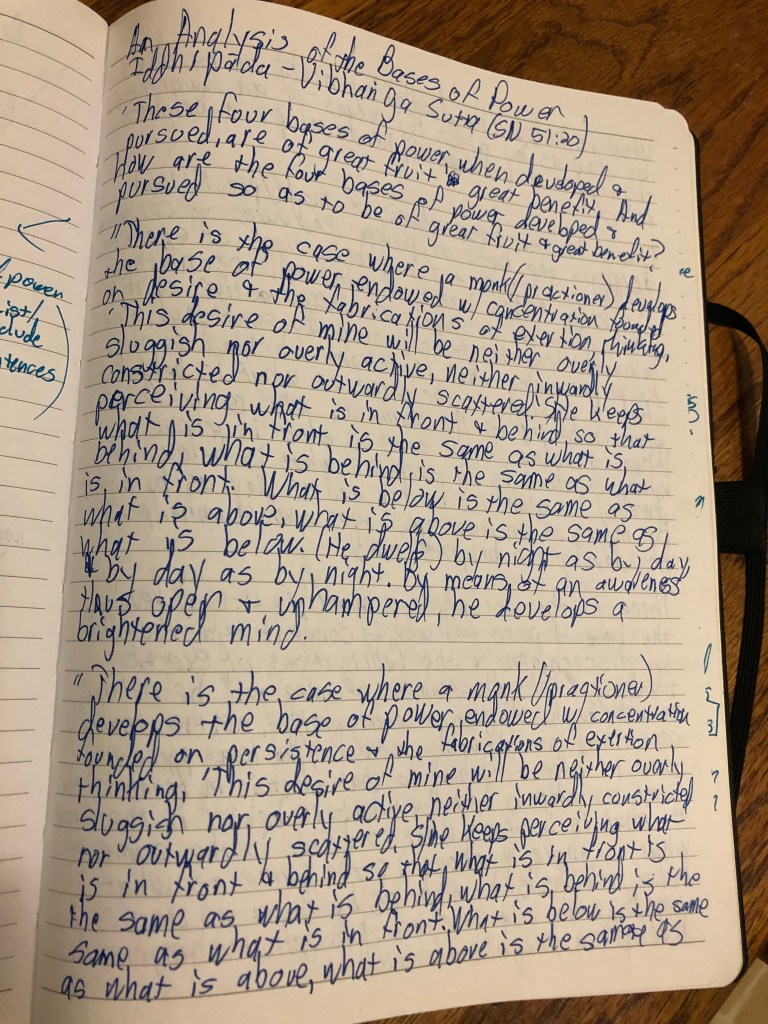


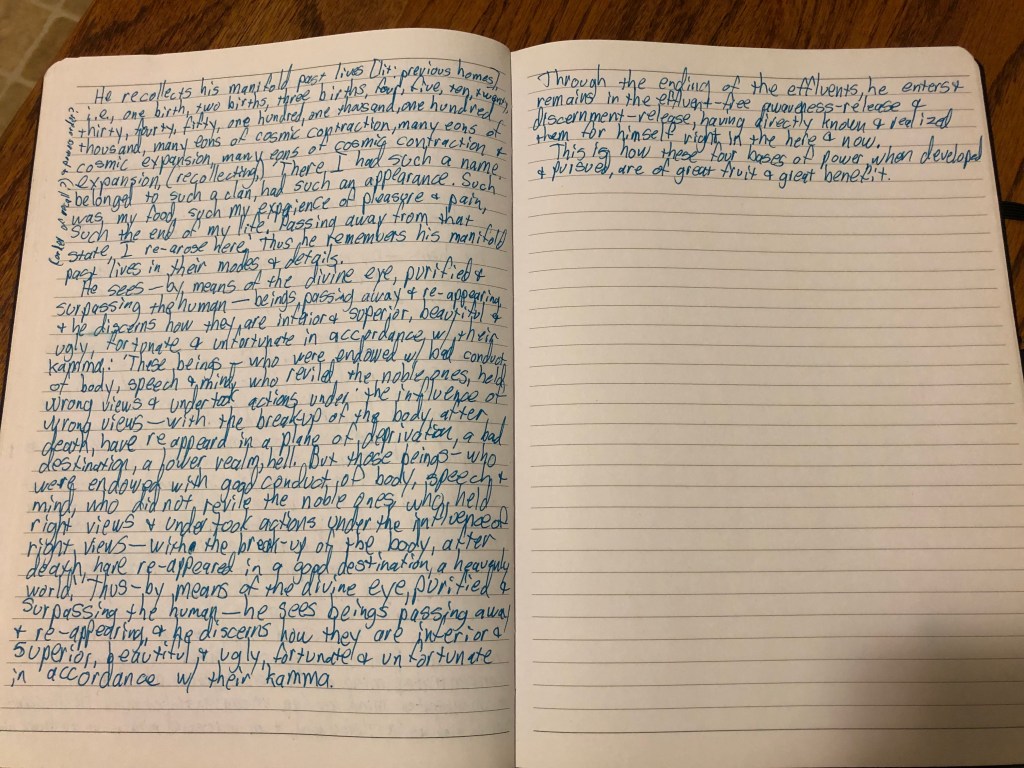
I’ll present this series via seven categories/blog posts/podcasts:
- This introduction; the key encapsulation/encoding/summary paragraph of the whole sutta which includes and weaves in the four powers; and a reading of one of two translations for the sutta
- Unpacking of the hindrances and the other of two translations for the sutta
- (Type of) situational awareness
- 32 parts of the body
- Perceptions of night, daytime and light
- “Psychic Powers,” practice combinations and miscellany
- Summary, findings, observations and comparisons
Given a current innerstanding one can basically approach this sutta as training, development, cultivation and use of the four Iddhipāda — desire, persistence, intent and discernment — primarily via:
- the 32 parts of the body (including substances/parts/sections/regions/etc)
- (inhabiting) a type of situational awareness
- (variations of/on) (inverse) perceptions of night and day/light separately and woven together
In more detail, the four Iddhipāda — sometimes translated as bases of psychic power, basis of psychic power, bases of power, base of spiritual power, wings to success, paths of accomplishment, accomplishments, or roads to power — are:
- chanda: desire; enthusiasm; purpose; wish
- viriya: persistence; energy; effort; will
- citta: intent; consciousness; knowing mind; mental development; devoting mind to; heart-mind
- vīmaṃsā: investigation; inquiry; discernment; discrimination; reason; interest; intelligent curiosity; [(perhaps a new contribution, or for chanda:) balanced and helpful enthrallment, fascination]; feedback and fine tuning, adjustment; learn from doing; circumspection

























 Integrating Presence