Better than a thousand useless words is one useful word, hearing which one attains peace.
Better than a thousand useless verses is one useful verse, hearing which one attains peace.
Better than reciting a hundred meaningless verses is the reciting of one verse of Dhamma, hearing which one attains peace.
Though one may conquer a thousand times a thousand men in battle, yet he indeed is the noblest victor who conquers himself.
Self-conquest is far better than the conquest of others. Not even a god, an angel, Mara or Brahma can turn into defeat the victory of a person who is self-subdued and ever restrained in conduct.
When we look at truth — in most any context, including those of spiritually related natures — being forthcoming with credible information takes key significance.
One reason this blog post and podcast series came about could likely be due to my meditation practice becoming stale and now provides an outlet for a somewhat more advanced level where details are dived into. If and when exploring this sutta on your own, it’s recommended to drop the intricate, sometimes tedious language I go into here to the fullest extent possible. It’s important to remember my intent here of placing plenty under a spiritual microscope to merely visit modes of deconstruction and analysis for study and (formal) practice possibilities, not as a general normalized mode of living. And while I go into minute details pertaining to this sutta please keep in mind it’s likely more helpful not to keep considering this sutta in isolation but within the broader context of the Buddha’s (other) teachings.
While I reference some non-Buddhist material most everything in this blog post and podcast episodes are solely my effort to relate considerations, questions, experiences, explorations, suggestions, interpretations and practices involved and associated with this sutta. They are not entirely the same thing as the actual experiences and phenomena that inspired them, only my interpretation of them in language. In other words, our interpretation of experience is not the same thing as experience itself.
A significant portion of this sutta mentions so called “psychic powers” which in today’s postmodern world I observe a polarity of either garnering dismissal, jokes, and relegation to comic book movies in the “scientific” Western world. Or, on the other end, looked upon with fear and trepidation (by detractors), or obsessed about by the power hungry. As long as precepts and ethics are involved it is OK to empower ourselves this way just as the Buddha taught in this sutta, especially since he says, “This is how these four bases of power, when developed & pursued, are of great fruit & great benefit.” Ethics are required before preceding as this material gives zero allowance for (its) ill-use.
For background, I’ve been exposed to some (esoteric) teachings about “psychic powers” but no formal training from a book or teacher. Perhaps a well known reference point in spiritual circles are the Siddhis, which is used interchangeably with the Pali iddhi or rddhi in Sanskrit. These are “material, paranormal, supernatural, or otherwise magical powers, abilities, and attainments that are the products of yogic advancement through sādhanās such as meditation and yoga” mentioned in the Yoga Sutras of Patanjali.
For well over four months I worked with, studied and practiced with this sutta with formal practice consisting of about 80 minutes a day including allotting a/the full 80 minutes to each of the 32 parts within this sutta. Perhaps this could be the equivalent to a month-long retreat or a two week intensive retreat.
Doodle with the four symbols/icons on top representing sun/light; day & night; a space for situational awareness; and a “layered” meditator for the 32 parts of the body
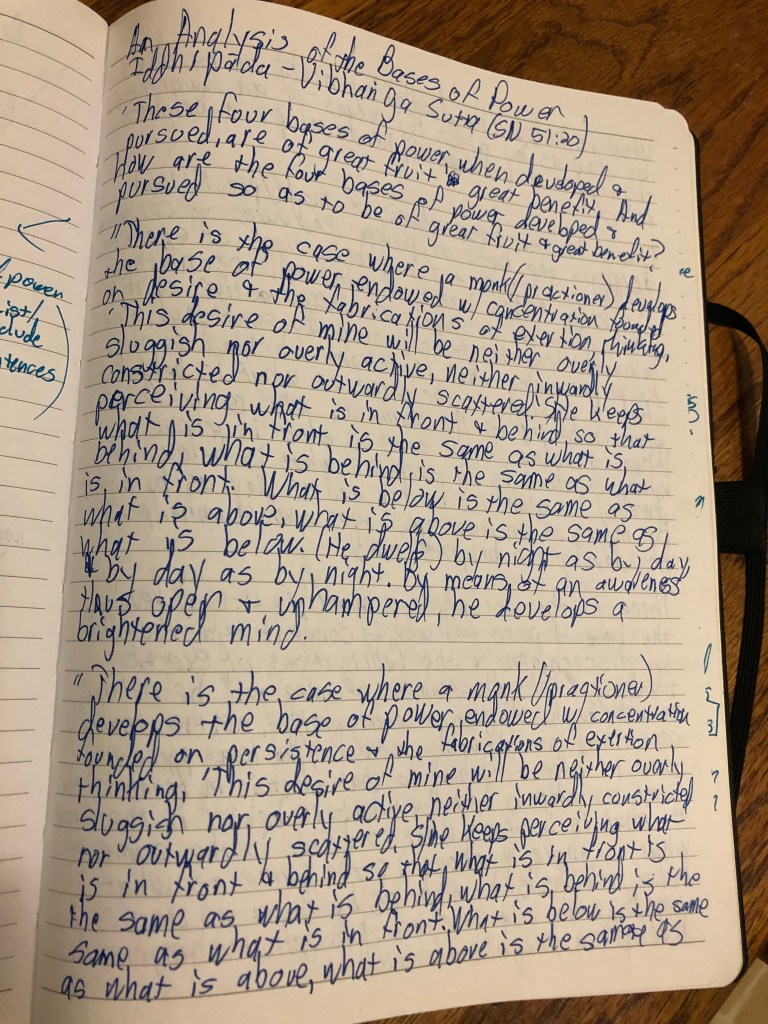
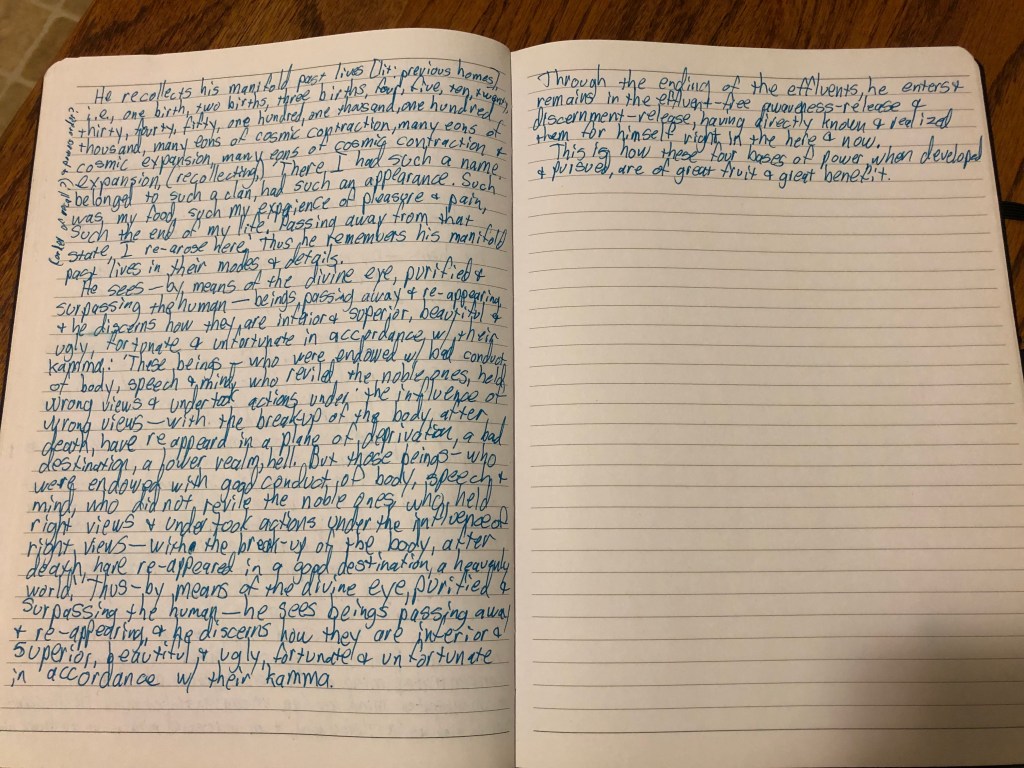
Some of the more esoteric insights, correlations and comparisons came upon the first read, but the nitty gritty details came piecemeal day after day, session after session. I even did a doodle to encapsulate some of the practice approaches and wrote down one translation of the entire sutta long hand, expanding it out by adding the redundant standard textual omissions in the text(s) included here.
I’ll present this series via seven categories/blog posts/podcasts:
Given a current innerstanding one can basically approach this sutta as training, development, cultivation and use of the four Iddhipāda — desire, persistence, intent and discernment — primarily via:
In more detail, the four Iddhipāda — sometimes translated as bases of psychic power, basis of psychic power, bases of power, base of spiritual power, wings to success, paths of accomplishment, accomplishments, or roads to power — are:
vīmaṃsā: investigation; inquiry; discernment; discrimination; reason; interest; intelligent curiosity; [(perhaps a new contribution, or for chanda:) balanced and helpful enthrallment, fascination]; feedback and fine tuning, adjustment; learn from doing; circumspection
Anjellea Godwin is an Elemental Intuitive Advisor who ‘gives information and insight into the hidden Essence of your Soul’s Blueprint, your true inner nature. She works with the elements of your nature (fire, soil, metal, water and wood) including her intuitive claircognizant ability and numerology and other modalities to give you clear and precise information to your current situation. To give you support so you discover and reveal the gifts you came into this world with, including the challenges so you know your weaknesses in order to identify how you can improve in those areas in order to apply the strengths in the most effective way. . .’
We chat about:
Anjellea’s grandmother tarot abilities (from personal experience)
her story and journey
living in an ashram
discovering and developing claircognizance
the benefits of the five elements system with a brief example reading that sheds light on the larger system as well as Anjellea’s own approach which includes the 10 bodies and Tantric numerology
Some of Anjellea’s work, offerings and services — including much beyond what’s mentioned here — can be found at: https://elementalintuitiveadvisor.com
For 15 minutes or so I invite discussion on forgiveness in general; from experience; as an ideal; as consideration; phrases for three-pronged forgiveness practice: 1) forgiving another/others 2) asking for forgiveness 3) forgiving self; not condoning actions; and next level front-loading forgiveness
A variation of pre-show notes:
religious or non-religious
not weakness, submission, failure, loss, blame
ideally many would like to but can’t, not sincere, not ready, exploring, etc so allow non-forgiveness
Andrea Fella: thousands of miles apart and being angry and begrudging likely didn’t affect other person
anger like tossing a hot coal to burn another
not accepting anger like not accepting a gift — it goes back, or belongs to the giver
pain in my heart and behind heart in meditation
picking up trash
Three-way forgiveness phrase:
To those I may have caused harm knowingly or unknowingly through my thoughts, words or actions I ask you to consider forgiving me.
To those who may have caused me harm knowingly or unknowingly through their thoughts, words or actions I freely offer my forgiveness as best as I am able at this time.
And for any harm I may have caused myself knowingly or unknowingly through my thoughts, my words, my actions I offer my forgiveness; I forgive myself as best I can at this time.
This brief Wisdom app talk on March 3rd looks at the psychology of apologies, especially pertaining to those in Customer Service followed by a call-in chat with Malcolm who relates first hand experience working in this field.
My edited notes:
wondered why I felt off when apologized to by many Customer Service representatives so I investigated
not addressing apologies amongst friends
not saying Customer Service reps shouldn’t apologize either
based on perceiving an issue
reflexive, push button, surface level reaction
contains one (another) to surface level
distances one emotionally
psychological tactic of gauging emotional response to apology
on upside it forces a moment of a type of mindfulness
how then is such knowledge used? To get the upper-hand emotionally? If so, how?
inverted cover for Schadenfreude for some
why do some say one thing, mean another, then do something entirely differently?
response of impotency or perceived impotency — sometimes neither one can (or wants) to take action, or can do anything, or concludes the other party can’t do anything
can be a groundless conclusion of limitation
on the upside, it’s an opportunity to acknowledge and appreciate ourselves as frustration is often a prompting for this
Possible response:
Apologize for their apology:
I’m sorry that you’re sorry
I apologize for your apology
Audio: The Psychology of Customer Service Apologies
finding, making and holding dear spiritual friends (or those aligned and supportive on your path/journey)
selecting teachers one resonates with and benefits from
There’s a saying that when you’re ready the teacher will appear. And when you’re really ready the teacher will disappear. For me, especially when starting out — and after getting past the baggage of unhelpful perceptions about many run of the mill school teachers — it sometimes seems like I still come across teachers by happenstance, but more likely it’s due to conditions and cause and effect. More so currently, teachers often seem to appear via synchronicity and similar mutual alignments.
Most of my formal meditation and spiritual teachers since I started out in 2012 are via online only (as of now). And just like most stuff online there’s a deluge of information silos to sift through to get to the good stuff, if one approaches finding teachers like most things online.
I then spent several years after starting out binge consuming podcasts and YouTube, often with each info dense episode leading to all kinds of other stuff and thus an exponential continuation of material to search out, consume, make connections, research, discern, etc. It’s important to exercise the saving grace of regular reminders about information overload.
During this phase I also found it very helpful to pause in the middle of something, walk away, and briefly assess — via thought, gut and intuition — if listening to the entire podcast or video would be worth the time (especially for the longer ones). Starting off, one’s inner guidance may likely be rusty and not nearly as trustworthy as it later becomes once developed.
For many, the popular, more mainstream teachers can serve as reference points for other teachers, and for wading through, sorting and roughly labeling vast amounts of material and teachings. This approach often supports discussions with friends and (potential) teachers.
While spiritual guru culture likely peaked in the 60s and 70s it can still be interesting to observe remaining gurus, their devotees, followers, cultures and lifestyles. For me, in general, teachers worth their salt will likely encourage moving on once they no longer help serve, expand, grow and assist one at the rate and amount to make it worth one’s time. Celebration is actually in order for such outgrowing and lack of clinging.
Other odds and ends of teacher vetting include:
Do their teachings and path(work) include the heart? If not, it would be very challenging for me to recommend them
How open and encouraging are they to questions and feedback?
Who are their own teachers, past and current?
Especially for those discovered without reference, is there somehow an immediate recognition of the teacher as important and worthwhile? Do their general teachings seem to speak directly to one’s path/journey?
There is the three fold training of sila (ethics), samadhi (meditation) and paññā (wisdom) but there is also this from from pages 662-3 in Chapter 7 Awakened Beings of the book Buddhadhamma:
. . . Physical cultivation (kāya-bhāvanā): physical development; to develop one’s relationship to surrounding material things (includ- ing technology) or to the body itself. In particular, to cognize things by way of the five faculties (eye, ear, nose, tongue, and body) skil- fully, by relating to them in a way that is beneficial, does not cause harm, increases wholesome qualities, and dispels unwholesome qualities.
Physical mastery (bhāvita-kāya): this refers to those who have developed the body, that is, they have developed a relationship to their physical environment and to their physical bodies; they have a healthy, contented, and respectful relationship to things and to nature; in particular, they experience things by way of the five senses, say by seeing or hearing, mindfully and in a way that fosters wisdom. They consume things with moderation, deriving their true benefit and value. They are not obsessed or led astray by the influence of preferences and aversions. They are not heedless; rather than allowing sense stimuli to cause harm, they use them for benefit; rather than being dominated by unwholesome states of mind, these individuals nurture wholesome states. . .
Eventually, formal teachers may be needed less and less, and nearly everything and everyone we encounter can, in a certain light, be a teacher or tester.
Allow the hide-and-seek(-like) nature of remembering breath awareness to teach and guide
Sangha, criticism, the two truths, service to others, emptiness, generosity, conduct, non-clinging, non-harming, energy, the three unwholesome roots, and clarity round out the main topics for February 2022, month six of “The Pāramitā Challenge”. See also Months 1-3, Month 4 and 5.
Instructions are to journal contemplations resulting from observed intentions, opportunities, and actions to be generous, moral and ethical while arousing faith in the Triple Gem then seeing where/when confident and where/when in doubt.
Again, I’ve not taken Bodhisattva vows, and so with little instruction in Mahāyāna Buddhism, apart from maybe a smidgen of the zen stuff, there’s the benefit of beginner’s mind is a nice way to put it. I continue to shoot from the hip in this recording and will use a Theravada lens now and again plus plenty of inquiry as I ponder out loud. It may come off at times as criticism, and sometimes it may actually be, but these are mostly solo efforts at summonings what is really meant by the material.
Only a couple notes this month. For the first portion of “don’t discuss the faults of the Sangha” I failed to mention in Theravada, as far as my current innerstanding, the monastic training rules of the Vinaya were mostly established by the historical Buddha during his time and often prompted by certain incidents. Also, I did not receive February’s Challenge until after I checked back on February 17th after initially asking a friend toward the beginning of the month who help spur it along I guess. So with travel in late January, another trip in early February, and more or less being forced to move by the end of February (not worth mentioning here) this month is recorded all in one go.
On the upside, I was told the entire material for the challenge, up to this point is public and (now) at https://maba-usa.org/paramita-challenge. And if I were to guess, there’s plans for it to continue to be retrievable online, but it seems like much of this challenge has been just getting/having access to it. I trust social distancing only goes as far as some occasions in real life and doesn’t continue online, if a “bad” joke here is allowed.
Fellow Insight TimerteacherLydiaGrace inspired the title of this month’s regular open-audience, open-discussion “Ask Us Anything” — continuing discussions about meditation and related topics.
Recently on Lydia’s Insight Timer circle Embodied Living she said of one of her solo live events, “…you didn’t actually miss the live because I got on briefly to say I couldn’t do it today due to a migraine and needing to rest.” This is how to Show Up even when one can’t. Lydia’s nuanced and expansive healing BodyTalk technique helps us Listen Up beyond our day-to-day attentiveness. And both Lydia and I are now no strangers on how to Speak Up even if we would rather not interrupt each other but continue doing so. We aim to inspire those with interest in more publicly — or even just more boldly — sharing what one feels called to share with kindness, integrity, authenticity and alignment.
Show upListen upSpeak up
Doing full show notes seems to take (me) a lot of time and energy so I may or may not include full notes later. I welcome any inspired listener(s) to take and send show notes for inclusion here by emailing them to integratingpresence[attt]protonmail.com
Audio: Show Up. Listen Up. Speak Up. | (2/22/2022 — “Ask Us Anything – LIVE” With Lydia Grace)





























 Integrating Presence