Practicing in the Desire Realm | (5/25/2021 — “Ask Us Anything – LIVE” With Denny K Miu)

For this month’s regular open-audience, open-discussion “Ask Us Anything” — continuing discussions about meditation and related topics — (despite some technical snafus) Denny and I pick one topic each we’ve yet to discuss much publicly — the Eight “Touches”, and wholesome sexuality(/sexual energy), respectively. (Amended) show notes are as follows:

(From Josh):

What is Kusala (Wholesome) Sexual Energy?

  • Five Training Precepts are about refraining from — as in refraining from misusing sexual energy by avoiding breaking up relationships and sexual activity only in committed relationships
  • So what’s the opposite positive version? Skillful and appropriate relational energy [6/8/2021 UPDATE: Equating relational energy and sexual energy may be my (mis)interpretation from hearing Ajahn Sucitto. I’m still re-listening to several talks for more references. Plan to post more clarification here if found]
  • Most anything of sexual nature is taboo in the West for both skillful and wise reasons as well as unskillful and unwise reasons
  • Cognitive dissonance of hyper-sexualization promoted in mass media and culture but along with #MeToo, sexual repression, dress codes, “princess code/programing“, “toxic masculinity”, emasculation, gender confusion, using sex to gain power, and “battle of the sexes”

Denny mentions Miller’s planet, a water planet from the film Interstellar

(From Denny):

Five stages of mind practice

  1. Knowing
  2. Quieting
  3. Contemplating
  4. Deconstructing
  5. Emancipating

Eight “Touches”

  1. Movement (動) : interaction of all four elements, earth, water, fire and wind causing either regular or irregular movement or gyration of body
  2. Itchiness (癢)
  3. Cold or Coolness (冷)
  4. Hot or Warm (暖)
  5. Weightlessness (輕) : exaggeration of the wind element, body feels light, like cloud or dust, as if flying
  6. Heaviness (重)
  7. Smoothness (滑) : body feels smooth as butter or milk, can sense bright light
  8. Roughness (澀) : body feels rough, like sandpaper

Josh mentions similarities of Eight “Touches” to Four-Elements Meditation as taught by Venerable Pa-Auk Sayadaw. See page 114 on PDF of Knowing and Seeing and Mindfulness of Breathing & Four Elements Meditation [PDF]


“Tapussa the householder, here, has said to me, ‘Venerable Ananda, sir, we are householders who indulge in sensuality, delight in sensuality, enjoy sensuality, rejoice in sensuality. For us—indulging in sensuality, delighting in sensuality, enjoying sensuality, rejoicing in sensuality—renunciation seems like a sheer drop-off. Yet I’ve heard that in this doctrine & discipline the hearts of the very young monks leap up at renunciation, grow confident, steadfast, & firm, seeing it as peace. So right here is where this doctrine & discipline is contrary to the great mass of people: i.e., [this issue of] renunciation.’”

“So it is, Ananda. So it is. Even I myself, before my Awakening, when I was still an unawakened Bodhisatta, thought: ‘Renunciation is good. Seclusion is good.’ But my heart didn’t leap up at renunciation, didn’t grow confident, steadfast, or firm, seeing it as peace. The thought occurred to me: ‘What is the cause, what is the reason, why my heart doesn’t leap up at renunciation, doesn’t grow confident, steadfast, or firm, seeing it as peace?’ Then the thought occurred to me: ‘I haven’t seen the drawback of sensual pleasures; I haven’t pursued [that theme]. I haven’t understood the reward of renunciation; I haven’t familiarized myself with it. That’s why my heart doesn’t leap up at renunciation, doesn’t grow confident, steadfast, or firm, seeing it as peace.’

[1] “Then the thought occurred to me: ‘If, having seen the drawback of sensual pleasures, I were to pursue that theme; and if, having understood the reward of renunciation, I were to familiarize myself with it, there’s the possibility that my heart would leap up at renunciation, grow confident, steadfast, & firm, seeing it as peace.’

“So at a later time, having seen the drawback of sensual pleasures, I pursued that theme; having understood the reward of renunciation, I familiarized myself with it. My heart leaped up at renunciation, grew confident, steadfast, & firm, seeing it as peace. Then, quite withdrawn from sensuality, withdrawn from unskillful qualities, I entered & remained in the first jhana: rapture & pleasure born from withdrawal, accompanied by directed thought & evaluation.

“As I remained there, I was beset with attention to perceptions dealing with sensuality. That was an affliction for me. Just as pain arises as an affliction for a healthy person, even so the attention to perceptions dealing with sensuality that beset me was an affliction for me.

[2] “The thought occurred to me: ‘What if, with the stilling of directed thoughts & evaluations, I were to enter & remain in the second jhana: rapture & pleasure born of composure, unification of awareness free from directed thought & evaluation—internal assurance.’ But my heart didn’t leap up at being without directed thought, didn’t grow confident, steadfast, or firm, seeing it as peace. The thought occurred to me: ‘What is the cause, what is the reason, why my heart doesn’t leap up at being without directed thought, doesn’t grow confident, steadfast, or firm, seeing it as peace?’ Then the thought occurred to me: ‘I haven’t seen the drawback of directed thought; I haven’t pursued that theme. I haven’t understood the reward of being without directed thought; I haven’t familiarized myself with it. That’s why my heart doesn’t leap up at being without directed thought, doesn’t grow confident, steadfast, or firm, seeing it as peace.’

Selection from:
Aṅguttara Nikāya
Book of the Nines
9.41. To Tapussa

Many people shaken by fear go for refuge to mountains and woods,
to places with beautiful trees.
That is not a secure refuge,
that is not the refuge supreme,
nor is it the refuge to come to that liberates from all suffering.

Whoever has gone for refuge to the Buddha,
the Dhamma and the Saṅgha,
and who sees as it really is the four noble truths.
That is a secure refuge,
that is the refuge supreme,
that is the refuge to come to that liberates from all suffering.

Śaraṇavagga — Bhikkhu Ānandajoti
Patna Dhammapada
13. The Chapter about Refuge

Audio only version — Practicing in the Desire Realm | (5/25/2021 — AUA Live | Joshua Dippold and Denny K Miu)

Or listen via Insight Timer (app or website)


Currently, for a chance to experience, practice, and receive Yi Jin Jing instructions from Denny plus more mindful exercise join in free on Saturdays:


Continue reading “Practicing in the Desire Realm | (5/25/2021 — “Ask Us Anything – LIVE” With Denny K Miu)”

Dharma Questions: Miscellany — Part 3

This irregular “Dharma Questions” series deals with “dharma” meaning both the truth of the nature of reality and some Buddhist teachings. Please see this post on the intensions for questioning and not questioning. Amongst other things these questions can be, but not necessarily:

  • thought experiments
  • borderline musings not meant to be answered
  • from laziness of not contemplating or researching them yet

  1. If all compounded things are not self, how and why is there a sense of agency? And how and why does our experience seem to be associated with body?
  2. Are there intents of/behind/to samsara? If not, why not? If so, how do these intents operate and how are they established, maintained and abolished?
  3. How do sankhārā [formations/mental formations/volitional formations] come from ignorance? What is the process?
  4. What would be the pros and cons of allowing A.I. translations of Buddhist texts/scriptures — for texts already translated and yet to be translated?
  5. Does the Pali cannon have anyone explicitly asking along the lines of, “how did you become a Buddha?” and/or “can I become a Buddha too? If so, how can I become a Buddha?”
  6. If consciousness does not arise [in the process of dependent origination — for example, during dreamless, unconscious sleep] do the links following consciousness cease (temporarily)? If so, without the six sense base consciousnesses (active), can mindfulness of breathing be known (without body-consciousness, sound-consciousnesses, etc)? If not, how can consciousness be optimized for (more continuous) mindfulness of breathing?
  7. Do alternatives to reality exist besides samsara/nirvana (here or elsewhere)? If not, why not and how is it known?
  8. Why are the aggregates five in number? Why aren’t two or more unified/combined? Why not just energy and consciousness as the first four — form, feeling, perception, formations/fabrications — are energy/energetic?
  9. How does Buddhism square with divinity? [No mention of an ultimate creator god/being with a set beginning — only that the Buddha could detect no discernible beginning or end to births/deaths/rebirths. But there’s also mention of the “divine eye”]
  10. Would there ever be incentive (both inside and outside Mahayana) to prevent (certain individual) beings from reaching full enlightenment? Why or why not? If so, how?
  11. Does/would the 100th monkey effect apply to saving/liberating/emancipating/awakening beings? Why or why not?
  12. What happened to the other early Buddhist schools besides Theravada?
  13. How does effort for vitakka wax & wane? How does vitakka turn into, or allow, or go along with vicāra?
  14. What are the root conditions of 1) mindfulness 2) any and all opposites of mindfulness 3) the fluctuations between these? What exactly is attending mindfully and how is this done? What is knowing?
  15. Could taṇhā also be interpreted as: unaware denial and lack of acknowledgment of how things actually are?
  16. There’s seems to be a partial sense of a certain amount of agency and non-agency in experience. How does this work? Why do some beings appear to exercise greater agency than others (within similar conditions)?
  17. To what extent can karma be investigated and studied without the danger of becoming insane by engaging in this imponderable?
  18. Are each of the eight factors of the noble eight fold path ultimately impermanent, unsatisfactory and not-self?
  19. How did the deva who told Bāhiya he wasn’t anywhere near enlightenment know this? How did both the deva and Bāhiya know/find the location of the Buddha?

“Now, what is the food for the arising of unarisen mindfulness as a factor for awakening, or for the growth & increase of mindfulness as a factor for awakening once it has arisen? There are mental qualities that act as a foothold for mindfulness as a factor for awakening [well-purified virtue & views made straight]. To foster appropriate attention to them: This is the food for the arising of unarisen mindfulness as a factor for awakening, or for the growth & increase of mindfulness as a factor for awakening once it has arisen.

Food (for the Factors for awakening)
Āhāra Sutta  (SN 46:51)

Resources for Abhidhamma — Advanced Buddhist Thought, Inquiry, Analysis and Psychology

Abdhidhamma and Development of Buddhist Thought

Disclaimer: I cannot vouch for the accuracy, usefulness and effectiveness of the resources here so what follows is for informational purposes. Please use your own discernment and consult the wise and teachers with questions, how to proceed, etc (if need be)

After auditing the now public Abdhidhamma and Development of Buddhist Thought, part of Mid-America Buddhist Association’s Diploma in Pali and Buddhist Studies (DPBS) I was inspired to create this post. (If interested in checking out ongoing classes at MABA, please email to request free auditing, or please enroll).

Here’s some Abhidhamma resources, some of which were mentioned in class:


1. What is “Abhidhamma”? via https://www.youtube.com/@Acharineehttps://www.youtube.com/watch?v=eYEZGEVhhhM

Beth Upton answers some Abhidhamma questions


10 Part Teaching on Theravada Abhidhamma with Bhikkhu Bodhi

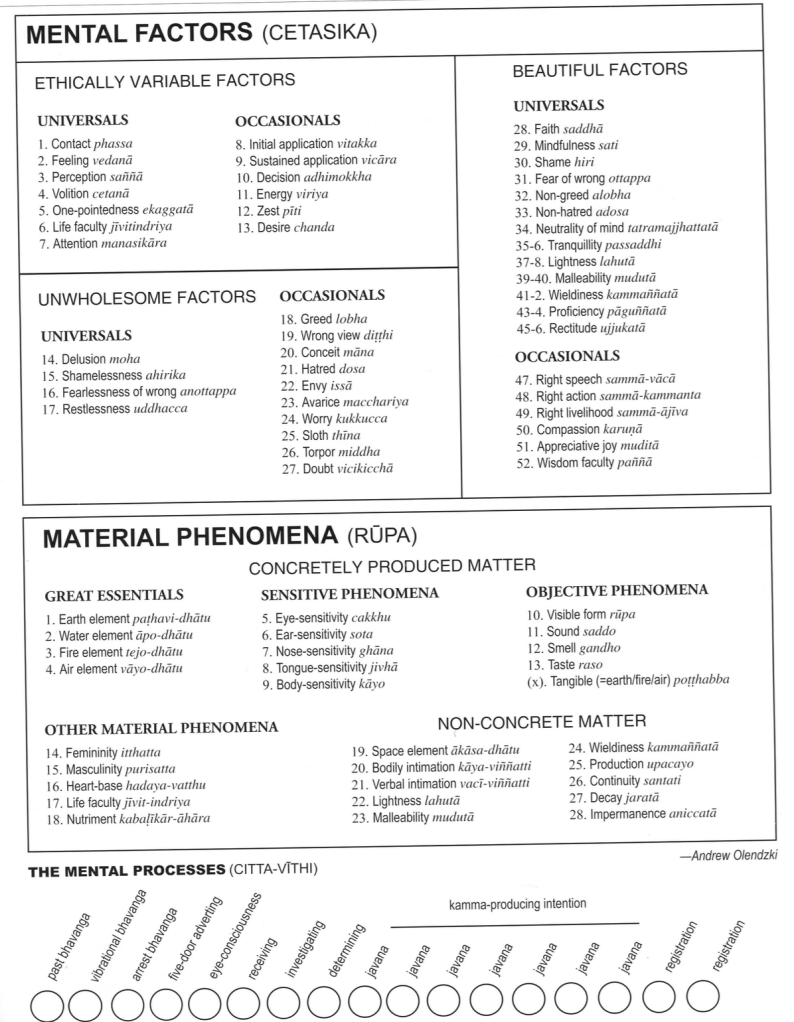
This comprehensive lecture series breaks down the fundamental tenets of Theravada doctrine, heavily grounded in the Abhidhammattha-saṅgaha and Abhidhamma Piṭaka. It covers topics such as Rūpa (matter), Citta (consciousness), Cetasika (mental factors), and ultimate realities (Paramattha Dhamma)
Dhammavinicchaya Series: In-depth Theravada analytical discussions examining specific questions, fine details of Dhamma, and Abhidhamma interpretations.
Path to Paṭisambhidā Lecture Series: Advanced textual and analytical series exploring deep analytical knowledge (Paṭisambhidā) and Abhidhamma principles. Accompanying Handouts & PDFs: https://drive.google.com/drive/folders/147PwZJHa7kuzU8Ra5mwHwsgHkqUCCn3i


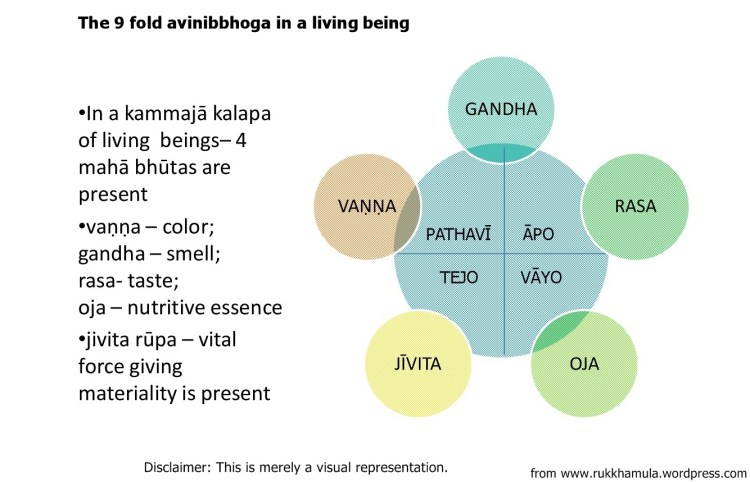
via https://rukkhamula.wordpress.com/add-ons/abhidhamma-add-ons/a-pictorial-representation-of-rupa-kalapas-for-visual-learners/
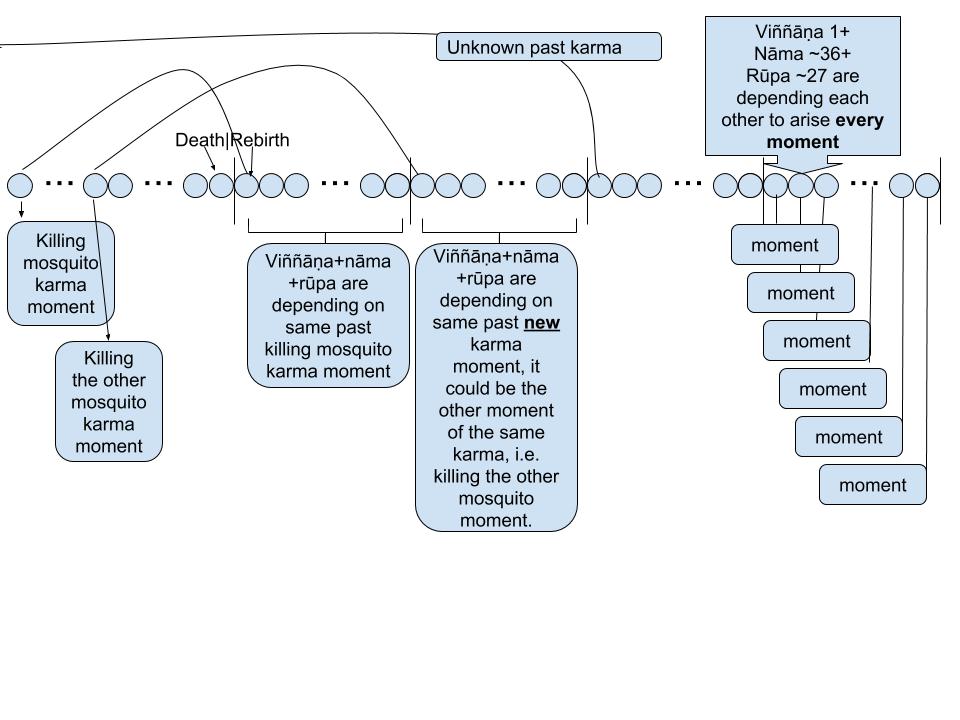
via https://buddhism.stackexchange.com/questions/31157/does-vi%C3%B1%C3%B1%C4%81%E1%B9%87a-generate-n%C4%81mar%C5%ABpa-in-the-sense-that-would-make-uploading-concsciou

I feel what’s below both relevant to include in this blog post and that it ought to be somewhat apparent by the answer why we still need seasoned Abhidhamma practitioners and even Dhamma teachers in general if going by ChatGPT‘s answer to “What are some of the most contested Abhidhamma questions?”:

As an AI language model, I do not have personal opinions or beliefs. However, some of the most contested Abhidhamma questions among scholars and practitioners include:

  1. The nature of consciousness: Whether consciousness is a momentary process or a continuous stream.
  2. The concept of self: Whether there is a permanent self or soul that exists beyond the aggregates.
  3. The role of karma: Whether karma is deterministic or whether it allows for free will.
  4. The nature of nibbana: Whether nibbana is a state of cessation or an ultimate reality.
  5. The relationship between mind and matter: Whether mind and matter are separate entities or whether they are interdependent.
  6. The role of meditation: Whether meditation is necessary for attaining enlightenment or whether it is just a tool for developing concentration and mindfulness.
  7. The concept of rebirth: Whether rebirth is literal or metaphorical, and how it relates to the concept of karma.

These are just a few examples, as there are many other questions and debates within Abhidhamma studies.

Irregular Inquires — Questions For Regular Contemplation: Ethics

  • If I’m doing ______ what would the world look like if everyone was doing this?
  • If I _______ will it lead to (more) harm or non-harm? How will harm or not harm and why?
  • If I don’t _______ will it lead to more harm or non-harm? How and why?

“Whenever you want to do [while you are doing, and having done] a bodily action [verbal action, mental action], you should reflect on it: ‘This bodily action [verbal action, mental action], I want to do [are doing, and have done] — would it [is it, was it] lead to self-affliction, to the affliction of others, or to both? Would it be [is it, was it] an unskillful bodily action, [verbal action, mental action] with painful consequences, painful results?’ If, on reflection, you know that it would lead [is leading, has lead] to self-affliction, to the affliction of others, or to both; it would be an unskillful bodily action [verbal action, mental action] with painful consequences, painful results, then any bodily action [verbal action, mental action] of that sort is absolutely unfit for you to do. But if on reflection you know that it would not cause self-affliction, to the affliction of others, or to both; it would be a skillful bodily action [verbal action, mental action] with pleasant consequences, pleasant results, then any bodily action [verbal action, mental action] of that sort is fit for you to do.”

Ambalatthika-rahulovada Sutta: Instructions to Rahula at Mango Stone (with my edits/additions in brackets in order to condense the text)

  • If the whole universe is within, what is going on internally that leads to the perception of an external ill and/or external wholeness?

. . . it is just within this fathom-long body, with its perception & intellect, that I declare that there is the cosmos, the origination of the cosmos, the cessation of the cosmos, and the path of practice leading to the cessation of the cosmos.

selection from the Rohitassa Sutta: To Rohitassa

I, Kulla, went to a charnel ground
and saw a woman’s body abandoned there,
discarded in a cemetery,
full of worms that devoured.

“See this bag of bones, Kulla—
diseased, filthy, rotten,
oozing and trickling,
a fool’s delight.”

Taking the teaching as a mirror
for realizing knowledge and vision,
I examined this body,
hollow, inside and out.

As this is, so is that;
as that is, so is this.
As below, so above;
as above, so below.

As by day, so by night;
as by night, so by day.
As before, so after;
as after, so before.

Even the music of a five-piece band
can never give such pleasure
as when, with unified mind,
you rightly discern the Dhamma.

Verses of the Senior Monks
The Book of the Sixes
Chapter One
6.4. Kulla

Sāriputta
With what kinds of conduct and morality,
growing in what sorts of karmas,
will a person well-established be
for attainment of the highest goal?

Buddha
Let that one be an honourer of elders, never envious,
a knower of the right time for the teacher seeing,
and when Dharma’s being taught, a knower of that time
to listen precisely to those well-spoken words.

And at the right time go to the teacher’s presence
in an unassuming way, discarding obstinacy,
with restraint and recollection of the way to practise,
remembering the Dharma for the life of purity.

Dwelling in the Dharma, delighted in Dharma,
in Dharma established, and skilled in deciding Dharma,
never uttering words to the Dharma’s detriment,
Let such a one be guided by well-spoken truths.

Disputatiousness, gossip, complaints and ill-will,
deception, hypocrisy, longing and pride,
aggressiveness, harshness, defilements-attached,
fare abandoning these, pride-free, of steady mind.

Understanding’s the essence of well-spoken words,
while that and the learnt is the essence of calmness;
but wisdom and learning in one do not grow—
that person who’s hasty and negligent both.

Delighting in Dharma by Noble Ones taught,
their mind, speech and body all unsurpassed—
in gentleness, peace, meditative-states firm,
attained to the essence of wisdom and learning.

Sutta Nipāta
Kiṁsīla Sutta
2.9. What is Good Conduct?

Types Of Samadhi (From Early Buddhist Texts)

“Monks, these are the four developments of concentration. Which four? There is the development of concentration that, when developed & pursued, leads to a pleasant abiding in the here & now. There is the development of concentration that, when developed & pursued, leads to the attainment of knowledge & vision. There is the development of concentration that, when developed & pursued, leads to mindfulness & alertness. There is the development of concentration that, when developed & pursued, leads to the ending of the effluents.

Selection from: Concentration
Samādhi Sutta  (AN 4:41)

Here and there I’ve come across different types — or names of — various versions of Samadhi while consuming material where such things crop up. Such flavors of Samadhi usually seem to be in Sanskrit or Pali, and because of the tricky spelling (at least for me) sometimes a (duckduckgo.com) search turns them up, sometimes not.

And after coming up empty-handed searching for a Samadhi list, I turned to Buddhism Stack Exchange where a fella ‘did an in depth research going through a digital search of the pali suttas and compiling a comprehensive list of every type of usage of Samādhi: broad umbrella term in every type of usage in EBT [Early Buddhist Texts].’

The following is a sampling of his compilation:

  • sammā-samādhi
  • Ānā-pānas-sati-samādhi
  • a-nimitta ceto-samādhi — sign-less mind’s-undistractable-lucidity
  • ap-paṇihito samādhi, ap-paṇidhāya bhāvanā — un-directed samadhi
  • Ariyassa pañc-aṅgikassa sammā-samādhissa — 5 factors = 4 jhānas + reflection-nimitta + 5 similes
  • ariyo sammā-samādhi sa-upaniso itipi sa-parikkhāro itipī — noble right concentration 7 factored
  • a-vitakko a-vicāro samādhi
  • a-vitakko vicāra-matto samādhi
  • samādhi-bala — one of 5 bala)
  • samādhi-bhāvanā
  • samādhi-sambojjhanga
  • samādhi-khandha
  • samādhi-nimittā
  • paṇihito samādhi, paṇidhāya bhāvanā — directed samadhi
  • samādhi-parikkhārā — requisites, equipment, indispensables
  • sa-vitakko sa-vicāro samādhi
  • suññato samādhi — emptiness samadhi

Would love to see someone take this even further by including Sanskrit, Chinese, etc. sources.

[6/4/2021 UPDATE] Starting a running list of other samadhi names:


Here’s a (copy and pasted) portion of the aforementioned work:

4👑☸ Cattāri Ariya-saccaṃ 四聖諦

4👑☸ → ☂️ Samādhi (in broadest sense)8🌄 🔝

☂️ Samādhi (in broadest sense)

Continue reading “Types Of Samadhi (From Early Buddhist Texts)”

An Integrating Presence Meditation at Fat Cat Longevity Wednesday May 5, 2021

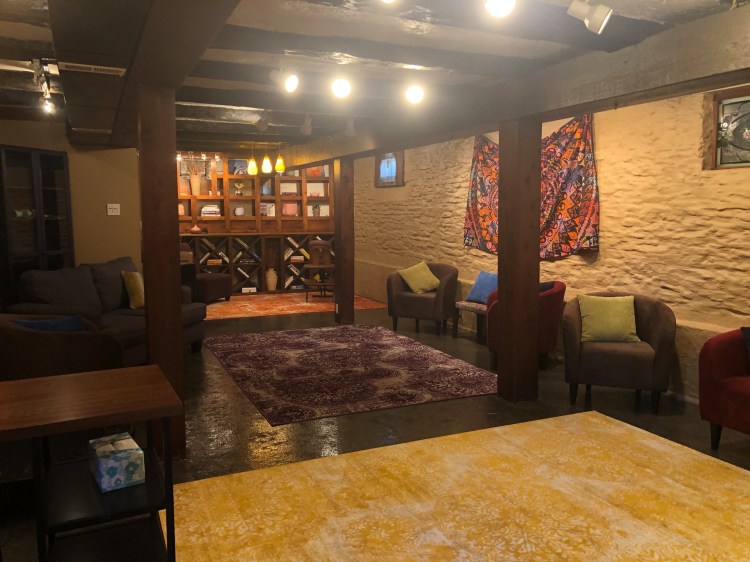
Join meditation 7:00-7:45pm Wednesday, May 5th at Fat Cat Longevity [https://facebook.com/freyflow] downstairs next to Peace Love Coffee at Mary’s House of Healing, on Main St in St Charles, MO.

We plan to start with brief instructions along with a discussion before and after.

Our semi-formal meditation possibilities include a combination of:

  • compassion and loving-kindness
  • (open) awareness
  • 5 simple qigong breathing exercises
  • mindfulness [1) body 2) heart-mind: thoughts, emotions, moods, mind states 3) relationship to our experience]

Mary’s House of Healing
524 South Main Street
Downstairs at Fat Cat Longevity next to Peace Love Coffee…
St. Charles, MO 6330

May 5, 2021 — 7:00pm – 7:45pm

Doors open: 6:50pm — Doors close: 7:05pm

Cost: Fat Cat Longevity price packagesmonthly membership or generosity inspired donation

Mindful Practice Of Body, Qi And Mind – 1st Annual Review | (4/27/2021 — “Ask Us Anything – LIVE” With Denny K Miu)

For this month’s regular open-audience, open-discussion “Ask Us Anything” — continuing discussions about meditation and related topics — Denny and I review the 63 consecutive weeks of online practice Denny continues to lead. The original (amended) show notes are as follows:

(From Josh):

(Depending on temperament and experience level, some may find this chat tedious, overwrought, boring, too specific; or fascinating, affirming, inspirational, connective; or even redundant, low level, missing the mark. Please take only what is helpful.)

  • General summary and overview of Denny (and Josh’s) practice(s)
  • Review of Denny teaching pretty much everyday online since Co-V
  • What are any common themes?
  • Goals?
  • What’s been learned?
  • Challenges and rewards?

Practice questions:

  • If I’m remembering correctly, on 4/10/21 Denny mentioned Metta as mindfulness of mind. This is a first for me. Maybe mindfulness of heart, or heart-mind? I would like to hear more details of this. And maybe if Denny feels there is a significant difference between more a more Asian definition of “heart” and “mind” and Western definition of “heart” and “mind?”
  • Why only 3 breath exercises in chair?
  • How does one find energy points on the inside and outside of legs? By noticing what areas are more sore or sensitive than others?
Continue reading “Mindful Practice Of Body, Qi And Mind – 1st Annual Review | (4/27/2021 — “Ask Us Anything – LIVE” With Denny K Miu)”

The Buddha’s Images For The Five Clinging Aggregates

“What is your definition of self,” is often one of the first questions I ask someone once it is clear they are serious about seeking, and/or clear about their spiritual path, or even someone heavily seeped in philosophy.

From what I innerstand, while the historical Buddha never simply denied that there’s a “self” directly and in brief, he gave teachings on anattā or “not-self”. Such teachings often seemingly get at least somewhat misunderstood today.

It is quite beyond my current scope of realization to give a somewhat original teaching or explanation on anattā (although there’s plenty of accessible, clear, helpful and useful material regarding “not-self”.) Nor will I say much about how anattā relates to the five khandhas, or five (clinging) aggregates other than to say, upon deconstruction of answers to the question “what is your definition of self,” these answers often seemingly can break down further into various deconstructions of the five aggregates. For example, if body is said to be self then: am I the body; do I own the body; am I in the body; is the body in me?

Instead, this post simply displays visual representations of what the Buddha likened each of five khandhas to.


Rupa/Form or Body = chunks of foam

“Monks, suppose that a large glob of foam were floating down this Ganges River, and a man with good eyesight were to see it, observe it, & appropriately examine it. To him — seeing it, observing it, & appropriately examining it — it would appear empty, void, without substance: for what substance would there be in a glob of foam? In the same way, a monk sees, observes, & appropriately examines any form that is past, future, or present; internal or external; blatant or subtle; common or sublime; far or near. To him — seeing it, observing it, & appropriately examining it — it would appear empty, void, without substance: for what substance would there be in form?”

— SN 22.95

Vedana/Feeling = water bubbles

“Now suppose that in the autumn — when it’s raining in fat, heavy drops — a water bubble were to appear & disappear on the water, and a man with good eyesight were to see it, observe it, & appropriately examine it. To him — seeing it, observing it, & appropriately examining it — it would appear empty, void, without substance: for what substance would there be in a water bubble? In the same way, a monk sees, observes, & appropriately examines any feeling that is past, future, or present; internal or external; blatant or subtle; common or sublime; far or near. To him — seeing it, observing it, & appropriately examining it — it would appear empty, void, without substance: for what substance would there be in feeling?”

— SN 22.95

Saññā/Perception = mirage

“Now suppose that in the last month of the hot season a mirage were shimmering, and a man with good eyesight were to see it, observe it, & appropriately examine it. To him — seeing it, observing it, & appropriately examining it — it would appear empty, void, without substance: for what substance would there be in a mirage? In the same way, a monk sees, observes, & appropriately examines any perception that is past, future, or present; internal or external; blatant or subtle; common or sublime; far or near. To him — seeing it, observing it, & appropriately examining it — it would appear empty, void, without substance: for what substance would there be in perception?”

— SN 22.95

Saṅkhāra/Fabrications aka formations aka mental formations aka volitional formations = banana tree trunk

Banana tree core

“Now suppose that a man desiring heartwood, in quest of heartwood, seeking heartwood, were to go into a forest carrying a sharp ax. There he would see a large banana tree: straight, young, of enormous height. He would cut it at the root and, having cut it at the root, would chop off the top. Having chopped off the top, he would peel away the outer skin. Peeling away the outer skin, he wouldn’t even find sapwood, to say nothing of heartwood. Then a man with good eyesight would see it, observe it, & appropriately examine it. To him — seeing it, observing it, & appropriately examining it — it would appear empty, void, without substance: for what substance would there be in a banana tree? In the same way, a monk sees, observes, & appropriately examines any fabrications that are past, future, or present; internal or external; blatant or subtle; common or sublime; far or near. To him — seeing them, observing them, & appropriately examining them — they would appear empty, void, without substance: for what substance would there be in fabrications?”

— SN 22.95

Plantains, like bananas, are referred to as trees, but they both are large herbs. The leafy pseudostem at the center of this plant stands in for a woody trunk that is seen on a tree.

Banana plants, with their towering heights, look much like trees, but they are usually called plants and not trees. This is because their “trunks,” which are called pseudostems, are made of leaves that are tightly woven together. Banana plants grow much like palm trees, in that the new leaves twist up through the center of the pseudostem and sprout from the crown of the plant. One banana plant may grow on one pseudostem, or more commonly, on several of them.

https://homeguides.sfgate.com/plantain-trees-62419.html

Viññāna/Consciousness = magic/conjurer’s trick

“Now suppose that a magician or magician’s apprentice were to display a magic trick at a major intersection, and a man with good eyesight were to see it, observe it, & appropriately examine it. To him — seeing it, observing it, & appropriately examining it — it would appear empty, void, without substance: for what substance would there be in a magic trick? In the same way, a monk sees, observes, & appropriately examines any consciousness that is past, future, or present; internal or external; blatant or subtle; common or sublime; far or near. To him — seeing it, observing it, & appropriately examining it — it would appear empty, void, without substance: for what substance would there be in consciousness?”

— SN 22.95

F̶̶̶o̶̶̶r̶̶̶ ̶R̶̶̶e̶̶̶s̶̶̶e̶̶̶a̶̶̶r̶̶̶c̶̶̶h̶̶̶ ̶P̶̶̶u̶̶̶r̶̶̶p̶̶̶o̶̶̶s̶̶̶e̶̶̶s̶̶̶ ̶O̶̶̶n̶̶̶l̶̶̶y̶̶̶:̶̶̶ ̶”̶T̶̶̶r̶̶̶a̶̶̶n̶̶̶s̶̶̶c̶̶̶e̶̶̶n̶̶̶d̶̶̶e̶̶̶n̶̶̶t̶̶̶a̶̶̶l̶̶̶ ̶M̶̶̶e̶̶̶d̶̶̶i̶̶̶a̶̶̶t̶̶̶i̶̶̶o̶̶̶n̶̶̶”̶ ̶M̶̶̶a̶̶̶n̶̶̶t̶̶̶r̶̶̶a̶̶̶ ̶V̶̶̶a̶̶̶r̶̶̶i̶̶̶a̶̶̶t̶̶̶i̶̶̶o̶̶̶n̶̶̶s̶̶̶?̶̶̶

8/30/2022 UPDATE: Please see: https://integratingpresence.com/2022/08/30/cease-and-desist-letter-for-blog-post-referencing-tm-org/

Dharma Questions: Miscellany — Part 2

This irregular “Dharma Questions” series deals with “dharma” meaning both the truth of the nature of reality and some Buddhist teachings. Please see this post on the intensions for questioning and not questioning. Amongst other things these questions can be, but not necessarily:

  • thought experiments
  • borderline musings not meant to be answered
  • from laziness of not contemplating or researching them yet

  1. How does merely maintaining continuous awareness of the meditation object result in the various wondrous benefits from doing so?
  2. Does Citta (heart-mind) exist beyond/outside/apart from the five aggregates? Why or why not?
  3. If practicing open/”choiceless” awareness, what determines how attention becomes fixed on a particular object over another? Could/Does using the term “choiceless” affect the decision making process and choosing (– perhaps seeding into the mind that choosing could mostly be a random process with little to no agency involved/possible)? Why or why not?
  4. Could aversion be (used for) a (type of) shortcut — albeit an unwholesome one — to non-relishing, or non-delight, mentioned in Mulapariyaya Sutta: The Root Sequence? Do some ascetic practices aid in realizing non-delight, non-relishing?
  5. Why are there so many beings with non-realization of enlightenment/of awakened awareness/of Buddha nature? (And how did it get like this?)
  6. What is the root condition (and causes) for (each of the) unwholesome roots of greed, ill-will and delusion (lobha, dosa, moha)?
  7. Is there possibly of Nibbana without samsara? [Eckhart Tolle says, “it is through the world, and ultimately through you that the unmanifested knows itself.” … Does the unmanifested need to know itself? If not, why would it want to know itself?] [Perhaps more precisely: is there a possibility of nothing but all-encompassing, absolute Nibbana without Samsara? If so, is sustainability possible (and how)?]
  8. What is the middle way within Buddhism itself? If answering with Theravada, Mahayana, or Vajrayāna, what’s the middle way within that?
  9. When it is sensed that a thought is about to arise, and then seemingly prevented from arising, what happens to any and all (potential) thought energy (that seemingly ended) when preventing the arising of thought(s)? How exactly does this process happen — this process of what is being sensed to potentially become a thought about to happen but is stopped, suppressed, prevented, dissolved, disappeared, dissipated, or otherwise non-arised? And does this produce a karmic result? If so, how does it compare to the karmic production and karmic result of thinking/a thought? [Rephrased: When it is sensed that a thought is about to arise, and then seemingly prevented from arising, what happens to that seemingly ended thought potential or thought energy; how is this stopped; and does this create a karmic effect?] And how would it be known?
  10. Why and how is pain (and pleasure) intrinsic to the human condition? What is the origin and root condition of pain?
  11. Are there root conditions for (each of the 12 links of) dependent origination? If so, what are they? If not, why not?
  12. What are all the different meditative techniques from all the different Burmese Vipassanā schools/methods? Is there a compendium of these?
  13. Why do the Ānāpānasati instructions omit details on how to bring mindfulness to the fore and calm bodily formations?
  14. How does “owner of my kamma/actions” from the five daily reflections jibe with anattā — the teachings on “not-self”?
  15. Does the Deathless (one of the 33 synonyms for Nibbana) = immortality?
  16. Why wasn’t/isn’t Buddhism called (perhaps) Tathāgataism instead of Buddhism?
  17. What are the impacts of acts made in order to control kamma?