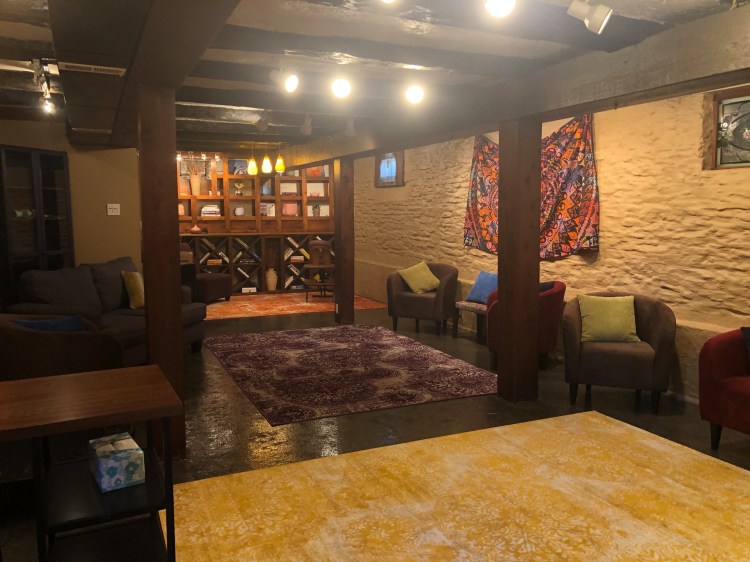
After joining several meditation circles I now wish to facilitate one. We’ll each bring our meditation experiences to interacting with one another and can then apply beneficial circling takeaways to deepen and enrich our meditation practices.
We start by taking on truth and presence as ground rules by refraining from speaking deliberate falsehoods while setting aside talk of past and future events and of folks who aren’t in the circle.
Additionally, for energetic cleanliness, we take self-responsibility for welcoming our experiences with acceptance while leaning into communication, relation and articulation.
Then, after a brief period for questions, and a few moments of silence, circling starts.
Without giving too much away, most of the circling involves verbalizing and mutually interacting with various mindfulness based meditation practices.
The practice wraps up with another short silence followed by a group debrief and ends with another moment of silence.
Given Integrating Presence’s long list of healing modalities and resources; occasionally providing commentary about care during Denny K Miu‘s Saturday “Mindfulness of Qi : Mindful Fitness & Yi Jin Jing” and “Mindful Practice for Everyone : Each Differently Abled”; and an upcoming “Ask Us Anything” guest who focuses on redefining care, it seems appropriate to interview “Ron”.
Ron is not his real name. He previously worked several (supervisory) roles in quality and project management on the revenue cycle side within an emergency department, within a directed mission department, at a large healthcare system.
Along with a brief bio and role descriptions some of the topics we get into include:
Physicians basically only spending 7 minutes per patient, per visit for one item
Personal responsibility
Prominence of Medicare and Medicaid
Push for profits and efficiency often times over quality of care
Related insurance industry undertakings and operations including details and examples
Leadership
Potential solutions:
Food availability and equality
Nurse practitioners and physician assistants
Reimbursements based on quality of outcome
Audio: A Healthcare System Audit From Back Office Supervisor “Ron”
I recently received some questions spurred by a comment I made during a book club meeting where we’re now reading “Whatever Arises Love That.” I mentioned how earlier in the day I had shared with some loved ones about empathing a very specific pain of another loved one resulting in an unexpected backfire, and how after reading a passage at the book club, I became aware of my unconsciousness at the time of sharing with loved ones not realizing I was feeling victimized by their responses. More context in my response below.
Questions:
Hey Josh, when you mentioned the empathic knowledge of someone else’s pain, and then you mentioning it to them and them turning it back on you, what do you think is the lesson here? I’ve done the same thing and have had emotions ranging from wanting to find my tribe or people who “get it” so I can say whatever I want without worrying about being different to feelings of unacceptance so trying to love myself more…just curious your take on it.
I also heard from a past life reader that if I feel it strongly in me as well it’s because I have the same unhealed energy in me which is why I could feel it…but I’m not sure as when I worked with people feeling what they feel was one of the main ways I received messages. But maybe me and my clients at the time were all working through the same stuff…
My (slightly edited) response, in a somewhat reversed/mixed order:
If I’m remembering right, Matt Kahn has said what we notice in others is what we’ve already addressed in ourselves. I feel this is along the same lines albeit a much more skillful and wise view than the kind of blaming of not yet good enough or healed enough.
And I was already contemplating earlier about mentioning such an empathic response and being met with what I was met with. I wonder how much of me mentioning this was my own cry for love and innerstanding — which can only likely come from myself in the amount and way I need and want — and how much was motivated from spiritual ego.
I don’t feel they turned their back on me, but I said what I did without intuiting that maybe such a thing was intimidating to them and was met with an inverted, fear based version of care although they were doing the best they could. If they could have done better they would have.
Perhaps also applicable is the analogy Matt gives: you wouldn’t call a third grader stupid for not knowing calculus. Plus, if it could have happened any other way it would have. . . And I’m still contemplating: what weakness is this helping me strengthen?
And yes, I too have had longing for finding such a mutually resonant tribe for similar reasons. And I’ve found these folks here and there. I’m noticing more and more during this transition period where we all are kind of being put into various jurisdictions of sorts with certain types of folks. What Randi Green calls a subdividing, or an emplacement. (There’s more important points to make about this that I’m not conveying.) She mentions this again in her new video (which is really mostly just an update on how she plans to go forward with her work). It’s detailed more in other videos and in The HAL Philosophy book.
As you know, worry is the worst kind of fantasy. We can care without being concerned. Care is thoughtful. Concern is fear.
When I first started waking up and embarking on a type of healing journey I felt I couldn’t really talk to anybody about this stuff and so it was very lonely for awhile, even with some bouts of paranoia. But, as is more times the case than not, some friendships grew apart, allowing more resonant and aligned friendships to emerge.
Even right before the book club I met a young Christian pastor who was expounding new perceptions; new methods of congregating; and new ways of being that I felt very unlikely to emerge from and within Christianity in my lifetime. It all seemed very natural and easy yet somehow surreal at the same time.
I’m also holding back less and less, and trust what happens is what needs to happen. I don’t feel this way is for everybody, and sometimes this comes back and bites me in the ass. Although there are still plenty of times I know I’d be wasting energy for all parties involved so I don’t engage much. On the other hand sometimes I push it (and push it and push it).
Auspicious timing, btw, as I’ve been piecing together notes for an article I’m working on with a similar angle with the working title of “Dharmic Strategies For Empaths”
And naturally, as of now, the bottle line: love is the only answer, and we all deserve more love not less
For this month’s regular open-audience, open-discussion “Ask Us Anything” — continuing discussions about meditation and related topics — Denny presents the long standing Five Element system mostly in terms of astrology, Qi and the body — an expansion on his article Qi and the “Real” Organs — with me commenting along the way until the show ends prematurely due to unknown technicalities with live streaming services.
Denny amended the video solo to wrap up. My closing comments are tacked on in the audio only version.
Audio: Qi And Astrology | (8/31/2021 — “Ask Us Anything – LIVE” With Denny K Miu)
The audio only version includes my post-show comments
Friends and associates (known and unknown) as well as public and private societies involved in the rise to popularity of certain historical figures
Differences and similarities with astrology and astronomy and religion’s influences
History is (re)written by the victors (usually with agenda)
Western astrology sometimes not in accord with actual positioning of space object
Chinese 12 deities or 12 zodiac system
How leap year factors into Denny’s building of a clock chip in experimental physics lab
Five Elements (/materials/ phases/ liveliness/ movements/ behaviors/ interactions/ etc) of water, metal, fire, wood, earth and their correspondence to Mercury, Venus, Mars, Jupiter, Saturn respectively
Using this system on the surface with next step maybe being verifying it in one’s own experience and eventually maybe even investigating how this system was discovered, assembled and propagated
The organs and elements’ relation to emotions
“Treasure Organs” and “Vessel Organs”
Various bodily/organ essences
Role of kidneys in marrow
The ambiguity in translating Chinese, for example the two relationships between elements translated three ways as 1) nourishes, suppresses 2) supports, opposes 3) generating interaction; overcoming interaction
Role and influence of teachers and how they teach such as from the book and from experience
Displaying of physical metals
Micro (and Macro) Cosmic Orbit; a famous chart displaying this and its possible origins
8 immortals
Synthesis of:
Taoism (understanding how the Dantian is the treasure)
Zen (difference of pain and suffering / sensation vs perception)
Eastern medicine in context of Western medicine and where it may be going
Various definitions of Qi:
maybe mystical
(but mostly:)
air
breathing
rice
external substances brought into the body
no fire/lack of fire
circulation (between kidney/water, heart/fire and lung/metal
metabolic harmony (between kidney/water, Earth/spleen and liver/wood)
Other questions and points (most left unmentioned in the video version):
Variations on theories of astrologers. How some correlate and build on each other; how some oppose; and how they evolved and devolved over time
Why is the air element missing in this element system?
– – – – – – is overcoming interaction & (solid line) ——- is generating interaction
When pentagram/pentagon diagram arrows reverse so do the interacting relationships between elements
Do the different time zones and locations on Earth make a significant difference for what optimal time periods correspond with various body, organ/meridian functions? Why or why not and how? Is only one time zone in China relevant to this?
Fond of Denny’s translation of Triple Focus for what’s usually translated as Triple Burner.
Perhaps possible similarities in the Distillation, Fermentation, and Calcination stages of the 7 stages of Western alchemy relating to fog (upper burner), foam (middle burner) and gutter (lower burner) respectively
Noticing the vast benefits for ourselves and others from using this Five Element system and when we may be clinging to it; ignoring/rejecting something that seems to run contrary to it; and/or only categorizing (experiences and phenomena) in terms of the Five Elements as a replacement for not investigating for one’s self
How does using disorder as in “Metabolic Disorder” and “Lifestyle Disorder” help wake one up to motivate healthy, beneficial changes and how much does it promote unnecessary psychological shame, blame and guilt thus influencing/impacting physiology?
Currently, for a chance to experience, practice, and receive Yi Jin Jing instructions from Denny — plus more mindful exercise join in free on Saturdays:
Disclaimer: investigate these questions at the potential risk of wasting: time, serenity, perhaps some sanity and even energy.
What is energy? How do you know?
Where and how do you experience energy?
What kinds, or types of energy are there?
Why is energy important?
Where does energy come from? Where does it go?
What brings energy, in what degrees, and how?
What drains, or dissipates energy, in what degrees, and how?
What (all) supports and does not support energy?
Are there energetic rhythms, patterns, systems, anomalies, cycles, environments/spaces? If so, what differences and similarities exist for each and between and amongst these?
Watch You Tube videos youtu.be/zYv_jjmdSRs and youtu.be/RvoIflpaU4Q for background information 5 hierarchical layers of dynamic energy for original human systems: Radiation – emission fields (waves) Vibration – vibration or resonance fields (magnetism) Units – particle or cluster fields (atoms) Holographic – grid or lattice fields, fluctuating Crystalline – fixed fields (All levels can be altered via code systems) via https://toveje.dk/about/the-hal-project-articles
Saying “all life is suffering” seems a gross misrepresentation of the First Noble Truth. Perhaps more helpfully, skillfully, wisely put: it is “the truth of suffering,” or even “all life contains suffering.” The words “suffering,” “stress” and even “unsatisfactoriness” don’t really seem totally and adequately translate “dukkha” either — “commonly explained as a derivation from Aryan terminology for an axle hole, referring to an axle hole which is not in the center and leads to a bumpy, uncomfortable ride.”
Another decent dukkha definiton is ‘made up of the prefix du and the root kha. Du means “bad” or “difficult”. Kha means “empty”‘ with one interpretation of this in the graphic below:
However, on an ultimate level, yes, until full awakening is realized, it seems all life is suffering — at least on the very subtle layers of craving/clinging to being/becoming and/or craving/clinging to non-being/non-becoming. Nearly all phenomena seem associated with this. For example, if getting up to walk to the bathroom, there’s craving to want to do bathroom stuff. If scratching, it’s likely there’s subtle craving to want to no longer be somebody with an itch. Crappy examples but perhaps enough to make the point.
These more subtle forms of dukkha are not so practical for purposes of everyday life though. More practical is acknowledging whatever suffering, stress, and/or unsatisfactoriness happens. And then how do we respond? Easy answer. With compassion. Compassion here mostly meaning simply to acknowledge, instead of not noticing or denial, with willingness to skillfully and wisely do what can be done for alleviation.
I liken much of the notes below to a game of telephone where one can seem to hear what one wants, often with copious misinterpretations. In light of this, please (also) listen directly to the retreat.
Sitting meditation posture:
Big emphasis on uprightness
Pelvis and hips stable
Tendons relaxed
Stomach drops to floor
Spinal discs of lower back stacked atop each other with slight arch
Slight pressing toward the chest from between the shoulder blades
Relaxing rope-like muscles of the neck from the skull down
Body, breath and mind:
When body relaxes the mind gets signaled to relax
Body/breath has sense of internal tissue intelligence — body knows itself internally
The breath channel(s) through the tissues extends beyond the physical
Noice longer, lighter, sustained stretches with(in) the body, tissues and breath
As energies bubble up from the depths mind can concoct stuff with them. Draw back into experience (with)in the body and breath through uprightness
That which is moved and touched by knowing something, otherwise it is just awareness
(Perceptual meditation) techniques:
Like a Buddha surveying the karmic field
Being enveloped in a sphere of love
Hands supporting, holding a level skull allowing the rest of body to dangle then energy rising up like mist
Establishing upright axis of a spinal energy column while aware of the sky, one’s feet on the ground and spaciousness then there’s no place for projected negative energy to land
Horizontal axes along shoulders and pelvis/hips in addition to the axis of the energetic spine
Detaching from the inner and the outer by staying in the doorway between the two
Using the Five Faculties — faith/conviction, energy, mindfulness, samadhi (unified, gathered, sustained focus, stable, stillness of mind) and wisdom — to check effectiveness of meditation
An insight during retreat:
Since it seems we’re always aware (of something) — to verify this just try to stop being aware for 60 seconds — we only seem to lose awareness because the connection (and/or common thread) from the first remembered moment of awareness is severed, broken, or lost. It seems (correct) reference points can help with the linking and continuity of awareness.
In the Buddha’s Dhamma, the four expressions of the loving heart establish the atmosphere for our practice. Combined with the opening and enrichment of the body’s somatic presence, they clear negative patterns such as fear, guilt, self-criticism and resentment. In this retreat, the cultivation of breathing, devotion and wise reflection are offered to further this process.
The daily schedule will include sitting, walking and standing meditation, Dhamma teachings, chanting, and question & answer sessions.
This retreat is offered freely in the spirit of generosity. There is no fee to register. You will have the opportunity to offer Dana (donation) at the close of the retreat. Information will be provided.
Retreat Schedule for PDT and UK Time Zones
SATURDAY, JULY 10 – THURSDAY, JULY 15, 2021
6 – 7 am PDT | 2 – 3 pm UK — Chanting ~ Guided Meditation
8:30 – 11 am PDT | 4:30 – 7 pm UK — Instruction ~ Meditation
12 – 1 pm PDT | 8-9 pm UK — Meditation ~ Q&A
3 – 6 pm PDT | 11 pm – 2 am UK — Instruction ~ Meditation
8 – 9:30 pm PDT | 4 – 5:30 am UK — Dhamma Reflection ~ Meditation
Ajahn Sucitto has been a Buddhist monk in the Thai Forest tradition for 45 years. He trained under Ajahn Sumedho, the senior western disciple of Ajahn Chah, and is based in Cittaviveka Monastery in Chithurst, in southern England.
Willa Thaniya Reid has trained in the Ajahn Chah forest tradition both in lay practice and in monasteries in England, where she served as the senior nun at Cittaviveka. She lives in New Zealand with Elizabeth Day, where they have a center dedicated to sharing the Buddha’s teachings.
This meditation (recorded live) aims to strengthen and deepen the 32 Parts of the Body portion of Body Contemplation in the Four Foundations of Mindfulness — not meant as a regular practice or substitute. My apologies for the air conditioning, dehumidifier and other background noises. Partial inspiration comes from this Four Foundations of Mindfulness visual:
Just as if there were a double-mouthed provision bag full of various kinds of grain such as hill paddy, paddy, green gram, cow-peas, sesamum, and husked rice, and a man with sound eyes, having opened that bag, were to take stock of the contents thus: “This is hill paddy, this is paddy, this is green gram, this is cow-pea, this is sesamum, this is husked rice.” Just so, monks, a monk reflects on this very body enveloped by the skin and full of manifold impurity, from the soles up, and from the top of the head-hairs down, thinking thus: “There are in this body hair of the head, hair of the body, nails, teeth, skin, flesh, sinews, bones, marrow, kidney, heart, liver, midriff, spleen, lungs, intestines, mesentery, gorge, feces, bile, phlegm, pus, blood, sweat, fat, tears, grease, saliva, nasal mucus, synovial fluid, urine.”
For this month’s regular open-audience, open-discussion “Ask Us Anything LIVE” — continuing discussions about meditation and related topics — Denny and I chat with meditation teacher Beth Upton most significantly about the Dependent Origination link Nāmarūpa, or Materiality and Mentality, which, according to Wikipedia, is “used in Buddhism to refer to the constituents of a living being: nāma is typically considered to refer to the mental component of the person, while rūpa refers to the physical.”
Audio: Materiality and Mentality | (7/27/2021 — “Ask Us Anything – LIVE” With Denny K Miu And Guest Beth Upton