For this month’s regular open-audience, open-discussion “Ask Us Anything” — continuing discussions about meditation and related topics — Denny and I review the 63 consecutive weeks of online practice Denny continues to lead. The original (amended) show notes are as follows:
(From Josh):
(Depending on temperament and experience level, some may find this chat tedious, overwrought, boring, too specific; or fascinating, affirming, inspirational, connective; or even redundant, low level, missing the mark. Please take only what is helpful.)
General summary and overview of Denny (and Josh’s) practice(s)
If I’m remembering correctly, on 4/10/21 Denny mentioned Metta as mindfulness of mind. This is a first for me. Maybe mindfulness of heart, or heart-mind? I would like to hear more details of this. And maybe if Denny feels there is a significant difference between more a more Asian definition of “heart” and “mind” and Western definition of “heart” and “mind?”
Why only 3 breath exercises in chair?
How does one find energy points on the inside and outside of legs? By noticing what areas are more sore or sensitive than others?
“What is your definition of self,” is often one of the first questions I ask someone once it is clear they are serious about seeking, and/or clear about their spiritual path, or even someone heavily seeped in philosophy.
From what I innerstand, while the historical Buddha never simply denied that there’s a “self” directly and in brief, he gave teachings on anattā or “not-self”. Such teachings often seemingly get at least somewhat misunderstood today.
It is quite beyond my current scope of realization to give a somewhat original teaching or explanation on anattā (although there’s plenty of accessible, clear, helpful and useful material regarding “not-self”.) Nor will I say much about how anattā relates to the five khandhas, or five (clinging) aggregates other than to say, upon deconstruction of answers to the question “what is your definition of self,” these answers often seemingly can break down further into various deconstructions of the five aggregates. For example, if body is said to be self then: am I the body; do I own the body; am I in the body; is the body in me?
Instead, this post simply displays visual representations of what the Buddha likened each of five khandhas to.
Rupa/Form or Body = chunks of foam
“Monks, suppose that a large glob of foam were floating down this Ganges River, and a man with good eyesight were to see it, observe it, & appropriately examine it. To him — seeing it, observing it, & appropriately examining it — it would appear empty, void, without substance: for what substance would there be in a glob of foam? In the same way, a monk sees, observes, & appropriately examines any form that is past, future, or present; internal or external; blatant or subtle; common or sublime; far or near. To him — seeing it, observing it, & appropriately examining it — it would appear empty, void, without substance: for what substance would there be in form?”
“Now suppose that in the autumn — when it’s raining in fat, heavy drops — a water bubble were to appear & disappear on the water, and a man with good eyesight were to see it, observe it, & appropriately examine it. To him — seeing it, observing it, & appropriately examining it — it would appear empty, void, without substance: for what substance would there be in a water bubble? In the same way, a monk sees, observes, & appropriately examines any feeling that is past, future, or present; internal or external; blatant or subtle; common or sublime; far or near. To him — seeing it, observing it, & appropriately examining it — it would appear empty, void, without substance: for what substance would there be in feeling?”
“Now suppose that in the last month of the hot season a mirage were shimmering, and a man with good eyesight were to see it, observe it, & appropriately examine it. To him — seeing it, observing it, & appropriately examining it — it would appear empty, void, without substance: for what substance would there be in a mirage? In the same way, a monk sees, observes, & appropriately examines any perception that is past, future, or present; internal or external; blatant or subtle; common or sublime; far or near. To him — seeing it, observing it, & appropriately examining it — it would appear empty, void, without substance: for what substance would there be in perception?”
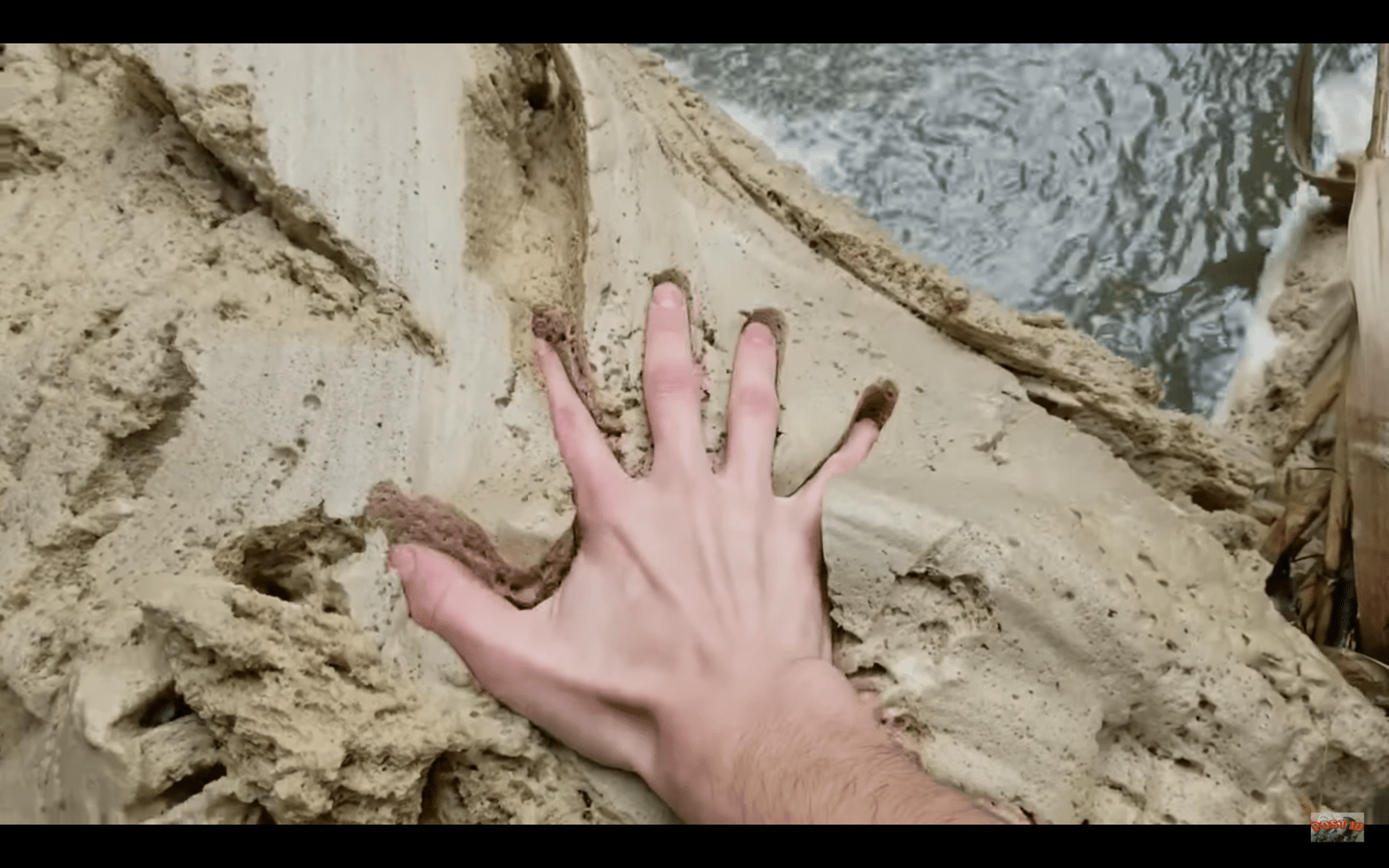
“Now suppose that a man desiring heartwood, in quest of heartwood, seeking heartwood, were to go into a forest carrying a sharp ax. There he would see a large banana tree: straight, young, of enormous height. He would cut it at the root and, having cut it at the root, would chop off the top. Having chopped off the top, he would peel away the outer skin. Peeling away the outer skin, he wouldn’t even find sapwood, to say nothing of heartwood. Then a man with good eyesight would see it, observe it, & appropriately examine it. To him — seeing it, observing it, & appropriately examining it — it would appear empty, void, without substance: for what substance would there be in a banana tree? In the same way, a monk sees, observes, & appropriately examines any fabrications that are past, future, or present; internal or external; blatant or subtle; common or sublime; far or near. To him — seeing them, observing them, & appropriately examining them — they would appear empty, void, without substance: for what substance would there be in fabrications?”
Plantains, like bananas, are referred to as trees, but they both are large herbs. The leafy pseudostem at the center of this plant stands in for a woody trunk that is seen on a tree.
Banana plants, with their towering heights, look much like trees, but they are usually called plants and not trees. This is because their “trunks,” which are called pseudostems, are made of leaves that are tightly woven together. Banana plants grow much like palm trees, in that the new leaves twist up through the center of the pseudostem and sprout from the crown of the plant. One banana plant may grow on one pseudostem, or more commonly, on several of them.
“Now suppose that a magician or magician’s apprentice were to display a magic trick at a major intersection, and a man with good eyesight were to see it, observe it, & appropriately examine it. To him — seeing it, observing it, & appropriately examining it — it would appear empty, void, without substance: for what substance would there be in a magic trick? In the same way, a monk sees, observes, & appropriately examines any consciousness that is past, future, or present; internal or external; blatant or subtle; common or sublime; far or near. To him — seeing it, observing it, & appropriately examining it — it would appear empty, void, without substance: for what substance would there be in consciousness?”
This irregular “Dharma Questions” series deals with “dharma” meaning both the truth of the nature of reality and some Buddhist teachings. Please see this post on the intensions for questioning and not questioning. Amongst other things these questions can be, but not necessarily:
thought experiments
borderline musings not meant to be answered
from laziness of not contemplating or researching them yet
How does merely maintaining continuous awareness of the meditation object result in the various wondrous benefits from doing so?
Does Citta (heart-mind) exist beyond/outside/apart from the five aggregates? Why or why not?
If practicing open/”choiceless” awareness, what determines how attention becomes fixed on a particular object over another? Could/Does using the term “choiceless” affect the decision making process and choosing (– perhaps seeding into the mind that choosing could mostly be a random process with little to no agency involved/possible)? Why or why not?
Could aversion be (used for) a (type of) shortcut — albeit an unwholesome one — to non-relishing, or non-delight, mentioned in Mulapariyaya Sutta: The Root Sequence? Do some ascetic practices aid in realizing non-delight, non-relishing?
Why are there so many beings with non-realization of enlightenment/of awakened awareness/of Buddha nature? (And how did it get like this?)
What is the root condition (and causes) for (each of the) unwholesome roots of greed, ill-will and delusion (lobha, dosa, moha)?
Is there possibly of Nibbana without samsara? [Eckhart Tolle says, “it is through the world, and ultimately through you that the unmanifested knows itself.” … Does the unmanifested need to know itself? If not, why would it want to know itself?] [Perhaps more precisely: is there a possibility of nothing but all-encompassing, absolute Nibbana without Samsara? If so, is sustainability possible (and how)?]
What is the middle way within Buddhism itself? If answering with Theravada, Mahayana, or Vajrayāna, what’s the middle way within that?
When it is sensed that a thought is about to arise, and then seemingly prevented from arising, what happens to any and all (potential) thought energy (that seemingly ended) when preventing the arising of thought(s)? How exactly does this process happen — this process of what is being sensed to potentially become a thought about to happen but is stopped, suppressed, prevented, dissolved, disappeared, dissipated, or otherwise non-arised? And does this produce a karmic result? If so, how does it compare to the karmic production and karmic result of thinking/a thought? [Rephrased: When it is sensed that a thought is about to arise, and then seemingly prevented from arising, what happens to that seemingly ended thought potential or thought energy; how is this stopped; and does this create a karmic effect?] And how would it be known?
Why and how is pain (and pleasure) intrinsic to the human condition? What is the origin and root condition of pain?
Are there root conditions for (each of the 12 links of) dependent origination? If so, what are they? If not, why not?
What are all the different meditative techniques from all the different Burmese Vipassanā schools/methods? Is there a compendium of these?
Why do the Ānāpānasati instructions omit details on how to bring mindfulness to the fore and calm bodily formations?
How does “owner of my kamma/actions” from the five daily reflections jibe with anattā — the teachings on “not-self”?
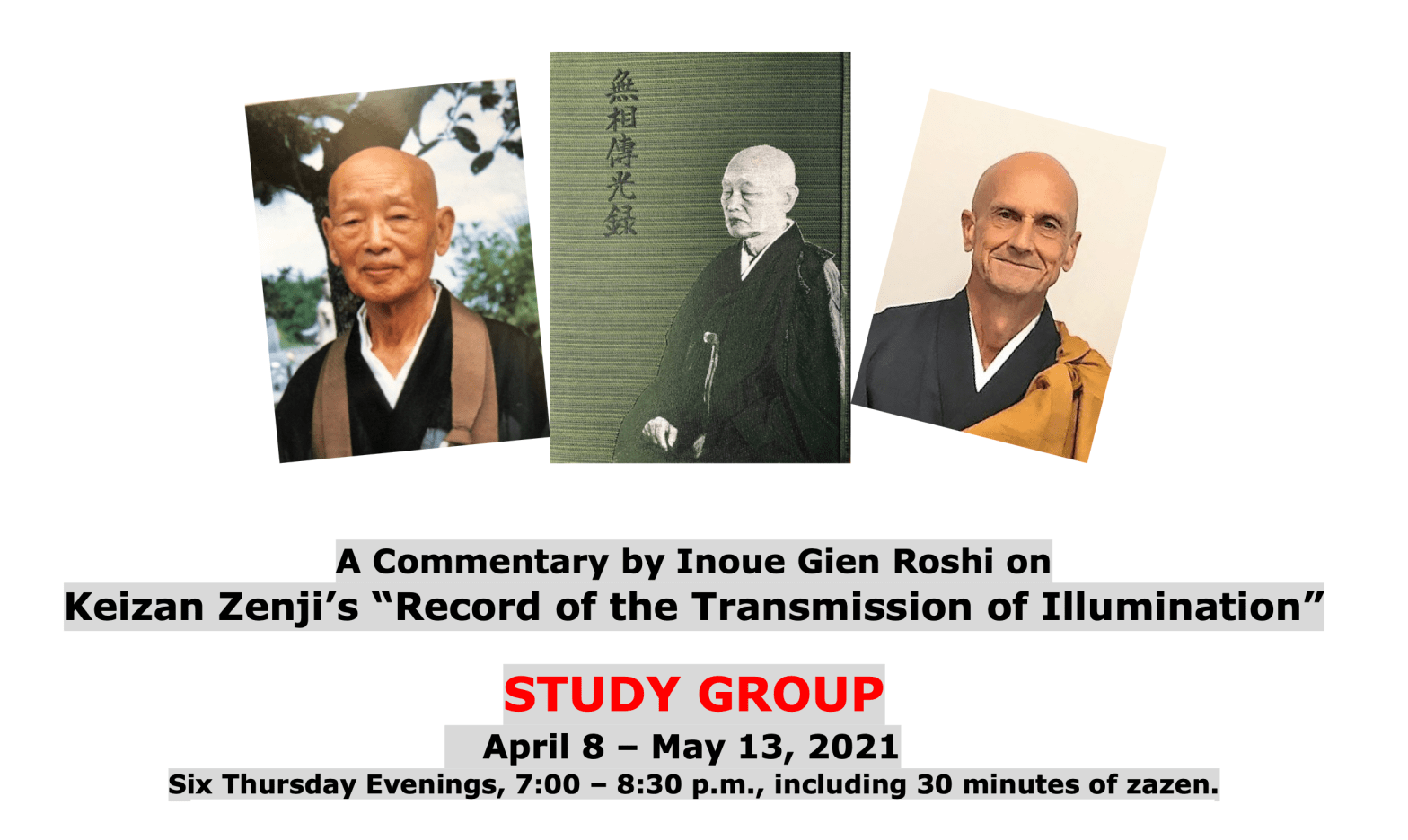
A Confluence Zen Center study group, for six consecutive Thursday evenings starting April 8th:
. . . will be reading a commentary by Inoue Gien Roshi on Keizan Zenji’s , “Record of the Transmission of Illumination” [German-English translation in PDF from Terebess and PDF from Shastaabbey]. This is the current text that Daigaku is translating. We will be reading the first 2-3 chapters. Keizan Jōkin ( 1268–1325), also known as Taiso Jōsai Daishi, is considered to be the second great founder of the Sōtō school of Zen in Japan. While Dōgen, as founder of Japanese Sōtō, is known as Highest Patriarch , Keizan is often referred to as Great Patriarch. All are welcome to attend.
Email confluencezen AT gmail DOT com if interested in joining. More details in the image below
[5/13/2021 UPDATE:]
Since this Study Group wrapped, some quotes from the text along with a few questions and comments with the disclaimer that what follows from the text is not necessarily what may/will make it into the official published version, and anything else added below is not (necessarily) associated with this project:
Two Questions
What are the seven penetrations and eight masteries?
Answer from the glossary:
“This is a play on the expression “to penetrate”, meaning to “understand fully.” The interpolation of the numbers “seven” and “eight” adds a sense of repetition and thoroughness, so the meaning of “seven penetrations and eight masteries” is “complete mastery.”
[At that instant [of the Buddha realizing enlightenment],] he suddenly realized a world which is truly one to the extent that he wasn’t aware of the oneness.
In a way similar to how he had suffered because of the “conscious mind,” all people were having difficulty just because they were deceived by the “conscious mind.”
. . . the Buddhadharma [Buddhism] teaches what is not being touched [by the self]. Just because you don’t know the way to realize this, you cannot avoid [losing sight of it].
(My) Sub-Commentary
[The ability to know “I am alive”] is called the “conscious mind,” the discerning, knowing mind. This “conscious mind” is the most precious mind for all of you. Calling it “reason” or “intelligence,” people think this is the highest quality of the human mind. You all live by means of this mind. [You all live in the world of thoughts fabricated by the “conscious mind.”] However, once you see how things really are, [you will know] reason and intelligence bring the greatest harm. This “conscious mind” is the root of delusion. Human reason and intelligence mislead you and confuse you. They annoy and perplex you, and nobody is aware of this. Keizan Zenji, as well, did not understand this. On seeing great enlightenment, however, he clearly understood that these things are poison.
I somehow liken this to repeatedly forgetting to replace the empty shower gel bottle and finally throwing it on the floor where it will have to be addressed
For this month’s regular open-audience, open-discussion “Ask Us Anything” — continuing discussions about meditation and related topics — Denny and I reprise Zen, dig into Chán and primarily present Yi Jin Jing in light of its importance for linking body and mind. Show notes are as follows:
(From Denny with the bulk of his notes from the slides):
For me, the most important question is why Bodhidharma bothered with Yi Jin Jing? It’s the same question I asked, why Master Jiru bothered with the Five Contemplation of Breath exercise.
The answer must have something to do with the historical fact that both the historical Buddha and Bodhidharma were yogi’s.
1. The Unconditioned 2. The destruction of lust, hate, delusion 3. The Uninclined 4. The taintless 5. The truth 6. The other shore 7. The subtle 8. The very difficult to see 9. The unaging 10. The stable 11. The undisintegrating 12. The unmanifest 13. The unproliferated 14. The peaceful 15. The deathless 16. The sublime 17. The auspicious 18. The secure 19. The destruction of craving 20. The wonderful 21. The amazing 22. The unailing 23. The unailing state 24. The unafflicted 25. Dispassion 26. Purity 27. Freedom 28. Non attachment 29. The island 30. The shelter 31. The asylum 32. The refuge 33. The destination and the path leading to the destination
Wouldn’t it make sense — and be universally beneficial — to reflect and contemplate (more) on what’s really, truly important in (your) life? If yes, here’s perhaps a few:
What is important?
What stops me right now from complete happiness?
What does this depend on?
What expectations, value judgments, longings is it founded upon?
This is a March 19th 2021 Zoom interview/conversation/teaching (experience)/chat with Ms. Beth Upton.
For the video version I imagine some of this could appear awkward especially for the audience. While I seem to handle awkwardness with indifference, Beth graces with gentle and pleasant speech.
I have been teaching meditation since 2014, and the more I teach the more I love it. If there is one thing that I have learned in my years teaching it is that we are all different, with our own strengths and weaknesses. In order to teach well, I need to get to know each student individually, guiding each to tap into their own innate wisdom, offering instruction that fits each student’s unique circumstances.
The ten years I spent as a Buddhist nun afforded me the great privilege of being able to practice meditation in much depth and detail. I was blessed with masterful teachers and all of the support I could have hoped for. I spent five years in Myanmar training diligently in the Theravada tradition under the guidance of Pa Auk Sayadaw. I then spent a further five years training in several other methods, and spent many months doing long solo retreats in various caves and forests.
The opportunity to practice meditation so comprehensively has been the greatest gift of my life. My passion is now to repay that debt of gratitude by providing the same opportunity to others.
Since deciding to disrobe in 2018, I have been on a sharp and wonderful learning curve, reintegrating the challenges of western lay life into my Dhamma practice. Through this process not only has my appreciation of the Dhamma grown deeper, but also my understanding of the students I am teaching.
As well as teaching meditation I am also enthusiastic about building community. Over the past years I have been leading Sanditthika Meditation Community in the caves of Almeria, Southern Spain. I am also finding ways that we can support each other wherever we may be in the world. I am also finding ways that we can support each other wherever we may be in the world. If this work interests you, I welcome you, either online, or in person, or both, to join our community.
End of Beth’s website bio. [Video correction: the end of a portion of Beth’s bio]
Amongst Beth’s copious wisdom teachings a big thanks goes for furthering my training in mindfulness of speech and presentation.
Be aware that audio challenges may be from me adjusting the zoom volume without monitoring the audio level for the screen recording.
Advice for establishing and maintaining a daily meditation practice
Meditation trends
What Beth’s meditation interviews are like and a mini example interview from my current practice addressing tinnitus and energetic blockages
Samatha / Vipassanā
And Surpamundane or psychic powers [Video correction: I mistakenly say Supermundane instead of Supra]
As we run out of time, I dangle a question about arhatship, so I include it here with a few pro and cons not included in the video:
What are the pros and cons for revealing and then discussing arhatship — for both lay and monastic — while mentioning and considering the relevant monastic rule(s) surrounding this? Also how are the Four Stages of Enlightenment verified?
Cons:
lay community may be more likely to ignore other monastics/teachers
followers could end up boosting personality (in their own minds) thus detracting from their practice
more desire for Dana to arhats for greater merit
risk of locking in particular arhat’s experiences as litmus test, benchmark, and/or “this is the way arhatship is, not what so-and-so says about it”
stirring up politics — what country/monastery/tradition has most arhats.
could attract jealous detractors and those denouncing validity of attainment
potentially inciting unwise external comparisons perhaps leading to overemphasizing striving for attainment, or the opposite of giving up because it seems unrealistic and so far away
Pros:
proof that it’s actually possible (in this very life) and not hearsay
inspiration for practice
demystifies
perhaps more helpful advice available for those closer to the arhat stage in their path
could better settle wonderings about what it would be like to interact with an arhat and how an arhat would experience such and such
more authoritative perspectives
Audio only version — Well Rounded Meditation and Generosity | In Conversation with Beth Upton