
In this forty-sixth installment of the ongoing live series with Wendy Nash, we continue our inquiry into meditation practice both on and off the cushion this time keeping on with a kind of 37 theme from last month’s “The 37 Practices of a Bodhisattva” and now to the 37 Factors of Awakening from the Theravada tradition essential to realizing awakening. We approach these in a non-systematic manner to see what insights and wisdom come up from our studies, experiences and practices while spending more time towards the end on various perception of the physical body including death and decay of the body. As usual we invite questions and comments live, beforehand and after.
Not mentioned in the show: I was later taught that ideally — and eventually, practically too — all these factors need to be cultivated together
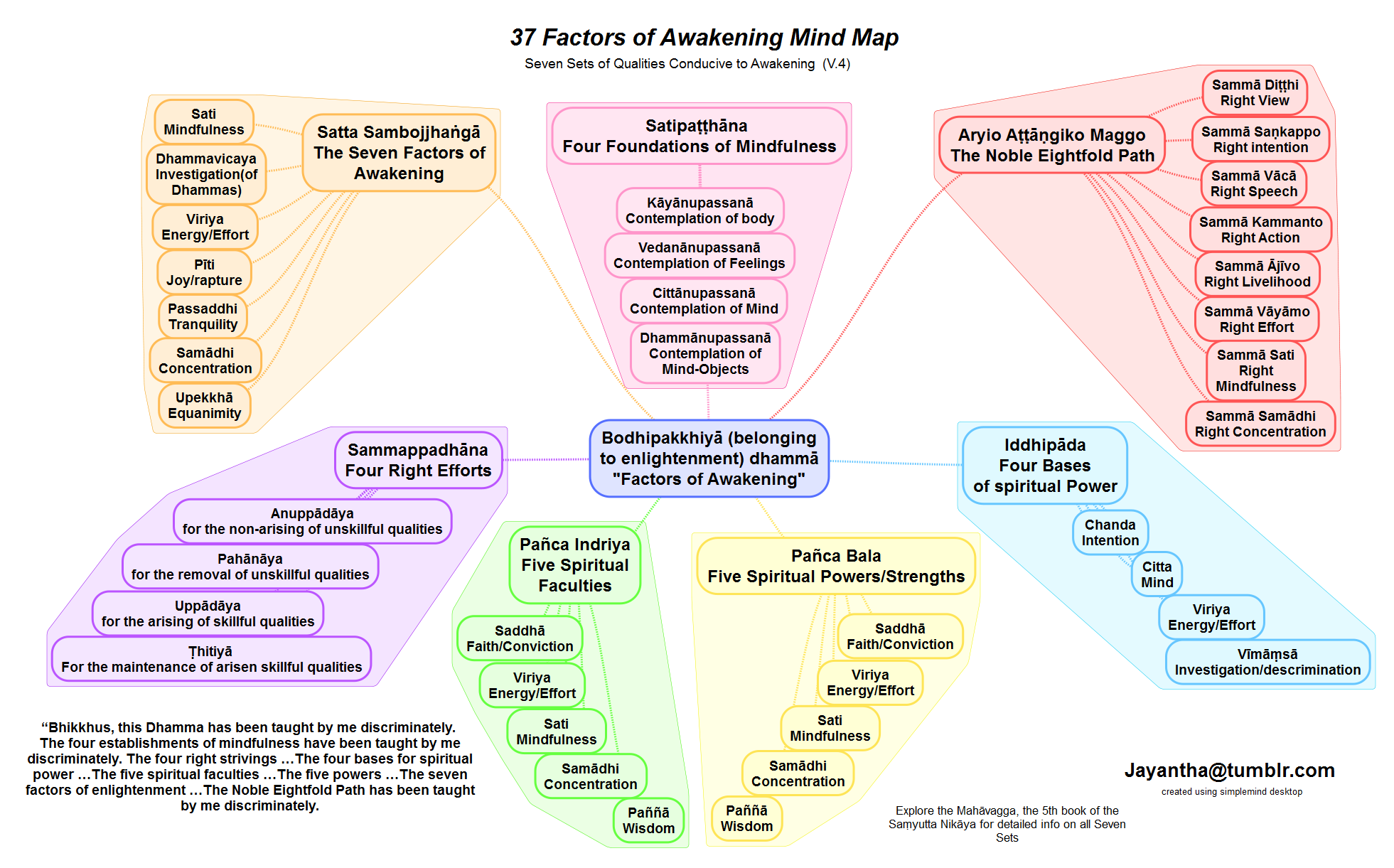
Overview of the 37 Factors of Enlightenment
The 37 factors of enlightenment in Theravada Buddhism are essential teachings that guide practitioners toward spiritual development and liberation. These factors are categorized into several groups, each contributing to the path of awakening.
Categories of the 37 Factors
| Category | Factors Included |
|---|---|
| 1. Four Ways of Attending to Mindfulness | – Mindfulness of the body (kāyānupassanā) – Mindfulness of feelings (vedanānupassanā) – Mindfulness of the mind (cittānupassanā) – Mindfulness of mental objects (dhammanupassanā) |
| 2. Four Right Strivings | – Efforts to prevent unwholesome states – Efforts to abandon unwholesome states – Efforts to develop wholesome states – Efforts to maintain wholesome states |
| 3. Four Paths to Power | – Concentration (iddhipāda) – Effort (sammāppadhāna) – Mindfulness (sati) – Investigation (dhamma vicaya) |
| 4. Five Faculties | – Faith (saddhā) – Energy (viriya) – Mindfulness (sati) – Concentration (samādhi) – Wisdom (paññā) |
| 5. Five Strengths | – Faith (saddhā) – Energy (viriya) – Mindfulness (sati) – Concentration (samādhi) – Wisdom (paññā) |
| 6. Seven Factors of Awakening | – Mindfulness (sati) – Investigation of the Dhamma (dhamma vicaya) – Energy (viriya) – Joy (pīti) – Tranquility (passaddhi) – Concentration (samādhi) – Equanimity (upekkhā) |
| 7. Noble Eightfold Path | – Right view (sammā diṭṭhi) – Right intention (sammā saṅkappa) – Right speech (sammā vācā) – Right action (sammā kammanta) – Right livelihood (sammā ājīva) – Right effort (sammā vāyāma) – Right mindfulness (sammā sati) – Right concentration (sammā samādhi) |
*There’s naturally an ongoing open call for meditation (related) questions for the (roughly) monthly “Meditation Q & A” either by the various social media means listed; integratingpresence[at]protonmail.com or just showing to type/ask live.*

Background
Regular, current and past visitors to Integrating Presence may recall the monthly series “Ask Us Anything” I did with Denny K Miu from August 2020 until January 2022 — partially including and continuing on with Lydia Grace as co-host for awhile until March 2022.
For a few months thereafter I did various Insight Timer live events exploring potential new directions and/or a continuation of the Ask Us Anything format while weaving in other related teachings to these events.
Then, after chats with meditation coach Wendy Nash, it became clear to start a new collaboration similar to “Ask Us Anything” simply and clearly called “Meditation Q & A” especially due to the original intent of the Ask Us Anything’s being “discussions about meditation and related topics.”

Audio: 37 Factors Of Awakening | “Meditation Q & A With Wendy Nash” #46
Past chats with Wendy:

Full Verbatim Transcript (with timestamps removed and perhaps minor corrections via ai):
Hey, folks. Welcome. This is Josh of Integrating Presence and I’m joined by Wendy Nash once again. Wendy, what’s going on?
Well, I’m here on Gabbie Gabbie country in Queensland in Caboolture as usual. What’s going on? I was in an expo this morning about well-being. I gave a mindfulness session. So, do you know how many people came along? How many, Wendy? Zero.
I guess everybody’s completely well.
That’s great. Yeah. Well, you know, I’m not sure that’s quite how it works, but it’s not—it’s a very poor community, so I don’t think that’s going to be the case. It’s more just it’s not the right time and place. And I think that’s the thing about meditation, you know, sometimes people just aren’t ready for it. And that’s just how it is. You know, it took me I think five years or something, three years before I decided, oh yeah, I’m ready now. So, yeah.
You know, that’s a really good point. And I’ve now been meditating with people from Buddhist countries and things and actually from what I understand a lot of folks from Buddhist countries, a lot of them don’t even meditate either. You know, it’s purely kind of devotional and dāna and sīla is a practice, you know, ethics. And so I guess it is more rare than we want to believe even though there’s supposedly a huge Western mindfulness craze. You know, I guess it is what it is. And yeah, so today’s session we’re going to—I mean, you know, well, this is kind of unusual because I don’t normally do themes and things but since we did 37 Practices of a Bodhisattva last time I thought 37’s an interesting number. There’s another number I know, 37, and it’s called the 37 Factors of Awakening. And in Buddhism there’s a lot of lists and so this is no exception. In fact, this is kind of a super list of lists of lists type of thing. So, let me just read the little introduction I have here again.
In this 46th installment on the ongoing live series with Wendy Nash, we continue our inquiry into meditation practice both on and off the cushion. This time, keeping on with a kind of 37 theme from last month’s the 37 Practices of a Bodhisattva like I just mentioned and now to the 37 Factors of Awakening from the Theravada tradition, essential to realizing awakening. We will likely just approach some of these in a non-systematic manner to see what insights and wisdom come up from our studies, experiences, and practices. As usual, invite questions and comments live and after.
So, I’m just going to put this graphic on the screen if that’s cool. I brought up an AI LLM version, so it may be contentious, but it’s quite interesting. It’s done the 37 Factors and I’ve got—and it’s come to 37 which is good.
Mhm.
So we can talk about it. Oo that’s very pretty.
This—who I need to give credit to whoever this is. Actually it’s their little thing on the side. So hopefully I can use that. These are jayanta.tumblr.com.
Yes. So j-a-y-a-n-t-h-a.
That is the creator, not us. And hope if there’s any trouble using this, please let me know and I will try to take it off. These factors are of course in the public domain. They’re not, you know, there’s no copyright on the actual factors themselves. So yeah, where to start on this? You know, of course we’re not going to do this comprehensively. We could probably do an entire talk on each individual one of these. But since we already started with meditation and mindfulness, how about sati or mindfulness itself? I mean that’s kind of—unless Wendy has other ideas. I’m open to it because I don’t really have any—well, the way it’s listed here. I don’t know if it’s listed in a particular order but it says four foundations of mindfulness. So it starts with mindfulness of the body and then of mindfulness of vedanā, mindfulness of mind and then mindfulness of the dharmas. So I don’t know—has it got in that lovely beautiful amazing—
Yes it does. That’s the satipaṭṭhāna. So the four foundations of mindfulness—it’s top center. So in pink in the top center: contemplation of body, feelings, mind and mind objects.
So yeah the one with sati of course this mindfulness—it goes over various lists. So on the left you know the seven factors of awakening we have at the top sati and then we have the mindfulness of all these four factors and then the next one you know noble eightfold path, right mindfulness is the seventh one and let me see if there’s any other—yeah and so the five indriya spiritual faculties which turn into the five powers on the bottom middle there of course there’s both mindfulness there and yeah so that one is a really important one that spans actually most of the lists other than the five spiritual powers, the iddhipāda and the four right efforts. But I think it’s interesting with the four right efforts because two are about stopping, not doing things and two are about doing things. That’s a really nice—because there is something about, you know, you don’t ever—today with children you don’t smack children, which is good. I don’t believe in punishment, but there’s—for some people it’s actually very hard if they don’t have a firm boundary. And in Tibet they smack children. Most places they smack children. But I mean not places that I, you know, want to hang out in, I’d be honest. But there is something about you need to find a way to do—to not do something as well as how you need a bit of carrot and stick I guess.
Yeah. Saying carrot and stick.
Yeah, exactly. And this is really important to Wendy. Your audio is coming in just a little bit hot. I think I don’t know if that’s—
Is that better if I do it like that? It’s a little bit—it’s still just a little bit loud, but let me see.
Maybe it’s just on my end, too. But let’s—while you look at that. Yeah, that’s it. It could be also because I’m—it’s early in the morning here and I still haven’t completely—speaking of awakening factors here.
You know, let’s just take this example of hitting children. And it’s a really—I think it’s a really important one. And from what I understand, if I’m getting this right, it is illegal in Denmark even to spank a child, you know, and yeah, you know, and maybe it’s a little bit too personal or something, but I mean, I still was spanked as punishment as a child. And I don’t see any reason why it’s helpful at all really. You know, I mean, maybe there could be. You know, I think our folks were doing the best they can, but you know, there’s so many better ways to, I think, instill better behavior in children than that. To me, it just seems like there’s a lack of parenting skills and laziness. But, you know, maybe that’s not possible for some people. I don’t know. Wendy, I want to hear what you have to say about this because I don’t—
Okay, so there’s some—we’re getting away from the 37 Factors of Awakening, but it is about mindfulness and it is about skill.
So I guess there’s a class dimension here. So in poor communities, they often will use corporal punishment and often the stakes are higher. So it’s a more complex picture. They often don’t have the same sense of physical safety, you know, they often do physical jobs and they often do, you know, that their housing isn’t so good, the streets are more dangerous, that sort of stuff. Whereas in wealthier neighborhoods, it tends to be more use of reasoning and stuff, but their environments are not so dangerous. So there’s—I think that it’s important to—if something is dangerous to just kind of stop it happening. Some child’s putting their hand on the hot plate. I’ve done that, you know, straight away.
I do—I mean I don’t like it when someone hits me. I don’t think it gives a good result. But I—I’m also not a parent or a teacher and having to deal with ratbag kids and I think some kids if they have corporal punishment at home and a lot of violence and then they go to school and they don’t get any corporal punishment then I think there can be a kind of “I can get away with it, nothing’s going to happen to me” and that can be very disruptive for other people in the class. So, I think it’s more—I think it’s important to put nuance in.
Yeah. No, these are really good points that I haven’t really considered before. And of course, yes, if something is a dire consequence and force needs to be used, I guess, to protect their life. I mean, obviously that, you know, if some situation is going to save the kid’s life versus, you know, just causing short-term harm, then yeah, that seems obvious to do. I don’t know if that comes in this situation, but along those lines, right? Yeah. And like you said, it depends, I guess, how old the kid is, too, you know, and you talking about teenage kids. Yeah. Like you put a scenario there.
Depending on the background and who they are, they might not respect anything other than physicality, physical responses and harm like that in order to have some kind of boundary. That might be the only boundaries they respect is physical boundaries. And at the same time I wonder, you know, if just the psychological means and, you know, language can be really strong and harm some people too. But again if they’re not responsive to that. So this goes back to right conduct we’re talking about here and this is foundational even before the factors of awakening. So you know this comes in as a prerequisite I would say and it comes along with right effort too, right, about preventing unskillful things and actually eradicating unskillful things, you know. So I would definitely—this is—when those of us who are involved with other beings, if we think that that’s the only possible response, well maybe it is, maybe it isn’t. Yeah like Wendy said it is a lot more nuanced. So when we bring wise effort and wise action. Wise effort and of course this is an internal aspect of it too. Yeah.
Yeah. So the next four were bases of spiritual power which was desire or intention. Chanda which is a very bad word in Australia.
Chanda. I don’t know if you know what it means.
No. I don’t know if it’s appropriate for you to tell me either.
Well actually we’re all adults here.
But it comes from—it comes from like “watch under.” So what it’s to do with apparently if you’re not feeling well and you become—it’s like there’s an expression which is to chuck a chanda and that is to like watch under because bad stuff is coming your way. So chanda is a very Australian term for vomiting.
I didn’t know that. Yeah.
Yeah. Learn something new. I love slang idioms. Yeah.
Okay. Viriya is energy or persistence and mind or collectedness is citta. Okay. And investigation is vīmaṃsā.
Yes. And I’ve actually done like a six-part series on these iddhipāda, these four bases of success of spiritual power. And actually these qualities are needed too to really accomplish anything in life to be successful and stuff. So speaking—I’ll just play on your thing—chanda this coming forth. So anything we have to be interested in it. We have to want to do it. And so there’s a nuance between craving and a sensual desire and an actual desire like chanda, a wholesome thing to want to engage in something wholesome and see it kind of come to fruition and completion and engage in it because if we’re not even interested in anything we’re not really going to have a chance to engage in it and develop it. It does take a wholesome healthy desire to get into it. Yeah.
Yeah. So the next ones are the five faculties which is conviction or faith, saddhā. We got viriya again. Yes. And sati and sati mindfulness, concentration samādhi and discernment or wisdom paññā. So well a couple of things because concentration—it took a long time that it’s not like a really tight focus. It’s like concentration. So, it’s about centering in amongst this kind of about the eye of the storm. It was very interesting when I was in Amsterdam on an insight dialogue retreat just as the pandemic was opening—like starting—and we had to go home early because they’d stopped all the planes and of course in Australia to get from Amsterdam it’s a big paddle home. So, excuse me.
And but I had this because I was going what’s samādhi and I just had this really clear experience of that whirlwind. So yeah, it’s very interesting. Yeah, it’s like I’ve been doing this samatha practice for the past few years of cultivating, you know, getting towards higher and higher or I wouldn’t say higher and higher maybe access concentration and yeah a lot of people don’t like this word concentration as a definition for samādhi but I like Wendy’s definition of it too because in the West we think we have to really bear down really be tight and do it really—but that’s not what we’re talking about when it’s—that’s a whole other nuance conversation, but I think Wendy’s is going to go is on a roll here to do like an overview before we dive into any specifics. Yeah.
So, I prefer discernment to wisdom. I think wisdom is too much. I am the grand old wise woman. And I think you know we’ve got a whole thing in our society about being clever. And I think it sort of feeds into that big ego kind of my magnanimous capacity to bestow my wisdom onto you and I just go yeah. Anyway, so I think discernment is better because that’s about what do you—it is about assessing kind of where are we at? It’s about evaluating and yeah discern—can’t go wrong with discernment. I love that word too. Very very helpful. I will—I just want to make a distinction between cleverness though. I used to value cleverness really high before I got into all this, you know, what can I—how can I show off how smart and what I can get away with, you know, and how stupid other people are, how sharp I am or whatever. So I was—and then even they used to call like people into magic and stuff like that clever people or clever, you know, or something like that. So that’s not what I mean when we talk about wisdom—that’s not what I think wisdom is, you know, but Wendy makes a valid point here because yeah it can get into that—it can get into this thing. No, how I look at this is like, okay, this is from basically skillfulness and understanding and response from experience, not from a book, not from me wanting to show off or get ahead, but like this is using discernment for wise and helpful action. But anyway, yeah, we can just use discernment. I like that one, too.
That’s really good. So I looked up the etymology of both the word prajñā or paññā. Yeah. Paññā sorry. No no no no it’s Sanskrit. So prajñā is the Sanskrit version of it. Yeah. And Pali is paññā. So it comes from—so in Sanskrit it’s knowing clearly, knowing fully, understanding distinctly and that’s not wisdom in our kind of idea. So I quite like that one. Discernment in English comes from to be able to separate so distinguish one thing from another.
Yes.
So and it’s interesting because I was actually listening to Ṭhānissaro Bhikkhu recently about no-self. Maybe we’ll get back to that one.
Sure. But it’s just mentioned here—Ṭhānissaro Bhikkhu’s frequent translation of paññā as discernment quite revealing. They meet in something very close to what Buddhist practice asks you to do rather than merely knowing Buddhist propositions. You become increasingly able to distinguish things with experience. For example, what leads to suffering and what leads away from it. What is skillful? What is unskillful? What is intention and what is result? What am I adding to an experience that isn’t inherent in the experience itself. So I think that’s quite a nice way of exactly directly from our experience.
Yeah. And I and he’s also known as Ajahn Geoff and I listen to his daily dharma talks. They’re only like five minutes long sometimes and the evening ones are only like 10 probably 15 under 20 usually and yeah it’s just he just packs so much good stuff in there and so wise of course he’s a prolific translator as well. So yeah pointing to our direct experience of knowing this—we hear about it but then we know from our own lived life of the things. Yeah.
I’ll have to get to Ṭhānissaro. You’ll have to send it to me after.
Sure. Sure. Sure. I just think—yeah. I’m really interested because oh, he’s really—I haven’t heard those that side of things before. Yeah.
Yes. And he’s also very practice-oriented and in his situ practice as well in some of these, but then he works in different small themes as well. Really bite-size for today as well. Yeah, I just wanted to throw in a disclaimer here that yes, unfortunately you have to listen to me talk about the 37 Factors of Awakening from my own limited experience. I’m not saying that you know if you can tune in to some folks or some venerables who actually have a higher level of realization than me, please do. But this is from my own enthusiasm and wanting to talk about where I am now, no matter how distorted or far away that is. So yeah, exactly. We’re all in this together. That’s right.
So I think the next one is the five powers. These are the same five qualities once they have become strong and difficult to shake.
Yes. So when they’re fully developed the conviction, energy, mindfulness, concentration, and discernment. Yes.
So there you are. So I think yeah well you know later when I—you know, they clearly don’t—I don’t think the Buddha had a smartphone back in the day to kind of make him go like this. That’s what we have to deal with.
It’s a different time. You know if we were better off then we would all be enlightened. But now there’s more for us to do I would think compared to back then. But yeah, that’s the goal though of awake. Yeah, seven factors of awakening are mindfulness, investigation of dhammas. So I think I might need a bit of exploration, energy, rapture or joy, pīti, tranquility, concentration, equanimity. So I’m just going to get all those translated.
There’s different ideas of dhammavicaya, investigation of dhammas. I would, you know, one way to maybe oversimplify this if I’m hitting the mark is just contemplation of everything we’re talking about here. You just bring one of these to mind and then you see what comes up. There’s probably way more systematic ways to do this, but it’s just being curious and investigating all the dhammas is just basically all these different—so let’s see where is the other one—investigation of phenomena, analysis of qualities, discrimination of dhammas—this one becomes especially interesting given the question about paññā. Vicaya means investigation, examination, discrimination or analysis. It comes from a verb concerned with sorting out, examining and distinguishing. Dhamma here is difficult to capture with one English word. In this context, it can refer to the qualities, principles or phenomena being examined in experience, particularly in terms of what is skillful and unskillful and what leads where. So rather than vaguely observing phenomena, think examining experience to understand what’s actually going on. There is curiosity in it, but discriminating intelligence as well.
And then they’ve got viriya, joy. Pīti which is—and then passaddhi which is tranquility and then samādhi which is concentration and then upekkhā which is equanimity. And ah so there is another important structure within them. The early texts treat investigation, energy and pīti as relatively activating factors useful when the mind is sluggish. Tranquility, samādhi and equanimity are relatively calming factors useful when the mind is agitated. Sati is useful throughout. So awakening isn’t being conceived simply as being calm and calm. There is something much more dynamic going on. Investigate, energize, settle, collect, balance. That makes dhammavicaya particularly interesting in light of what we were just discussing about paññā. The path continues a very explicit place for inquiry and discrimination rather than asking you to simply remain passively aware of whatever arises.
Yes, these are classically known as balancing the energizing factors of viriya and pīti and dhammavicaya because these are activating energizing things and then the other three are the tranquilizing—tranquility itself, concentration, equanimity—and then balanced by sati mindfulness. It’s like they say those are like three horses on each side pulling a chariot and mindfulness keeps them in sync. This kind of the classic thing. But I just wanted to say the dhammavicaya investigation of dhammas—really important that it does lead towards skillfulness and not away from skillfulness and these investigation of dhammas if we look at this other four foundations of mindfulness the contemplation of mind objects that fourth one there is a list of five other lists and so yeah if you—that would be another good thing to apply investigation of dhammas to these five lists on that one. So, yeah, some of these have lists within lists within lists.
Now you tell me. Yeah. Right. Right. Now you tell me.
Well, we’ll have to—let’s do one of those lists.
Okay. Well, I’m not getting in the right orders, but then some of these overlap as well because one of those lists is the four foundations—I mean, sorry, the four noble truths. Right. And so going back again that would be on this list of lists that would be the noble eightfold path the fourth one anyway. So but then the other one—another one in that is again another cross reference would be those four—those seven factors of awakening that we just—that Wendy just talked about. That’s another list on there. And then we have the four right efforts. Again that’s another list. So these are kind of nested and overlapped. And then oh I’m—the noble eightfold path.
So right view, intention, speech, action, livelihood, effort, mindfulness, and concentration.
But I’m curious about so where does the four noble truths fit? I’m curious. Probably says well duh right at the very beginning numbskull.
No no no it’s the four noble truths is contained in that satipaṭṭhāna mind objects. Let me just get the list of the other ones I’m missing but they pretty much they pretty much overlap quite a bit but—
So it says here dukkha, samudaya, nirodha and magga. So dukkha is stress, suffering, dissatisfaction. Samudaya is origination, the arising or the cause of dukkha. Nirodha is cessation, the ending of dukkha. Magga is the path the way leading to cessation. Which one’s that Wendy? What list is that? That’s the four noble truths.
Oh, interesting. I never heard those terms given like that. Okay.
Yeah. Each truth asks you to do something different. So dukkha—what identifies it is suffering and stress. The task is to comprehend it. Samudaya identifies the origination. So abandon it. Nirodha which is its cessation is to realize it and magga is the path.
Yeah. Yeah. Yeah. We’re just using the Pali terms here. My bad. Okay. So out of all these factors that we’ve talked about here, of course, I think sati is probably one of the most important ones, but it’s because it is like a regulating factor and I don’t know if we’ve done a show at all just on mindfulness itself, but yeah,
Your audio—I can’t hear your background anymore. I don’t know if I can—No. No, you just muted it. That’s why. So I did—I muted it. I filled up my water bottle. Cool. Cool. Let me, you know, I’ve got a draft of a post on like mindfulness because some people—it’s a big topic and I think a lot of people have different definitions of it. I don’t know if we want to drill too far into it today, but maybe I’ll just ask Wendy, what do you—when people say mindfulness, what does that mean? What does that mean to you?
Yeah. You know, it’s one of those words that means many things. You know, it’s like a blue sky. What does that actually mean? A green tree. What does that actually mean? Like I—it’s not a good word at the best of times. So, let me look up the etymology of words particularly in foreign languages because I think that tells you so much more. So tell me the etymology of the word sati because I think it’s not mindfulness.
Yeah that was applied early on actually—memory. Mhm. Remembering. Yeah. Yeah. Recollection.
So call to mind. I think that’s a nice way of boiling—to call to mind. Mhm.
So I’ve heard so many different definitions of this over the years and a lot of them are really good. I mean, one of the other ones I like, some of them combine a lot of things, but bringing something to mind and turning it over and over in the mind, keeping it in mind, you know, keeping it there and then just continually going over it and over and over with the mind like on one topic. So, yes, the ability to bear something in mind. But I also like this notion of memory. There’s an old story about this woman named Sati and I don’t even know the whole story well enough to say it but it involves grieving and throwing oneself into a funeral pyre over grief and yeah so that’s maybe for another time but I think some people say that it was—this word was based on that or a reimagining or repurposing of this tragic tale to remember and of course there’s a huge remembering element in this story as well. Another way—the another one I like is bodyfulness. I mean this is a Gil Fronsdal translation of Dharma teacher and he says bodyfulness which I think is really interesting too because instead of just the mind you know we got the four foundations of mindfulness and the body. So I’m going to throw it back to Wendy here for a little bit.
So Sati—a useful modern rendering might therefore be sati the capacity to remember to remain attentive to what is relevant.
Yes relevant that would also go along with keeping something in mind. So yeah it’s—so what Wendy mentions there I think is a more practical application of it. So then that also involves discernment. Well what is really relevant to pay attention to? There’s a Zen saying the most important thing is to remember the most important thing. But it can also be a contemplative type thing where I choose whatever—choose the topic and then I keep that in mind in order to train the mind to stay with one, you know, one thing and go deep on that. But also when I’m moving in the world, like Wendy said, okay, what’s relevant to pay attention to here? And then I can do that.
Yeah. So I looked up the Pali word sati. So I looked up about a woman throwing herself on the pyre in grief. So I looked it up.
So the Sanskrit word for sati is a good or virtuous or faithful woman or wife.
Yes. And this involves supposedly a woman named Sati. And I need to find the story here a bit.
So this sati became associated with a historical practice in which a widow died on her husband’s funeral pyre. Interestingly Oxford’s discussion points out that the Sanskrit sati originally referred to the woman not the practice itself. The English usage shifted the meaning so that sati came to mean widow self-immolation.
It’s also the goddess Sati. Yes in Hindu mythology Sati is the wife of Śiva. Her father Daksha holds a great sacrifice and excludes or insults Śiva. Sati is so distressed and outraged by her father’s treatment of her husband that she immolates herself in the sacrificial fire. Śiva then grieves intensely for her. So she doesn’t throw herself onto her husband’s funeral pyre because Śiva isn’t dead. There is however an older funerary tradition involving widows and pyres. Intriguingly scholarship on the Ṛgveda suggests an early ritual in which a widow lay beside her dead husband on the funeral pyre and was then called back to the world of the living rather than being burned. Oxford notes that this makes the relevant Vedic passage very poor evidence for actual widow immolation in the early Vedic period. So I was mixing my metaphors here, but I was close. So there is—they are linguistic false friends as you would say.
So we’ve got the goddess story and we’ve got the traditional practice there. But I think maybe the Buddha repurposed this even or drew on that to say, you know, pay attention. This is important, you know. Yeah.
So now I’ve read all of them, I think, haven’t I? Yes, you have. I’m pretty sure.
Yes. So when it comes to practice because we’re about practicing meditation, what is useful to know here, what is useful to engage with and that I guess depends on each person. But given how unenlightened we are and how far we are from being awakened well I guess where do you begin and how do you know when you’re kidding yourself because I always think that’s the thing that’s so important to know is because totally of the two witnesses trust the principal one you kind of know when you’re kidding yourself but you also kind of can get really deluded. So yeah, what are your suggestions?
And the mind is very clever to use that word again and it knows no shame and it can also come up with lots of fabrications real easily and the perceptual apparatus is not always reliable either. So yes so the Buddha highly praised of course mindfulness of the body. So if we look at the satipaṭṭhāna these are—there’s two lists in the Pali or two kind of suttas or two practices we should say that we get more detail on and one is satipaṭṭhāna the four ways to attend to mindfulness four foundations of mindfulness the four establishments of mindfulness however we want to translate it and then we have ānāpānasati mindfulness of breathing those where we get a little bit more detailed ones but the Buddha praised mindfulness of body so much throughout the entire—I mean almost so much all the time and this and we were talking about mindfulness so it’s this is the four ways to use mindfulness to attend to things that are important so I would think this applies not only to meditation but outside of meditation into daily life because if we look at just getting into mindfulness of the body there’s six ways that are elaborated to do that you know so those can be applied pretty much every time unless we’re sleeping. So we’ve got—and just to run those down of course breath is included in that. Then we’ve got our mindfulness of postures. So we more or less are in four different postures all the time. Sitting, lying down, standing and walking variations of that. Then the next one is like throughout daily life like reaching your arm, going to the bathroom, chewing food—kind of a proprioception knowing where various areas of the body are at a time and bringing awareness to that. Then we can look—then we can split it into different elements the four elements. Oh, which one? I’m missing one here. And then there’s also—oh, 32 parts of the body before that if we’re going in order. So, that’s just carved up the body in 32 different ways to explore what’s going on in her body. The outside ones that we can see with our eyes or our head hair, body hair, nails, teeth, and skin, and eyes. And then we’ve got these cemetery contemplations, which if we read those, I don’t know if there’s seven of them, they’re really can be really grotesque and very disgusting, but that’s kind of the point to really kind of shock ourselves in some sense into knowing that, oh yeah, this body that we’re lugging around is going to be of the same nature to do that given the right conditions, you know. So this one really brings me in my body. And of course this is to realize the immediacy of our experience that how much we’re taking for granted and how much we’re really not aware that this body is going to come to an end state and it will be—it will return to these four elements eventually.
So yeah it’s very interesting. So I was just looking here and the four elements are earth, water, fire and air. And then the cemetery contemplations are nine stages of decomposition. There’s nine of them. So I then looked that up which was recently dead and beginning to decay. So just one two three days dead being eaten by animals. A skeleton with flesh and blood. A skeleton with blood but little or no flesh. A skeleton without flesh or blood. Scattered bones. Bones bleached white. Bones heaped together and aged. Bones crumbling to dust. After each contemplation comes essentially the same recognition. This body too is of the same nature. It will become like that. It is not exempt from that fate. And it was very interesting sort of looking—hearing you talk about it and then looking a little bit to the notes here and just going, you know, because I think like every woman and probably most guys, you know, like the sort of sense of self-loathing about the body, the body and the parts of the body being so hated. I hate my arms or I hate my backside or I hate my tummy or you know and there’s something about what you were saying which was really made me think about so one time when I was a young woman I was on the train and I could hear this sort of self-criticism about my body and how much I hated my body and so I thought okay well I’ll start at the top and I’ll go all the way down and I’ll go, is there one place that I like in my body—one? And I got to the end and I went, no, none of it. And I went, well, that’s a big waste of effort. Like, just imagine hating your body that so intensely. And at the time, I was quite a babe actually. So, I look back like I should show you a photo, but I was a total babe at the time. And I thought, wow. Like now I look back and I go, wow. But it’s very interesting because here I still am not very comfortable with my body. And I still don’t sit there kind of going, well, actually, this is something I should treat preciously. But I go, ah, yeah, I wish I could lose weight, and I wish I was more toned, and I wish I wish I wish I wish. And then I look around, you know, at the community and poor community, you know, you get lots of health issues. And I was at this well-being expo at the local neighborhood center today and there were two women who I know a little bit. He said, oh, you’re a snob. You don’t say hello. I was like, I always say hello when I see you. Don’t be ridiculous. Anyway, and they had both had breast cancer. So, they were flat and with sort of with gaps with a big pot belly out the bottom and they had lots of like walking issues and lots of lots of problems. And if I look around, generally I’m sort of in the right height, weight range for my age and physique. And yet I’m somehow got this idea of, oh, I need to lose 3 kilos and I need to be more toned and if only I did this and if only I did that. You know the little mara—never good enough, never good enough, never good enough. Doesn’t matter what you’ve got, you never good enough, never good, never. And it’s like well a it’s a waste of effort but gee it’s so heavily lodged in the mind and in our environment and yeah wow what a waste of effort it is and there’s so many distortions.
It’s the other way around too because with like narcissism, right? Oh, I look so amazing. Oh, I’m so like buff, bro. Or like I, you know, I’m so good-looking. And you know, guys are a little bit more comfortable walking around naked, too. I don’t know if it’s appropriate to say that, than females.
Yeah. And there’s—there’s a whole—there’s so many complications around this. There’s body dysphoria. I think that’s a thing too, you know, and the huge amount of the beauty industry I think with females, right? And maybe it goes beyond that of like you’re—I mean, how could they sell products if everybody was satisfied with, you know, comfortable with how they looked? Nobody would buy their stuff. So, they have to constantly compare like unrealistic basically models that are, you know, airbrushed and manipulated in their image. That’s not how they actually look either. So then nobody can—they compare people compare themselves to that and they’re not good enough. But if you buy this product then maybe you can do that. If you do this exercise, if you do this gym membership, if you do this treatment, if you know—so yeah, it’s this constant thing and I think it’s preyed upon by people that want money as well. But like that’s one thing and then I think another thing is like how much is ever enough you know will it ever be good enough? So actually some of these practices that we just mentioned and the way Wendy read is a little bit more sanitized because some of the translations I heard like a festering livid corpse, a bloated a hacked and scattered corpse. You know, these are very graphic images and they’re almost like, oh my gosh, this is like—and death is so overly sanitized in the West, too. Like you nobody gets to see it. They’re rushed away. They’re embalmed. They’re put makeup on if you even get an open casket and things like that anymore or it’s burnt right away. And so yeah, this is a—and we don’t really have kind of a lot of history of different practices and ways of being around death. I guess it’s getting a little bit better. So this is a huge topic here. But I think what the important thing I want to more distill it down to is like how do we work with this in meditation practice. I would say this isn’t for everybody. But it can also—somebody that’s really attached to beauty and like and health and things. This maybe can be helpful—maybe that’s a little bit egotistical. This could be helpful of like this body inside of it is really filthy and it’s going to die. But some people that might distress and they might get without the right guidance and the way to do that they might get freaked out and there’s stories in the canon of doing this. So, and then to tie back into a previous question when he said, how do we know when we’re deluding ourselves? How do we know kind of how much progress we had? And the easy answer to this and easy way out is have a teacher because, you know, I practiced really long without a teacher and it was great, but then I did—I had no idea that there’s so much more. Well, I did, but the really vast details of how much more there can be as well. And also it’s okay to have one teacher for a while and or study in one lineage or group and then let go of that or stay in that and then have another teacher and hopefully we can surpass our teachers. That would be great too, I think. But okay, so back to mindfulness of these—these cemetery contemplations as they’re known to. Is there anything else or around the body as well? I think this is—I was actually I got a bit distracted because before the American Civil War it was generally women who cared for what happened after death and then during the Civil War there weren’t enough women and so men took over. So I just—and then it became paid and then it became big business. So now you know the whole—it’s a huge huge business with shareholders and it’s very predatory. It’s really awful. So, there was a much—so that was my argument and then the AI LLM said there was a much bigger transformation underway. Industrialization, urbanization, hospitals, professionalization, changing ideas about expertise, commercial undertaking, and embalming were all shifting death out of the household. The Civil War greatly accelerated and popularized that process rather than being single-handedly creating it. And there is something rather striking about this in relation to what we’re discussing about the cemetery contemplations. For most of human history, and certainly for many women in pre-industrial communities, a decomposing body wasn’t necessarily as culturally remote as it is for many of us. Birth, sickness, dying, and preparing the corpse happened much closer to ordinary domestic life. So when an early Buddhist text says essentially look at this body and remember that this body is the same of nature, our reaction to that instinct may be substantially different from that of people for whom washing, handling, witnessing dead bodies was an ordinary part of community life.
See, and we—I never heard this before. I didn’t know that a Civil War was the demarcation point in the West because we don’t—I didn’t hear accounts before that of anything that they’re closer to the dead bodies and things like that. You know, that would be interesting to hear some interesting historical accounts in the West of how that was. But yeah, and I grew up—my dad was a hunter and before I started waking up a little bit, I did some of that unfortunately too. And so I saw animals being skinned and cut up and gutted and things like that. So that’s quite a trip to lay on a young person, I think, perhaps. But I do have a really visceral experience with stuff like that. There’s roadkill in the Midwest of America. It’s very common to see dead animals being run over by cars. And I had a friend whose dad was an undertaker, too. So that was a really interesting mindset and group of people that got together. And so yeah, so I did have a little bit more experience with this than I think the average Midwesterner growing up. As well, I don’t know if that helped me. Maybe in the long run, in the short term, maybe not as much. It’s really hard to know because there’s so many different causes and conditions having so many different effects. So we do build roads in the middle of nature. So of course we build it and then you know these poor animals are such at the mercy of our heinous transport system—we’re going to wrap up a little bit earlier today so we’ll start winding down but I also wanted to say this since we’re on this practice from what I understand in ancient India and stuff and I think it still goes on today in some areas that the people that couldn’t be afforded a cremation or a burial they just chuck their body in this area called a charnel ground and they just sat in there and the animals or whatever nature just had their way and that’s how they got rid of the body. They didn’t do anything else in that. But then some monastics or sāmaṇeras and you know ascetics they would go and go there to practice to see this and to be close to death so to speak and practice with it. Today I don’t know it would be weird I think if somebody was sitting at—No, you can still sit in cemeteries. You just—I guess you just couldn’t set up shop there and just meditate for hours and hours and hours, especially in the middle of—I’m sure that there are meditation centers that do go to cemeteries. I feel uncomfortable about that only because I feel that there—this kind of voyeurism about people’s lives I don’t feel comfortable about. So there’s a sort of cemetery tourism which I don’t like. Yeah. What’s respectable and we’re talking about Native American cultures and native cultures, you know, they took this stuff really seriously, you know. And like if we—people that are digging up remains and things for science, I don’t know how I feel about that too. It just—yeah, there’s, you know, what is proper respect for the dead, too? You know, what is it? It’s interesting. So, there’s a program called Alone. I think there’s an American one and a Danish one and there’s an Australian one and there was a woman who won it a couple of years ago called Gina Chick and she had a very—she was very much sort of connected to land. So she was coming from the earth. She approached it as very much as the land—we are part of the same thing. The land and me. We are all together in this. And so, and it was quite interesting because there was another fellow and he was fighting fighting fighting nature and he was getting skinnier and skinnier and sort of I would say the gods provided for her and treated her really well. And one night she got up and she went to the toilet and she sat down and all of a sudden there’s this wallaby and she gets it and she whacks it over the head just at a time when she really needed protein and she—oh wallaby is a small kangaroo by the way—and she got it and she skinned it and she was like you beautiful beautiful thing and she was so reverential and she skinned it and she but throughout she was incredibly deferential to this animal and I think that’s—that’s a sort of—I think that’s an interesting way to look at life and I and I think with the hunting experience I don’t have any qualms about you hunting as long as you were not just leaving it there to rot and it was just some disgusting thing hanging up from the roof—you from the wall you my little scary animal sticking out from the wall. But yeah, so I think it’s—
Yeah. Anyway, I you know, and this is the kind of the prevailing sentiment, but I will have to push back a little bit that the story that you told me—it was going along good until you said it killed something. And then to me, that’s a little creepy. That seems like the movie—what’s the one where the woman keeps the guy in her house and breaks his legs? The Stephen King novel. But I know what you—so like if somebody killed me and then was skinning me and then being really nice and, you know, like oh you had—you sort of had to see it. You sort of had to see it—it wasn’t creepy at all.
No I get—I’m not—I’m hopeless at killing anything. I’m vegan. Sure. Exactly. And that’s the main point. I don’t want to go into the weeds here, but the main point where I push back and disagree is is a really clear no killing. So that’s yeah, the skinning, the eating, that’s whatever. But it’s the killing. Now maybe it’s different if they have to survive. Like if you’re in the Arctic, I would be more willing to entertain killing something for survival when there’s no other options. But theoretically aside, my guess is, and I’m not passing judgment so much, it’s just like if there’s a way to survive without killing, then that seems the way to go for me. But I also agree. Yeah, of course. Yeah, we—you don’t waste things like that’s illegal for hunters anyway. But it is the intentionality to cause harm consciously to someone that that breaks the first precept and it’s not necessary either. And it’s more than likely going to have repercussions. You know what I mean? But the point I think you’re trying to make is being in—because this body is the four elements, right? It will go back to the earth, water, wind, fire. If we get away of all these perceptions, then those are the boiled down perceptions that are left. And this body is that—it will return to nature whether we wanted to or not. And I think with that, we’re going to wrap this up. And wrap it up quick. Sorry if I offended anybody out there. Sorry. Sorry. Sorry.
Sorry, don’t write me hate mail.
Yes, please forgive us. We encourage you to watch that particular section. It’ll be somewhere out there in cyberspace. So, yeah, we’re open to exploring things. That’s how we develop our perceptions. So, yeah, that’s right.
All right. Thanks, guys. Have a great one. Bye.

