
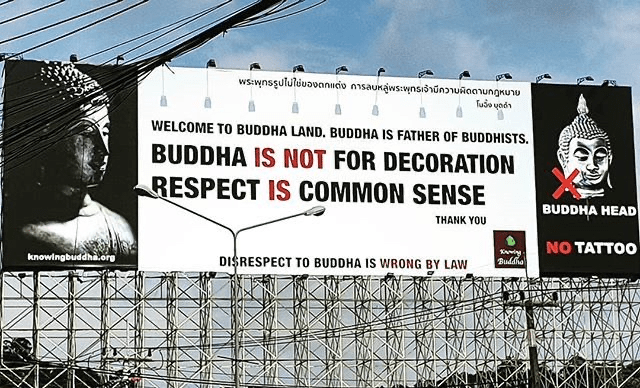
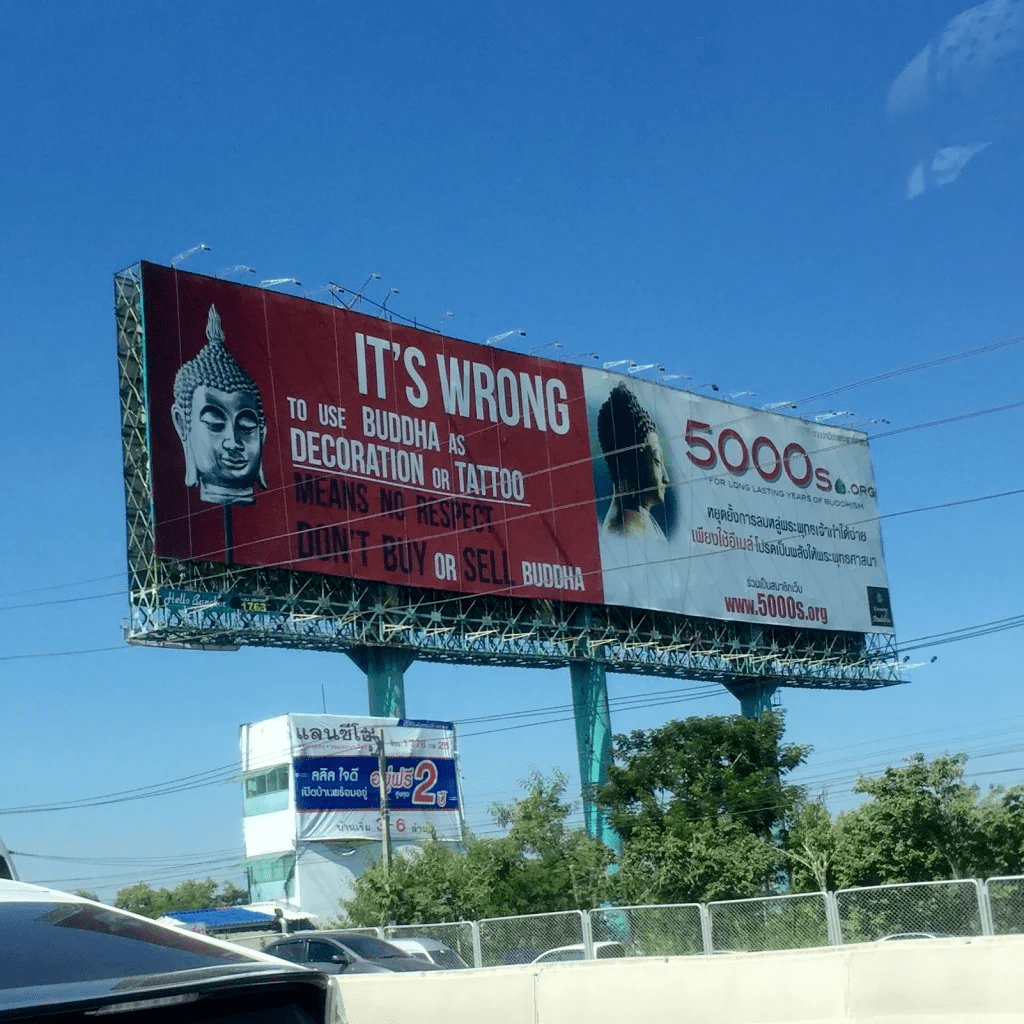
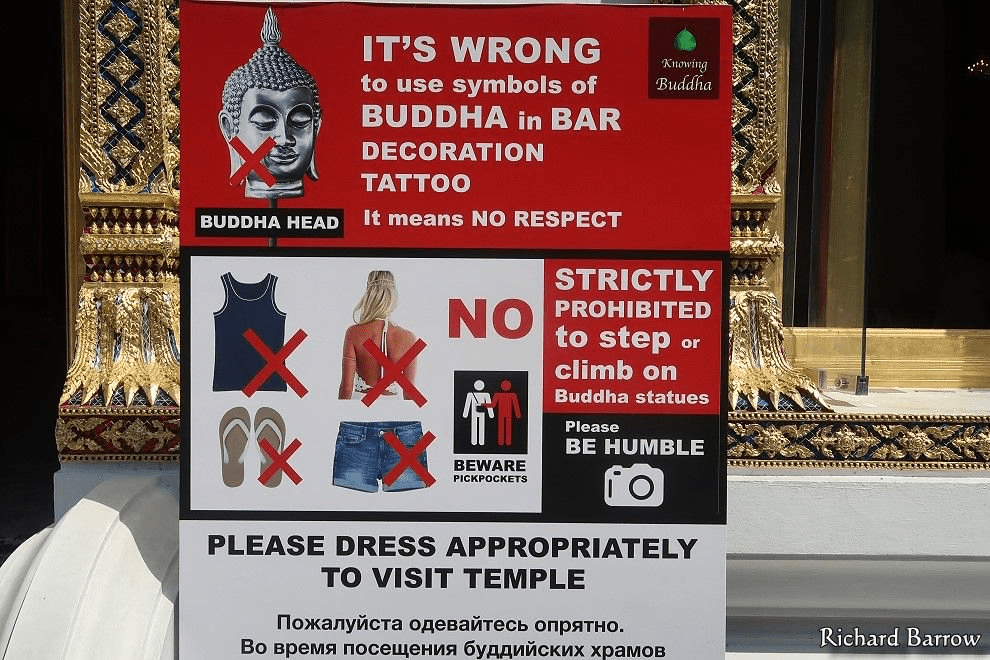
Things change and I’m due back in Denmark earlier than originally planned. In this fortieth installment of the ongoing live series with Wendy Nash inquiring into meditation practice on and off the cushion we delve into the areas of worship, respect and inspiration. How can some activities like pujas (easily) get attributed to worship when they are not actually that? How can we not fall into (blind) worship? Where and how does inspiration and that which deserves respect play into this? And where does all this fit into meditation practice? (This episode was originally spurred primarily by the billboard below)
According to Ai:
The billboard campaign was put up by the Knowing Buddha Organization in Bangkok, Thailand
The billboard has appeared along major highways near Suvarnabhumi Airport and into Bangkok, where tourists first arrive in Thailand.
Zen story on respect and worship:
On a cold winter night, Ikkyū was staying at a temple. Freezing, he took a wooden Buddha statue and burned it in the fire to keep warm.
The caretaker was horrified.
“How dare you burn the Buddha!”
Ikkyū calmly poked through the ashes with a stick.
The caretaker asked, “What are you doing?”
Ikkyū replied, “I’m looking for the sacred relics (śarīra).”
The caretaker said, “But it’s only wood — there are no relics in it!”
Ikkyū answered, “If there are no relics, then it’s just wood. Why not burn it?”
Later, when the caretaker saw Ikkyū bowing to a stone by the road, he asked, “Why bow to that?”
Ikkyū replied, “If you can burn a Buddha, you can bow to a stone.”
A short morning talk by Thanissaro Bhikkhu entitled “Respect Opens Your Mind” — https://overcast.fm/+AAvZro9lDww
PUJA: RITUAL THAT BRIGHTENS THE HEART
[Excerpt from KAMMA AND THE END OF KAMMA by Ajahn Sucitto]
In Buddhism, and in other religions, access to and dwelling in the heart-tone of bright kamma is occasioned by devotion and recollection. In Buddhism, this is called ‘pūja’ – an act of raising up, and honouring that which is worthy of our respect. The very fact that there are human models and actions that one can feel deep respect for is itself a blessing to take note of: honouring opens and uplifts the heart. With pūja, we attend to a skilful felt meaning, linger there and allow the effects to nourish the citta. From this basis, it’s likely that inclinations or even specific ideas in line with bright kamma will arise. Either that, or the mind easily settles into a state that supports meditation. This is how and why one should linger in any bright kamma.
So in the act of honouring the Buddha, one first opens the heart in respect and brings to mind the meaning of an Awakened One: someone of deep clarity; a speaker of truths that penetrate and bring healing to the human condition; one accomplished in understanding and action – a sage whose teachings can still be tested and put into action. If one has a Buddha-image, it’s something that should be held with respect – one cleans it, illuminates it with light, and offers flowers and incense to it. We place it on an altar, bow to it and chant recollections and teachings.
This is not a mindless activity; we use ritual means and resound words and phrases because this full engagement embodies and strengthens the quality of respect in a way that thinking can’t. With the openness of heart that these attitudes bring, any aspect of the teaching that’s brought to mind goes deeper.The act of offering that begins a pūja is a case in point: offering flowers symbolizes bringing forth virtue, offering light is about bringing forth clarity, and incense does the same for meditative concentration. In this way, pūja introduces the heart to important Dhamma themes.
Pūja is especially helpful when people perform it as a group. Then we are participating in the Dhamma as both the expression and the Way of awakening, as well as in the collective commitment to, and engagement with, that Dhamma. This collective engagement ritualizes the ‘Sangha’, that is, the assembly of disciples. Chanting in a group has a harmonizing, settling effect: sonorous and unhurried, it steadies bodily and mental energies and supports an atmosphere of harmony with fellow practitioners. Tuning in and participating brings us out of ourselves and into a deep resonance with heart-impressions of the sacred. We can be touched by a sense of timeless stability, purpose and beauty. If these intentions, felt senses and recollections are established regularly, we know where to find good heart, how to attend to it, and how to allow ourselves to be uplifted. Such kamma feels bright.
The expressions that are used in recollecting Dhamma are that it is experienced directly (not just as a theory), is of timeless significance, and is accessible and furthering for those who practice it. So that gives us an encouragement to look into what the Buddha taught and modeled: the way to the end of suffering and stress. With this, we recollect aspiration, learning and commitment as our common touchstone, and suffering and ignorance as our common challenge. Then we no longer feel so alone with our difficult mind-states, and we can handle them in a more open and aware way. Recollection of Sangha reminds us that although there is greed, anger and confusion in the human world, there are also people who cultivate a way out of that.
If you use pūja on a regular basis, it aligns you to the ‘Triple Gem’ – Buddha, Dhamma and Sangha – by presenting content in terms of images, ideas and themes, and values and practices that guide the heart. It also occasions acts of steering and composing attention. So pūja works both on what the mind is dealing with, and how it operates.
‘At any time when a disciple of the noble ones is recollecting the
Tathāgata … the Dhamma … the Sangha … their own virtues: “[They
are] untorn, unbroken, unspotted, unsplattered, liberating, praised
by the wise, untarnished, conducive to concentration.” At any time
when a disciple of the noble ones is recollecting virtue, his mind is not
overcome with passion, not overcome with aversion, not overcome
with delusion. His mind heads straight, based on virtue. And when the
mind is headed straight, the disciple of the noble ones gains a sense of
the goal, gains a sense of the Dhamma, gains joy connected with the
Dhamma. In one who is joyful, rapture arises. In one who is rapturous,
the body grows calm. One whose body is calmed experiences ease. In
one at ease, the mind becomes concentrated.‘Mahānāma, you should develop this recollection of virtue while you
are walking, while you are standing, while you are sitting, while you
are lying down, while you are busy at work, while you are resting in
your home crowded with children.’~ (A.11:12; B. BODHI, TRANS.)
. . . . ‘Or is there then, Vāseṭṭha, a single one of the Brahmans up to the seventh generation who has seen Brahmā face to face?’
‘No, indeed, Gotama!’
‘Well then, Vāseṭṭha, those ancient Rishis of the Brahmans versed in the Three Vedas, the authors of the verses, the utterers of the verses, whose ancient form of words so chanted, uttered, or composed, the Brahmans of to-day chant over again or repeat; intoning or reciting exactly as has been intoned or recited—to wit, Aṭṭhaka, Vāmaka, Vāmadeva, Vessāmitta, Yamataggi, Aṅgirasa, Bhāradvāja, Vāsettha, Kassapa, and Bhagu—did even they speak thus, saying: “We know it, we have seen it, where Brahmā is, whence Brahmā is, whither Brahmā is?”’
‘Not so, Gotama!’
‘Then you say, Vāseṭṭha, that none of the Brahmans, or of their teachers, or of their pupils, even up to the seventh generation, has ever seen Brahmā face to face. And that even the Rishis of old, the authors and utterers of the verses, of the ancient form of words which the Brahmans of to-day so carefully intone and recite precisely as they have been handed down—even they did not pretend to know or to have seen where or whence or whither Brahmā is. So that the Brahmans versed in the Three Vedas have forsooth said thus: “What we know not, what we have not seen, to a state of union with that we can show the way, and can say: ‘This is the straight path, this is the direct way which makes for salvation, and leads him, who acts according to it, into a state of union with Brahmā!’”
~selection from DN 13 Tevijjasutta — The Three Knowledges
*There’s naturally an ongoing open call for meditation (related) questions for the (roughly) monthly “Meditation Q & A” either by the various social media means listed; integratingpresence[at]protonmail.com or just showing to type/ask live.*

Background
Regular, current and past visitors to Integrating Presence may recall the monthly series “Ask Us Anything” I did with Denny K Miu from August 2020 until January 2022 — partially including and continuing on with Lydia Grace as co-host for awhile until March 2022.
For a few months thereafter I did various Insight Timer live events exploring potential new directions and/or a continuation of the Ask Us Anything format while weaving in other related teachings to these events.
Then, after chats with meditation coach Wendy Nash, it became clear to start a new collaboration similar to “Ask Us Anything” simply and clearly called “Meditation Q & A” especially due to the original intent of the Ask Us Anything’s being “discussions about meditation and related topics.”

Audio: Worship, Respect, Inspiration | “Meditation Q & A With Wendy Nash” #40
Past chats with Wendy:

Unedited transcript via YouTube:
Most welcome. This is Josh integrating presence in her skill. Today I have Wendy Nash back again. Wendy, how’s it going? Yeah, I’m here on Gabby Gabby country in Queensland in Kabula. And how’s it going? Uh, pretty good actually. I’m feeling inspired. So, not only in my dharma practice, that’s always inspiring, but also just generally in life.
So, but we’ll talk about that. Well, that’s cool. Yeah, I’m interested in hearing about that, too. Um, inspiration is always a great thing, especially uh when I’m lacking it, then it’s even more important. Um, I wouldn’t say I’m necessarily lacking it, but I don’t think I have a huge amount of it either.
But so today’s uh topic I’ve I’ve uh titled Oh, um let’s see here. I’m getting my screen up. if I just accidentally closed out one thing, but it’s called worship, respect, inspiration, and this is our 40th meditation Q&A that Wendy and I have done. So, yeah, that’s a little bit of a milestone. So, that’s cool. So, here’s the description.
I I put things um actually, I don’t need to read the the first sentence. So, in this 40th installment of the ongoing live series with Wendy Nash, inquiring into meditation practice on and off the cushion, we plan to delve into the area of worship, respect, and inspiration. Um, how can some activities like pujas, which we’ll go into what that means if you’re not familiar with the term.
How can some activities like pujas easily get attributed to worship when they are not actually that? How can we not fall into blind worship? Where and how does inspiration and that which deserves respect play into this? And where does this all fit into meditation practice? So, this came from a billboard um that I saw from a dharma friend.
And I want to see if I can actually share it on screen. Um but we’ll we’ll see. Um maybe I can I’m not prepared. Um, but maybe I can get that while while we’re talking here if it’s not too distracting. So, um, so let me just just describe that billboard before I throw it up. It shows the Buddha.
Um, this is a billboard in Thailand. It says, “The Buddha is not for decoration. Respect is common sense.” So, it shows a big red X over a Buddha head and saying no tattoos, meaning no Buddha tattoos. And basically, now I’m missing the other image. It’s there’s um an image basically saying they’re not for Oh, here it’s it’s wrong to use symbols of Buddha in the in the bar for decoration or tattoos. This means no respect.
And I also want to talk about this Buddha head too that’s in a retreat center that I was at that is interesting and how this um there’s certain um removals now of Buddhahads and and whatever. So we can we can talk about that. But so I just want to throw it over to Wendy here to see what Wendy makes of all this and where we should start with this too.
Yeah, it’s an interesting thing. So a long while ago I was in a cafe and they had a Buddha sitting on the counter and they had business cards on it and it was like a business card holder. And so I said to one of the people behind the counter, I said, “Would you have Mary or Jesus?” Turned out she was French.
So, um, she’s deeply Catholic. And she said, “Oh, no. This is completely offensive.” And, and I thought this was a really good way of describing it. Well, would you have, you know, Mary or Jesus do doing that, you know, and how how would that be? So I think we have as a sort of a non less religious society not understood that for some people Jesus, Mary, Buddha, the prophet Muhammad, whoever it is are key figures and you can’t des you know, you know, what is the word? Descrate. Descrate. Yeah.
No, this is a really um uh really So, what I wanted to do actually because of the potentially inflammatory nature of uh if I got too far to one side or the other, I mean, I’m sure I’m going to maybe upset some Buddhists by not being reverent and respectful enough uh with some of the things I might bring up.
Um, and these aren’t my personal beliefs or opinions. I just want to cover kind of the whole spectrum of this if we can as much as we can within a wise reason, you know, and as as respectful as we can as kind of an outside like archaeologist looking at things or something like this. And then I’m I I could potentially do that, but also um to the the to the other end where um that that uh maybe I’m too religious around this, you know what I mean? over that’s the other extreme kind of too fundamental and religious around this and not opening up um you know
maybe too orthodox. So um just just due to that and then all the things in the world going on right now. Apparently my my partner uh read some things about more war mongering and saber rattling and um war beating the war drums. And so and some of this um I would imagine has religious undertones, overtones um involvements and how this could potentially even though we’re putting it in context of Buddhist how it could potentially be extrapolated out to other religions who actually do worship.
So it is it can be a potentially sensitive in issue for for people on both sides whether people think that religion is horrible and it’s a cause of a lot of problems or other people who say it’s because we don’t have religions that there’s you know what I mean so it’s just on all sides you know uh they say not to talk about religion and politics in polite company but this this um this topic we’re talking about does play into our meditation practice.
So if um if we just just what I call the three breath highway. So I like to just close our eyes and take um just well a couple deep breaths before we even do the deep breath or the three breath highway and come into the body and just follow three full entire breaths from every moment of the inhale to any pause and then every moment of the exhale. So I’ll give a silence here.
It doesn’t have to be every single moment if you can’t do it. It doesn’t have to be exactly three breaths. Just staying with every moment you can. Inhaling, pausing, exhaling, pausing. And however it is, it’s okay. And I’ve just noticed that my breath is really kind of shallow and and fast now because of I’ve had a cup of coffee this morning, which I normally don’t before these things. I like to do tea.
And um and then with that, I’d actually like to have Wendy do a brief um reflection on loving kindness because that’s her main practice and how she does it. Sure. But I do want to say a highway is a like that is an inflammatory word for me because that’s about that’s all the car dependence.
We do not worship the car. Just say that’s right. It’s need if you’re like if you’re near a highway, you definitely need this. And we can change it to the bike path, right? We can say maybe a bike path or you could just say a path. There we go. Uh yes. How we’re getting on someplace uh where we can both be challenged extremely but also it can be of benefit to us um that we have a path.
Right. All right. So we’ll do I’ll do my my version which is very hands-on very straightforward. You don’t need to close your eyes, but if you feel like it, by all means. And basically what what I like to do for loving kindness meditation is to notice the small gestures that help you feel at ease.
So for instance, Josh opened today thinking ah it be really good to make sure that people who might feel unsettled by the topic would be um would like to feel at ease and so he created a meditation and then he thought well I too would like to do that and he knows that loving kindness meditation is an important uh aspect for me and then when I raised the name of it that he took that with some humility and response which shows just within these few minutes how important it’s been to just appreciate these small tiny gestures that Josh has helped us feel at ease and
that applies to anyone anywhere. So for instance, wherever you are here, where whatever you were doing this time yesterday, just think back to what was somebody doing to help you feel at ease. You know, whatever time of the day it was. So for me, it’s coming up to dinner time.
Did somebody cook? Did somebody clean for you? Did somebody text you something? Like somebody messaged me today and said, “You might be interested in this.” And it was actually two people did that today and it was such a lovely gesture. And so just looking for these small things. Did somebody turn up to a meeting prepared? Josh came prepared today.
Did somebody pay an invoice on time? A supplier. So these are small things perhaps we can take for granted. But just noticing any small acts in the last 24 hours that just made your life easier for the fact that if it hadn’t been there, you would have really felt irritated. So these are small acts to help you feel at ease.
So that’s the that’s the journey. I don’t know if that was okay, but there you go. So beautiful. And just let me reinforce this because it it also helps mindfulness and posit uh it counters our negativity bias because I I know that a lot of times I’m looking and the the problems stand out, you know, and I’m not always like this like this is an artificial container, right? And Wendy helps um provide that space and helps draw this out, which I would say this this is true and accurate.
It’s just not I’m not just not like this all the time, right? So, this is a special container where this a certain qualities can be amplified just like Wendy’s practice too. Uh, and it’s it’s authentic. It’s not lying or pretending some kind of um you know um some kind of um a uh affirmation that you know that I hope to get to someday. It’s real true.
It’s happened. It’s inclining the mind towards something helpful. It’s taking time. Then we have to review, right? we have to be mindful and use memory and uh recall uh things. So it’s it’s helping us and then it’s helping it condition to be on the lookout for this to condition the mind to see this and then to not as a theoretical thing but like an energetic feedback and can feel how beneficial this feels and it’s also I just go on and on like it’s conducive for relationships and interactions as well because you’re automatically
showing value towards someone else and not taking that for granted and how we’re all interdependent on each other. So yeah, I can’t say enough good things about this this um this version of loving kindness that that Wendy puts forth. It’s so it’s so beneficial, you know. And speaking of of relationships, my partner, you know, we have a relationship like any other relationship.
And every now and again I get irritated with him cuz that’s what I get irritated with myself. Why wouldn’t I get irritated with somebody else, you know? So of course I’m going to do that. And it just means that that time when I want to kind of get irritated, which is often it just I instead of being irritable, I just go, “Oh, thanks for doing this.
Thanks for doing that.” And we both do it. And it it just really creates such a nice space. So, it’s interesting how you talk about the negativity bias. I don’t think I’ve got that anymore because I think I’m just so I’ve been training in this for five years now, maybe a bit longer. I I’m just always looking for the good stuff and always noticing everything positive and yeah so things don’t work my well but work my way but actually I’m so trained to look for the good stuff I kind of go ah and then I go oh well oh well there you go
and it’s also helpful too once I have that momentum I found when I did this practice more then it when we really faced with something really negative in life it helps counterbalance that because I and reflecting on how I’ve been more negative Nancy or you know been in that kind of tail spin of negativity then the positivity helps balance that out as well you know and we’re looking we’re we’re trying to incline the heart and mind to things that are beneficial for us and for others especially in the long term now
I’m I’m not saying that so I guess the the the counterbalance is not to and Wendy’s is really good about calling out BS that’s what I another thing I really appreciate it and she does it in a kind helpful way too. So this is um this you know this is it helps condition the heart to deal with things that are negative and not beneficial in life and how then to go about the best way to deal with those to view with those situations and instances and then how to respond to them because if um if I don’t have enough resources to deal with that
then the tendency for me is just to match the same type of energy and just continue to go down the toilet or down the spiral right if I don’t have like a reference point and a strength of the opposite type of energy and uh view to to bring to a situation. So yeah. Well, you know, we talked about inspiration, so that’s inspiring.
And I recently feel inspired because um well, maybe I’ll talk about that a little bit later on, but I find that a really inspiring practice because then it makes me recognize the goodness in others all the time. So, I really like it. But there’s no polyiana. So, look, I have to deal with I’ve got a a not for-p profofit.
I have to deal with state departments. I have to deal with, you know, software producers. I have to deal with all that. And Yep. And I don’t want to deal with it. And I get really irritated by the letters and I and the interactions and all that sort of stuff. Um but but but but nonetheless, I think it’s more that we just aren’t looking for the other stuff to counter counter it. So that’s that.
So I think I don’t know. I found that a very inspiring practice and I think that’s why my partner speaking before I think that’s why we managed to have such a high level of respect for each other because he then notices every time I notice what he’s doing. So doesn’t give the opportunity for resentment to arise because he knows that I’m always noticing everything he does.
So it’s a sort of a respecting little I don’t know ping pong or something we’ve got going. It is. Yeah. It’s it’s compounding as well, right? And you know especially for guys I think is the it’s a big deal for guys to be respected or disrespected. You know what I mean? So uh if you you know traditionally speaking the masculine tendency I think these this day and age it’s it’s really kind of a big bigger deal for for guys I think is this respect or lack of respect and uh yeah we can we can go into that too.
And then also value we show that we value and things are validated when they’re kind of we get external reinforcement and external um cues and indications that something is valuable. something is valued. Yeah. So it and that’s kind of a feminine tendency maybe traditionally and so both it reinforces and helps both of these things. Yes.
So yeah. So I don’t go with a whole masculine feminine. I’m just not a feminine person at all. You know I just get cranky and I have to work with that and I so I don’t I don’t go with that sort of stuff. I’m much more interested in introverts and extroverts I find. And they it’s Yeah.
But but I think everybody wants to be respected. No one wants to be taken for granted. Exactly. And I think that often um everybody takes everybody a little bit for granted. And and that practice of just saying thank you every time you do something. Every time the other person does something for you, it just is fantastic.
And the other thing to do is to say sorry. And that’s respectful as well. And you know, it just seems like it’s nothing. Why should I say sorry? And it’s like, does it really matter? Just say sorry. Like, no one likes to upset anybody. I’m sorry I upset you. It uh I found in relationships, too. It saves a lot of time, hassle, and trouble and and squabbbling.
It’s just come out as soon as I can and admit my wrong my u shortcomings, you know. And yeah, it takes a it it takes a lot of strength and courage to do that for some people too. And I like just that like you say making it habitual in a way. It doesn’t mean that I’m um less than or anything like that.
It’s for I feel like the greater balance and harmony of um you know the relationship which then can have a snowball effect and help those around us and those we interact with too. So yeah, it really is. And and I’m I I think I’m learning that the hard way more. I it’s it’s like I should get that quicker, I feel.
But it better late than never. And did you use the word highway again? No, I don’t think I did actually. What did you I I misheard I was slightly distracted by We’ve got a couple of comments here. One is by flight because which is one of those random kind of are you guys on a date? Whatever. Not interested. So don’t post stuff that’s not about meditation.
And then somebody’s written Dave Thomas 30. He got Josh, what are you on? And I think that’s also an irrelevant thing. So I think we’ll skip that one. So if you’re hoping for an answer for that, delete. The uh the trolls are out. We don’t we’re not feeding the trolls, right? Uh but yeah, I’ll just just transform that into some playful humorous guy banter.
Let’s just say that. And just a haha, that’s funny, dude. Something like that. Um but okay so but maybe that’s also an indication to go ahead Wendy. Yeah. Yeah. So I looked up the etmology of the word worship. So respect and inspiration is one that sort of ones that we talk about pretty commonly here. Mhm.
And worship comes from the old English word. I’m just looking up in one of the AI things and it says worship comes from the old English word worthship pronounced worth but it’s got funny letters in there and it said which meant the condition of being worthy or honor dignity glory so worth means worthy or valuable and ship skip is state condition ship as in friendship or leadership by the 13th century worship began to take on religious connotations.
So it didn’t actually start there. It just meant that it’s worthyful. It’s a state of worth. Wow. So that is that. So that’s and I think I think that makes it much more like in that way. Okay. So by the 13th century, so 1200 something or rather worship began to take on a religious conversation conversation convers connotation and connotation.
Our friend M. Reed is here. Hello. So lovely to see you again. Really nice really nice to have you back. Uh worship began to take on a religious connotation referring to the act of showing reverence, devotion or honor to a deity or sacred object. Hence its relevance to us today. It has also retained its secular meaning referring to honor or respect shown at to someone of high status.
For example, uh we worship you know royalty or whatever. Modern usage today worship primarily refers to religious devotional rituals attending a worship service. It can also describe deep admiration or love for someone or something. Eg she worships her favorite musician. So, so this is completely different than what I take worship to mean now.
you know, um, respect is is from the modern day at least connotation that I have of worship is that worship is can be potentially distorted that there’s no kind of um thought process involved or wisdom involved that it’s maybe like an automaton um on automatic and that I’m giving my energy away uh mindlessly.
So I I don’t know if that’s an accurate refraction, but that’s kind of what I when I think of worship, that’s what I kind of uh think of that, right? Um now that’s different from like you saying the ethmology. So and I would say I’m not too far off maybe in what people think about worship or the way it’s sometimes used these days.
Now honor and respect might be similar to that, but it’s not um what I just laid out there, but it’s it’s it’s different. If I respect something, it doesn’t there’s a kind of a okay I um some people I guess do it on automatic pilot without thinking or they do it in fear out of fear or without um vetting if it’s worthy of honor and respect or not.
They just do it for other reasons. But yeah, so the the reason this also came up is cuz I just got back from a meditation retreat like at a monastery, right? A winter retreat where we were doing puja pretty much uh many days. And so let’s just for people that don’t know puja um how maybe I would describe it is just more literally in this context you you you go early and in the morning you’re you’re doing silent meditation and then after that period of silent meditation which is maybe around 40 minutes to an hour then we’re doing some chanting uh
out of a chanting book and it has it’s it’s about basically Buddha Dhamama sanga and various themes um for the most part let’s just say to simplify it and Um yeah and then um that that that’s pretty much what it constitutes and then in the evening it’s the the opposite or reverse where you’re doing some chanting first uh and then and then doing the silent sitting.
Um but that’s that’s the kind of then there’s a huge there’s a damah hall right there’s a huge Buddha statue a Buddha rupa at the front candles and incense are lit there’s monastics and robes and so we can talk about all these externalizations and there’s also bowing involved so that’s uh I think very uh foreign at least for me in the west to do the these type of things right so if from an outsider with no context just walking in and observing this from the outside it looks like a worship like um like I was uh you know raised in um uh Lutheran which is a
Protestant um Christianity and so they’re basically you know the things they say the the hymns they sing you know the the sentiments that are expressed even though it’s kind of dialed back and more I would say repressive that that is yeah it’s it’s that’s known as worship that’s my reference point for what worship is and they’re they’re um explicitly acknowledging that it’s worship in Christianity this some people would say this is worship and some Buddhists say this is worship um but some like me I I I wouldn’t consider it that and we have
to go into details of why I wouldn’t considered worship that I would consider it more inspirational there’s the word right and um respectful and conducive to meditation practice and faith and wisdom so there’s kind of maybe some splitting hairs here and some fine lines that we can I don’t know how granular We want to go into details on this, but I have put the image up now um for this as well.
Um and maybe we can talk about Wendy already mentioned one story around this. There’s so much to say for me around this, but I don’t want to talk the entire time. I want to throw it back here to Wendy and see uh where we should go with all this. Yeah. So, as it’s interesting because I have a completely different take on the word worship.
Um I got I was more like that with devotion. I’m like I’m not devoted. I’m not going to be devote. So I had a funny reaction and I think it’s just my own um childhood something or other. I I I don’t really have that. But it’s interesting. I’m supporting a friend at the moment who’s got some mental health issues and some marital issues and stuff like that.
he follows a different religion and I always encourage him to really think about the and he’s he’s very attentive to the book of that religion and uh so I encourage him always to kind of well what is the essence of that so rather than going through the ritual of it what is the essence and it turned out that he had been doing things sort of uh because he felt he should so through the ritual what you would call the worship and then I was going but you don’t really practice it and I think it’s because it’s got this punitive you should be you know doing this this this
is part of your um rituals your worship you’re showing your devotion and um yeah it’s been a very interesting experience for me to sort of see who somebody who is very very faithoriented actually to go actually I practice because I just I do go through the motions of it whereas I because I I mean he was born into that religion whereas I’m I was born into Christianity I suppose but not really and then I have found my own path into Buddhism and so I think I for me I mean I maybe it’s just me in the way that I see it
but I see it’s about practice There’s no point for me participating in a religion unless I want to take it with some um unless I want to become a better person. I don’t want to become one of these earnest, boring, self-righteous people. I can be like that. I’ve been like that. I’m still like that. But I think it is important also to recognize that I don’t know like everyone’s trying their best but I really dislike the whole ritual stepping it through the sun what do they call it the Sunday Christian or something you know I I
don’t like that at all because to me it just feels fake and insincere and I don’t care what I’m doing I don’t like it when people are fake and insincere and that doesn’t apply to that doesn’t apply just to religion. So yeah, I couldn’t agree more, Wendy. And that that’s the whole point of doing this because when I found myself doing the pua when I’m not when I wasn’t mindful, I found myself potentially going falling into that trap and just going on pilot, everyone around me is doing the same thing, right? And as soon as I lose
heatfulness or mindfulness, then I’m just kind of going through the motions because everybody else is and I’m doing this every day. And I don’t want to do that because that’s to me that’s not helpful. and then that could fall into worship and I don’t want to do that. Right? Wendy says, “How is this going to be a support for my practice? And how is this going to be a support for the the betterment of my life and those around me instead of just falling into another ritual that I do every day and and do it mindlessly and and it’s it’s just on
automatic, right? So so that’s the that’s the potential danger of this, but that’s not the intent in the practice behind it. I feel with with these pujas now I can obviously see how people can mistake it for that and I know firsthand how easy it is to actually fall into that.
Um but I can also see how this can be a very good mindfulness practice in the intentionality behind it. And also when I’m when I’m go to bow then I uh when I’m mindful I bring to the heart okay how authentic do I feel doing this? Sometimes I feel, oh well, this doesn’t feel natural. And then notice that as a as a response in the heart.
Other times it does feel authentic and natural and out of sincere honor and respect and one that’s going to benefit u my practice and those around me by showing u respect and honor to that which is deserves it basically and is worthy of it and and because of that is helpful. And yeah, this this notion um reminds me too, I want to say this, of um the the kind of head of the western SA in Taiforce tradition of Ajan Cha, the monasteries who has been practicing out in in um in England.
um Lumpur Suchito Ajan I’m sorry um Ajan Sumido uh um Lumpur Sumo he’s famously known for and I’m going to take this out of context a little and not paint the context but it’s just kind of almost a shocking statement he’s he’s known for saying if I’m getting this right I don’t want a bunch of bloody Buddhists you know and I thought that was actually really inspiring in a way a little bit controversial but what that for to me what that points to and I could be getting it wrong in our context is that he doesn’t want a bunch of uh followers and worshippers and people
that take this on as a religion. What he wants is sincere practitioners who are going to you know have honest uh true faith as best as they can and uh confidence and um you know the the qualities that are going to be helpful and also um their own sincere practice and ability to verify this faith and confidence with their own wisdom or the cultivation of wisdom through their practice of meditation um is kind of what I get about this. Yeah.
So, I guess the other thing to do is talk about the opposite of this is um dishonor and dis disrespect. So, I’ve got the you can Can you see the billboard up here in the screen? Okay. So, yeah, we got it up now. I can take it down a little bit after we talk about it. But yeah, just trying to turn my light so I got don’t look like I’m sitting in the dark.
Um yeah, it’s an interesting thing that you know what does it mean like who am I to decide what is what is fake what is sincere but it’s true interestingly I read an article about tattoos and there’s a whole lot of people who’ve got this eye disease because of the ink in tattoos so there’s some yeah so I think they’ve got like it’s a cancer let me see if I can pull it up so it just that’s an aside.
So, apart from anything, don’t get a a tattoo of a Buddha, but don’t get a tattoo actually in general. Yeah, I’ve had a guest on recently that talked about the dangers of tattoos, or I haven’t heard him say, but he he recommends it. I’m It’s almost more rebellious not to have a tattoo these days anyway because so many people have them.
So, here it is. A small but increasing number of Australians are being diagnosed with a rare tattoo related eye condition. It’s known as tattoo associated u u ititis and can cause permanent vision loss. So it’s to do with the chemicals they use in um in the ink. Yeah. And and they’re wandering around the body.
So that’s Yeah. And it’s interesting because a lot of people who are really into a lot of natural stuff get tattoos and I’m like they don’t re recognize that that’s just another thing. So yeah. Interesting. So Emmery has said authentic living the only way to live. Well, it would be nice if we could all do it.
But imagine if you were in a really horrible place and and actually being authentic created problems, then what do you do? Well, it’s it’s a really good point. Uh and so I think we kind of each know that for ourselves that that statement I I take to mean that people that are fake, right? That statement is meant for people that kind of know they’re kind of lying to themselves and that they’re they’re they’re not being true to um themselves or having honesty.
So that’s when I find it’s really but yeah just let’s preface that with just because I’m authentic doesn’t mean that I don’t have to be ethical now because you know I’m just going to be however I want and be real, right? That’s not what we mean by at least that’s what I take it to mean. So, so that statement I think is meant for people that are just okay, they see something and they want to be pretend to be a certain way because of certain reasons, right? Um, yeah.
And so, yeah, it’s a good point, Winnie, because that that the other extreme of that it could be overdone. Oh, hey, I’m real. I’m honest. I’m just going to speak truth the entire time and not have any regard for anything else. So, which is a good point here. So yeah, when we do this talk it just reminding of white speech here to to keep myself in check.
The first one is it true that’s and that’s the the most important you know is it honest and true to the best of my knowledge right now. Then is it is it kind because it’s then we can be inflammatory and cause which the next one we want to make it con um for concord instead of division. So that’s where the kindness helps out to bring concord instead of division.
And then is it the right time to say that say this? And actually if we get if I push it a little bit too far maybe it’s not the right time to go into religious fervor for some or can say because of because of the state of the world right now. So is it the right time to say it? And then is it necess is it helpful you know uh and then is it necessary is it is this really necessary to say and that’s a tough one because uh with yeah always chatting you know so Emry Emmery said move I think it means authentic living the only way to
move I think that’s where oh I guess to move maybe to move about in the world to to to to yeah we can we can ask for for clarification. Yeah, she said, “Silence has power as speech does knowing when to do one over the other.” A great chat. Thanks. It’s always lovely to have you here. Um I think you know there is something about the a pregnant pause or you know silence is louder than words often.
So there’s there’s that too. It’s a response as well. Choosing to remain silent is a choice in response as well. You know what I mean? not to speak out on something, not to say something, to hold back is a type of um response as well. So, let me um so we we’ve we’ve talked a little bit, sorry, I get this um we’ve talked a little bit about um you know the the the disrespect.
So for me um the let me just say the Buddha head um it’s if you don’t know this then then maybe fly in the radar and so education um from what I understand some of these Buddha heads have been ripped off of statues and things you know um like as kind of a well if you if you’re after someone’s head right you some waring cultures used to take it as a trophy so they would cut off people’s heads put it on a stake you know put it for display and say okay this is what happens to people to do this.
This is our prowess as warriors and things like that. So I I’m taking some people interpret it as that, right? They they desecrate um a Buddha rupa which in itself, you know, um uh is is just a form. So this is again this is a complex issue from what I understand. Actually, the Buddha uh if we’re going to be strict about this, he he didn’t want a lot of religious imagery around to begin with.
I think there was only approval of like footprints. um a wheel, an empty throne. Um trying to think of a few other ones, but over time um those became like uh because of our I would say I can’t speak for everybody because of our lack of decline in understanding and uh wisdom that those then beca those images that were approved u if I’m getting that right now someone chime in if I’m getting that wrong then meant nothing and so they were kind of empty and hollow.
So then we needed a more um a Buddha rupa like is a Buddha form to then uh have a reminder of like what this notion of the Buddha is or was and what it represents. So so then we have that and to me I it it depends how we use that. Yeah. It’s a reminder and Wendy wants to jump in here. Sure. Go ahead. I do.
I do. The Gandara Buddha which is the one that we see everywhere which is the robes and everything like that. So Alexander the Great um who was great I think according to his own legend rather than anything that anybody else did because he was pretty ruthless and nasty. Um he died at 33 interestingly didn’t live a long life but he brought it over from Maced Macedonia.
So it’s the Roman kind of robes and Greek robes that we’re seeing that’s that’s it is he’s buff Buddha you know he’s not emaciated is he? He’s strong and he’s tough and all the rest. So, um I’ll look up the history of that. Sure. Sure. And that’s my understanding. That’s one version. That’s right. That’s one version of it.
We do have like an emaciated uh Buddha. That was before he was Buddha, you know, as he was an aesthetic, but that’s not a common one. We do have thinner Buddhas, you know, there’s there’s Buddha Rupas from Burma that aren’t as, you know, big and buff and Roman-esque, let’s just say. Um so there’s various different types of Buddha images.
Um, where I was going with this though is okay, it’s like what is the intention in the heart and what is this respect now and I also go into the Zen thing that goes to the other extreme of how I wouldn’t say extreme but points out that some people are taking this over um being over um reverent towards it and almost religious towards it and then maybe mistaking the image for the actual thing and being overly um overly protective of it.
So, let me just read this little Zen story here that um talks to the opposite of this. So, on a cold winter night, uh I don’t know how to say this. I KK Ku Yu a Caillou was staying at a temple. Freezing, he took a wooden Buddha statue and burned it in the fire to keep warm. The caretaker was horrified.
How dare you burn the Buddha? I you calmly poke through the ashes with the stick. The caretaker asked, “What are you doing?” Um, he replied, “I’m looking for the sacred relics, Seria.” So, what this really um that this is what happens when um you um when you kind of um cremate a body and there’s things left in the body that science can’t explain and some of them look like gems, some little things remaining that should have burned up for regular people, but there’s now things in the ashes. So, back to the story.
The caretaker said, “But it’s only wood. There are no relics in it.” And then I answered, “If there are no relics, then it’s just wood. Why not burn it?” Later, when the caretaker saw Ikyu bowing to a stone by the road, he asked, “Why bow to that?” Iku replied, “If you can burn a Buddha, you can bow to a stone.
” There we are. So, I’ve looked up through my AI thing. The evolution of how the Buddha was depicted in art is a fascinating journey. So, it’s got pretty bad text, but anyway, reflecting changes in religious thought, cultural exchange, and artistic traditions. Here’s a concise history. So, the aniconic symbols, the 5th to the 1st century B.C.E.
In the earliest period, the Buddha was not depicted in human form. Instead, artists use symbols to represent his presence and teachings. the dharma wheel, footprints, empty throne or bo uh bodhic tree, lotus flower or a stuper. So early Buddhists may have avoided human depictions due to the influence of an iconism avoiding idolatry because the Buddhist physical form was considered too transcendent to represent anthropomorphic depictions first century CE onward.
The shift to human depictions of the Buddha began around 1st century CE influenced by several factors. Gandara and Mthura schools which is the first to third century Gandara modernday Pakistan Afghanistan under Greco Roman and Persian influence the Buddha was depicted as a human figure with helenistic features wavy hair draped robes and a serene expression hardly Asian.
Um this style reflected the Greek artistic tradition the Gandara Buddha Matura which is in India. The Buddha was shown with Indian features wearing a monastic robe and often with a halo. These depictions emphasized his spiritual authority and divine nature. Key features usha cranial bump the third eye the m the mudras the hand gestures.
Why the change? Cultural exchange. The Silk Road facilitated the blending of Greek, Roman, and Indian artistic styles. Devotional needs as Buddhism Buddhism spread. Followers wanted tangible images for worship and meditation. There’s your thing. Mahayana Buddhism emphasized the Buddha’s divine and compassionate aspects, encouraging more humanlike representations.
So as it spread across Asia in the 4th to the 13th century CE, China became Buddha became more round and serene. Confus reflecting confusion and dowist ideals of harmony. Southeast Asia, Thailand, Cambodia, Indonesia. Depictions include elaborate headdresses, ornate robes, and mudras blending Indian and indigenous styles.
In Tibet, it’s often shown with intense expressions and intricate mandalas. In Japan, the Buddha’s image became more abstract and symbolic with influences from Shinto and Zen. The buff Buddha, which is what I called it, um, as a jolly round figure, also called laughing Buddha or Buddha, is a misconception. Buddha is a hotel in Japan.
The 10th century Chinese monk known for his laughter, kindness, and large belly. He was not the historical Buddha but became a folk symbol of happiness and abundance. Confusion over time Buddha’s image merged with the Buddhas in western pop culture leading to the fat Buddha stereotype. Depictions of Sedata Gutama the historical Buddha uh remain slender and serene in traditional Buddhist art reflecting his acetic origins.
So there’s reclining Buddha which is in Thailand obviously standing Buddha shows him performing miracles or teaching and cosmic Buddha abstract formless representations in esoteric traditions. So it just depends on what your what your thing is your cultural artistic representations. So continues to evolve I think and so why is this all important you know why is this all important for like meditation practice and you know I we one might say well this is all superficial this is external trappings you know where’s the
real internal and and I would agree with that to a certain degree it’s just that uh we normally don’t interact in our waking life in the external world like that you know unless you’re a really deep accomplished practitioner you know that you can see through these these um changing form, you know, forms in the external.
But for a lot of us who are are not that accomplished and wise yet and who can see that this this this these these images are images are very powerful, right? They’re they’re huge. They they they they evoke emotions. Our emotions are with them. We turn on the news and how we can get triggered out by just seeing certain images. How um watching a movie can be completely involved in and loss.
So, so images are very um um striking and powerful and you know going to a monastery and but it’s not just some book or some idea or you know a statue or some guy on an island in Denmark you know practice talking really good stuff but like is that real you know is how is he when the camera goes off and things like this.
No, you go you can go to these places and monasteries today. You can see people um venerables that are wearing these robes and they’re they’re they’re holding each other to account of this very high standards of conduct and and practice. And of course they’re not perfect either, but there it’s a living uh breathing tradition today that they’re open to um you know seeking the truth of the way things are and the best way to go about it for their own well-being and and that of those around them.
And so it’s not it’s a it’s a real living tradition and that visual images are very powerful but at the end of the day how is all this affecting the heart and mind right this is not an abstract all mental thing not all emotional either but like where is the balance of heart and mind what is the benefit and and what are the drawbacks of all this and how I’m seeing it viewing it and responding to it you know where’s the balance yeah so uh Emry Reed says, “You asked the question, Wendy.
What does it one do in a not so nice environment, etc. I answered move, walk away.” So that’s where that Oh, yes. Got it. Okay. Yes. Yes. So, yeah. I mean, I think that’s right. So, we’ve still got another 15 minutes. Yeah. And so, I guess images of I mean, anything can be good or bad. And often I don’t know that we know what is good or bad.
And I I don’t know. Uh do we have to be perfect? No such thing. So I guess in terms of worship, respect, inspiration, if someone’s just going through the motions, how bad is it? Does it mean that you know in 10 years down the track when it suddenly goes, “Oh, actually now the some terrible calamity happens.
” and they go, “Ah, that’s what that means.” And they take it to heart. So, is that good enough? It’s a really good point, Wendy. And I think that’s for each individual kind of to know for themselves and figure out for themselves. Um, so here’s I want to read if it’s okay this this some of this passage from Ajan Suchito.
And I think this is really um the heart of what kind of pua is. So, it’s a ritual that brightens the heart. Do you think it would make sense to read read that? Um, yeah. Excuse me. How rude am I? I’m yelling. No, it’s it’s okay. Maybe I’ll just read a couple things. And so this kind of is the whole point behind this for for those who look at this and say, you know, maybe this is pointless or what’s the point of this? So in Buddhism and other religions, and this is from Ajan Suchito, in Buddhism and other religions, access to and dwelling in the
heart tone of bright comma is associated by devotion and recollection. in Buddhism is called puja. An act of raising up and honoring that which is worthy of our respect. The very fact that there are human models and actions that one can feel deep respect for is in itself a blessing to take note of. Honoring opens and uplifts the heart.
With puja we attend to skillful felt meaning, linger there and allow the effects to nourish the chitta which is the heart mind. uh from this basis it’s likely that inclinations or uh even specific ideas in line with bright comma will arise either that or the mind easily settles into a state that supports meditation.
This is how and why one should linger in any bright comma. So in the act of honoring the Buddha, one first opens the heart in respect and brings to mind the meaning of an awakened one, someone with deep clarity, a speaker of truths that permeate and bring healing to the human condition, one accomplished in understanding and action, a sage whose teachings can still be tested and put into action.
If one has a Buddha image, it’s something that should be held with respect. One cleans it, illuminates it with light, and offers flowers and incense to it. We place it on an altar and bow to it and chant recollections and teachings. This is not a mindless activity. We use ritual means and resound words and phrases because this this full engagement embodies and strengthens the quality of respect in a way that thinking can’t.
With the openness of heart that these attitudes bring, any aspect of the teaching that’s brought to mind goes deeper. The act of offering that begins a puja is a case in point. Offering flowers symbolizes bringing forth virtue. Offering light is about bringing forth clarity. And incense does the same for meditative concentration.
In this way, puja introduces the heart to important dharma themes. So, and then one more, I’ll just read another one paragraph. Oh, puja is especially helpful when people perform it as a group. Then we are participating in the dharma as both the expression and the way of awakening as well as the in the collective commitment to and engagement with that dharma.
This collective engagement ritualizes the sa that is the assembly of disciples. Chanting in a group has a harmonizing settling effect. Um sonoris and unhurried. It steadies bodily and mentally mental energies and supports an atmosphere of harmony with fellow practitioners. Tuning in and participating brings us out of ourselves and into deep resonance with heart impressions of the sacred.
We can be touched by a sense of timeless stability, purpose, and beauty. If these intentions, felt senses and recollections are established regularly, we know where to find good heart, how to attend to it, and how to allow ourselves to be uplifted. Such comma feels bright. And by comma here uh means action. So yeah, it’s this kind of that’s the kind of sentiment that’s um that that that I when I’m not mindful of that, it’s easy to fall away and fall into worship.
But that’s the whole point of kind of puja having a Buddha image and going through different kind of rituals and practices and chanting and things like that. So yeah, it’s easily confused as otherwise especially I think in the west when we have this uh when I have this um um other notion of what this is where you go to church you’re just repeating and believing without you know really verifying and not that there’s anything wrong actually I I it’s commendable to some degree because other having no ethics or having kind of um just falling into heedlessness and doing
things mindlessly that is is a better alternative. especially to start with than the alternative I find uh perhaps. Yeah. Oh, Wendy, I can’t uh so I’m I I’m not hearing you, Wendy. That’s all right. That’s okay. My mistake. I turned it on to mute. Okay. Uh Emry says, “Thank you for this chat. Was very insightful.
I also look into the ethmology of words. Thank you both for this chat. Nice to be here listening in.” So, always great to have Emry here every time. Yes. Um, yeah. I was thinking about the word worship and puja and the sort of ritual process and I’m wondering if what you’re describing is the empty worship like to me you worship is worship you know it’s just I worship whatever and and I think what I’m hearing is if it’s empty and if Like the thing that bothers me more is not so much whether you’re mindful in the moment, but that you are
a Sunday Christian for lack of a better word. And I think that makes it um harmful. So even if you fall for you’re not perfect, there’s something about um being say for instance in a in a meditation place and doing one thing and then you’re different the rest of the week or when you’re outside there. And I think that’s really really and then you’re self-righteous about how good am I cuz I go to the church, the synagogue, the mosque, the um temple.
But yeah, and I think it’s that that causes the problems. That’s me anyway. That’s so well put. I mean, I really couldn’t put it more clearly and concisely than that, Wendy. Uh and that’s what it’s about. And this is where and even that’s not perfect too, right? So if we do find ourselves in that situation, okay, now what do I do about that? How can then I be more authentic and um rectify or how do I address that? If I find myself in that position where I’m actually being, you know, self-righteous and maybe fake
about it or, you know, just being a Sunday Christian and then I’m considering changing that. How do I do that? and how do I not beat myself up over that and get out of that and be more authentic, you know, and be more real and uh helpful as well. So, so yeah, so that’s it’s a possibility to do that or or when I find myself falling into that, how do I how do I best address that without either beating myself up or uh on the other end not taking it seriously enough, you know, like, oh, no big deal or, you know, um
oh, I got to get out of that. On one hand, it’s I’m shouldn’t do that. On the on one hand, on the other hand, oh, who cares? I I can just do that. I’ll fall into that. No big deal, you know. Yeah. Yeah. Yeah. So, we’ve got five minutes left or a bit less because we inspiration, too.
I want to hear about the inspiration thing you mentioned at the beginning. Yeah. Uh ah yes. So, it’s interesting. So, I have this community not for profit grassroots thing for more active and public transport in my town. And I I’ve done and I kind of am doing okay. I’m doing quite well given I started with nothing and I’ve done kind of okay.
But I was doing a course on communication the other day and it just helped me reframe how to talk about it with other people with more confidence. And there’s something about now that I like this is something I talk to people all the time and now that I know kind of how to frame things, what to look for and how not to frame things and how to move away from contentious for from from ways of describing it that are going to only end up down a negative spiral, so to speak.
then it’s been really helpful because that’s having felt sort of not very good at it and having this course and a bit of training and I’ve gone ah I feel so much more confident and now I’m going ah I feel really more inspired to go out and do more stuff. So I don’t know if that’s a good way of thinking about the word inspired but what I was thinking of is in terms of the dharma that we might not understand.
We sort of think we know understand. We go what am I doing? What am I doing? And then we actually somebody tells us this is a way of approaching it. And then we go ah now I have some confidence about how to approach it and now I can actually apply that really easily. So I’ve Yeah. So, I’ve just been thinking about that and how helpful it is. Yeah, you go.
No, that’s that’s great. And that’s where I wanted to go into this because this this way you illustrate here the inspiration, it plays uh hand in hand with this faith or we can call it um trust and confidence like you’re saying, right? And we can um we can see living examples of this you know and then that it can provide what you’re talking about.
So yeah, it can provide confidence. It can, you know, fa at least consider, oh wow, I really admire this in this person or this teaching and then oh wow, what would it be like if I could be you know like that or I could adopt the same qualities or I embodied the same type of qualities. How beneficial that would be for myself and others and how helpful that would be.
And so that brings about this uh kind of inspired faith and and trust and confidence. you know, we can kind of like borrow it or, you know, um, yeah, have support in a way. I don’t know exactly how to put it, but be inspired by that brightness and what what those qualities we see and know that it’s possible for us too to to train to be like that and to have the same qualities that we’re observing and those we respect and admire and be inspired like, okay, what do I need to do? I I’m inspired now. what what what do I need
to do to get there to be like that, you know, for my own self authentically? Yeah. Excuse me. So, what it really speaks to is that we learn vicariously. Like, it’s such a huge thing. Speaking of vicariously, look at that. Oh my goodness. Time’s up. We have to turn into a pumpkin. I will vicariously end this with you.
Yeah. Have fun everyone. All right. Bye, everybody. Thanks. Thanks again.


3 thoughts on “Worship, Respect, Inspiration | “Meditation Q & A With Wendy Nash” #40”