Wash [the dishes] so that they are completely pure and clean, placing up high those that belong in high places and putting down low those that belong in low places. “High places are high and level; low places are low and level.”
And another striking selection:
When Xuefeng resided at Dongshan [monastery], he served as cook. One day when he was sifting rice [master] Dongshan asked him, “Are you sifting the sand and removing the rice, or sifting the rice and removing the sand?” Xuefeng said, “Sand and rice are simultaneously removed.” Dongshan asked, “What will the great assembly eat?” Xuefeng overturned the bowl. Dongshan said, “In the future you will go and be scrutinized by someone else.”
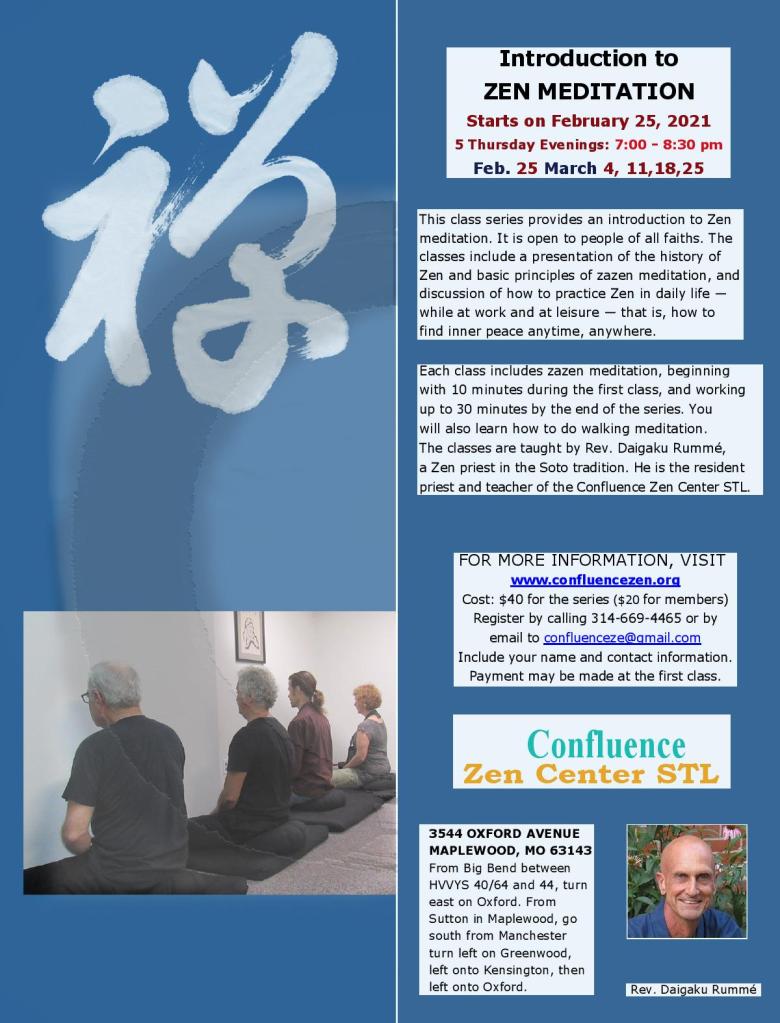
And again now, the forthcoming 2021 class series an Introduction to ZEN MEDITATION the evenings of 2/25, 3/4, 3/11, 3/18 and 3/25 at Confluence Zen Center in Maplewood, Missouri.
Classes include zazen meditation beginning with 10 minutes and working up to 30 minutes, as well as learning walking meditation. To register call 314-669-4465 or email confluencezen@gmail.com with name and contact information.
Why and how has the topic of gender become so prevalent, pervasive and taken such precedence — appearing on forms, social media bios, etc., often with no opt-out, or room for comment — seemingly overnight, perhaps in a manner similar to The Corona?
What are the origins, and who are the major supporters of this phenomena? What are the ramifications of all those whom frame gender the way it is now being framed, and ramifications for those who base requirements around this, and for those who promote, use and consent to such frameworks, as well as ramifications for those who denigrate, decry, fight and opt-out?
Is the amplified (purported) importance of gender helpful, not helpful, good, bad, ugly, or otherwise?
And as for appearing on IntegratingPresence.com, what is the relevance of gender (confusion and politics) to meditation? I’m not really sure. The historical Buddha, when asked “who are you” often replied with the “Tathāgata” instead of using the pronouns me, I or myself. “Tathāgata” means something like, “I am thus” or “I’m like this” or “this is how I am” or “one who has thus gone” or “one who has thus come”, or sometimes “one who has thus not gone.” Perhaps uttered to indicate the having gone beyond the human condition, and beyond the otherwise endless cycle of rebirth and death, beyond dukkha (aka stress and unsatisfactoriness). Because with ultimate reality, gender does not apply:
Amongst the ultimately non-existent, amongst women, men, it [ignorance] hurries on; amongst the existent, however, amongst the aggregates, etc., it does not hurry on….
What does this mean? It means that ignorance (delusion) sees only conventional truth(sammuti∙sacca): women and men, mothers and fathers, wives and husbands, daughters and sons, dogs, cats, pigs, and chickens, etc. These things do not exist according to reality(yathā∙bhūta).
The things that do exist according to reality, however, are the aggregates(khandha), the elements(dhātu), the bases(āyatana), mentality-materiality(nāma∙rūpa), dependent origination(paṭicca∙samuppāda), the workings of kamma, the three characteristics, etc.: in brief, the Four Noble Truths. These things, which are ultimate truth(paramattha∙sacca), ignorance does not see. And as we also explained in connection with the ‘Gaddula∙Baddha’ sutta, that is why beings run on from life to life. This ignorance is the delusion associated with unwholesome consciousnesses.
Greed, hatred, and delusion make a consciousness unwholesome, which means the volition is unwholesome: unwholesome kamma. The Buddha calls it also evil (pāpa), and demerit(apuñña). And the accomplishment of unwholesome kamma, He calls also bad conduct(du∙ccarita), and demeritorious formation(apuññ∙ābhisaṅ- khāra). If that kamma produces its result, it will be an unwished for, undesired and disagreeable result, and will lead to continued production of kamma.
— from p.47 of The Workings of Karma by meditation master the Most Venerable Pa-Auk Tawya Sayadaw
It seems though, the majority of beings still find themselves within relative, or conventional reality.
I don’t really have any answers, or opinions, nor currently any impetus for involvement with another topic seemingly readymade for divisiveness, or even desire to study this much.
However, the information below I class as significantly relevant and missing from the everyday thinking and increasingly status quo narrative on gender, and have already shared it privately with several folks. Firstly, some of the most pertinent information via the Ascension Glossary article Gender Confusion Pain followed by a full newsletter dedicated to the Law of Gender.
Psychological and emotional pain in regard to gender confusion, sensations of gender-mix up, feeling ostracized and bullied for feeling different in this way is a source of real psychological-spiritual trauma that may start in early childhood. Unfortunately our society is not equipped to support children and adults that may suffer greatly with inner gender reversals and related gender confusion as a result of spiritual or sexual trauma. The point of this information is to be aware that there is a specific Mind Control agenda to spread transhumanism through surgically and medically induced transgenderism in order to reverse the inner gender principle, which destroys the human lightbody. We have to know we have a Lightbody and how it works in male and female principle, before we can accurately assess ourselves and our environment about who we really are as a human being. How can a human being that has been subjected to psychological warfare and Social Engineering targeting his or her gender and sexual beliefs throughout their lifetime, make a sound and healthy decision that impacts the state of their gender biology and sexual preferences? They simply cannot and are radically impaired.
Thus, as human beings we must make some effort to educate ourselves about the pitfalls of the current events happening in the Ascension Cycle, like transhumanism’s alliance with transgenderism and be willing to address the layers of spiritual trauma that damages gender. Sadly, religions tend to demonize others suffering with gender trauma and it’s important to recognize the true humanity, the heart and soul that is traumatized by such spiritually abusive behaviors. Compassion and Empathy for the suffering of human beings that undergo gender trauma is very much needed, as well as being better informed about such matters. As awake and informed parents, before allowing children to make decisions like taking hormone therapy, plastic surgery or sex change surgery, openly discussing gender issues and where permanent effects on the biology can potentially produce even more spiritual harm to the consciousness body is suggested.
Gender Biology
During the ascension cycle there is a lot of confusion about gender as people do not take into consideration that humans inherently have both male and female characteristics and operate in Gender Principle. The human body is designed as a gender biology that works in alignment to the Law of Gender and Law of Polarity. There is a necessity of being willing to do the inner emotional work to support our male and female to be expressed in the most energetically balanced way possible. If a male feels his feminine attributes and feminine right brain characteristics being activated in the Ascension Cycle, this does not mean he is transgender or he is a biological woman. If a school girl feels more masculine and wants to wear what society labels as male clothes, this does not necessarily mean she is transgender. Adults and children are incredibly confused about the forces they are being exposed to now. The problems with society placing demands on people to act in accordance to rigidly expected gender roles, shuts down their ability to explore gender issues openly without backlash. This sets up the problem of persecution and integration into a society that is not tolerant of flexible gender roles, which only increases desperation and suffering for all involved. People that feel desperate and are suffering with gender issues rarely make good decisions.
To better understand why Transgender people and gender reversals are radically increasing in the Death Culture requires reexamining the fundamentals of who we are as human beings and what makes us men or women. Also we must acknowledge that gender principles and the gender concept is currently being greatly expanded upon in human beings during the ascension cycle. As a part of spiritual evolution we have to inquire deeply inside and take a hard look at ourselves, to give some thought to how the death culture has defined gender and places expectations on males and females in different ways. Before we can truly understand how someone can have a different gender than their assigned gender biology, we have to understand the Law of Gender and how gender actually translates into our body and Consciousness. We must explore how the concept of gender was built into the NAA mind control programs, how it was used as a weapon against us and how the gender split has affected us all. This goes way beyond just accepting others and allowing them to be themselves, and takes us into the deeper examination of who we really are and what we are becoming.[1]
Gender Wounds
Some of the most traumatizing events are those painful memories from distortions existing between men and women being forced to abuse each other, over and over. These Gender Principle distortions have been used to propagate some of the deepest levels of spiritual abuse, Sexual Misery and personal torture that could occur to a race of beings. Many people feel this pain as Soul crushing and there are reasons for that which is warranted from the cellular memories of hidden human history. True spiritual marriage as a part of natural biological spiritual Ascension was stolen from humanity through the NAA alien invasion, and the pain of that theft and emotional abuse has damaged many people’s hearts. The heart damage, both physical and energetic, has blocked the soul’s center of communication with the entire body. For this reason there is a unconscious terror in accessing the heart center because the soul wound is so painful for so many on the earth.
With the shifts into the next Harmonic Universe there are some changes happening in the light body, which are affecting merkaba mechanics and how the gender fins of the light body operate. With these changes come new opportunities to uncover and heal any gender distortions we may be carrying. These changes also deepen our understanding of how Gender Principles are part of the Natural Laws, and how unifying gender principles manifests as the diamond sun Krystallah orb body. With the Paliadorian Activations there are new mathematical proportions of the diamond sun 12 Tree Grid pattern being embodied, including the reclamation of Adamic lines. In contrast there is an aggressive form of gender confusion being amplified, which is linked with the Transhumanist agenda. We observe what is happening in the promotion of gender reassignment surgeries and discuss some of the impacts Transgenderism may have on the soul and lightbody.
All things exist within the Gender Principle of Creation, everything has its masculine and feminine principle, which produce metaphysical forces. These forces arrange within the spiritual blueprints that translate into the gender principle that manifests itself upon all dimensional planes. There is not one aspect of life, consciousness and creation where the masculine and feminine principles remain non-existent or absent, it is an absolute truth that the Law of Gender is manifested within everything. It is impossible for creation to take place without this Universal Law in action at some level, even when the gender principles have been replicated, reversed, or manipulated through artificial technology. Whether organic or inorganic the Law of Gender will always apply to what has been manifested. Gender principle is intrinsic to every form in existence including the human body, which is designed in a gender principle biology. It is important to be aware that the Law of Gender is intentionally violated, damaged and distorted by the NAA upon the earth, as they learned that through splitting the gender principle into grotesque mutations, it further served their enslavement agenda.
As previously stated, fortunately or unfortunately, or both, or neither, Zoom services, studies groups, retreats and shorter practice periods are part of meditation practice for folks at this time.
There are benefits to both solo meditation and practicing with a group. In a way, we all basically both arrive on earth alone and leave alone, being separated from all we hold dear. Solo practice can allow not only coming to terms with this but also cultivating a contentedness informing skillful thought, speech and action while we’re here. Group practice allows for teachers, community, friends, honorings, external validation (if still helpful), and support for meditation practice and all associated with it and beyond.
A sort of twist to this, as a teacher once told me, just as you can tap into the benefits of being and practicing outdoors simply by tuning in to what that’s like while indoors, one can practice solo meditation as if they were in a group setting and vice versa.
Please share anything that needs updating and additional related resources (in the comments) as this post is not regularly maintained
sanditthika.org meditation community, at the time of writing this offers various online sitting groups. Sign up for their newsletter and/or contact them for more info and details
‘The sessions are held by Gaia House teachers, Community Dharma Leaders (CDL) and trainee teachers. Each meeting includes some meditation, Dharma teachings and time for questions.
The sessions are offered three times weekly via the easy-to-use Zoom platform. The sessions last between 1 hour 15 mins and 1 hour 30 mins.’
dhammasukha.org has various ongoing online offerings as well as related site:
This page is a constantly growing compendium of resources to support one’s practice primarily for those based in the United States. It is not comprehensive. Online Practice Communities:
No guidance is offered during our daily hour long silent meditations, just a start and end bell. The meetings offer a space for sitting in silence, listening to a recorded Awaken the World meditation, or any recording that best serves your practice. We do ask that you remain as still as possible and keep your audio muted. https://zoom.us/j/6131117777
GUIDED 30 MIN MEDITATIONS EVERY MONDAY 8PM EST
GUIDED 60 MIN MEDITATIONS SAT. FEB 13TH AND 27TH 8AM EST 2021
MORNING ZAZEN Mondays/ Tuesdays/ Thursdays 6:20 a.m.- 7:00 a.m. (40 minute sitting meditation) Followed by a short sutra service Please arrive at least 5 minutes prior to sitting
EVENING ZAZEN Mondays 7:00 pm- 7:40 pm Followed by a short sutra service
Meditation Audio: Foundations of Mindfulness — recorded live at Fat Cat Longevity 2/10/21
This recorded live guided meditation goes through the first three foundations of mindfulness — body; hedonic or feeling tone of pleasant, unpleasant, or neither of these; and mind. (Apologies for the heating system and water feature sounds.)
Join meditation 7:00-7:45pm Wednesday, February 10th at http://FatCatLongevity.com downstairs next to Peace Love Coffee at Mary’s House of Healing, St Charles, MO. We plan to start with brief instructions along with a discussion before and after.
Is this life activity, what ever it may be, worth $10,000 an hour? This seemingly outlandish question — at least at first anyway — came across my ears recently from a podcast with a former college who recommends continually asking this question. While our paths have mostly diverted — in very valid and beneficial ways for both — this question strikes strong in its power and its command of prioritization.
I too have yet to find anything to qualify. Besides being able to speak with fellow human beings in real life (something we still take for granted), meditation is the only thing coming close for me.
This $10,000 question, in a very common way most modern people easily innerstand, slaps us with the immediacy, fleeting nature and importance of each and every moment, never to return again in the same way.
As for meditation being the closest thing worth $10,000 an hour, imagine actually paying that amount then meditating. Do you think your mind would wander off as much?
If you’re already around the ages of 30 or 40 are there really many experiences left on your bucket list significantly different from what you’ve already known and/or watched and heard many countless others do?
This is not to discredit external reality, it is more to draw attention to our inner worlds which remain primarily unexplored by the masses with access not currently as limited as the external world in extent and ease of accessibility. Not to mention the primary reasons for meditation.
Whatever the answer, or lack of answer to this question is — using a $10,000 monetary price point as a mirror to represent real non-monetary value — do you humbly value your time, and more importantly, yourself in such a way?
The extent of shaming and shameless proliferation in the meditating mind can sometimes be staggering. (Perhaps drawing inspiration from the hand sketched characters within the artwork from the Beastie Boy’s Hot Sauce Committee Part 2 record) what’s listed below are various forms of mental activity that can arise and fade away during meditation reformulated into a personality, character or title.
The wide ranging advice and instructions on how to address and deal with these characters won’t be gone into here other than the self-inquiry prompts of: what do you do, or would you do, or not do with these guys while on the cushion? What kind of character considers such a question? What kind of relationships are involved? Would it make sense to allow (any of) them a supporting role in staying with the meditation object? Should I just delete this blog post?
Also, feel free to sketch these.
There’s the:
inquirer
master planner
helper
humanitarian
reminiscer
instructor
conversationalist
alarmist
fascinater
baiter
day dreamer
fantasizer
the space out
lostling
authoritarian
(false) expert
distractor
escapist
infantilist
royalist
analyser / analyst
doubter
freak(out)
proliferationist
urger
advocate
brainiac
(false) genius
trickster
dice(wo)man
deliverer
rescuer
messenger
calmist
doer
(play-by-play sports) commentator
comedian
fixer
cell mate
validator
admirer
person of valor
assessor
judge, jury and executioner
reveler
revelator
marketer and promoter
manager
thought/people pleaser
commiserater
follower
guru
officiant
entitlement demander
referee
negotiator
arbitrator
diplomat
justifier
astonisher
4/6/2021 UPDATE: Recently realized a potential caveat pertaining to this post — that which some call Dissociative Identity Disorder (formally known as Multiple Personality Disorder) while others mention (their) “alters”. Whether creditable or not, such a topic and related topics seemly hold potential to become quite dark quite quickly with material like the Congressionally documented Project MK ULTRA; claims of (Project) Monarch; SRA/trauma-based-mind-control (with two counselors being Sandra Fecht and Jay Parker); and even a book called The Illuminati Formula to Create an Undetectable Total Mind Control Slave which enumerates intricate details. The links above are a few one-sided resources — as countering information seems more easily locatable at the moment. Such links are for those who feel called to research this stuff in the cases that this post happened to trigger more than eliciting lightheartedness and if there happens to be anything to this. If researching please exercise caution and discernment and know the researcher bears responsibly for any and all outcomes, or lack of outcomes.
4 : something true makes lies sound like veracities
Truth. Solipsism? 2 + 2 = 4. Relative and ultimate truths. Here’s some quotes and bits and pieces regarding truth (which doesn’t really need defending):
Truth is that which conforms to fact and reality. Truth is precise accordance with what is. Truth is the body of real things, actual events, genuine facts. Truth is the authentic nature and condition of something.
Truth is not a reward for good behavior nor a prize for passing some tests. It cannot be brought about. It is the primary, the unborn, the ancient source of all that is. You are eligible because you are. You need not merit truth. It is your own..
~Nisargadatta Maharaj
“…people are prepared to transcend all moral boundaries to sustain their view and to fixate upon it beyond all reason. Beyond investigation. Investigation is considered a conspiracy. To actually try to find truth is considered a deviant occupation…”
~Ajahn Sucitto
“Bright, loud and mobile is the false. Subtle and indistinct is the true.”
There are higher truths as well as lower truths wherein each lower truth acts as a step on a staircase helping you ascend into higher altitudes of perspective.
Matt Kahn
Two truths teaching in Buddhism — “conventional” or “provisional” (saṁvṛti) truth, and the “ultimate” (paramārtha) truth.
When you want to help people, you tell them the truth. When you want to help yourself, you tell them what they want to hear.
~Thomas Sowell
There are truths that are 4 ways:
pleasant and profitable
unpleasant and profitable
pleasant and unprofitable
unpleasant and unprofitable
“As for the course of action that is unpleasant to do but that, when done, leads to what is profitable, it’s in light of this course of action that one may be known—in terms of manly stamina, manly persistence, manly effort—as a fool or a wise person. For a fool doesn’t reflect, ‘Even though this course of action is unpleasant to do, still when done it leads to what is profitable.’ So he doesn’t do it, and thus the non-doing of that course of action leads to what is unprofitable for him. But a wise person reflects, ‘Even though this course of action is unpleasant to do, still when done it leads to what is profitable.’ So he does it, and thus the doing of that course of action leads to what is profitable for him.
“As for the course of action that is pleasant to do but that, when done, leads to what is unprofitable, it’s in light of this course of action that one may be known— in terms of manly stamina, manly persistence, manly effort—as a fool or a wise person. For a fool doesn’t reflect, ‘Even though this course of action is pleasant to do, still when done it leads to what is unprofitable.’ So he does it, and thus the doing of that course of action leads to what is unprofitable for him. But a wise person reflects, ‘Even though this course of action is pleasant to do, still when done it leads to what is unprofitable.’ So he doesn’t do it, and thus the non-doing of that course of action leads to what is profitable for him.”
“…There are five things that can turn out in two ways in the here-&-now. Which five? Conviction, liking, unbroken tradition, reasoning by analogy, & an agreement through pondering views. These are the five things that can turn out in two ways in the here-&-now. Now some things are firmly held in conviction and yet vain, empty, & false. Some things are not firmly held in conviction, and yet they are genuine, factual, & unmistaken. Some things are well-liked and yet vain, empty, & false. Some things are not well-liked, and yet they are genuine, factual, & unmistaken. Some things are an unbroken tradition and yet vain, empty, & false. Some things are not an unbroken tradition, and yet they are genuine, factual, & unmistaken. Some things are well-reasoned and yet vain, empty, & false. Some things are not well-reasoned, and yet they are genuine, factual, & unmistaken. Some things are well-pondered and yet vain, empty, & false. Some things are not well-pondered, and yet they are genuine, factual, & unmistaken. In these cases it isn’t proper for a knowledgeable person who safeguards the truth to come to a definite conclusion, ‘Only this is true; anything else is worthless.“
…
When, on observing that the monk is purified with regard to qualities based on delusion, he places conviction in him. With the arising of conviction, he visits him & grows close to him. Growing close to him, he lends ear. Lending ear, he hears the Dhamma. Hearing the Dhamma, he remembers it. Remembering it, he penetrates the meaning of those dhammas. Penetrating the meaning, he comes to an agreement through pondering those dhammas. There being an agreement through pondering those dhammas, desire arises. With the arising of desire, he becomes willing. Willing, he contemplates (lit: “weighs,” “compares”). Contemplating, he makes an exertion. Exerting himself, he both realizes the ultimate meaning of the truth with his body and sees by penetrating it with discernment.
“To this extent, Bharadvaja, there is an awakening to the truth. To this extent one awakens to the truth. I describe this as an awakening to the truth. But it is not yet the final attainment of the truth.
“Yes, Master Gotama, to this extent there is an awakening to the truth. To this extent one awakens to the truth. We regard this as an awakening to the truth. But to what extent is there the final attainment of the truth? To what extent does one finally attain the truth? We ask Master Gotama about the final attainment of the truth.”
“The cultivation, development, & pursuit of those very same qualities: to this extent, Bharadvaja, there is the final attainment of the truth. To this extent one finally attains the truth. I describe this as the final attainment of the truth.”
For this month’s regular open-audience, open-discussion “Ask Us Anything” — continuing discussions about meditation and related topics — Denny gives an in-depth presentation on Qi, Qigong and Daoyin (with presentation slides above) including the following mentions:
Don’t go by reports, by legends, by traditions, by scripture, by logical conjecture, by inference, by analogies, by agreement through pondering views, by probability, or by the thought, “This contemplative is our teacher.” When you know for yourselves that, “These qualities are skillful; these qualities are blameless; these qualities are praised by the wise; these qualities, when adopted & carried out, lead to welfare & to happiness” — then you should enter & remain in them.
As you all know, Josh and I have done a few AUA (Ask Us Anything) sessions. This Thursday (1/14/2021) we are doing our first AUA Live, in response to a simple but profound question asked by our friend and a new student of our Saturday morning exercise/meditation practice …
What Happens to your Mind when you Meditate?
The two formats (AUA versus AUA Live) are slightly different in that the regular AUA is pre-scheduled for every last Tuesday of the month with a pre-selected topic, whereas the LIVE version is more like ER where a question was asked and we find it necessary to answer ASAP. The Live format is going to be less formal.
Please accept our invitation to join us this Thursday. If you want to be in front of the camera, please send us an email [at integratingpresence [AT] protonmail [DOT] com or denny k miu [AT] gmail [DOT] com (without spaces)] so we can send you a link. Or you can watch and provide live comments with the following:
http://dennykmiu.com/Facebook (this one works 100%) [UPDATE: 1/14/21 11:23am Central Time from Denny: “For some reason, I am not able to do live streaming on Facebook today and all my previous videos and posts that had to do with live streaming are deleted. We will go back to Zoom and live stream with Youtube.”]
Thanks and we look forward to seeing you on Thursday (1/14/2021) at 10:00 am PST.
Denny & Josh
(Pre)show notes from Josh:
I usually feel introducing us — with self-deprecating humor — as “The Dumb and Dumber of Buddhadharma” can only thin the ego down so far getting minimal laughs, but today it seems way more appropriate for two guys attempting to master the human mind in an hour. [Note: I mistakenly say Bodhidharma instead of Buddhadharma in the video]
As always, we encourage everybody viewing or listening to use what is presented here as points of reference in their own research and check everything in their own (meditative) experience. What you hear today may even lead astray from better innerstanding the mind.
For better or worse, my lack of a Western Philosophical background which most people in the US addressing this topic are well versed in. My interest actually deals more with fringe topics that we won’t go into today other than to say they have potential to expand, give new perspectives and deeper comprehension with the risk of getting lost in the weeds and being unable to relate any insights to alleviate stress and suffering.
Define mind and provide distinction between similar terms of brain, attention, mindfulness, awareness, consciousness, thought/thinking, “thoughting” (thoughts happening without knowing why or willing them), and contents of mind/(mental) phenomena
Some cultures when asked where the mind is point to chest, others point to the head
Thinking seems to either be primarily in language, or primarily in image
Thinking exercise: OK, do not think of a pink elephant
Awareness exercise: OK, I want you to stop being aware, just cut it out.
[recently, from arrowriver.ca, heard definition of] Saṅkhāra as broadly defined as (compounded) formations/fabrications >> more narrowly can be defined as >> mental formations >> and yet more narrowly can be defined as >> volitional formations
Insights into Namarupa / Body and Mind
Some say because mind can’t be detected with senses there’s no such thing as mind.
Two other potentially relevant science-based sites:
heartmath.org — “HMI has developed reliable, scientifically validated tools since 1991 helping people reduce and avoid stress while experiencing increased peace, satisfaction and enjoyment. Research at the HeartMath Institute shows that, adding heart to our daily activities and connections produces measurable benefits to our own and others’ well-being. We are at the dawn of recognizing Love as the new transformational intelligence.”
noetic.org — Institute of Noetic Sciences: Inspired by Science, Transformed by Experience. The Institute of Noetic Sciences (IONS) is a research center and direct-experience lab specializing in the intersection of science and profound human experience.
Bhikkhus, whatever a bhikkhu frequently thinks and ponders upon, that will become the inclination of his mind. If he frequently thinks and ponders upon thoughts of sensual desire, … upon thoughts of ill will, … upon thoughts of cruelty, he has abandoned the thought of non-cruelty to cultivate the thought of cruelty, and then his mind inclines to thoughts of cruelty.
Perhaps another pertinent point: the three types of people in the world likened to a person with a mind like an open sore, a person with a mind like lightning, and a person with a mind like diamond.
Audio only version — What Happens To Your Mind When You Meditate? | (1/14/2021 — “Ask Us Anything – LIVE” with Denny K Miu)
I’ve previously mentioned being fortunate enough to not really have been bogged down by physical pain, yet how to work with pain in meditation is a seemingly common request. Instead, for a while now, I’ve faced (energetic) blockages; or worse, ignoring them to continued and often increased detriment. I trust most of the following considerations may be helpful if experiencing blockages, especially when in meditation and contemplation:
Assessment: What’s being blocked, from where, how and why?
What is the origin, causes and root condition?
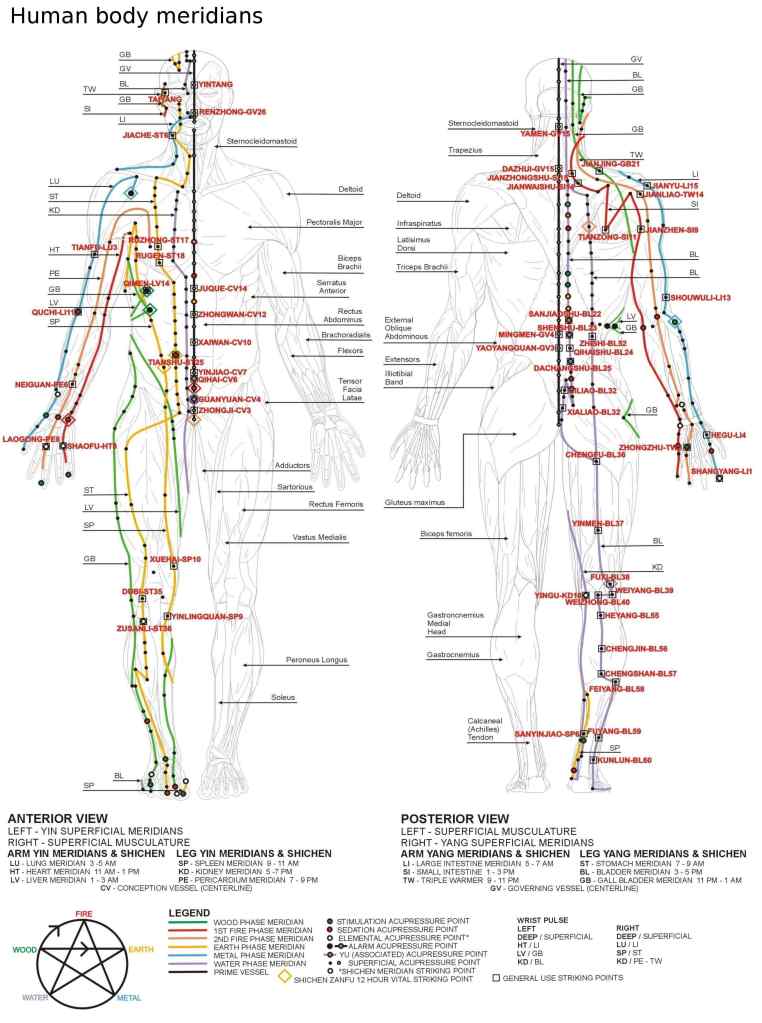
Is there an associated organ, energy meridian, and/or area of the body?
Can the heart of the blockage be located?
What is the essence of the blockage?
Can the blockage(s) be used as meditation object and/or how can it be incorporated into meditation?
Explore any and all correlation of the blockage(s) with cessation
What is the overall relationship with/to the blockage? Are there any other corresponding areas of the body with the blockage, and if so, what’s the relationship like between them? What is the relationship like between the blockage and the whole body?
Feel into the truth of the blockage
What can be noticed of the breath in and around the blockage?
What are any associated and related emotions? Why and how might emotions be relevant?
When/how do different aspects of the blockage change?
How could this blockage be trying to help?
Can this be made into a teacher?
Reverse psychology: what if I desired more of this blockage? Can I actually express genuine gratitude for and towards the blockage?
What does it need? Perhaps ironically, how can you serve it?
Bring complementary energy, not contentious or conflicting energy
Abstain from giving extra energy to the blockage’s blocking
Focus on the blockage’s changeability
Bring awareness to the wholesome pleasures of meditation
How is the energy — and energy circulation/flow — in and around the blockage?
Soften and notice energy flowing near the edges
Plug into and connect to any places of flow within the blockage area; as well as any other flow places in the body and with the body as a whole
Upon noticing, is there a defaulting to habitual patterns and tendencies in the ways and manners of attending to the blockage? If so, how quickly and frequently? And how long does it usually take to become aware of this?
What energy is needed and/or required for (and/or to address) this blockage?
Are there more wise and skillful terms to use and refer to other than “blockage” and “stuck energy”?
Is it helpful and wise to practice with the blockage using the four great elements — earth, wind, fire, water?
Consider perspective shift: ‘…shifting your awareness from “get me outta here” or “let me go” to “thank you for transforming me. I am ready to trust you now”.’ [(not specifically for blockages) via Matt Kahn 7/25/2021 newsletter]
Starting around 12 minutes 38 seconds, Ajahn Succito talks about how to work with blockages (on an energetic level) including:
introducing and invite blocked energy to unblocked energy
bringing the energy of the heart to the energy of the body
inclining the heart to open and patiently stay with and encompass the blocked area in benevolent energy
As a practice suggestions:
invite ideal energy — perhaps an area where there’s unblocked energy — to, from, circulating through, in, out and around in all directions, boundless. If requiring more specific energy, the sublime abidings of the Brahama Viharas may be helpful.
“wrap” the blockage in an energetic cocoon of the aforementioned energy
‘Feeling blocked does not mean anything is in your way. That’s just an old way of interpreting the mysterious complexities of life while confusing self-criticism and blame for new forms of insight. Quite literally, feeling blocked means you are in such a state of expectation that you are innocently blocked from seeing the circumstances of this very moment as evidence of what’s already on its way. The reason you may live in drastic states of anticipation is because you are an intuitive being who is so excited about what the future holds, you can’t help but do everything in your power to rush towards it.
The opposite of feeling blocked is being in the flow.
Quite literally, being in the flow means you are advancing towards the future in a more balanced, heart-centered, and grounded way — so much so, you are able to clearly see each moment as auspicious evidence of what is already flowing in your direction. The notion that you have to fix your blocks and ‘do everything you can to stay in the flow is an old paradigm way of unknowingly blocking the awareness of life’s inherent flow. It is simply the case of life planting seeds of possibility, only to refine the process as individual and collective consciousness ripens in maturity.’
Only if yet to achieve mastery with the aforementioned do I recommend considering the following, somewhat fringe, more metaphysical approaches that I’m not responsible for what does or does not happen so proceed only with full self-responsibility and with caution:
Investigate from various levels: astral, intuitional, vital, etheric, spiritual, divine, etc. [For possible reference see dharma teacher Phillip Moffitt’sNine Bodies of Consciousness teachings and meditations]
Perceive blockage as a reminder that on an higher/expanded dimension (perhaps 8D) any blockages have already been transmuted, transformed, and/or healed.
Experiment merging with the blockage
3/27/21 UPDATE: Beth Upton provides two major approaches that relate to cultivating samadhi: (starting at around 52min 11sec) One is an excluding and ignoring training where blockages unravel by themselves. The other is finding blockages and doing certain practices to unblock them.
RELEASING BLOCKAGE
In order to release the knot whereby saṅkhārā form the contracted state, you use skilful saṅkhārā. These helpful formations include the kind of thinking and the heart-energies and attitudes that flow along with healthy breath-energy. In a nutshell: be guided by your breathing rather than your self.
As a practical tip, this means that you don’t aim for the centre of the problem, and you don’t try to fix it; instead, you turn your attention to the overall embodied presence and let that steady your awareness. From that basis you access a source of steady and soothing energy – in this case, that of in- and out-breathing. (Otherwise, the presence of a kind and steady person is an invaluable resource.) Then the practice is to keep connecting the difficult area to the healthy mix of verbal, heart and embodied energies you have established as a foundation. This can then flow into and work on the difficult pieces – in its own time and way. Herein the golden rule is that you don’t go into a bodily or psychological area that feels highly activated, troubled or potent without that steady presence. The motto is: ‘good energy knows what it’s doing, so stay with it.’
As this work, and the releasing effect that it has, may seem disorienting, how can you be confident that this is the correct approach? The two standards to keep checking in with are a) ‘Is my whole body here – can I feel my feet, and my back? If I can’t, am I spinning out or tightening up? Better stand up, flex a little, or walk.’ This approach can help to facilitate a proper boundary within which energy can settle. In tandem with that, point b) is ‘Can I establish and maintain a quality of goodwill towards this experience?’ This isn’t as straightforward as it may seem, because it requires wise goodwill, not a sentimental coating. Goodwill as a Dhamma practice is informed by the understanding that ‘This energy or condition needs some supportive attention. I will place my awareness next to it and listen. May this quality of patient and sympathetic attention help it to find its resolution.’
This may seem to be over-cautious, but saṅkhārā are both the patterns laid down by reactions such as fear or repression or other forms of stress, as well as the ways whereby we manage these reactions. In brief, our emotional outbursts, our skilful and unskilful responses – kamma – are saṅkhārā. But rather than suppress or complicate them, the wise approach is to use embodiment and a steady heart to release and resolve these ‘kamma-formations’.
















 Integrating Presence