
Things change and I’m due back in Denmark earlier than originally planned. In this fortieth installment of the ongoing live series with Wendy Nash inquiring into meditation practice on and off the cushion we plan to delve into the areas of worship, respect and inspiration. How can some activities like pujas (easily) get attributed to worship when they are not actually that? How can we not fall into (blind) worship? Where and how does inspiration and that which deserves respect play into this? And where does all this fit into meditation practice? (This episode was originally spurred primarily by the billboard below)
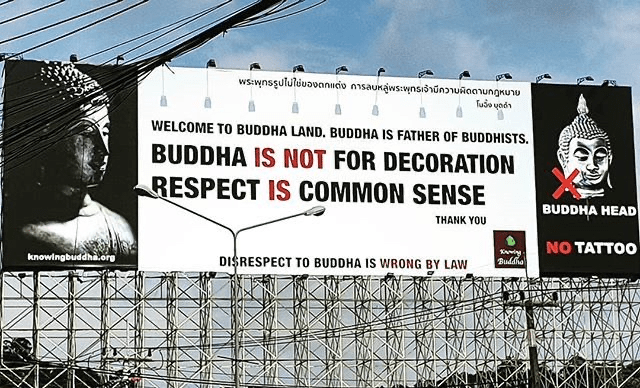

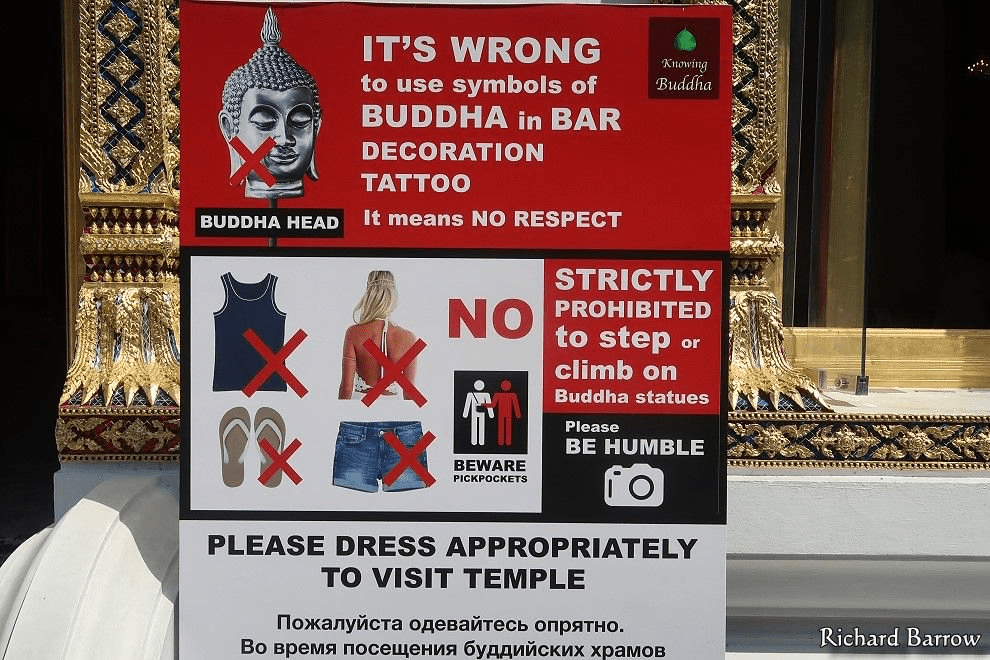
According to Ai:
The billboard campaign was put up by the Knowing Buddha Organization in Bangkok, Thailand
The billboard has appeared along major highways near Suvarnabhumi Airport and into Bangkok, where tourists first arrive in Thailand.
Zen story on respect and worship:
On a cold winter night, Ikkyū was staying at a temple. Freezing, he took a wooden Buddha statue and burned it in the fire to keep warm.
The caretaker was horrified.
“How dare you burn the Buddha!”
Ikkyū calmly poked through the ashes with a stick.
The caretaker asked, “What are you doing?”
Ikkyū replied, “I’m looking for the sacred relics (śarīra).”
The caretaker said, “But it’s only wood — there are no relics in it!”
Ikkyū answered, “If there are no relics, then it’s just wood. Why not burn it?”
Later, when the caretaker saw Ikkyū bowing to a stone by the road, he asked, “Why bow to that?”
Ikkyū replied, “If you can burn a Buddha, you can bow to a stone.”
PUJA: RITUAL THAT BRIGHTENS THE HEART
[Excerpt from KAMMA AND THE END OF KAMMA by Ajahn Sucitto]
In Buddhism, and in other religions, access to and dwelling in the heart-tone of bright kamma is occasioned by devotion and recollection. In Buddhism, this is called ‘pūja’ – an act of raising up, and honouring that which is worthy of our respect.The very fact that there are human models and actions that one can feel deep respect for is itself a blessing to take note of: honouring opens and uplifts the heart. With pūja, we attend to a skilful felt meaning, linger there and allow the effects to nourish the citta. From this basis, it’s likely that inclinations or even specific ideas in line with bright kamma will arise.Either that, or the mind easily settles into a state that supports meditation. This is how and why one should linger in any bright kamma.
So in the act of honouring the Buddha, one first opens the heart in respect and brings to mind the meaning of an Awakened One: someone of deep clarity; a speaker of truths that penetrate and bring healing to the human condition; one accomplished in understanding and action – a sage whose teachings can still be tested and put into action. If one has a Buddha-image, it’s something that should be held with respect – one cleans it, illuminates it with light, and offers flowers and incense to it. We place it on an altar, bow to it and chant recollections and teachings.
This is not a mindless activity; we use ritual means and resound words and phrases because this full engagement embodies and strengthens the quality of respect in a way that thinking can’t. With the openness of heart that these attitudes bring, any aspect of the teaching that’s brought to mind goes deeper.The act of offering that begins a pūja is a case in point: offering flowers symbolizes bringing forth virtue, offering light is about bringing forth clarity, and incense does the same for meditative concentration. In this way, pūja introduces the heart to important Dhamma themes.
Pūja is especially helpful when people perform it as a group. Then we are participating in the Dhamma as both the expression and the Way of awakening, as well as in the collective commitment to, and engagement with, that Dhamma. This collective engagement ritualizes the ‘Sangha’, that is, the assembly of disciples. Chanting in a group has a harmonizing, settling effect: sonorous and unhurried, it steadies bodily and mental energies and supports an atmosphere of harmony with fellow practitioners. Tuning in and participating brings us out of ourselves and into a deep resonance with heart-impressions of the sacred. We can be touched by a sense of timeless stability, purpose and beauty. If these intentions, felt senses and recollections are established regularly, we know where to find good heart, how to attend to it, and how to allow ourselves to be uplifted. Such kamma feels bright.
The expressions that are used in recollecting Dhamma are that it is experienced directly (not just as a theory), is of timeless significance, and is accessible and furthering for those who practice it. So that gives us an encouragement to look into what the Buddha taught and modeled: the way to the end of suffering and stress. With this, we recollect aspiration, learning and commitment as our common touchstone, and suffering and ignorance as our common challenge. Then we no longer feel so alone with our difficult mind-states, and we can handle them in a more open and aware way. Recollection of Sangha reminds us that although there is greed, anger and confusion in the human world, there are also people who cultivate a way out of that.
If you use pūja on a regular basis, it aligns you to the ‘Triple Gem’ – Buddha, Dhamma and Sangha – by presenting content in terms of images, ideas and themes, and values and practices that guide the heart. It also occasions acts of steering and composing attention. So pūja works both on what the mind is dealing with, and how it operates.
‘At any time when a disciple of the noble ones is recollecting the
Tathāgata … the Dhamma … the Sangha … their own virtues: “[They
are] untorn, unbroken, unspotted, unsplattered, liberating, praised
by the wise, untarnished, conducive to concentration.” At any time
when a disciple of the noble ones is recollecting virtue, his mind is not
overcome with passion, not overcome with aversion, not overcome
with delusion. His mind heads straight, based on virtue. And when the
mind is headed straight, the disciple of the noble ones gains a sense of
the goal, gains a sense of the Dhamma, gains joy connected with the
Dhamma. In one who is joyful, rapture arises. In one who is rapturous,
the body grows calm. One whose body is calmed experiences ease. In
one at ease, the mind becomes concentrated.‘Mahānāma, you should develop this recollection of virtue while you
are walking, while you are standing, while you are sitting, while you
are lying down, while you are busy at work, while you are resting in
your home crowded with children.’~ (A.11:12; B. BODHI, TRANS.)
*There’s naturally an ongoing open call for meditation (related) questions for the (roughly) monthly “Meditation Q & A” either by the various social media means listed; integratingpresence[at]protonmail.com or just showing to type/ask live.*

Background
Regular, current and past visitors to Integrating Presence may recall the monthly series “Ask Us Anything” I did with Denny K Miu from August 2020 until January 2022 — partially including and continuing on with Lydia Grace as co-host for awhile until March 2022.
For a few months thereafter I did various Insight Timer live events exploring potential new directions and/or a continuation of the Ask Us Anything format while weaving in other related teachings to these events.
Then, after chats with meditation coach Wendy Nash, it became clear to start a new collaboration similar to “Ask Us Anything” simply and clearly called “Meditation Q & A” especially due to the original intent of the Ask Us Anything’s being “discussions about meditation and related topics.”

Audio: Worship, Respect, Inspiration | “Meditation Q & A With Wendy Nash” #40
Past chats with Wendy:

Unedited transcript via YouTube:
 Integrating Presence