American Buddhism | (10/27/2020 — “Ask Us Anything” With Denny K Miu)

For this month’s open-audience, open-discussion “Ask Us Anything” — continuing discussions about meditation and related topics — Denny and I expand from last month’s chat on “Hīnayāna” as a superlative and more on Theravada and Mahayana in general. We also get into:

On one occasion the Blessed One was staying near Savatthi, in Jeta’s Grove, Anathapindika‘s monastery. Then Rohitassa, the son of a deva, in the far extreme of the night, his extreme radiance lighting up the entirety of Jeta’s Grove, went to the Blessed One. On arrival, having bowed down to the Blessed One, he stood to one side. As he was standing there he said to the Blessed One: “Is it possible, lord, by traveling, to know or see or reach a far end of the cosmos where one does not take birth, age, die, pass away or reappear?”

“I tell you, friend, that it is not possible by traveling to know or see or reach a far end of the cosmos where one does not take birth, age, die, pass away, or reappear.”

“It is amazing, lord, and awesome, how well that has been said by the Blessed One: ‘I tell you, friend, that it is not possible by traveling to know or see or reach a far end of the cosmos where one does not take birth, age, die, pass away, or reappear.’ Once I was a seer named Rohitassa, a student of Bhoja, a powerful sky-walker. My speed was as fast as that of a strong archer — well-trained, a practiced hand, a practiced sharp-shooter — shooting a light arrow across the shadow of a palm tree. My stride stretched as far as the east sea is from the west. To me, endowed with such speed, such a stride, there came the desire: ‘I will go traveling to the end of the cosmos.’ I — with a one-hundred year life, a one-hundred year span — spent one hundred years traveling — apart from the time spent on eating, drinking, chewing & tasting, urinating & defecating, and sleeping to fight off weariness — but without reaching the end of the cosmos I died along the way. So it is amazing, lord, and awesome, how well that has been said by the Blessed One: ‘I tell you, friend, that it is not possible by traveling to know or see or reach a far end of the cosmos where one does not take birth, age, die, pass away, or reappear.'”

[When this was said, the Blessed One responded:] “I tell you, friend, that it is not possible by traveling to know or see or reach a far end of the cosmos where one does not take birth, age, die, pass away, or reappear. But at the same time, I tell you that there is no making an end of suffering & stress without reaching the end of the cosmos. Yet it is just within this fathom-long body, with its perception & intellect, that I declare that there is the cosmos, the origination of the cosmos, the cessation of the cosmos, and the path of practice leading to the cessation of the cosmos.” It’s not to be reached by traveling, the end of the cosmos — regardless. And it’s not without reaching the end of the cosmos that there is release from suffering & stress. So, truly, the wise one, an expert with regard to the cosmos, a knower of the end of the cosmos, having fulfilled the holy life, calmed, knowing the cosmos’ end, doesn’t long for this cosmos or for any other.

  • Buddhism in America in reference to Buddhism in Asia
  • Distinctions between belief/disbelief, information, reference points, data, facts, histories, etc.
  • The “Pizza Effect
  • Ehipassiko – Investigate & See for Yourself
  • Confusion and bullheadedness surrounding “Vipassana” as technique; a way of learning; as a concept; etc
  • Bodhisattva vow of “save all beings” better translated as “guiding others”
  • Identity politics and xenophobia
  • Parable of the Burning House in the Lotus Sutra where (the three) “yana” (or vehicles) is said to derive from
  • The first and second Buddhist councils
    • Upali and Ānanda at first council
    • Various Buddhist positions on female monastics
    • Anagarikas in the Thai forest tradition
    • 10 points of controversy
      1. Storing salt in a horn.
      2. Eating after midday.
      3. Eating once and then going again to a village for alms.
      4. Holding the Uposatha Ceremony with monks dwelling in the same locality.
      5. Carrying out official acts when the assembly was incomplete.
      6. Following a certain practice because it was done by one’s tutor or teacher.
      7. Eating sour milk after one had his midday meal.
      8. Consuming strong drink before it had been fermented.
      9. Using a rug which was not the proper size.
      10. Using gold and silver.


Or listen via Insight Timer (app or website)


Continue reading “American Buddhism | (10/27/2020 — “Ask Us Anything” With Denny K Miu)”

Artificial Flower of Life/Metatronic Flower of Death aka Daisy of Death aka Bloom of Doom aka Flower of Doom and the (Real) Flower of Life?


Easy to remember shortcut link for this blog post: tinyurl.com/bloomofdoom

[November 30, 2023 UPDATE: From here on newer additions atop the post. Scroll down to the first triple line to start primary article / blog post:]


May 8, 2026 UPDATE:


Nov 2025 UPDATE:

Saw that someone shared this very blog post on “Fakebook” which I’m not on but was still able to see quite a few worthwhile comments and discussion:

https://facebook.com/groups/SacredGeometry369/posts/3421398701519314


July 2025 UPDATE:

Valdamar Valerian – Matrix IV [pdf]


https://twitter.com/CymaticJoule


June 7, 2025 UPDATE:


Aug 3, 2024 UPDATE:


April 12, 2024 UPDATE:

and his site: https://tcotlc.com

January 14, 2024 UPDATE: The channel Knew Geometry in general


January 12, 2024 UPDATE: Some new images


November 30, 2023 UPDATE:


[12/12/2021 UPDATE: Below the (next) triple line separators there’s a “new” reconstructed and edited version hobbled and pieced together from many sources. (Find the older version archived here.) Challenges encountered: some of the sources just provided broken/missing images. Others sources were referenced to paste in missing sections from more complete sources. Still others provide “new” images from elsewhere to ideally better accompany some of the text.

With such a kaleidoscopic, piecemeal endeavor such as this I keep intact numerous redundancies, repetitions and repeats for reference sake and learning purposes.

Much respect to archivists, researchers and editors as this took me many hours. I feel I owe it to the readership here though as this continues to be the most popular blog post. I often used reverse image search to get a high quality version of images when possible. I also use brackets and italics for editing notes throughout.

To put it kindly, working with this subject matter in this way seems to have unique effects/affects so please share any error corrections and/or suggestions in the comments, or contact me directly.

I claim zero credit for any of this. Please visit and support the original sources.]


The so-called “flower of life” appears on various merchandise at new age, crystal and metaphysical shop quite prevalently. Imagine the surprise then when encountering the following contradictory information in this blog post.

I don’t feel qualified, nor moved to comment at this point.

Question all you hear, read and see here. It is up to you to do your own research and investigation with this information. Please only take what’s useful of this information for your journey and investigation. Ultimately — like with just about anything else — what is mentioned here is not to be taken as ultimate truth to be clung to.


[Update 1/22/2021 (further amplification of non-commenting:)

Symbols and sigils seem quite powerful on various levels, involved in nearly every major business and a lot of magical practices. A major realization coming from the follow questions is that without a high level of awareness — along with an absence of intense study and testing — being able to confidently comment on a symbol or sigil does not seem wise (for me) and is potentially further compounded by subjectivity and whomever may be the recipient readers:

  • What does a symbol and/or sigil represent and contain energetically; in relation to consciousness; in regards to life (force); and what is the intent?
  • What is the origination and who/what was involved therein?
  • Why are they so prevalent and ubiquitous?
  • What are any (and all) modifications from the original symbol/sigil (if an original is possible) and what effects do modifications have?
  • What kind of maintenance is required and/or preformed?
  • What amount of knowing the aforementioned is possible?
  • Can similar, or greater effectiveness come from ways and means either approximating symbols/sigils, or vastly different from them, or somewhere in between?]


From the transcript of “Ascension Mechanics — Project Camelot interviews Ashayana Deane Parts 1 – 3″:

A: . . . So anyway, this is what our solar system looks like up here, this artificial it’s like a wobbling orbit. It’s not just our planet that wobbles. We, there’s actually a wobble created in the solar plane itself, it’s actually taken the solar plane, where it doesn’t sit flat in the galactic plane anymore. I think it’s around a 45 degree tilt to the, you know to the galactic plane. And it also created this thing here that threw the core and especially in the closer to the core planets like earth and the sun, it has harnessed how fast things spin, which means its harnessed the time pulse, so it could – through this device, they have been able to progressively get control over how fast things spin so they can synchronize the spins of things over here with the things that they’re trying to merge them with on the parallel side. It’s a bizarre and fascinating and horrifically morbid technology this death star technology.

Now, what that creates on a planetary level, when we look at our poor little earth sitting in the middle of this, and its not just that this has happened on the solar level, they’ve also put the same type of mechanisms in the planetary core and in the star gate systems here, to create the same effect to plug our planet into that whole system. They’ve done it on the other planets too, the ones that don’t have, anything that has its axis that’s not tilted the same as the sun, is either in its normal place and the sun got tilted, which is part of the case here, or its not in its right place, cause they should all be sitting on a natural, you know vertical and horizontal plane with each other.

This is what we have right now and like the science tells us this is normal and this is natural, you know, well our planets’ tilted about 23.5 degrees, and it does this cycle called the procession of the equinoxes, and you know

K: Right

A: we’ve got the ecliptic shield you know, that cuts through, you know the sun shield is here and ours you know comes here. This is totally twisted, this, our our our planet is tilted it’s it this messes up its entire system. Its not just tilted. When, this one here shows at least a relatively normal looking Kathara grid inside, there’s a whole set of un – unsacred? Not sacred geometries that go with the death star Merkaba stuff. It has to do with the shapes of the flows. Where before we had the, I talked about those ah the arms that you know… petals that stood out like this and they’re 45 degree angles and they phase and spark and generate quantum, right? There’s another on that has them pulled down like this, where they look much more like a flower. We call it the daisy of death, or the bloom of doom, but they’re phase locked, where they can’t phase and that means they can’t generate quantum. It means it’s a planet that is dying because it can’t breathe. And that’s one of the things and it constricts the Kathara grid at the center. It (____ ?) something. I think we have one that shows that. What that also does, is create a bulge at the equator, where it squashes the natural spherical shape down. Hello to earth.

K: Is there also ah, is there also a correlation with the cross. In other words, the actual symbol of the cross reflecting what is in essence this frozen inability to generate, yeah

A: yes, yes and and even more. That has to do with the mutation of natural Shalaya light units, into, forcing them into the vesica piscis dead light unit configurations, the sign of the cross

K: Interesting, yeah

A: The original cross has the perfectly equal, and it’s called the (Rueshay?), and it has perfectly equal. I think the Celtic cross is the closest you get these days as far as symbology.

K: and it fits inside a circle

A: Yeah

K: in other words, cause then you know it’s

A: Yeah I don’t have mine on, anyone have one on? Its one of our sacred symbols.

So, this is right now we have, this is all part, part of the mechanics of the ah death star Merkaba…ah technologies, we have the un natural procession of the equinoxes, this is called the sexton shield. It’s actually the, it’s a distortion shield of energy that keeps those vortices spinning at their you know tilted angle. It keeps us aligned with, we we flip between being aligned with Polaris, which we are in that phase now, and flipping back ah into alignment with Vega. And we just keep cycling back and forth and we’re all going back and forth in the procession of the equinoxes, and they’re not normal. There, they just released in, when was Ireland, November last year? They just released, October? Yeah, They just released some fascinating things about the old pagan rights and stuff and what, what this actually has done in its relationship with parallel earth, this was done for a reason and the cycles of the equinoxes and the solstices have to do with alignments between parallel earth and here and between parallel earth and the center of the milky way galaxy, the black hole there and that’s what were looking at coming up on in 2012, and that’s why 2012 was you know the Mayans got the word it was going to be the end of times and those kind of thing because of the dark road. Yeah the dark road alright.

So, these things, these configurations that we’re seeing, the sexton shield is not the natural clock or or shield that…that the natural spin ration that you would have for the planet on its axis. They actually have been accelerating time for the last thirteen thousand years, to make it faster so it would catch up with the ah parallel anti particle universe so they could merge them. And it means our days have gotten shorter, our spin has gotten faster, as far as on the planet and that kind of thing.

There’s other aspects to this that are created by this technology and all of these go together, right? Like when you see one it implies the others.

This is our poison apple. This is the net field, ok? Now part of the poison apple isn’t shown here, ill show that on this one, but um this is literally a containment net. It is ah (Ashona?) which means that made up by Vecka units instead of light units. A containment harness and this is what the um the death star Merkaba actually creates around a planet a system or a body. When you work those Merkaba mechanics, this is what you’re creating, its a torsion field that turn… constantly circles energy in on itself, but it does not have a connection to anything outside of itself, except of what it can feed off at its center, from its core.

And this is, there are there are three levels of this that actually move in earths atmosphere, and they literally control, one of them runs through like the magnetosphere area and actually there’s three others down from that so there’s really four, four major layers of this. It controls, it reminds me of that old thing, we control the vertical, we control the horizontal remember that show that used to say that? I think outer limits or something used to say that on TV? Well its kind of like, yeah, they they pretty much do, all of these net systems are plugged into things like the HAARP machine and ah, I’m sure the hadron collider has something to do with activating all of these too. I heard that they just had their first good test yesterday or something? Yeah? This week? Good timing, why not.

Unknown: Full activation..

A: Full activation, yeah. So these net fields are responsible for literally wiping out the DNA. Science has already figured out that DNA is sensitive to a couple of things. It’s sensitive to radiation, it could destroy DNA. It’s sensitive to magnetism, electromagnetism. You mess with the magnetic fields, you mess with the DNA. That, just like its blocking the natural currents and flows that would normally come into the planet, it does the same thing to the biology’s on this planet. This is why we have no memory. It’s wiped it right out of the DNA. It’s actually still in there, it’s in junk DNA, it’s in pieces, that’s what were working with the technologies that the guardians give to re-assemble.

K: I see

A: and it does it to controlling the epigenetic overlay. Which is the chemical sheath that science is just learning, actually triggers, what how genes will behave in the DNA, alright? So it’s the culmination of both. But this is why we have no memory of our race memory or any of that. And this is what is holding the mutation in the body. Right now our own bio fields and the biofields of the life forms on the planet carry all of these same mutations. We carry these, we carry the wobbling vortices, we carry the phase locked, you know bloom of doom – in their flows in and of that and if we are gonna ever get out of here, while we have time left with the gates are open. It’s amazing the gates are even open or even still usable after all of this, but we need to reverse mutate our bodies, and we have been working for ten years with that.

We’ve worked through the light body layers we worked through the spirit body layers now were into something called the (AhGee?) body layers that they’re kind of, the AhGee body is interesting its ah ah a combination between the the spirit body and the light body and the atomic body, that once you master that, it allows you to actually do the transfiguration and turn into light. The the first stage of that is called glide – where you’ll learn to bi-locate, where you put yourself into orb and you go elsewhere and bi-locate and then come back. But you still have, leave a body here. The second stage, is what we’re working on now, is um called translocation where you get to the point where you can do a certain level of transfiguration of a certain quantum of your atoms into light temporarily so you can go visit elsewhere and take your body with you but you’ll still be keyed to the space time imprint or encryption of this planet until a certain other thing happens, right?

From the transcript of “Ascension Mechanics — Project Camelot interviews Ashayana Deane Parts 1 & 2 & 3“:
Continue reading “Artificial Flower of Life/Metatronic Flower of Death aka Daisy of Death aka Bloom of Doom aka Flower of Doom and the (Real) Flower of Life?”

Addressing and Working with Pain On and Off the Cushion

Fortunately, as of now, I haven’t had to work with physical pain much. I’m currently dealing more with blockages, which may or may not be blocking pain. It’s hard to tell until unblocked.

For several years, until my grandmother’s passing, she dealt with osteoporosis and the pain of her bones disintegrating with Fentanyl, a very strong pain killer.

It also seems a huge portion of pain is psychological, and other than merely physical pain, often going unaddressed.

A few folks have asked about how to address and work with pain both during meditation and in daily life. If pain is a persistent challenge please listen to these in-depth talks and meditations for pain; check out The Challenge of Pain by Bhikkhu Anālayo [pdf] and the translated talks Feeling of Pain and Investigating Pain by Venerable Acariya Maha Boowa Ñanasampanno

The following is a quick partial summary of points for investigating, perceiving and working with pain:

  • What is the attitude towards pain?
  • What is the default perception and response for pain?
  • What is the relationship with pain?
  • If the pain is gripping pretty much the entire experience, how might changing how might changing one’s relationship to and with the pain be of benefit?
  • Visualizing pain to change relationship to it
  • Pain is weakness leaving the body
  • Can you turn pain into a gift/opportunity/teacher?
  • Can pain be met with compassion instead of aversion?
  • Feel it to heal it
  • Feel into the pain in an ever-relaxing way
  • Soften around pain
  • Simply move the body slightly if being distracted from meditating
  • Recollection of sīla
  • It is like this now due to conditions and for a lawful reason. There no requirement to feel any certain way about pain
  • It is OK to be in pain; one is not less then or a failure for experiencing pain
  • Some say pain is trapped energy
  • What do I need (right now)?
  • Pain is not what we think it is
  • Name it to claim it. Label the pain to lessen its power. What kind of pain? Burning, throbbing, stinging, pulsing, stabbing?
  • What is the intensity level (on a scale of 1-10)?
  • How long does it last (at currently labeled intensity level)?
  • Zoom way in to see how pain is changing
  • Find/track its edges/boarders. Do these edges/boarders move?
  • Who’s (changing) pain is this?
  • This pain is not me, mine, nor am I made of it
  • Zoom way out and to see how it affects other areas of body and areas of life beyond the body and how other phenomena effect the pain
  • Breath into/out of the pain
  • “How can I serve you pain?” It is almost impossible to be in conflict while serving
  • Find pleasure or neutral places (within the pain and/or other body areas) and keep attention there. Then sweep back to pain to invite it to those pleasant and neutral areas and go back to the pleasurable or neutral places for awhile before repeating.
  • For enduring being with pain, learn to discern between merely reacting to unpleasant sensations from those sensations warning of potential bodily harm

At one time Venerable Anuruddha was staying near Sāvatthī in the Dark Forest. And he was sick, suffering, gravely ill. Then several mendicants went up to Venerable Anuruddha, and said to him:

“What meditation does Venerable Anuruddha practice so that physical pain doesn’t occupy his mind?”

“Reverends, I meditate with my mind firmly established in the four kinds of mindfulness meditation so that physical pain doesn’t occupy my mind. What four? I meditate observing an aspect of the body … feelings … mind … principles—keen, aware, and mindful, rid of desire and aversion for the world. I meditate with my mind firmly established in these four kinds of mindfulness meditation so that physical pain doesn’t occupy my mind.”

Linked Discourses 52
1. In Private
10. Gravely Ill — Bāḷhagilānasutta

Why and Why Not to Question/Inquire

“…what is the benefit that Master Gotama lives for? … the Tathagata lives for the benefit and fruit of true knowledge and liberation.”

SN 46.6: Kuṇḍaliya —Translation by Bhikkhu Bodhi

A fool is known by three things. What three? They ask a question improperly. They answer a question improperly. And when someone else answers a question properly—with well-rounded, coherent, and relevant words and phrases—they disagree with it.

These are the three things by which a fool is known.

An astute person is known by three things. What three? They ask a question properly. They answer a question properly. And when someone else answers a question properly—with well-rounded, coherent, and relevant words and phrases—they agree with it.

Numbered Discourses 3
1. Fools
5. Improper — Ayoniso Sutta

A few reasons — some simple, some setting a very high bar — I’ve noticed in myself and others on perhaps why to inquire, and mostly why not to inquire and ask questions:

  1. First and foremost obviously, zero harming
  2. Not for denigration; to invalidate and/or say something is being done wrong
  3. Not to challenge anyone’s knowledge
  4. Not to discredit anyone or anything
  5. Not to challenge authority
  6. Not to promote one viewpoint over another
  7. Not to upset the (surrounding) status quo and certainly not to divide
  8. Not to test
  9. Not for domination
  10. Not for control
  11. Not for distraction
  12. Not for delay
  13. Not to mislead or misguide
  14. Not to disrupt
  15. Not for uneasiness
  16. Not to enact any agendas, known, unknown, or otherwise (other than valid reasons to inquire/question)
  17. Not for grandstanding, gaining favor, merit, credit, or brownie points
  18. Not to impress
  19. Not to destroy
  20. Not to uphold
  21. Not to rebuild or reconstruct (from a place of loss or defeat)
  22. Not for any specific changes
  23. Not to prove who’s right and who’s wrong from a place of righteousness
  24. Not in order to prove one’s doubt
  25. Not for the requirement to receive an answer
  26. Not for any unskillful, unwise, unwholesome reasons associated with modern day schooling systems aka educational institutions
  27. Not to nitpick and get lost in the weeds
  28. Not to leave others behind
  29. Not to patronize and/or speak down to anybody
  30. Not to dumb down oneself for a better chance to be under/overstood
  31. Not to ask one thing but mean another
  32. Not to personally prove oneself
  33. Not to suggest preferences or desired outcomes without clearly stating them
  34. Not to ask because one can
  35. Not to be seen and/or heard (in order to be heard and/or seen)
  36. Not for mere curiosity
  37. Not to overly accelerate progress without understanding the (possible) fallout and/or repercussions

Perhaps inquire, assess and question with intent to lead toward true knowledge, liberation and the (long-term) well-being of all


And along with the standard wise speech guidelines of truthfulness, kindness, helpfulness, necessity, timeliness, and non-division, here are some additional potential considerations:

  • consider confidence levels and ability levels
  • intuit how the question(s) will be taken / perceived or not
  • assess context and audience it (may be) intended for
  • intuit potential fall out, ramifications, benefits, aftermath / after effects the question(s) may or may not have

Ven. Sāriputta said: “All those who ask questions of another do so from any one of five motivations. Which five?

“One asks a question of another through stupidity & bewilderment. One asks a question of another through evil desires & overwhelmed with greed. One asks a question of another through contempt. One asks a question of another when desiring knowledge. Or one asks a question with this thought, ‘If, when asked, he answers correctly, well & good. If not, then I will answer correctly (for him).’

On Asking Questions
Pañhapucchā Sutta  (AN 5:165)

Two Buddhist Forum Posts Shutdown: Body Ownership and Secret Society Influences

“While body is not me or mine what is a wise response to those claiming various degrees of ownerships on body?” is the title of a now closed forum post. The closed post in full:

What are some kind, wholesome, skillful, wise and helpful responses and views to the following various claims of body ownership:

“The United States government claims 100% ownership over all your DNA and reproductive rights. This astonishing revelation has emerged from the fact that the U.S. Patent and Trademark Office claims the power to assign ownership of your DNA to private companies and universities who apply for patents on your genes.

To date, more than 4,000 genes have been assigned ownership to corporations and universities by the U.S. patent office. Such an assignment of ownership proves that the government believes it owns 100% of all human genes — you cannot transfer ownership of something unless you first own it yourself.

To date, 20 percent of your genetic code is owned by someone else. About two-thirds of these patents belong to private companies, and one-third belong to universities. The company that owns the most patents is called Incyte, a drug company based in California which “owns” the patents on 2,000 human genes.” Via https://www.naturalnews.com/040400_gene_patents_genetic_slavery_human_DNA.html

And from 2012 via http://anh-usa.org/fda-new-claim-body-is-a-drug/ :

…[The] FDA says your own stem cells are drugs—and stem cell therapy is interstate commerce because it affects the bottom line of FDA-approved drugs in other states!

We wish this were a joke, but it’s the US Food and Drug Administration’s latest claim in its battle with a Colorado clinic over its Regenexx-C™ procedure, a non-surgical treatment for people suffering from moderate to severe joint or bone pain using adult stem cells.

The FDA asserts in a court document that it has the right to regulate the Centeno-Schultz Medical Clinic for two reasons:

1) Stem cells are drugs and therefore fall within their jurisdiction. (The clinic argues that stem cell therapy is the practice of medicine and is therefore not within the FDA’s jurisdiction!)

2) The clinic is engaging in interstate commerce and is therefore subject to FDA regulation because any part of the machine or procedure that originates outside Colorado becomes interstate commerce once it enters the state. Moreover, interstate commerce is substantially affected because individuals traveling to Colorado to have the Regenexx procedure would “depress the market for out-of-state drugs that are approved by FDA.”

[note: full articles linked here link to source documents]

Reasoning given for closing the post: governments can also put the human body in prison, or tax it, or kill it, or assign it a birth certificate and a nationality, and so on, but there is no Buddhist related question.

Fair enough. Yes, explaining the interrelationship of the potential violation of human rights mentioned above with Buddhist doctrine, thought, ethics, practice, worldview, etc, would likely help better fit into the decorum and proceedings at Buddhism Stack Exchange. At the same time could this post not being allowed public indicate a hot button, controversial topic?

How can we harmoniously — and in concord with all — convey, remedy, and resolve the reality of abuse potential from various forces claiming ownership on humanity?

[7/4/2021 UPDATE:] In this short audio a similar question put to Bhante Sujato at Vesak Poya Week on the Life of the Buddha

Audio: On genetic ownership attempts — Day 1 – Vesak Poya Week – Life of the Buddha by Ajahn Sujato – 28th May

The title and body of the second closed post:

Which (semi)secret societies influence Buddhism?

What are the names of the (semi)secret societies — any and/or all of them — that have influenced, are influencing (and, via common consent, may influence in the future) Buddhism?

and further comment:

To clarify, the key word here is “influence.” Not so much that there are secret Buddhists withholding secret Dhamma. Rather, we can see how some large public organizations are now very interested in the popularity of mindfulness which may result in a knock-on effect on “Buddhism.” Where attention goes, energy flows. So then, why wouldn’t those in power attempt to exert influence? Furthermore, wouldn’t those in power (outside of Buddhism) have less power if they were 100% transparent? As a reference please look to the vast amount of State secrets and the “security clearances” involved.

Summarizing some replies:

  • Theosophical Society shaping Theravada and constructing the term “Early Buddhism”
  • financing of some monastics to promote certain views
  • incentive for those in power to not promote true enlightenment
  • those in power steering the scientific community and public in directions in order to maintain power

This post was deemed “opinion-based” and closed.

Karma Knows | (9/29/2020 — “Ask Us Anything” With Denny K Miu)

September 2020’s, open-audience, open-discussion “Ask Us Anything” — discussions about meditation and related topics — with co-host Denny K Miu primarily address the term “Hīnayāna” and misunderstandings about karma.

My original questions for the talk (followed by Denny’s response):

  • Karma seems to be the People’s Magazine (perhaps an outdated reference) of dharma. Karma seems both fundamental and profound. Gross and apparent as well as hidden and subtle. While investigating all the ins and outs of karma is considered one of the imponderables — reserved for the Buddha because the potential for madness — how can we not get scared off from deeply studying and investigating the given teachings on karma and knowing/observing karma in ones experience? [While searching I also came across a lengthy list of the types of karma in Jainism] I feel as with most everything, we benefit from feedback from friends and teachers. [UPDATE 10/8/20: regardless of all of this, most importantly, how am I viewing what is happening in any given moment, and what is my response, if any?]
  • “Hīnayāna” as a superlative. As a westerner I don’t innerstand this and have no preference or value judgement to any of the vehicles, smaller (Theravada), greater (Mahayana), ultimate/indestructible (Vajrayana). If meaning just smaller vehicle, couldn’t a small vehicle, like a Porsche roadster, get somebody quickly to where they could be of assistance in special situations? I’ve also heard a non-Buddhist describe Theravada as a small path, or narrow path, or esoteric path that’s not for everyone and only a few can walk.
  • [note: we did not address this topic in the chat:] “self-love” as a negative term in Mahayana. Yes, on a higher level self-love obviously is not helpful. However, for those with low self-esteem, low self-confidence, victim mentality and/or with an inferior negative ego, I feel loving one’s own heart, if done appropriately, can fulfill a healthy psychological counter-balance
  • What does “Ji Ru” translate as?

(from Denny:)

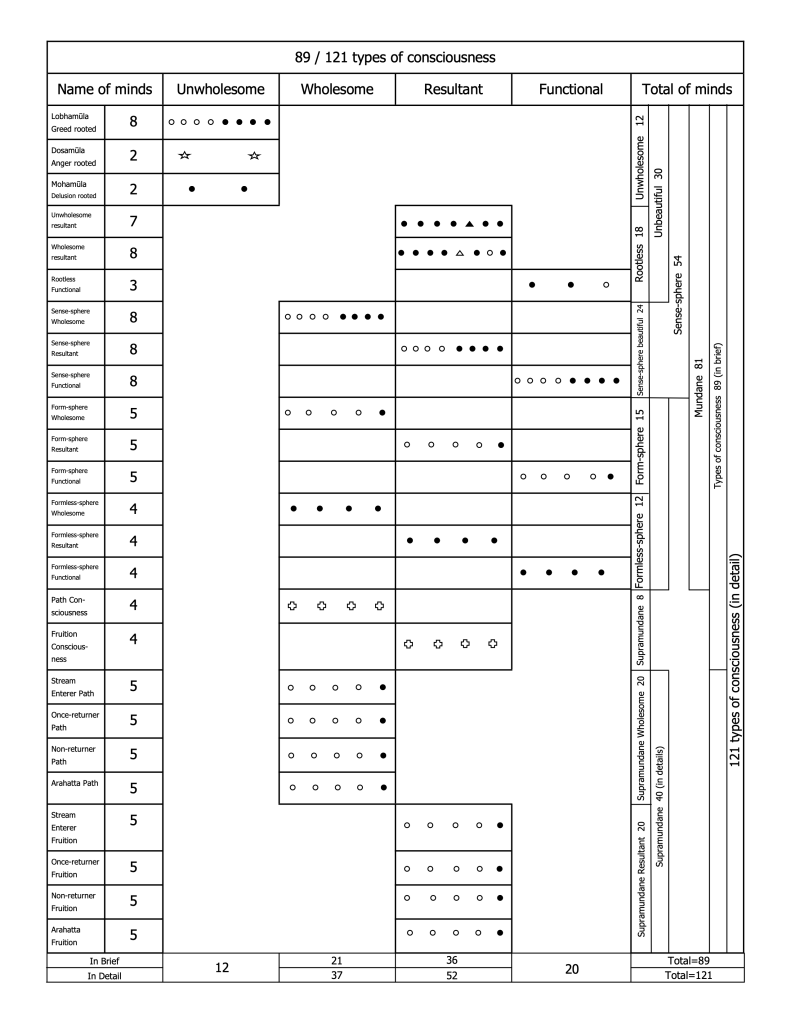
  • Six of the eight consciousnesses are associated with the body (sight, sound, smell, taste, touch and mental action/volition) and two are associated with the mind (self-grasping and memory/karma, aka mano and ālāya).  Each can be thought of as cause (seed) and effect (fruit).  The “sight” is an “effect” of the “eyes” coming into contact with simulants from the outside world, but it can also be the “cause” since it is the internal simulant for the brain (the mind root) resulting in mental action.  Therefore “karma” can also be both the “cause” and the “effect”.  “Karma” is the “fruit/effect” since it is a record of all mental actions, but it is also the “seed/cause” helping to shape future mental actions.  However, in order for a seed (cause) to grow into a fruit (effect), it requires “condition”.  The most common misunderstanding of “karma” is that it is the ”condition”.  This is wrong since “karma” is only the seed that affects the future but it is not the future.  We control the outcome because we control the condition.
  • Hina means small and Yana means vehicle.  Hanayana is a frictional term created by the Chinese buddhists to denigrate those who do not practice their so-called Mahayana tradition (Maha means big).  In 1950 the World Fellowship of Buddhists had declared that the term Hīnayāna should not be used when referring to Buddhism practiced in SouthEast Asia, instead the term Theravada should be used which means elders.  Surprisingly many Chinese Buddhist monastics still insist on using the pejorative term, consistent with their lack of modern education and world view.  One of the most popular Mahayana scriptures is the Lotus Sutra which was translated into Chinese in 286 CE.  The oldest scripture is the Aṣṭasāhasrikā Prajñāpāramitā Sūtra which was thought to be written around 50 CE.  In order words, the so-called Mahayana tradition did not come into existence until almost 500 years after the death of the historical Buddha whereas the Theravada tradition came into existence immediately after (through the 1st Council).   The tradition continued until the second Council which was around 300 BCE, 300 years after the death of Buddha.  And the third Council which was convened by King Ashoka was around 250 BCE and subsequently delegates were sent to various parts of the world including Sri Lanka.  In other words, the beginning of the Theravada tradition as practiced in SouthEast Asia predated the Mahayana tradition by at least 300 years.  So it is not only contextually inaccurate, it is also historically inaccurate to refer to anything non-Mahayana as Hinayana.  Finally, the beginning of Buddhism in China started with the Sutra of the Forty Two Chapters which was translated in 67 CE by two monks from India which predated the transition to Mahayana by also 300 years.  In other words, the original Buddhist tradition that came to China was not even the so-called Mahayana tradition.  The Mahayana tradition is actually a cultural amalgamation of Buddhism, Taoism and Confucianism.
  • Jiru is 繼如.  繼 means to continue.  如 could come from 如來 which is one of the ten epithets of Buddha.  In Sanskrit 如來 is Tathāgata which means the one beyond all coming and going – beyond all transitory phenomena.

Audio: Karma Knows | (9/29/2020 — “Ask Us Anything” With Denny K Miu)

Or listen via Insight Timer (app or website)


Join Denny live Saturdays online for Yi Jin Jing and mindful joint, stretching, breathing, and qi exercises via:


Full list of links at DennyKMiu.com


Continue reading “Karma Knows | (9/29/2020 — “Ask Us Anything” With Denny K Miu)”

Anesthetic consciousness: “If everything is consciousness, what happens during anesthesia?”

I recently listened to a voicemail from a friend who called asking, “if everything is consciousness, what happens during anesthesia?”

It’s a great question and the short answer is: I don’t know. And “if everything is consciousness” is only one perception of reality. After deferring to referring him to a few folks who may provide a decent answer, and without researching the question, I also offered:

Wild you ask that. We’re studying Yogachara, a consciousness-only, school of Buddhism. From wikipedia: ‘According to Dan Lusthaus, this tradition developed “an elaborate psychological therapeutic system that mapped out the problems in cognition along with the antidotes to correct them, and an earnest epistemological endeavor that led to some of the most sophisticated work on perception and logic ever engaged in by Buddhists or Indians.”‘

. . . I’ve never been under. My off the cuff thought is it would maybe be similar to how it is during drug-induced/hypnagogic/liminal/sleep/ dream-like states. [Combinations of these.] Then there’s the whole field of Buddhist psychology in the Abhidhamma with detailed extensive teachings on consciousness. I feel neuroscience is just starting to catch up with it.

And then a follow up reply:

Metaphorically, when we are “asleep” we could be likened more to dead than alive. As opposed to “awake”. At least that’s one perspective — as long as those aspiring to realize awakening don’t berate themselves for not being fully awake yet. This is perhaps described as a process and a journey.

. . . It seems to me we perhaps have a mini death and resurrection every night before sleeping and then awakening. Even more subtle is our constant day-to-day, moment-to-moment “death” of losing mindfulness and “rebirth” of regaining mindfulness.

An Integrating Presence Meditation at Mary’s House of Healing September 30, 2020

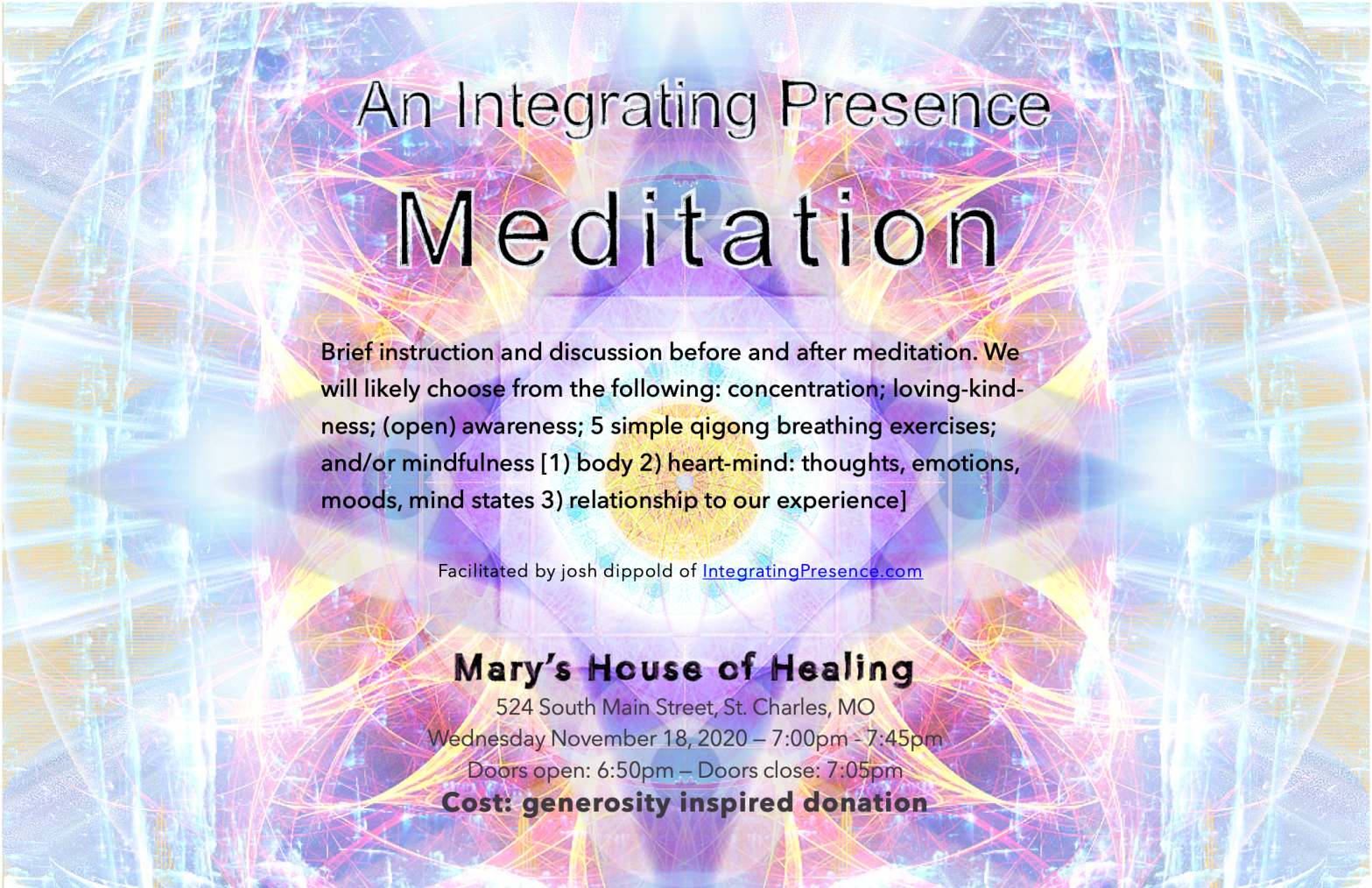
On September 30, 2020 at Mary’s House of Healing starting at 7pm, I plan to facilitate a guided meditation starting with brief instructions along with a discussion before and after. We will likely choose from the following: concentration; loving-kindness; (open) awareness; 5 simple qigong breathing exercises; and/or mindfulness (breath, body, feelings, mind)


Audio: An Integrating Presence Meditation at Mary’s House of Healing September 30, 2020

Fat Cat Longevity at Mary’s House of Healing

Mary’s House of Healing
524 South Main Street
Downstairs at Fat Cat Longevity next to Peace Love Coffee…
St. Charles, MO

September 30, 2020 — 7:00pm – 7:45pm

Doors open: 6:50pm — Doors close: 7:05pm

Donations welcome & appreciated

JNANI: The Silent Sage of Arunachala — Questions and Comments on the Film about Sri Ramana Maharshi

The Sri Ramana Maharshi biopic film JNANI: The Silent Sage of Arunachala is beautifully assembled with astonishing archival photos and first hand account interviews. Even though I’m a new comer to Ramana Maharshi — known for Self-inquiry — I feel what he conveyed and taught seem well represented in JNANI. Just witnessing the images of Ramana seem to quiet the mind resulting in a peaceful and awake contentment. The still photo in this post depicts Ramana Maharshi in the rain with a clear reflection of his immediate background on the wet ground but without a trace of Ramana’s body reflected.

There’s nothing but honor and respect for Ramana Maharshi, one of Earth’s most profound figures in recent times. And it is with this same honor and respect that I relate the following mundane questions, perhaps spurred on by a background interest in parapolitics. Unfortunately, underhanded politics work their way into spiritual matters. The intent is not to take any sides — either locally, with various nations or even globally — but to bring any needed awareness in order to bring truth to light for better viewpoints and better (future) individual and collective decision making while allowing any irrelevant lines of inquiry to easily fall away:

Disability

  • Were there other accomplished sages and saints of similar stature during his time, without much popularity, and who don’t look a little physically disabled?
  • Could Ramana’s popularity be related in any way with disability? As in, “oh, you want to be a great enlightened sage? OK, then here’s a role model with a portly/unfit body from neglecting his health”. [The potential purpose being those in power’s attempt to initially discourage a path of self-realization for those still attached to egos, images and personalities.]
  • And could his promotion as a popular spiritual figure possibly impact Hinduism division(s) (and diminish its numbers) via divide and conquer tactics?

Westerners and Eastern Politics

  • Who were the Westerners Maurice Frydman and Major A. W. Chadwick (a major Ramana Maharshi figure with no current Wikipedia entry)?
  • What was Frydman engineering background, and how and why was an engineer so instrumental in the Indian independence movement?
  • Being connected to Theosophists Wanda Dynowska and Jiddu Krishnamurti, what was Frydman’s position in Theosophy, if any?
  • Wanda Dynowska helped with Tibetan refugees in India and the film mentions Frydman’s instrumental part in bringing the Dalai Lama to India. Without doing a deep dive into the CIA’s role in China, Tibet and the Dalai Lama’s flight to India, I also wonder about such possible Intelligence Agency connections for these two Western figures — a ghostly WW I veteran, and an engineer with secret society connections and high level political involvement.
  • Taking liberties by extrapolating the aforementioned for thought experiments: Even with or without any known or unknown deliberate CIA influences on the situation, could the Dalai Lama signify/symbolize/signal CIA dominance by them saving the savior-like Bodhisattvas of Tibet? And from one perspective, could the CIA be seen as sort of besting a spiritual sect by providing seeming harmony and a better political climate for Tibetans in India while making China look like the bad guys (as perhaps another subtle reason for potential war) all the while, in a way, currently lording over a powerful foreign spiritual religion behind the scenes as a background influence (by means of “rescue”, emplacement, politics and normalizing Tibetan Buddhism into western culture, a la Free Tibet, Richard Gere, Uma Thurman’s father Robert Thurman, etc.)?

Miscellaneous Questions

  • Is he carrying a teapot in several photos? If so, any significance?
  • Is the true nature, big Self that he realized the Atman or perhaps Para Brahman?

Wisdom Snippets: Belief (Downsides And Solutions)

From “The Unfoldment: The Organic Path to Clarity, Power, and Transformation” (p. 41-48). Career Press. Kindle Edition. By Neil Kramer.

‘Belief is often about comfort. It is reassuring to know that a thing will be the same today as it was yesterday. We set up all kinds of routines and habitual practices in our daily lives in an attempt to persuade ourselves that change is somewhere far off in the distance, only occasionally dipping in to jiggle things around. Our brains have been conditioned to favor solidity, stability, and order in everything that we observe. We believe that the chair exists; we can see it and touch it. It was there yesterday, and it will most likely be there tomorrow. It is a defined experience, well evidenced and self-apparent. What could be more real than the physicality of the objects in our world? Surely, we can believe in their existence? Yet this way of thinking is not accurate.

In actuality, all things are in a constant state of flux at all times. Every material form is always vibrating, shifting, and transforming. Only our brains make them look still and concrete. In Buddhism, this observance is called annica (impermanence) and is one of the three marks of existence that characterize the illusory world (the others being dukkha, unsatisfactoriness, and anatta, non-self). Annica teaches that all formations are impermanent and real spiritual growth begins with dispassionate experiential mindfulness of the present moment. Consciousness is in its most natural, balanced, and truthful state when brought into the center of now. This is difficult to do when constrained by beliefs of any kind. When we believe things, we create constructs that can hinder the natural flow of consciousness. We fabricate illusions of permanence to make ourselves feel better.

In the Zen tradition, impermanence is called mujō, indicating the transience and mutability of all compound objects. It is a vital principle in understanding the flow of the unreal. The Zen student begins to actively engage with the reality that nothing lasts, yet nothing is lost. From the ultrasoup of infinite energy arise all forms and patterns, and back they go to tell their story, merging with the undifferentiated whole once more. After a time, forms separate out again and go onto the next voyage. Belief only slows this realization down.

In 1980, David Bohm published his book Wholeness and the Implicate Order, articulating the same ancient wisdom but in the modern language of quantum physics. His view of the enfolded implicate order and the unfolded explicate order was radically different from the prevailing mechanistic physics of the time. Today, his ideas are still deeply antithetical to the reductionist fetishes of mainstream science. In Bohm’s model, primacy is given to the undivided whole and the enfolded implicate order within the whole, rather than particles, quantum states, and continua. What this suggests is that forms arise from a wholeness of energy; they are a result of particular formations that are bound by consciousness. He shows that the universe is not a vast machine made up of atomic building blocks. Indeed, there is no sustainable distinction between manifest reality and consciousness. For Bohm, the whole language of quantum physics. His view of the enfolded implicate order and the unfolded explicate order was radically different from the prevailing mechanistic physics of the time. Today, his ideas are still deeply antithetical to the reductionist fetishes of mainstream science. In Bohm’s model, primacy is given to the undivided whole and the enfolded implicate order within the whole, rather than particles, quantum states, and continua. What this suggests is that forms arise from a wholeness of energy; they are a result of particular formations that are bound by consciousness. He shows that the universe is not a vast machine made up of atomic building blocks. Indeed, there is no sustainable distinction between manifest reality and consciousness. For Bohm, the whole encompasses all things, entities, structures, abstractions, and processes. Nothing is entirely separate or autonomous; it is all part of a unified and extremely cohesive whole.

It has to be said that the impermanence of all things can be an unsettling notion for even the most elastic of human minds. We can’t help but value an element of constancy and predictability as foundations for a well-ordered life. This is why we fashion beliefs—in the hope that they will serve as mental life rafts that will help keep us afloat. But there really is nothing to worry about. We must contemplate that it is consciousness itself that molds the objects around us. There is no physical boundary between oneself and that which is outside oneself. It is only our brain that proposes a gap, in order that we can navigate around our world more easily. But in the business of unfoldment, we can reduce or even dissolve that gap by realizing that our consciousness is the chair, just in the same way that our consciousness is our dreams. It is the intelligent holographic fabric of reality itself, an emanation from the divine. As the great alchemical sages put it, “the all is mind, the universe is mental.” Belief plays a key role in either opening or closing that flow of potential energy.

It certainly seems that there are helpful beliefs and unhelpful beliefs. A helpful belief is “I believe that by drinking this glass of water, my thirst will be quenched,” whereas an unhelpful belief might be “I believe that the nasty disease that I have just been diagnosed with is going to kill me.” They are both working models, though one has a positive aspect and one has a negative aspect. So why on Earth would anyone ever sustain a negative working model that does not benefit them? Why believe what might not be true and could well contribute to his or her own undoing?

People believe because of consensus. They believe because of the compelling gravitation of all the other people who believe the same thing. There are so many abiding beliefs that tell us that the body is just a machine, that hospitals are the best place for biological machines to get fixed, and that the system of Western medicine is the most advanced in the world. Such powerful and well-established beliefs—with such irresistible group blessing—soon overwhelm any individual conception of the body’s own innate capacity to heal itself. That is merely a wishful fantasy that promptly evaporates in the hard light of someone else’s manufactured reality.

The placebo effect is where a positive therapeutic effect is experienced by a patient, physically and/or psychologically, after receiving an inert treatment (such as an inactive sugar pill) that is believed by the patient to be an active and effective drug. Certain sections of the medical establishment have long sought to rubbish and discredit this whole phenomenon as it presents some worrying philosophical dilemmas for conventional medicine. Curiously, the placebo effect is not just limited to the patient’s physical and mental responses; the doctor’s attitude can play a role, too. In 1961, Henry K. Beecher, an influential figure in the history of anesthesiology and medical ethics, observed that surgeons he categorized as enthusiastic succeeded in relieving their patients’ chest pain and heart problems more than skeptical surgeons. Is consciousness once more being caught entangled in form?

In July 2011, the ABC Medical News Unit reported on a pilot study published in The New England Journal of Medicine. The report suggests that we should:

“Never underestimate the power of the mind when it comes to feeling better. In the newest demonstration of how healing can be triggered by patients’ expectations of what medical attention can do for them, placebo treatments were as good as real medication in making asthmatic patients feel they were breathing more easily. Thirty-nine asthma patients reported about as much perceived relief from a placebo inhaler or from sham acupuncture as from an inhaled dose of the steroid albuterol.”

Coauthor of the study Dr. Michael E. Wechsler, an asthma specialist at Brigham and Women’s Hospital and Harvard Medical School in Boston, writes, “Placebo effects can be clinically meaningful and can rival the effects of active medication in patients with asthma.” Predictably, the study later goes on to say that “patient self-reports can be unreliable.” However, in an accompanying editorial in the same issue of the journal, Dr. Daniel E. Moerman, an expert on the placebo effect from the University of Michigan–Dearborn, called into question the idea that patients’ self-reports were unreliable because their perceived improvements from treatment were not necessarily corroborated by lung capacity tests. He stated, “It is the subjective symptoms that brought these patients to medical care in the first place. They came because they were wheezing and felt suffocated, not because they had a reduced [lung capacity].” Not all doctors are swept up in the pressure to conform to the norm. In their 2005 paper, “Making Space for the Placebo Effect in Pain Medicine,” Dr. Daniel Moerman and Dr. Anne Harrington detail some fascinating mental effects of brand marketing on the administering of active drugs and placebos:

“In one study, 835 women who regularly used over-the-counter analgesics for headaches were placed randomly into four groups: one group received unlabeled placebo; one received placebo marked with a widely advertised and widely-available brand name, “one of the most popular…analgesics in the United Kingdom and supported by extensive advertising”; one received unbranded true aspirin, and one received branded true aspirin. Each subject was asked to note the amount of headache pain relief experienced an hour after taking the pills. The results showed, unsurprisingly, that aspirin was more effective than placebo. More surprising, perhaps, was the finding that brand-name aspirin was more effective than generic aspirin, and brand-name placebo was more effective than generic placebo. Aspirin relieves headaches, but so does the knowledge that one is taking pills whose efficacy one has learned to trust from television advertisements. In this study, a brand name itself turned out to have independent active properties, enhancing the effects of both placebos and true aspirin.”

Concluding their paper, Moerman and Harrington note:

“What we know, understand, think, and feel; what we are told and believe; the relationships we have with our clinicians—our doctors, nurses, and probably receptionists and parking lot attendants—can very directly affect our response to medical treatment, and, in particular, analgesic treatment. These matters are, these days, largely left to chance, or to ideology, or to market forces, but are still rarely subject to robust science. There is much to be learned here that is not only of enormous intellectual interest but that also might lead to material improvements of the quality of medical care for pain and other disorders; making room for the placebo in pain studies may complicate matters, but there is too much at stake to do anything else.” medical care for pain and other disorders; making room for the placebo in pain studies may complicate matters, but there is too much at stake to do anything else.”

The marketing of belief has a physical effect on the body. Whenever we detect that fear is being marketed, particularly through mainstream television, we should be on our guard. If fear is present in the propagation of a belief system—whatever that may be—there is always disempowerment. The dominant human tendency to identify with the biological shell of the body is a fundamental piece of fear conditioning. If people believe that they are their physical shell, then they will remain subservient and deferential to those who are apparently capable of looking after it. It is an old trick and one that has been used for a long time by those who desire to manipulate. Simply put, if your belief is being controlled, your mind and body are being controlled.

Questions arise. Is belief required for one’s authentic unfoldment? Does it have a role to play in the attainment of gnosis and the process of conscious individual growth? Is belief even necessary at all? With reason and honesty, these questions have remarkably straightforward answers.

Do we need to believe in God to have a relationship with God? No. We just have a relationship with God. Do we need to believe that we can cook a fabulous Thanksgiving dinner to actually succeed in cooking one? No. We just cook one. What about believing in ourselves? Or believing that we can play the piano beautifully? What we are really saying is that we would like to focus more conscious energy into these things. The more we do that, the better they will turn out. The belief associated with them is just an extraneous mental construct that gets in the way of the smooth flow of consciousness. It is not needed.

Our beliefs tend to be binary. They are either yes or no, black or white, 0 or 1. Popular consensus strongly affects that result, whether we like it or not. To believe that we cannot levitate the coin in the air because the overwhelming majority of people would say that that is impossible, means that the programmed subconscious mind will not permit it. The common mistake is then to immediately charge the opposite belief: that we can do it. This, too, gets in the way because it creates a paradigm-cracking conflict that the mind would rather not have to deal with. Paradoxes are not allowed in belief-laden minds. The wise move is to believe nothing. To carefully, but willfully, remove belief from the operating system altogether. To let consciousness flow without hindrance. This is the secret of the physics-bending adepts of Europe and Asia. They have learned to jettison belief and just get out of their own way.

We do not need to believe. We can operate with integrity, fine conduct, and honor without any beliefs at all. We can create, inspire, grow, and love without believing a thing. We can feel free to formulate striking and elaborate theories about the world, as many as we wish, but we need not become attached to them. We can let them come and go, transform, and evolve, in a much more organic way.

I propose that we replace the concept of internalizing beliefs with the concept of holding ideas. It is hard to dig out of a heavy belief, but it is not hard to let go of an idea that you are merely holding. Beliefs require ongoing energetic maintenance and a fixed narrative to sustain them. In contrast, something that is just being lightly held, without internalizing it as belief or disbelief, remains as light as a feather. It requires no safeguarding of any kind, and there is no weight to it. We can hold many ideas without feeling any weight at all. If any given idea proves to be useless or untrue, we simply let go of it. If it proves to be useful and true, we keep it. Over time, these ideas gain higher and higher fidelity as they continue to refine themselves, until they become totally weightless. No investment is required either way. No investment = no weight.

Don Juan Matus said, “A warrior is never under siege. To be under siege implies that one has personal possessions that could be blockaded. A warrior has nothing in the world except his impeccability, and impeccability cannot be threatened.” This applies equally to possessions of the non-physical kind. With no beliefs to carry, the speed, fluidity, and expansion of the spiritual warrior is greatly enhanced.’

Kramer, Neil. The Unfoldment: The Organic Path to Clarity, Power, and Transformation (p. 41-48). Career Press. Kindle Edition.


And from What the Buddha Taught by Walpola Rahula [pdf]:

It is an undeniable fact that as long as there is doubt, perplexity, wavering, no progress is possible.

It is also equally undeniable that there must be doubt as long as one does not understand or see clearly. But in order to progress further it is absolutely necessary to get rid of doubt. To get rid of doubt one has to see clearly. There is no point in saying that one should not doubt or one should believe. Just to say ‘I believe’ does not mean that you understand and see. When a student works on a mathematical problem, he comes to a stage beyond which he does not know how to proceed, and where he is in doubt and perplexity. As long as he has this doubt, he cannot proceed.

If he wants to proceed, he must resolve this doubt. And there are ways of resolving that doubt. Just to say ‘I believe’, or ‘I do not doubt’ will certainly not solve the problem. To force oneself to believe and to accept a thing without understanding is political, and not spiritual or intellectual.

Excerpt from What the Buddha Taught by Walpola Rahula