
Article shortcut: https://tinyurl.com/basesofpower
Iddhipāda (Pali; Skt. ṛddhipāda) is a compound term composed of “power” or “potency” (iddhi; ṛddhi) and “base,” “basis” or “constituent” (pāda).
https://en.wikipedia.org/wiki/Iddhipada
One reason this blog post and podcast series came about could likely be due to my meditation practice becoming stale and now provides an outlet for a somewhat more advanced level where details are dived into. If and when exploring this sutta on your own, it’s recommended to drop the intricate, sometimes tedious language I go into here to the fullest extent possible. It’s important to remember my intent here of placing plenty under a spiritual microscope to merely visit modes of deconstruction and analysis for study and (formal) practice possibilities, not as a general normalized mode of living. And while I go into minute details pertaining to this sutta please keep in mind it’s likely more helpful not to keep considering this sutta in isolation but within the broader context of the Buddha’s (other) teachings.
While I reference some non-Buddhist material most everything in this blog post and podcast episodes are solely my effort to relate considerations, questions, experiences, explorations, suggestions, interpretations and practices involved and associated with this sutta. They are not entirely the same thing as the actual experiences and phenomena that inspired them, only my interpretation of them in language. In other words, our interpretation of experience is not the same thing as experience itself.

A significant portion of this sutta mentions so called “psychic powers” which in today’s postmodern world I observe a polarity of either garnering dismissal, jokes, and relegation to comic book movies in the “scientific” Western world. Or, on the other end, looked upon with fear and trepidation (by detractors), or obsessed about by the power hungry. As long as precepts and ethics are involved it is OK to empower ourselves this way just as the Buddha taught in this sutta, especially since he says, “This is how these four bases of power, when developed & pursued, are of great fruit & great benefit.” Ethics are required before preceding as this material gives zero allowance for (its) ill-use.
For background, I’ve been exposed to some (esoteric) teachings about “psychic powers” but no formal training from a book or teacher. Perhaps a well known reference point in spiritual circles are the Siddhis, which is used interchangeably with the Pali iddhi or rddhi in Sanskrit. These are “material, paranormal, supernatural, or otherwise magical powers, abilities, and attainments that are the products of yogic advancement through sādhanās such as meditation and yoga” mentioned in the Yoga Sutras of Patanjali.

For well over four months I worked with, studied and practiced with this sutta with formal practice consisting of about 80 minutes a day including allotting a/the full 80 minutes to each of the 32 parts within this sutta. Perhaps this could be the equivalent to a month-long retreat or a two week intensive retreat.

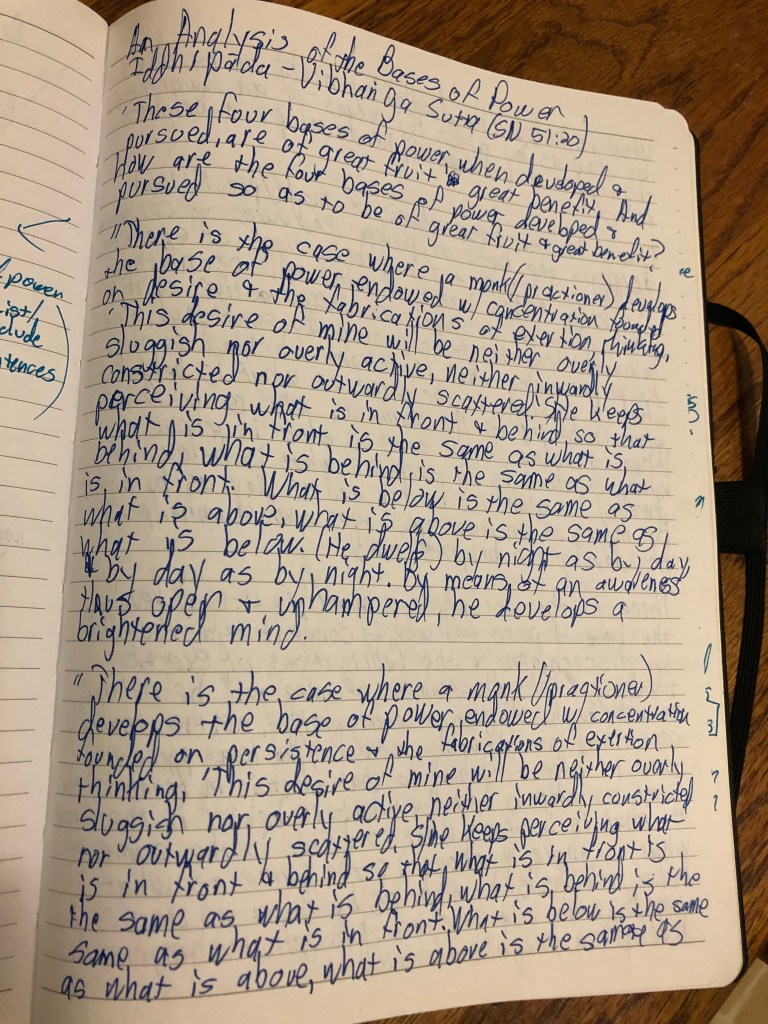
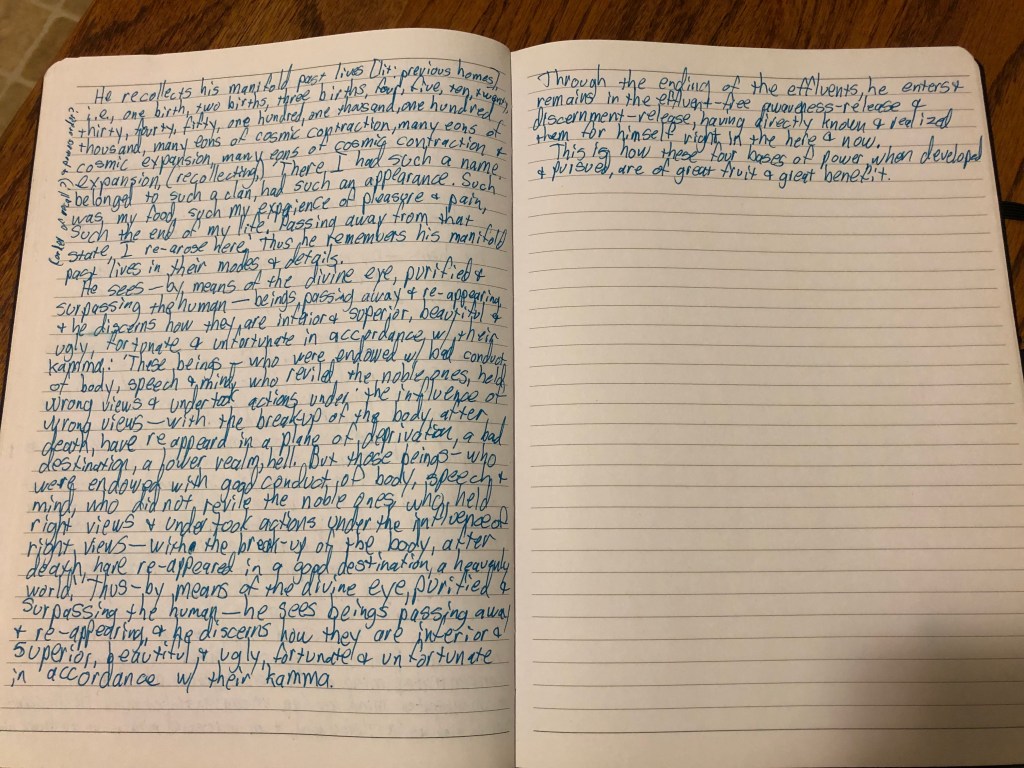
Some of the more esoteric insights, correlations and comparisons came upon the first read, but the nitty gritty details came piecemeal day after day, session after session. I even did a doodle to encapsulate some of the practice approaches and wrote down one translation of the entire sutta long hand, expanding it out by adding the redundant standard textual omissions in the text(s) included here.


I’ll present this series via seven categories/blog posts/podcasts:
- This introduction; the key encapsulation/encoding/summary paragraph of the whole sutta which includes and weaves in the four powers; and a reading of one of two translations for the sutta
- Unpacking of the hindrances and the other of two translations for the sutta
- (Type of) situational awareness
- 32 parts of the body
- Perceptions of night, daytime and light
- “Psychic Powers,” practice combinations and miscellany
- Summary, findings, observations and comparisons
Given a current innerstanding one can basically approach this sutta as training, development, cultivation and use of the four Iddhipāda — desire, persistence, intent and discernment — primarily via:
- the 32 parts of the body (including substances/parts/sections/regions/etc)
- (inhabiting) a type of situational awareness
- (variations of/on) (inverse) perceptions of night and day/light separately and woven together
In more detail, the four Iddhipāda — sometimes translated as bases of psychic power, basis of psychic power, bases of power, base of spiritual power, wings to success, paths of accomplishment, accomplishments, or roads to power — are:
- chanda: desire; enthusiasm; purpose; wish
- viriya: persistence; energy; effort; will
- citta: intent; consciousness; knowing mind; mental development; devoting mind to; heart-mind
- vīmaṃsā: investigation; inquiry; discernment; discrimination; reason; interest; intelligent curiosity; [(perhaps a new contribution, or for chanda:) balanced and helpful enthrallment, fascination]; feedback and fine tuning, adjustment; learn from doing; circumspection

After daily meditation for a few years the power and origin of. manifested phenomena seemingly sourcing from intent became apparent for me so I use intent as an entry point into the Iddhipāda for certain types of meditation. Sometimes I hold in awareness an intent, sometimes multilayered, without importance placed on what will or won’t happen other than fixing attention and awareness on it. Since there is already a seeing and knowing of the power and importance of intent, and with conviction of the (fabrication of the) importance of the selected intent, desire is (then) allowed to fuel this conviction, importance, power, seeing and knowing. At the same time if there’s any kind of obsessive, compulsive, and addictive energy it can be transformed into the wholesome desire to persist in staying with the chosen intention (as meditation object). Discernment comes in to quickly and sharply see then drop each and every arising other than the aforementioned. At least ideally anyway.

However one approaches the Iddhipādas I suggest exploring and developing all four — especially building concentration with them — before diving into this sutta.
In the recording I mention scientific studies of past lives and inquire into why this is not more common place.
Audio recordings for some sections contain two recordings: the first one more spontaneous without referring to notes; the second one consults notes so there may be some overlap and redundancies ideally important ones worth the repetition. Also, oops on any thumping due to sensitive mic too close to trackpad
Audio: Studying And Practicing With “The Iddhipāda-Vibhaṅga Sutta — An Analysis Of The Bases Of Power”: Introduction; The Sutta’s Key Encapsulation Paragraph & A Translation Reading (1 of 7)

Or listen via Insight Timer (app or website)

So here’s the key encapsulation/encoding/summary paragraph of the whole sutta which includes and weaves in the four powers:
“There is the case where a monk develops the base of power endowed with concentration founded on desire & the fabrications of exertion, thinking, ‘This desire of mine will be neither overly sluggish nor overly active, neither inwardly constricted nor outwardly scattered.’ He keeps perceiving what is in front & behind so that what is in front is the same as what is behind, what is behind is the same as what is in front. What is below is the same as what is above, what is above is the same as what is below. (He dwells) by night as by day, and by day as by night. By means of an awareness thus open & unhampered, he develops a brightened mind.”
Translated by Ṭhānissaro Bhikkhu
Or the Bhante Sujato translation:
“Mendicants, when the four bases of psychic power are developed and cultivated they’re very fruitful and beneficial.
How so? It’s when a mendicant develops the basis of psychic power that has immersion due to enthusiasm, and active effort. They think: ‘My enthusiasm won’t be too lax or too tense. And it’ll be neither constricted internally nor scattered externally.’ And they meditate perceiving continuity: as before, so after; as after, so before; as below, so above; as above, so below; as by day, so by night; as by night, so by day. And so, with an open and unenveloped heart, they develop a mind that’s full of radiance.”
I address my take on the significance of what’s encapsulated within this key paragraph in Part 7: Summary, findings, observations and comparisons

Ṭhānissaro Bhikkhu translation of “The Iddhipāda-Vibhaṅga Sutta — An Analysis Of The Bases Of Power” (SN 51:20) followed by the original Pali:
“These four bases of power, when developed & pursued, are of great fruit & great benefit. And how are the four bases of power developed & pursued so as to be of great fruit & great benefit?
“There is the case where a monk develops the base of power endowed with concentration founded on desire & the fabrications of exertion, thinking, ‘This desire of mine will be neither overly sluggish nor overly active, neither inwardly constricted nor outwardly scattered.’ He keeps perceiving what is in front & behind so that what is in front is the same as what is behind, what is behind is the same as what is in front. What is below is the same as what is above, what is above is the same as what is below. (He dwells) by night as by day, and by day as by night. By means of an awareness thus open & unhampered, he develops a brightened mind.
“He develops the base of power endowed with concentration founded on persistence…
“He develops the base of power endowed with concentration founded on intent…
“He develops the base of power endowed with concentration founded on discrimination & the fabrications of exertion, thinking, ‘This discrimination of mine will be neither overly sluggish nor overly active, neither inwardly constricted nor outwardly scattered.’ He keeps perceiving what is in front & behind so that what is in front is the same as what is behind, what is behind is the same as what is in front. What is below is the same as what is above, what is above is the same as what is below. (He dwells) by night as by day, and by day as by night. By means of an awareness thus open & unhampered, he develops a brightened mind.
“And how is desire overly sluggish? Whatever desire is accompanied by laziness, conjoined with laziness, that is called overly sluggish desire.
“And how is desire overly active? Whatever desire is accompanied by restlessness, conjoined with restlessness, that is called overly active desire.
“And how is desire inwardly constricted? Whatever desire is accompanied by sloth & drowsiness, conjoined with sloth & drowsiness, that is called inwardly restricted desire.
“And how is desire outwardly scattered? Whatever desire is stirred up by the five strands of sensuality, outwardly dispersed & dissipated, that is called outwardly scattered desire.
“And how does a monk dwell perceiving what is in front & behind so that what is in front is the same as what is behind, and what is behind is the same as what is in front? There is the case where a monk’s perception of what is in front & behind is well in hand, well-attended to, well-considered, well-tuned [‘penetrated’] by means of discernment. This is how a monk keeps perceiving what is in front and behind so that what is in front is the same as what is behind, and what is behind is the same as what is in front.
“And how does a monk dwell so that what is below is the same as what is above, and what is above is the same as what is below? There is the case where a monk reflects on this very body, from the soles of the feet on up, from the crown of the head on down, surrounded by skin, & full of various kinds of unclean things: ‘In this body there are head hairs, body hairs, nails, teeth, skin, flesh, tendons, bones, bone marrow, kidneys, heart, liver, pleura, spleen, lungs, large intestines, small intestines, gorge, feces, bile, phlegm, pus, blood, sweat, fat, tears, skin-oil, saliva, mucus, fluid in the joints, urine.’ This is how a monk dwells so that what is below is the same as what is above, and what is above is the same as what is below.
“And how does a monk dwell by night as by day, and by day as by night? There is the case where a monk at night develops the base of power endowed with concentration founded on desire & the fabrications of exertion by means of the same modes [permutations] & signs & themes that he uses by day, and by day he develops the base of power endowed with concentration founded on desire & the fabrications of exertion by means of the same modes & signs & themes that he uses by night. This is how a monk dwells by night as by day, and by day as by night.
“And how does a monk—by means of an awareness open & unhampered—develop a brightened mind? There is the case where a monk has the perception of light, the perception of daytime [at any hour of the day] well in hand & well-established. This is how a monk—by means of an awareness open & unhampered—develops a brightened mind.
[The above discussion is then repeated for persistence, intent, & discrimination.]
“When a monk has thus developed & pursued the four bases of power, he experiences manifold supranormal powers. Having been one he becomes many; having been many he becomes one. He appears. He vanishes. He goes unimpeded through walls, ramparts, & mountains as if through space. He dives in & out of the earth as if it were water. He walks on water without sinking as if it were dry land. Sitting cross-legged he flies through the air like a winged bird. With his hand he touches & strokes even the sun & moon, so mighty & powerful. He exercises influence with his body even as far as the Brahmā worlds.
“He hears—by means of the divine ear-element, purified & surpassing the human—both kinds of sounds: divine & human, whether near or far.
“He knows the awareness of other beings, other individuals, having encompassed it with his own awareness. He discerns a mind with passion as ‘a mind with passion,’ and a mind without passion as ‘a mind without passion.’ He discerns a mind with aversion as ‘a mind with aversion,’ and a mind without aversion as ‘a mind without aversion.’ He discerns a mind with delusion as ‘a mind with delusion,’ and a mind without delusion as ‘a mind without delusion.’ He discerns a restricted mind as ‘a restricted mind,’ and a scattered mind as ‘a scattered mind.’ He discerns an enlarged mind1 as ‘an enlarged mind,’ and an unenlarged mind as ‘an unenlarged mind.’ He discerns a surpassed mind [one that is not at the most excellent level] as ‘a surpassed mind,’ and an unsurpassed mind as ‘an unsurpassed mind.’ He discerns a concentrated mind as ‘a concentrated mind,’ and an unconcentrated mind as ‘an unconcentrated mind.’ He discerns a released mind2 as ‘a released mind,’ and an unreleased mind as ‘an unreleased mind.’
“He recollects his manifold past lives [lit: previous homes], i.e., one birth, two births, three births, four, five, ten, twenty, thirty, forty, fifty, one hundred, one thousand, one hundred thousand, many eons of cosmic contraction, many eons of cosmic expansion, many eons of cosmic contraction & expansion, (recollecting,) ‘There I had such a name, belonged to such a clan, had such an appearance. Such was my food, such my experience of pleasure & pain, such the end of my life. Passing away from that state, I re-arose there. There too I had such a name, belonged to such a clan, had such an appearance. Such was my food, such my experience of pleasure & pain, such the end of my life. Passing away from that state, I re-arose here.’ Thus he remembers his manifold past lives in their modes & details.
“He sees—by means of the divine eye, purified & surpassing the human—beings passing away and re-appearing, and he discerns how they are inferior & superior, beautiful & ugly, fortunate & unfortunate in accordance with their kamma: ‘These beings—who were endowed with bad conduct of body, speech, & mind, who reviled the noble ones, held wrong views and undertook actions under the influence of wrong views—with the break-up of the body, after death, have re-appeared in a plane of deprivation, a bad destination, a lower realm, hell. But these beings—who were endowed with good conduct of body, speech, & mind, who did not revile the noble ones, who held right views and undertook actions under the influence of right views—with the break-up of the body, after death, have re-appeared in a good destination, a heavenly world.’ Thus—by means of the divine eye, purified & surpassing the human—he sees beings passing away and re-appearing, and he discerns how they are inferior & superior, beautiful & ugly, fortunate & unfortunate in accordance with their kamma.
“Through the ending of the effluents, he enters & remains in the effluent-free awareness-release & discernment-release, having directly known & realized them for himself right in the here & now.
“This is how these four bases of power, when developed & pursued, are of great fruit & great benefit.”
Notes
1. Mahaggataṁ. This term is used, together with “immeasurable / unlimited,” in the standard description of the awareness generated in the practice of the brahmavihāras (SN 42:8). According to Ven. Anuruddha in MN 127, however, an enlarged mind is not immeasurable. Its range of awareness is larger than the body but still measurable, ranging in distance from the shade of a tree to the earth bounded by the ocean.
2. On the various levels of release, see DN 15, MN 43, and AN 9:43–45.
An Analysis of the Bases of Power
Iddhipāda-Vibhaṅga Sutta (SN 51:20) https://www.dhammatalks.org/suttas/SN/SN51_20.html

Again, this series comes via seven categories/blog posts/podcasts:
- Introduction; the key encapsulation/encoding/summary paragraph of the whole sutta which includes and weaves in the four powers; and a reading of one of two translations for the sutta
- Unpacking of the hindrances and the other of two translations for the sutta
- A (type of) situational awareness
- 32 parts of the body
- Perceptions of night, daytime and light
- “Psychic Powers,” practice combinations and miscellany
- Summary, findings, observations and comparisons
[The original Pali via https://suttacentral.net/sn51.20/pli/ms]:
“Cattārome, bhikkhave, iddhipādā bhāvitā bahulīkatā mahapphalā honti mahānisaṁsā”.
Kathaṁ bhāvitā ca, bhikkhave, cattāro iddhipādā kathaṁ bahulīkatā mahapphalā honti mahānisaṁsā? Idha, bhikkhave, bhikkhu chandasamādhippadhānasaṅkhārasamannāgataṁ iddhipādaṁ bhāveti—iti me chando na ca atilīno bhavissati, na ca atippaggahito bhavissati, na ca ajjhattaṁ saṅkhitto bhavissati, na ca bahiddhā vikkhitto bhavissati. Pacchāpuresaññī ca viharati—yathā pure tathā pacchā, yathā pacchā tathā pure; yathā adho tathā uddhaṁ, yathā uddhaṁ tathā adho; yathā divā tathā rattiṁ yathā rattiṁ tathā divā. Iti vivaṭena cetasā apariyonaddhena sappabhāsaṁ cittaṁ bhāveti.
Vīriyasamādhi …pe… cittasamādhi … vīmaṁsāsamādhippadhānasaṅkhārasamannāgataṁ iddhipādaṁ bhāveti—iti me vīmaṁsā na ca atilīnā bhavissati, na ca atippaggahitā bhavissati, na ca ajjhattaṁ saṅkhittā bhavissati, na ca bahiddhā vikkhittā bhavissati. Pacchāpuresaññī ca viharati—yathā pure tathā pacchā, yathā pacchā tathā pure; yathā adho tathā uddhaṁ, yathā uddhaṁ tathā adho; yathā divā tathā rattiṁ, yathā rattiṁ tathā divā. Iti vivaṭena cetasā apariyonaddhena sappabhāsaṁ cittaṁ bhāveti.
Katamo ca, bhikkhave, atilīno chando? Yo, bhikkhave, chando kosajjasahagato kosajjasampayutto—ayaṁ vuccati, bhikkhave, atilīno chando.
Katamo ca, bhikkhave, atippaggahito chando? Yo, bhikkhave, chando uddhaccasahagato uddhaccasampayutto—ayaṁ vuccati, bhikkhave, atippaggahito chando.
Katamo ca, bhikkhave, ajjhattaṁ saṅkhitto chando? Yo, bhikkhave, chando thinamiddhasahagato thinamiddhasampayutto—ayaṁ vuccati, bhikkhave, ajjhattaṁ saṅkhitto chando.
Katamo ca, bhikkhave, bahiddhā vikkhitto chando? Yo, bhikkhave, chando bahiddhā pañca kāmaguṇe ārabbha anuvikkhitto anuvisaṭo—ayaṁ vuccati, bhikkhave, bahiddhā vikkhitto chando.
Kathañca, bhikkhave, bhikkhu pacchāpuresaññī ca viharati—yathā pure tathā pacchā, yathā pacchā tathā pure? Idha, bhikkhave, bhikkhuno pacchāpuresaññā suggahitā hoti sumanasikatā sūpadhāritā suppaṭividdhā paññāya. Evaṁ kho, bhikkhave, bhikkhu pacchāpuresaññī ca viharati—yathā pure tathā pacchā, yathā pacchā tathā pure.
Kathañca, bhikkhave, bhikkhu yathā adho tathā uddhaṁ, yathā uddhaṁ tathā adho viharati? Idha, bhikkhave, bhikkhu imameva kāyaṁ uddhaṁ pādatalā adho kesamatthakā tacapariyantaṁ pūraṁ nānappakārassa asucino paccavekkhati: ‘atthi imasmiṁ kāye kesā lomā nakhā dantā taco maṁsaṁ nhāru aṭṭhi aṭṭhimiñjaṁ vakkaṁ hadayaṁ yakanaṁ kilomakaṁ pihakaṁ papphāsaṁ antaṁ antaguṇaṁ udariyaṁ karīsaṁ pittaṁ semhaṁ pubbo lohitaṁ sedo medo assu vasā kheḷo siṅghāṇikā lasikā muttan’ti. Evaṁ kho, bhikkhave, bhikkhu yathā adho tathā uddhaṁ, yathā uddhaṁ tathā adho viharati.
Kathañca, bhikkhave, bhikkhu yathā divā tathā rattiṁ, yathā rattiṁ tathā divā viharati? Idha, bhikkhave, bhikkhu yehi ākārehi yehi liṅgehi yehi nimittehi divā chandasamādhippadhānasaṅkhārasamannāgataṁ iddhipādaṁ bhāveti, so tehi ākārehi tehi liṅgehi tehi nimittehi rattiṁ chandasamādhippadhānasaṅkhārasamannāgataṁ iddhipādaṁ bhāveti; yehi vā pana ākārehi yehi liṅgehi yehi nimittehi rattiṁ chandasamādhippadhānasaṅkhārasamannāgataṁ iddhipādaṁ bhāveti, so tehi ākārehi tehi liṅgehi tehi nimittehi divā chandasamādhippadhānasaṅkhārasamannāgataṁ iddhipādaṁ bhāveti. Evaṁ kho, bhikkhave, bhikkhu yathā divā tathā rattiṁ, yathā rattiṁ tathā divā viharati.
Kathañca, bhikkhave, bhikkhu vivaṭena cetasā apariyonaddhena sappabhāsaṁ cittaṁ bhāveti? Idha, bhikkhave, bhikkhuno ālokasaññā suggahitā hoti divāsaññā svādhiṭṭhitā. Evaṁ kho, bhikkhave, bhikkhu vivaṭena cetasā apariyonaddhena sappabhāsaṁ cittaṁ bhāveti.
Katamañca, bhikkhave, atilīnaṁ vīriyaṁ? Yaṁ, bhikkhave, vīriyaṁ kosajjasahagataṁ kosajjasampayuttaṁ—idaṁ vuccati, bhikkhave, atilīnaṁ vīriyaṁ.
Katamañca, bhikkhave, atippaggahitaṁ vīriyaṁ? Yaṁ, bhikkhave, vīriyaṁ uddhaccasahagataṁ uddhaccasampayuttaṁ—idaṁ vuccati, bhikkhave, atippaggahitaṁ vīriyaṁ.
Katamañca, bhikkhave, ajjhattaṁ saṅkhittaṁ vīriyaṁ? Yaṁ, bhikkhave, vīriyaṁ thinamiddhasahagataṁ thinamiddhasampayuttaṁ—idaṁ vuccati, bhikkhave, ajjhattaṁ saṅkhittaṁ vīriyaṁ.
Katamañca, bhikkhave, bahiddhā vikkhittaṁ vīriyaṁ? Yaṁ, bhikkhave, vīriyaṁ bahiddhā pañca kāmaguṇe ārabbha anuvikkhittaṁ anuvisaṭaṁ—idaṁ vuccati, bhikkhave, bahiddhā vikkhittaṁ vīriyaṁ …pe….
Kathañca, bhikkhave, bhikkhu vivaṭena cetasā apariyonaddhena sappabhāsaṁ cittaṁ bhāveti? Idha, bhikkhave, bhikkhuno ālokasaññā suggahitā hoti divāsaññā svādhiṭṭhitā. Evaṁ kho, bhikkhave, bhikkhu vivaṭena cetasā apariyonaddhena sappabhāsaṁ cittaṁ bhāveti.
Katamañca, bhikkhave, atilīnaṁ cittaṁ? Yaṁ, bhikkhave, cittaṁ kosajjasahagataṁ kosajjasampayuttaṁ—idaṁ vuccati, bhikkhave, atilīnaṁ cittaṁ.
Katamañca, bhikkhave, atippaggahitaṁ cittaṁ? Yaṁ, bhikkhave, cittaṁ uddhaccasahagataṁ uddhaccasampayuttaṁ—idaṁ vuccati, bhikkhave, atippaggahitaṁ cittaṁ.
Katamañca, bhikkhave, ajjhattaṁ saṅkhittaṁ cittaṁ? Yaṁ, bhikkhave, cittaṁ thinamiddhasahagataṁ thinamiddhasampayuttaṁ—idaṁ vuccati, bhikkhave, ajjhattaṁ saṅkhittaṁ cittaṁ.
Katamañca, bhikkhave, bahiddhā vikkhittaṁ cittaṁ? Yaṁ, bhikkhave, cittaṁ bahiddhā pañca kāmaguṇe ārabbha anuvikkhittaṁ anuvisaṭaṁ—idaṁ vuccati, bhikkhave, bahiddhā vikkhittaṁ cittaṁ …pe… evaṁ kho, bhikkhave, bhikkhu vivaṭena cetasā apariyonaddhena sappabhāsaṁ cittaṁ bhāveti.
Katamā ca, bhikkhave, atilīnā vīmaṁsā? Yā, bhikkhave, vīmaṁsā kosajjasahagatā kosajjasampayuttā—ayaṁ vuccati, bhikkhave, atilīnā vīmaṁsā.
Katamā ca, bhikkhave, atippaggahitā vīmaṁsā? Yā, bhikkhave, vīmaṁsā uddhaccasahagatā uddhaccasampayuttā—ayaṁ vuccati, bhikkhave, atippaggahitā vīmaṁsā.
Katamā ca, bhikkhave, ajjhattaṁ saṅkhittā vīmaṁsā? Yā, bhikkhave, vīmaṁsā thinamiddhasahagatā thinamiddhasampayuttā—ayaṁ vuccati, bhikkhave, ajjhattaṁ saṅkhittā vīmaṁsā.
Katamā ca, bhikkhave, bahiddhā vikkhittā vīmaṁsā? Yā, bhikkhave, vīmaṁsā bahiddhā pañca kāmaguṇe ārabbha anuvikkhittā anuvisaṭā—ayaṁ vuccati, bhikkhave, bahiddhā vikkhittā vīmaṁsā …pe… evaṁ kho, bhikkhave, bhikkhu vivaṭena cetasā apariyonaddhena sappabhāsaṁ cittaṁ bhāveti. Evaṁ bhāvitā kho, bhikkhave, cattāro iddhipādā evaṁ bahulīkatā mahapphalā honti mahānisaṁsā.
Evaṁ bhāvitesu kho, bhikkhave, bhikkhu catūsu iddhipādesu evaṁ bahulīkatesu, anekavihitaṁ iddhividhaṁ paccanubhoti—ekopi hutvā bahudhā hoti, bahudhāpi hutvā eko hoti …pe… yāva brahmalokāpi kāyena vasaṁ vatteti. Evaṁ bhāvitesu kho, bhikkhave, bhikkhu catūsu iddhipādesu evaṁ bahulīkatesu, āsavānaṁ khayā anāsavaṁ cetovimuttiṁ paññāvimuttiṁ diṭṭheva dhamme sayaṁ abhiññā sacchikatvā upasampajja viharatī”ti.
Dasamaṁ.
Pāsādakampanavaggo dutiyo.
Tassuddānaṁ
Pubbaṁ mahapphalaṁ chandaṁ,Moggallānañca uṇṇābhaṁ;Dve samaṇabrāhmaṇā bhikkhu, Desanā vibhaṅgena cāti.
Saṁyutta Nikāya 51
2. Pāsādakampanavagga
20. Vibhaṅgasutta
The raw unedited YouTube transcription of this podcast:
easiest way
[Music]
hold us and welcome to this podcast series on the four bases of power i’m josh
depolding you’re listening to an integrating presence podcast so i’ve already recorded all the other
episodes and sections of this series without editing it yet
and now i’m doing the introduction and more than likely i’m just going to read what i
wrote here kind of scripted but this will be pretty much the only section like that
except for reading the actual suit itself obviously i might deviate a little bit from this
so we’ll see so one reason this blog post and podcast series came about
could likely be due to my meditation practice becoming stale and now provides
an outlet for somewhat more advanced level where details are dived into
if and when exploring the suta on your own it’s recommended to drop the intricate
sometimes tedious language i go into here to the fullest extent possible it’s
important to remember my intent here of placing plenty under a spiritual microscope to merely visit
such modes of deconstruction and analysis for study and formal practice possibilities
not as a general normalized mode of living and while i go into my
minut details pertaining to the suta please keep in mind it’s likely more helpful
not to keep considering the sutta in isolation but within the broader context
of the buddha’s other teachings while i reference some non-buddhist material
most everything in this blog post and podcast episodes are solely my effort to
relate considerations questions experiences
explorations suggestions interpretations and practices involved
and associated with the suta they are not entirely the same thing as the
actual experiences and phenomena that expired them only my interpretation of
them in language in other words our interpretation of experience is not the same thing as experience itself a
significant portion of the iripada the bhanga suta an analysis of the basis of
power mentioned so-called psychic powers which in today’s post-modern world i observe a
polarity of either garnering dismissal jokes and relegation to comic book movies in
the scientific western world or on the other end looked upon with fear and trepidation by detractors are obsessed
about by the power hungry as long as precepts
and ethics are involved it is okay to empower ourselves this way just as
the buddha taught in the suta especially since he says this is how these four
bases of power when developed and pursued are of great fruit and great
benefit end quote ethics are required before proceeding as
this material gives zero allowance for its ill use for background i’ve been
exposed to some esoteric teachings about quote-unquote psychic powers but no
formal training from a book or teacher for well over four months i worked with studied and practiced with this suta
with formal practice consid consisting of about 80 minutes a day including
allotting the full 80 minutes to each of the 32 parts within the suta
perhaps this could be the equivalent to a month-long retreat or a two-week
intensive retreat some of the more esoteric insights correlations and comparisons came upon
the first read but the nitty-gritty details came piecemeal each day and day
after day session after session i even did a doodle to encapsulate some of the
practices and approaches and wrote down one translation of the entire suta longhand
expanding it out by adding the redundant standard textual omissions
in the text also included here i’ll present this via seven categories
number one this introduction along with the key encapsulation
or encoding or summary paragraph of the whole suta which includes and weaves in
the four powers and then a reading of one of two translations for the suta
number two unpacking of the hindrances and the other of the two translations
for the suta number three a type of situational awareness number four 32
parts of the body number five perceptions of night day time and light
number six quote unquote psychic powers practice combinations and miscellany
and seven summary findings observations and comparisons the plan is to release
these about a month apart from each other in seven different podcasts with each
one ranging from maybe oh i don’t know 30 minutes on the short end to an hour
and a half on the longer end so given a current inner standing one
can basically approach the suta by training developing cultivating and
using the fourier patter desire persistence intent and discernment via
the 32 parts of the body including substances parts sections regions etc
also inhabiting a type of situational awareness and variations
on inverse perceptions of night and day in daylight separately and woven
together i find perhaps at the core of the suta an analysis of and instructions
for the training development and use of will deconstructed into the four edipada
which are chanda often translated as desire enthusiasm purpose
second one is virya persistence energy effort maybe will are common
translations number three chitta intent translated as intent consciousness
knowing mind mental development devoting mind to and heart mind number four
the monsa investigation inquiry discernment discrimination interest intelligent
curiosity or perhaps a new contribution from me or maybe
this goes for chanda as well a balanced and helpful enthralment or fascination i
don’t know you decide also for vamanza i’ve heard it talked about as feedback
and fine-tuning adjustment and learning from doing so after daily
meditation for a few years the power and origin of manifested phenomena
seemingly sourcing from intent became apparent for me so i use intent as an
entry point into the indipada for certain types of meditation sometimes i hold an awareness and intent
sometimes multi-layered without importance placed on what will or won’t
happen other than fixing attention and awareness on it since there’s already a
seeing and knowing of the power and importance of intent and with conviction
of the fabrication of the importance of the selected intent desire is then
allowed to fuel this conviction importance power seeing and knowing at
the same time if there’s any kind of obsessive compulsive and addictive energy it can be transformed into the
wholesome desire to persist in staying with the chosen intention as meditation
object discernment comes in to quickly and sharply see then drop
each and every arising other than the aforementioned at least ideally anyway
however one approaches the idipadas i suggest exploring and developing all four
especially building concentration with them before diving into the suta one
newer note that didn’t make it into the other recordings and it hasn’t been written into
the script here is on the psychic powers so there was this curiosity
and i’m getting ahead of myself here for this series but there’s a portion of the suta that is about recalling
one’s previous lives if this is possible by some and there’s been plenty of
scientific research on this why is this considered a psychic power
by that i mean if some can do it why can’t moore do it what makes
those who can remember these more able to do so than many people
what is stopping the mass of the population from doing this and then if
they were able to or we are able to math society remember previous lifetimes
more often than would these really be considered psychic powers it would seem
like a natural faculty at that point so it’d be more commonplace
and wouldn’t be considered that big a deal anymore it’s also translated as
supranormal powers but i wonder why it’s not normal
if it’s possible to do and what’s in the way of this how it got
like that and why and who benefits from it being like this
so that’s just a taste of some of the deeper dives that go into
this suta with this podcast series so back now to the script
continuing with another technical note on how this series is structured
audio recordings for some sections contain two recordings the first one
more spontaneous without referencing notes and the second one
consults notes so there may be some overlap and redundancies
ideally important ones worth the repetitions so as i mentioned
before this first part there’s this key encapsulation encoding or summary
paragraph of the whole suta which includes and weaves in the four powers
and once this is kind of ingrained in mind the whole thing can be
kind of seen and unpacked from this paragraph once one gets to that stage of mastery with
this which honestly it seems like could take quite a few lifetimes for
some probably for me as well as you’ll see with the rest of the suta and with
the rest of my work with it so here it is the paragraph this first translation
by thanasarabiku quote there is the case where a monk develops the base of power
endowed with concentration founded on desire and the fabrications
of exertion thinking this desire of mine will be neither overly sluggish nor
overly active neither inwardly constricted nor outwardly scattered he keeps perceiving
what is in front and behind so that what is in front is the same as what is
behind what is behind is the same as what is in front what is below is the
same as what is above what is above is the same as what is
below he dwells by night as by day and by day as by night by means of an
awareness thus open and unhampered he develops a brightened
mind are translated this way by bonte sujato
quote mendicants when the four bases of psychic power are developed and
cultivated they are very fruitful and beneficial how so it’s when a mendicate
develops the basis of psychic power that has immersion due to enthusiasm
and active effort they think my enthusiasm won’t be too
lax or too tense and it will be neither constricted internally nor scattered
externally and they meditate perceiving continuity as before so after
has after so before as below so above as above so
below as by day so by night as by night so by day and so
with an open and unenveloped heart they develop a mind that’s full of
radiance so you’ll see when i get into this that this is just dealing with chanda translated as desire by thanos
arabica and enthusiasm by bonte sujato so it repeats
for virya energy
intent discernment let’s just say respectively just choosing a single
translation for those so the other episodes in the series will go on to
unpack in detail what this means and give thoughts and analysis on it as well
as the actual rest of the suta itself which now here’s
a reading of one of the two translations for the suta these four bases of power
when developed and pursued are of great fruit and great benefit and how are the
four bases of power developed and pursued so as to be of great fruit and
great benefit there is the case where a monk develops the base of power
endowed with concentration founded on desire and the fabrications of exertion
thinking this desire of mine will be neither overly sluggish
nor overly active neither inwardly constricted
nor outwardly scattered he keeps perceiving what is in front and
behind so that what is in front is the same as
what is behind what is behind is the same as what is in
front what is below is the same as what is above
what is above is the same as what is below
he dwells by night as by day and by day
as by night by means of an awareness thus open and
unhampered he develops a brightened mind there is the case
where a monk develops the base of power endowed with concentration
founded on persistence in the fabrications of exertion thinking
this persistence of mine will be neitherly overly sluggish
nor overly active neither inwardly constricted
nor outwardly scattered he keeps perceiving what is in front and
behind so that what is in front is the same as what is behind
what is behind is the same as what is in front
what is below is the same as what is above what is above is the same as what
is below he dwells by night as by day and by day as by night by means of an
awareness thus open and unhampered he develops a brightened mind
there is the case where a monk develops the base of power
endowed with concentration founded on intent in the fabrications of exertion
thinking this intent of mine will be nearly overly sluggish
nor overly active neither inwardly constricted
nor outwardly scattered he keeps perceiving what is in front and
behind so that what is in front is the same as what is behind
what is behind is the same as what is in front what is below is the same as what is
above what is above is the same as is below
he dwells by night as by day and by day as by night
by means of an awareness thus open and unhampered he develops a brightened mind
there is the case where a monk develops the base of power endowed with
concentration founded on discrimination and the fabrications of exertion
thinking this discrimination of mine will be neither leverally sluggish
nor overly active neither inwardly constricted nor outwardly scattered he
keeps perceiving what is in front and behind so that what is in front is the same as
what is behind what is behind is the same as what is in
front what is below is the same as what is above
what is above is the same as what is below he dwells by night as by day
and by day as by night by means of an awareness thus open and unhampered
he develops a brightened mind and how is desire
overly sluggish whatever desire is accompanied by
laziness conjoined with laziness that is called overly sluggish desire
and how is desire overly active whatever desire is accompanied by
restlessness conjoined with restlessness that is called overly active desire
and how is desire inwardly constricted whatever desire
is accompanied by sloth and drowsiness conjoined with sloth and drowsiness
that is called inwardly restricted desire and how is desire outwardly scattered
whatever desire is stirred up by the five strands of sensuality outwardly
dispersed and dissipated that is called outwardly scattered desire
and how does a monk dwell perceiving what is in front and behind
so that what is in front is the same as what is behind and what is behind is the same as what
is in front there is the case where amongst perception of what in front and behind
is well in hand well attendant to well-considered
well-tuned by means of discernment
this is how a monk keeps perceiving what is in front and behind so that what is in front is the same as
what is behind and what is behind is the same as what is in front
and how does a monk dwell so that what is the same as what is above and what is
above is the same as what is below there is the case where a monk reflects
on this very body from the soles of the feet on up from the crown of the head on
down surrounded by skin full of various kinds of unclean things
in this body there are head hairs body hairs nails teeth skin
flesh tendons bones bone marrow
kidneys heart liver pleura
spleen lungs large intestines small intestines
gorge feces bile phlegm
pus blood sweat fat
tears skin oil saliva mucus
fluid in the joints urine this is how monk dwells so that what is
below is the same as what is above and what is above is the same as what is
below and how does the monk dwell by night as by day and by day as by night there is
the case where a monk at night develops the base of power endowed with
concentration founded on desire and the fabrications of exertion
by means of the same modes permutations and signs
and themes that he uses by day and by day he develops the base of power
endowed with concentration founded on desire and the fabrications
of exertion by means of the same modes then signs themes that he uses by night
this is how a monk dwells by night as by day and by day is by night
and how does a monk by means of an awareness open and unhampered develop to brighten mind
there is the case where a monk has a perception of light the perception of daytime at any hour of the day
well in hand and well established this is how a monk by means of an awareness open and unhampered
develops a brightened mind and how does a monk dwell by night as by
day and by day is by night there’s the case where a monk at night
develops the base of power endowed with concentration founded on persistence and the
fabrications of exertion by means of the same modes
permutations and signs and themes that he uses by day
and by day he develops the base of power endowed with concentration
founded on persistence and the fabrications of exertion by
means of the same modes and signs and themes that he uses by night this is
how a monk dwells by night as by day and by day as by night
and how does a monk by means of an awareness open on an and unhampered
developed a brightened mind there is the case where a monk has the
perception of light the perception of daytime at any hour of the day well in hand
and well established this is how a monk by means of an awareness
open and unhampered develops a brightened mind and how does
a monk dwell by night as by day and by day as by night
there is the case where a monk at night develops the base of power
endowed with concentration founded on intent and the fabrications
of exertion by means of the same modes permutations
and signs and themes that he uses by day
and by day he develops the base of power endowed with concentration
founded on intent in the fabrications of exertion
by means of the same modes and signs and themes that he uses by night
this is how among dwells by night ass by day and by day as by night and how does a
monk by means of an awareness open and hampered develop a brightened mind
there’s the case where a monk has a perception of light the perception of daytime at any hour of the day well in
hand and well established this is how a monk by means of an awareness open and
unhampered develops a brightened mind and how does a monk dwell by night as by
day and by day as by night there is the case where a monk at night develops the base
of power endowed with concentration founded on discrimination
and the fabrications of exertion by means of the same modes permutations
and signs and themes that he uses by day and by day he develops the base of power
endowed with concentration founded on discrimination
and the fabrications of exertion by means of the same modes and signs and
themes that he uses by night this is how a monk dwells
by night as by day and by day as by night and how does a monk by means of an
awareness open and unhampered developed a brightened mind
there is the case where a monk has a perception of light the perception of daytime at any hour of the day well in
hand and well established this is how a monk by means of an awareness open and
unhampered develops a brightened mind
when a monk has thus developed and pursued the four bases of power he experiences manifold
supra normal powers having been one he becomes many
having been many he becomes one he appears he vanishes
he goes unimpeded through walls ramparts and mountains as if through space
he dives in and out of the earth as if it were water he walks on water without
sinking as if it were dry land sitting cross-legged he flies through
the air like a winged bird with his hand he touches and strokes
even the sun and moon so mighty and powerful he exercises influence with his body
even as far as the brahma worlds he hears by means of the divine ear
element purified and surpassing the human both kinds of sounds
divine and human whether near or far
he knows the awareness of other beings other individuals having encompassed it with his own
awareness he discerns a mind with passion as a mind with passion he
and a mind without passion has a mind without passion
he discerns a mind with aversion as a mind with aversion and a mind without
aversion as a mind without aversion he discerns a mind with delusion as a
mind with delusion and a mind without delusion as a mind without delusion
he discerns a restricted mind as a restricted mind and a scattered mind as
a scattered mind he discerns an enlarged mind
has an enlarged mind and an unenlarged mind as an unenlarged
mind he discerns a surpassed mind
one that is not at the most excellent level as a surpassed mind
and an unsurpassed mind as an unsurpassed mind he discerns
a concentrated mind as a concentrated mind in an unconcentrated mind as an
unconcentrated he discerns a released mind has a released mind and
an unreleased mind has an unreleased mind he recollects his manifold past lives
literally previous homes that is one birth two births
three births four five ten twenty thirty forty fifty one hundred
one thousand one hundred thousand many eons of cosmic
contraction many eons of cosmic expansion
many eons of cosmic contraction and expansion recollecting
there i had such a name belong to such a clan had such an appearance such was my
food such was my experience of pleasure and pain such the end of my life passing away
from that state i arose there there too i had such a name
belong to such a clan had such an appearance such was my food such my
experience of pleasure and pain such the end of my life passing away from that
state i arose here thus he remembers his manifold past
lives in their modes and details he sees by means of the divine eye
purified and surpassing the human beings passing away and reappearing and
he discerns how they are inferior superior beautiful and ugly fortunate
and unfortunate in accordance with their comma these beings who were endowed with bad
conduct of body speed and mind reviled the noble ones held wrong views
and undertook actions under the influence with the breakup of the body after death being reappeared in a plane
of deprivation a bad destination a lower realm hell these beings who were endowed with good
conduct body speech in mind who did not revile the nobles who held right view
and undertook actions under the influence of right views with the breakup of the body after death having
reappeared in a good destination the friendly world and thus by means the divine eye
purifying and surpassing the human he sees beings passing away and reappearing
and he discerns how they are inferior and superior and beautiful and ugly
fortunate and unfortunate in accordance with their comma through
the ending of the affluence he enters and remains in the effluent free
awareness release and discernment release having directly known and realized them
for himself right in the here this is how these four bases of power
when developed and pursued are of great fruit and great benefit
 Integrating Presence
13 thoughts on “Studying And Practicing With “The Iddhipāda-Vibhaṅga Sutta — An Analysis Of The Bases Of Power” (SN 51:20): Introduction; The Sutta’s Key Encapsulation Paragraph & A Translation Reading (1 of 7)”