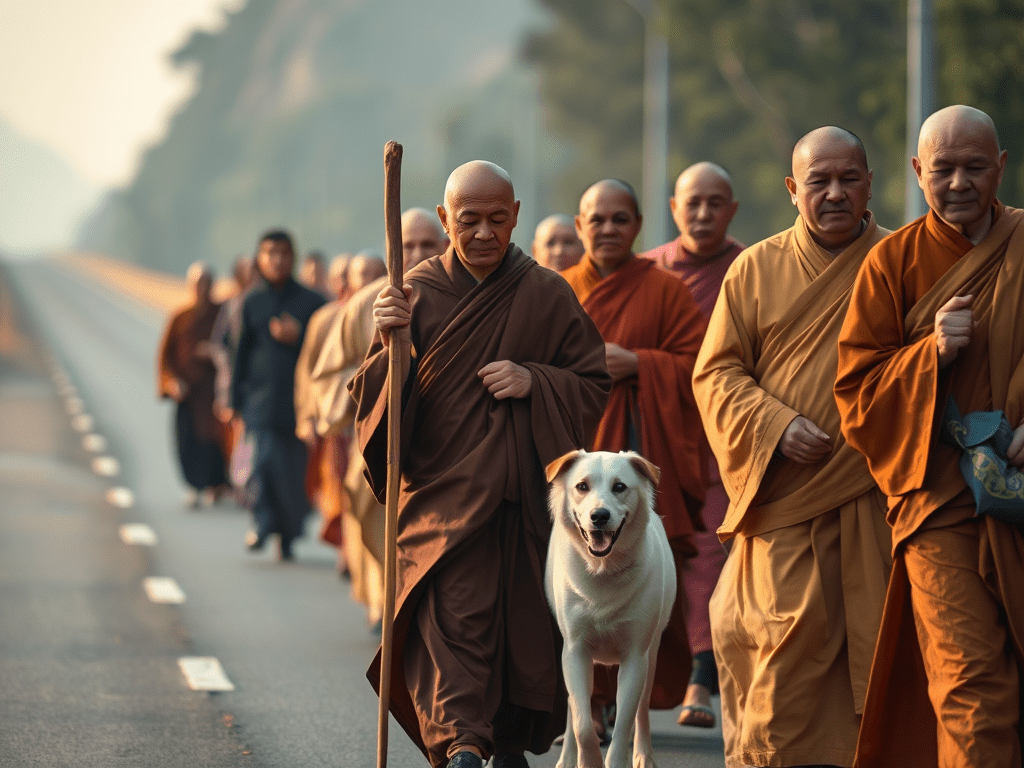
(Ai assist:) In this wide-ranging Dharma conversation and a kind of follow up episode, Asoka and I discuss types of identity and self-exploration (e.g., her ongoing shaved-head practice as a lay eight-precept holder despite no longer living monastically), then pivot to the viral Walk for Peace—a 120-day, ~2,300-mile pilgrimage by ~18–26 Vietnamese/Theravada-aligned Buddhist monastics from Huong Dao Vipassana Bhavana Center in Fort Worth, Texas, to Washington, D.C. (started October 26, 2025; expected end mid-February 2026). Accompanied by rescue dog Aloka, they promote inner peace, compassion, non-harming, and healing through meditative walking (inspired by traditional Thudong but with an engaged-Buddhism focus), drawing thousands of supporters, media attention, and occasional challenges (e.g., confrontations with preachers, a traffic accident injuring monastics).
Key themes include:
- Inner peace as the foundation for outer peace (start within via mind training, resolving inner conflict before external action).
- The Brahma Viharas (loving-kindness/metta, compassion/karuna, sympathetic joy/mudita, equanimity/upekkha—sometimes reframed as resilience) as tools for relating to self/others and dissolving the three poisons (or poisonous roots of greed, hatred/ill will, delusion).
- Non-duality as interdependence, seeing self/other reflections, loosening grasping/stickiness to stories and identity (anatta/non-self), while avoiding pitfalls like “idiot compassion” (over-giving without boundaries/dignity) or spiritual bypassing.
- Paradoxes in practice (conventional vs. ultimate reality; restriction vs. freedom; empathy vs. action).
- Practical applications: ethical precepts for merit/wishes fulfilled, spatial/situational awareness, breath-focused meditation (e.g., resting in natural awareness at breath pauses), middle way balance (avoid extremes), contentment/freedom from distractions (including digital ones), compassion even for flawed leaders/politicians by separating person from defilements.
- Modern concerns: AI/delusion risks, generational tech shifts, accelerating change, need for lineage verification, open inquiry (ehipassiko: come and see for yourself), and preserving authentic Dharma amid impermanence.
- Inspirations: Bodhgaya as unifying pilgrimage site across traditions; merit of hearing Dharma; freedom from (vs. freedom to); contentment with little.
https://www.instagram.com/walkforpeace.usa/
Takeaways:
“Inner peace is your strength.”
“You can only rely on your own inner peace.”
“Compassion for others starts with compassion for yourself.”
“Freedom from desire leads to true contentment.”
“Navigating duality requires a strong foundation in ethical practice.”
“The middle way is about finding balance in all aspects of life.”
“Self-honesty is a form of self-love.”
“Everything can disappear from your life in just one instant.”
“The seeds of inner peace grow from consistent practice.”
Chapters:
00:00 Introduction and Identity Exploration
02:28 The Walk for Peace: Purpose and Impact
06:32 Challenges and Encounters on the Journey
09:04 Inner Peace and the Brahma Viharas
13:30 The Role of Politics in Personal Peace
18:42 Non-Duality and Interdependence
28:39 Dissolving Boundaries: Self and Other
32:00 The Dangers of Idiot Compassion
36:24 Embracing Paradoxes in Spirituality
40:44 Understanding Compassion and Boundaries
47:28 Compassion in Politics and Society
51:42 The Importance of Authentic Teachings
57:32 The Significance of Pilgrimage Sites
58:25 Preserving Teachings Amidst Impermanence
01:00:00 Unity in Diversity: Bodhgaya’s Role
01:02:21 Defining Salvation and Inner Peace
01:05:09 Freedom from Distractions
01:07:14 Navigating Modern Challenges with Mindfulness
01:13:58 Building Resilience Through Inner Peace
01:18:18 The Middle Way in Practice
Links:
https://www.facebook.com/walkforpeaceusa
https://tricycle.org/article/what-do-buddhists-think-of-fort-worths-walk-for-peace-monks/
Past episode with Asoka: https://integratingpresence.com/2025/10/13/bridging-ancient-modern-bhutans-landmark-global-peace-prayer-festival-with-asoka/
Asoka’s Echoes & Stories of Dharma podcast:
https://echoesofdhamma.wordpress.com/
https://music.amazon.com/podcasts/78a58d8c-70d1-411c-8c86-b9c49d76e696/echoes-stories-of-dharma
https://www.instagram.com/echoes_and_stories_of_dharma
https://www.youtube.com/@Dhammaonthesidewalk108
Audio: Peace Walks Inward: Peace Pilgrimage, Resolving Inner Conflict, (Authentic) Dharma Lineages, Brahma Viharas and Navigating Duality with Asoka
Unedited transcript via YouTube:
Introduction and Identity Exploration
Holless welcome. This is Josh from Integrating Presence and today I have Ahsoka with me. Osoka, what’s happening?
Sorry. Yeah, you already said good good morning. So, good morning. Good morning. Good afternoon here in
Bangkok. Happy New Year. A bit late. It is. So, Ahsoka’s back for the uh
maybe a part two, but something different too. So, we’re going to figure it out kind as we go along. We’ve already talked for probably over a half
an hour beforehand about all kinds of Dhamma talk uh topics and I would consider a dama uh SOA dharma protector,
dhhamma enthusiast and dhamma globeer maybe I don’t know amongst many other titles. So um if there’s any kind of
introduction you want to give to yourself for people who haven’t listened to the first episode or we can skip
right over that and jump in to kind of what you want to talk to talk about today. It’s interesting that you’re
asking me this because I’ve been wondering myself in terms of identity. What kind of identity do I have? Do I
have a solid identity or not? None in disguise basically. That’s why my head is shaved still. Although I’m not living
in a monastery and usually how I introduce myself is an a precepta.
So an a preceptly practitioner. And um
can I add a little something? Go straight into the topic. The more I’m the more the more I’m watching the walk
for peace of all these monks, monastics walking and doing something which concretely contributes to let some
uh practices some schools of Buddhism actually be a little more known because usually Buddhism isn’t really proaliding
right especially they are very and it’s very it’s also very culturally
associated with Southeast Asia and you So the more I watch them, I’m saying
sometimes I’m really thinking why haven’t I ordained? Why I’m still an lay person.
So So here here we are in uh what what month are we in? January of 2026 for for
people that don’t know don’t know what you’re talking about. Um I would imagine a lot of people do because it’s been
kind of a media sensation. uh tell people a little bit about what you’re talking about this this walk for peace
and then why do you think it’s uh become so popular of all because I I’m I’m imagining things like this happen every
once in a while but just don’t get the media attention that this has gotten so far.
Yes. So, we’re talking about a group of I think initially there were 26
The Walk for Peace: Purpose and Impact
monastics and they come from a monastery in Texas
but I just found out recently as well that they had also done a similar walk
in India and that’s how they brought this dog Aloca how they brought it back
to how it were brought back to the U I mean brought to the US basically. So they at the moment they currently are
engaged in a 120 days practice of walking but while the practice of
walking from monasteries from places to places is very common in Theravada it’s
called the practice of tudong usually that’s what monks do during certain times of the year from monastery to
monastery which is a practice of normadism and a practice of non-attachment but in their case they
are doing it with a specific purpose of peace. So the message is peace. So it’s
a sort of engaged Buddhism. They’re walking for peace. In listening to so-called the leader, the the one the
monk who walks ahead in the line of monks. Usually they walk on seniority of
vasa. So they walk in seniority of how long they’ve been ordained. Something
like this. But I don’t know if they follow that in the in the current box. So I’ve listened to one of his talk you
know when they stop for walking or when they stop for having a meal or when they stop for for post um overnight he said
peace is something you achieve inside first.
So he’s giving he’s basically giving snapshots nano dharmat talk every time
to a population that is from all walks of life and and and that’s that’s very
we we we might be accustomed to listen to this you know develop inner peace
be mindful of what you’re doing before you talk be aware of your your you know
your mind’s defilements Be aware how you speak to others. Be aware how you position your body. Be
aware of of your actions and things like this. So body, speech, and mind. You know, these are the three components of
your training. But he speaks in a way that is really accessible to all and
especially people of all ages and all walks of lives. And he’s gathering momentum in the US at the moment. What
started to with just a few I would say just a handful of people you can count
on your on your two hands it’s now thousands thin thousands of people so what is going to happen when they reach
in Washington DC I don’t know but it’s going to be massive and the thing is they also
encounter some challenges so I’ve I’ve seen in a a video past few days they
were stopped on the road by by a preacher who was telling them stop
you’re going straight to hell because you’re diverting from the word of Jesus you know things like this so what was
interesting in that moment was the calm the non-engaging
and a very gentle way of saying okay we are not going to hell anyway but if that
is what you think we’re doing let us do it you know no you cannot do says
because I love you you cannot do this please don’t go to hell and he said we are not going to hell anyway if that is
your belief thank you so much for sharing it but we would like now to continue to walk because we are on a
different you know on a different path so these little events but the majority
of the encounters are really really a message of peace and also how to break
it down to really understanding how living in the world today requires that
Challenges and Encounters on the Journey
sort of inner peace that we’ve been developing with our practice or that we
might be more attuned to because we are in a we are
yeah to to just yeah to say the least and you know I haven’t followed this
very carefully I have seen it online and yeah it just surprises me how much media
attention that it’s got but of course the the message um the true message of peace if it were really sincere about
this and there’s no other political purposes involved which we’ll see you know what happens in Washington right uh
we don’t I don’t know the backgrounds of these these these monks or or anything like that but which just go on what’s
presented to us right this notion and message of peace the true message of peace is so very important and I feel
with all the shenanigans going on I mean I like my country, you know, and at the same time there is so much wararm
mongering and so much war that America is known for, right? And I don’t want to
have anything to do with it completely into nonharming. So that’s that’s the core. And so, but now when we take that
and leave that aside as a political topic and and internalize nonharming, that to me is peace,
non-conlict because um I would say at least in in the past for me there there’s so much
inner conflict, right? Uh just within us and so how is that going to inform how
I’m with everyone else? So once we have come to terms with this inner conflict
then uh of course my whole external life and my interactions and the way I re relate and respond to everything around
me is going to benefit when I work directly on such inner conflict and work
to resolve that and come to terms and and know how to deal with re relate and
manage that and let go of a lot of it too because we if we look closely within we realize a lot of it’s not really
needed and necess necessary and I think the Brahma viharas are are really helpful for resolving and dissolving
some of this inner conflict and not only that but relating to everything. It’s the best way I’ve come across to
relating to everything internally and externally is with these four Brahma viharas these four divine abidings.
Yeah. Yeah. So the four divine abidings is loving kindness and uh sympathetic
Inner Peace and the Brahma Viharas
sympathetic joy or you know supporting the effort of others also because
sympathetic joy say well I don’t like that fellow I don’t so I don’t care what
you know it remove you know it has so rejoicing I like rejoicing rejoicing yeah rejoicing at the success
of others and then compassion and equinimity basically equinimity
That’s a good Yes. I like this. I I’m a little maybe
because I speak numerous languages. So I’ve come and realize Yeah. But you know if you go into that language and speak
of equinimity it’s understood to a carteesian to a French carteesian structure of
language. It says yes but then I need to it’s not but if you speak about resilience it
becomes okay now I know what you mean but equinimity means I have to be equal
I have to so I I think it’s because I know a lot of languages I’ve come to my
understanding but yes so if I may just make a point the f one of the first talk
I heard about this monastic he said we we are not connected with any politics
it’s I my witnessing in my life as a monastic I’ve witnessed so much
suffering so I want to do something and basically along the road they speak to a number of
people and everybody start lots of people burst into tears and he said I’ve witnessed a lot of suffering and I want
to realize that that I want people to realize how that suffering is not
necessarily only caused by external condition but we we create we we might
be the ones who who are rep um maintaining it. So you have to
understand you’re training your mind. So he’s coming into that point of saying the mind and that comes with you know
start loving yourself. So you know loving kindness for yourself before for some people it’s very difficult to be
kind to themsel. So understanding that and then develop and understanding how
some of the what is called in Buddhism the three poisons greed, hatred and delusion or you can
call it greed, violence and delusion or whatever is you know how ill will I like
the word ill will. Yeah ill will how those are actually connected to everything that stands
behind the mind. So a root root they’re the unh wholesome poisonous roots. Yes,
exactly. I know that in Himalayan Buddhism it is also there are two more
uh in the poisons two more I have added. One is jaluzi
which is a jaluzi basically the opposite sort of rejoicing but it has other dimension and
also there is ignorance which is basically a ini which comes
as delusion but they they define it differently in the sense they they go it
goes from the point of not having not having right view. So your starting
point your starting point is already kind of unh wholesome in the basic
but I really appreciate the work that they are doing and that momentum that
they are gathering because I think it’s there’s there’s a seed being planted
there somehow it might dissolve and it’s not planned because there is an opposition as something happening
politically in the US at the moment it’s just that’s a good timing for things to happen you know maybe they will become
you know like Tiknatan also did something similar many many many actually that main monkey is actually
Vietnamese you were right in that sense anyway the braiharas to come to come to
the point of inner peace how do you develop inner peace when it’s completely crazy outside
you can’t avoid what’s happening outside unless you are in a position of decision
making or you are involved in that you can only work in your own leverage your own environment leverage and your first
immediate environment is your mind.
Yeah, I would I was just going to jump in here and say and this is why I’ve been so disillusioned by politics in
general is because it’s just if the problem was politically created, I don’t
The Role of Politics in Personal Peace
think another political solution is going to to solve it. So I I look at this and I look at politics in the
United States and it just goes back from left and right and there’s these two false choices. The only way I think
anything is ever going to change on a fundamental lasting level and maybe this is an oversimplification but it has to
come from within. We have to work on ourselves and that’s the only way really and I found this in my own experience
that when I change internally then my whole world around me seems to change. I
mean now if it does literally or not that’s not what I mean so much. I mean maybe yeah but it’s it’s how I view
things and then how I can respond to things instead of reacting right it’s
I’m able to see so much more than I couldn’t see before then working to on
these defilements like you talked about you know this these are like the roots of everything wrong in the world greed
how much of the ills of the world are driven by greed but we can’t just go and fight people that are greedy you know
because in the dhamapata right says ill will then ill will that’s the antidote
is meta or non-ill will so ill will never be overcome by more ill will only
by non-ill will it be overcome this is an ancient eternal law so these things
are done internally first I feel and foremost because if if I don’t have a degree of non- greed non-ill non-d
delusion well then how am I going to help change anything in the external world uh to the degree that I can if if
it’s there within first, you know, and so that’s that’s that’s the way I look at it. Again, I wouldn’t see the
value of this until, you know, um how do we get people to actually value that and
see how important it is? Because for us, it’s second nature and a no-brainer. But for other people, we’re trained
everything external, right? We’re trained to through is this is the external world. There’s nothing I mean
within that’s that’s something else for like therapists maybe or something like
this. Yeah. Yeah, but there’s what you what you’re talking here is people see
there’s a tendency to see the reality in terms of duality,
right? So the conventional the conventional world the conventional
reality which we need to act you know conventionally I cannot go to the bank
and say Josh promised me that he would give me a h 100,000 and Josh is my
friend so please behind I have to say I have to show papers my identity Josh
here yeah you can’t say money is a concept you can’t say money is a concept it doesn’t mean anything so you can just
give me all this you can just give me all this paper. It means nothing, right? Yeah. You need to use some of the the tracks
or the path that allow you to be conventionally to go from from on Monday to go from Bangkok to Bodgaya. I can’t
just teleport. Although I can do a lot of teleporting. I need to go to the airport and take a plane and physically
go to Bodgaya. I haven’t seen anyone yet flying in the sky. But maybe it would
happen. But this is one way of saying that we we tend to live in a dual world and that dual world creates is
reinforcing I think in my personal observation humble token it reinforces
the the the the how do you say the the triggering or the springing of these poisons of the unh wholesome roots
because I’m good they’re bad. So if you haven’t trained your mind to actually
see, yeah, but hold on. What makes me say this that I’m good, they’re bad. Yeah, okay, they’re not very wholesome,
but what can I do? Can I go to XY Z and say, hey, what you’re doing here is not correct. I could, but I don’t have that
leverage. And that’s I’ve had a long I’ve had several conversation with people talking even about people who
come from countries who that have been constantly on conflict right and when
you talk to them and you say how are you still alive well because I
develop compassion and eventually you develop compassion and you also realize
that to a certain extent you can’t function so you need to step out of this
conventional world and develop your own inner peace. Now for some people it
means stepping completely outside and maybe not developing training the mind but just I develop compassion. My state
has been in conflict. Millions of people have been passing away and dying for the
past millennia. It seems like it will never stop. What can I do as a human
being to stop that? Nothing. So I can step out. But other people say
those as you say for us no-brainer. If you develop your mind, you train the
mind to see that hold on as Gandhi was
saying somehow you know you have to do your cleaning in your own kitchen before you can actually do certain things. It
Non-Duality and Interdependence
means look at yourself first. You need to change you to have the change happening.
So oh yes but has never happened. I’ve made all those people walking months walking in the street will never make up
the America a peaceful world. Me being trained in mindfulness will never not
make my environment but it might make my family more peaceful. You learn to have a non to start living
in a nondual reality where what you put in comes back at you in a way but also
in a nondual world you realize how there is not just a conventional world there
is a different world that you can tap into. So when you start really observing
what is as you say for us maybe a little more normal you know you kind of stop having synchronistic thought with
someone you start having only realities that are made of meta so loving kindness
personally can say give you example you know there I never really have obstacle where people have obstacles why I don’t
know I live maybe in a So there are different planes of existence. But if you definitely only live on the
conventional level, you’re going to have several issues because the samsara is
made of these unh wholesome roots. And I think also if you remember yourself, the
Buddha also spoke about this, you know. Yes. So some someone the other day was
asking why is the Buddha always presented as sitting down and why is the
Buddha always presented as someone who detached himself from everything. I said yes he detached himself from everything
but to come back in a better way there is a level of detachment. You have to go
a little bit on feet. You have to step out a bit from what you accustomed to and that’s that comfort zone that little
void between the comfort zone and stretching in the comfort zone or stepping out where
how do I start? Okay, every morning
before you can decide every morning before touching the phone first thing I
take a breath. Okay, how is that going to help? Well, try it.
I’m just saying try this is because I scientifically it’s proven it works but if you don’t try you would not
know how can you I try not to be angry at being bullied well realize that that
person is having a bad day it’s not about you you know things like this it requires so much that
eventually the seeds of this m of the mindfulness path for yourself start and
then you start entering a completely different realm where
it becomes easy to go to the bank and ask for money from you know I mean living in around monastics also helps
understanding these how to because the monastics even though they on retreat they still have to interact with the
conventional world for instance receiving meals or in other traditions
as well having answer questions that for them are completely maybe irrelevant. You know, if they are not householders,
how can a monastic who’s not a householder, who’s never been a householder understand
the issues of a householder, divorcing, children going to school
because we, you know, for them it’s they are going to give you the base for you
to understand your own problem. So I think that that inner peace is the the
the seed of for for at least developing better
humans in this world somehow. And it’s important whether it is expressed by
walking in a walk of peace for 2,500 kilometers miles or whether it is to sit
down meditation. I don’t know what your take is on this any good raised so many good things
Ahsoka and um I think the kind of skepticism you present there is is
really helpful too cuz people you know what what difference does it make you know this kind of apathetic giving up
and I would say people in power they bank on that that that people get either
outraged in conflict or they throw up their heads and say what can I do I can’t do anything it’s pointless I don’t
care just going to check out and do nothing But even, you know, the Buddha said, “Drop by drop, the water buckets
filled.” I say this a lot. I use this a lot. But everything could potentially add up to something. So don’t think, you
know, good’s not going to come to me, bad’s not going to come to me or whatever. Every little thing does matter. And you know, the it’s cliche,
but the longest journey starts with one step. You know, we’re seeing that in this play out, right? So don’t think
that it doesn’t matter. I mean this gradual effort just a little bit here and there it will add up over time
especially if you keep with it and a seed like you mentioned a seed is another great metaphor for that you know
some seeds won’t sprout but others will and others will be very fruitful and and plentiful and beneficial and you know
others maybe are more weeds and sometimes they take really long time but they can get really huge too over time.
So you know you mentioned uh why you have all these good things coming and they reminded me of another suta that
basically uh preceptors they get their wishes granted in a way you know I don’t know I have to find the exact suta but
basically especially eight preceptors they’re saying that their their wishes are more easily fulfilled when they’re
keeping precepts. So it it’s it’s it’s really amazing how foundational this
ethical practice is for me and how important it is. And in Ty force tradition too I I feel in Thailand that
the precepts are really important you know. Now the non-duel thing this one
maybe we can explore more because I know this is you have more of a vajriana background and for me I I think it’s a
great concept and it’s it’s really helpful and some of these teachings are so deep and so profound and they’re
helpful to me. The one the few things I have trouble that let’s just say not trouble or maybe but I’ll ask you about
I don’t really have a clear definition on what nonduality means and then not
even the term non-dual right there accepts that there is a duality right so
how can there you know be nonduel with the duality and then but what I’m the
most um want to know about is how we actually take those non-dual teachings
and practices and then go on the street with the average Joe who is so far
removed from this stuff. It makes a lot of sense to me and brings a lot of peace and inner calm and puts me in a really
great mind state and heart state with these teachings and really contemplating and feeling into them and using them.
But then when I go into the everyday world, you just it’s just like I’m not to the point where I can just pretend
that Joemo that’s not the right way to put it. But okay, h how do I then take this wisdom of non-dual teachings and
then use it for mutual benefit with the just the man on the street, you know,
that’s completely asleep, you know, in either good ways or bad ways. So that’s well
the non the nondual nonduality has is put it in really plain terms not would
say almost non-technical or nonjargon or just plain really plain is that
realizing what is usually commonly called what you put in you get realizing
an form of interdependence of everything of your body speech and mind It’s really
literally the ball you throw comes back at you in that way. So it’s seeing you
say you don’t have certain things happening but it’s because you perceive
them also differently. So it’s it’s what we is also called understanding how different level of consciousness are
operating. There is a very popular thing if you have a golf ball consciousness
you just have a very narrow perception of the world is really to keep it plain
is like that is to to to to realize that the the actual natural state of things
that seems to be moving around or being permanent and stable but actually you we
just are passing by you know Bangkok will be here probably in 50 years but I
won’t be watching this building the same way because I might not be here. Nonduality is it really is having a
clear understanding of the interdependence of everything that occurs within body, speech and mind and
interactions with other people interactioning. So the other person, the
other people around there are a reflection of what you’re calling. Does
it make sense? No, it doesn’t make sense in it doesn’t make sense. But no, what I meant by what I meant by
to me those are interavana teachings, you know, that’s dependent origination. That’s the interconnectivity of
dependent origination. That’s kind of a trained mind um with with with samadei,
you know, and this is an kind of an expanded consciousness. But I guess in the some of the non-dual teaching and I
don’t want to get in the weeds here, but I’ll just say this. What what I meant by non-dual teachings is is stuff like there is no there is no observer and
there’s no observed, right? Everything is one kind of this when they’re presented in certain ways, they can be
like this watered down new age thing that’s not helpful. But actually what you said there is very helpful and all
those teachings are in in Terravada too, you know. But I I get this this self and other. I think that’s where it’s really
Dissolving Boundaries: Self and Other
helpful in a sense like how hard is there a self and how hard is there an other?
Exactly. Dissolving those boundaries that they tried and it’s really helpful dissolving those boundaries in some
sense but then dep mentioned comma too cause and effect intentionality. So, it it does help
dissolve these boundaries a little bit, but then um uh I guess I don’t know what it’s depended on, but then it seems
flimsy, you know, that’s that’s what I meant by that because it’s using kind of a mind trick to be helpful to dissolve
these boundaries that really aren’t there to begin with, but it’s almost like I’ve seen some people kind of
spaced out and not being able to take some of what they’ve realized or are seen or think they understand and then
they get when they take that to the quote unquote real world. I don’t know. It doesn’t doesn’t seem to translate
well or I don’t know what I’m trying to say here. But that’s you’re trying to you’re trying to see that if you apply if you don’t if you
don’t have a proper understanding or if you if your understanding is too much on
the intellectual level then when you step out it’s not going to work because
there is no other opening like the heart opening consciousness opening. you
haven’t developed what is called in the tavada tradition the parameies you you know to you know to loosen up this self
of this sense of identity the other day I completed a book which is written by
patch riush he’s a a young girl from the the lineage of tuluian riush so it’s a
karmakaju but he’s wrote this book basically around the concept of dignity and why am
I speaking about dignity and non-duality is because it comes into the sense to
dissolving the boundaries that you might have between I am these
are but at the same time understanding that you also have a form of integrity.
So other teachers call would call this having compassion and having to help.
Okay, this person is suffering a lot. I need to help. Can I actually help? Do I
actually have the skills to help that person? And how can I help? And does that person want to be helped? So it
goes that boundary can become very loosened and not understood probably
correctly deeply and that becomes what is called idiot compassion. Some other teacher call that the idiot compassion
like Chongyam was calling that idio compassion which means I have to help because I need to be compassionate. I
love to be comp I love to give. I’m a giver. So I need to give. But then you
lose your own dignity because you can’t sleep anymore. Maybe you haven’t eaten. It comes at the detriment. It it it
actually depletes your own capacities. And the Buddha also said that you know we do have this experience of having
this human life. This human body is given to us. It’s very rare because there are a lot more ants than there are
human beings. So it’s very rare to obtain this human. And if you have the chance to hear the dharma or to you know
understand a bit about your mind just have that dignity to sometimes say okay you can have compassion but it doesn’t
The Dangers of Idiot Compassion
mean don’t go too much out of your way and sometimes that fact that nonp
perceiving the actual understanding of non-duality means I have to help you know this you
and me is the same we are one no no we are not one because we don’t have the same karma. We come from diff at the
subatomic level we are one. We have we are made of the same flesh and bones but
we are not one because our intentionality before we were born and
during this no I I am a very very strong on that but you know I keep it for
myself because it goes against the summer but that no non-duality can easily become okay we are one we one
love no love is very important but maintain the dignity of your practice
maintain the dignity of your of your sense that you are not that so much important eventually.
So you’re you’re very right. So you’re very right when you speak about the self identity because it actually touches the
very important point across all the schools of Buddhism about non-self. So what we seeing today
is a lot proliferation of teachings coming in all direction including Buddhist teachings and and a lack of
understanding of that Buddhism is not neihilism
neihilism that you know there’s nothing exists so I don’t have a self so no matter what I do you are like me no it’s
the grasping attachment and the grasping is not so much about the assets it’s
about the sticky in mind. How do you stick to the stories you tell yourself? If you losen that, you start really
realizing nonduality. Yes, the other person is suffering more than me. That doesn’t mean that I have
to help every single person I meet on the road, but it means that I can be kind to that person.
Yeah. There’s so you know we enter another we enter another path
where this nonduality becomes you know it it’s it’s not like a concept you have
to it’s not like glasses you have to put in and remove it’s just your world
becomes a completely different world. So when you see things happening in the reality like wararm mongering and this
and this you realize why they are doing this because the unh wholesome roots and sorry for them
but I can’t change them so I have to only I can only rely on the my own inner
peace and I’m really coming back to that it’s really and I I was actually thinking and what
we were going to this to come to to converse about our conversation today and I thought you know I come up with
What is inner peace is love in action. Love for yourself first. But it doesn’t
mean you have to become so selfish that you don’t love. It means you even you
love your heart. You can go inside the body. You love the stomach. your love,
your start there and then everything starts softening up because
because eventually you can’t battle so much outside and by
developing that love in option for yourself you’re developing it for others
and then you can step into other parameies and then you can you know you start understanding on
I don’t know these are also the basics of healing you know there’s there’s a lot of there’s There’s a lot of healing
in understanding uh and practicing Buddhism as you want to put it just globally like this.
Exactly. So I don’t know great points here. So the self- loveve I
want to get on in just a second but I wanted to to address some of this what what um Soka mentioned here there’s a
lot of paradoxes you know and I found that a lot of the spiritual path is being comfortable with these paradoxes
because when it’s pres there’ll be one thing presented one way another thing presented another way and some things
are just paradoxical and that doesn’t mean that they’re they invalidate each other it’s just when we talk about
teachings like this and views. They’re just they’re they’re so subtle and so profound that a lot of times we don’t
Embracing Paradoxes in Spirituality
have normal worldly reference points for this. So the what needs to be pointed
back to again and again is an experiential level. So we’re just trying to put words to things that we kind of
see and know in our experience. And even though conceptually it it’s it’s really
challenging to put it uh put a lot of these things in non-p paradoxical language sometimes because they are they
are paradoxical. It doesn’t make them in invalid or not helpful. So I can I can totally see how people say you know I
can’t resolve this paradox. Yeah. A lot of them uh can’t be resolved. So I just have to be comfortable holding paradox.
And just a quick aside, I I found cuz there’s so much cognitive dissonance right in our world too. Like one thing
will say one thing and then somebody says the other thing and they’re at odds but I see the value of both of these and
that can cause inner conf or it seems to promote inner conflict too. But actually if we take these two things that are
causing cognitive dissonance and and we can hold them lightly and sit with them
then I’ve found yes it may be unpleasant but then these things start resolving
themselves and working out and being okay with holding these two seemingly
conflicting things. And then what I found is a lot of the distortions will
start to fall away and more understanding and wisdom will start arising and then be able to kind of see
through both and come to how it should be kind of held and responded to and
addressed it. I know that’s kind of a lot of fancy language. I’d like to give a real solid example, but just think
about two just take two opposing things and how there seems to be some uneasiness and if we can just hold both
of those at the same time in our awareness and sit with the unpleasantness that’s uh um involved
with that or comes along with that and see how they can kind of resolve each other and things can kind of fall away
and there can be some peace uh with being able to be with those. Yeah,
it’s also I think the other thing sure it’s also an understanding in doing these things there’s a very big
understanding that comes to or realization about how certain things
work in the mind is where do these thoughts all come where do they come from so there’s a lot of imagery you
know in Zen you say it’s clouds passing by so people who have a tendency to
visualize very easily they going understand why in the clouds but that doesn’t mean that it’s it’s just imagery
if you actually understand who and what and where are this thought coming from
and going and why am I sticking to it so I’m coming back to the dignity was saying the issue is not so much
having or not having is really the sticky mind and the storytelling attached to the
sticky mind where is it coming from this very strong sense of self that I am a
solid sense I’m a solid yes I am a solid person in in in flesh and bones but the
story I’m telling is basically my label my inputting my constant inputting that
I also I am more important than the other I am this and I am that and usually I’m coming in the elevator I
don’t want anyone else in the elevator and all this expanding expanding constantly and become so solid that that
becomes your reality But that’s not the reality imag. So that’s where there are issues.
So whether you come from Teravada or you go to Vajayana, you pass all the Miamika schools, Zen, Mahayana, everything,
everybody everything touches back on that point. So how you develop inner
peace, loosen up the grasping on that sense of self.
Clinging is the problem. Clinging like you’re saying the stickiness. I like that word sticky because that people can
relate to but clingy people know what it’s like for someone to be clingy. Clingy, right? So that’s where all the
trouble I mean that one is pretty much everyone can relate to, you know, and how when we can loosen our grasp and not
Understanding Compassion and Boundaries
cling so much how much peace and ease that we can feel in our own experience, not a theoretical thing but a real
energetic reality. And it is yeah just a few words about um you know the boundaries in compassion it’s really
important I find too that just because well for me my compassion practice is
first acknowledgement right so just acknowledging to begin with some people don’t want to acknowledge anything but
that’s like the first step then comes care and this is before we even do anything and for me that’s a really
challenging one because I have doubts about my own authenticity of care or if I’m caring enough, right? Or if I’m
caring in the right way at the right time. So, it’s a little bit different, I think, maybe with males and females
sometimes about that. So, males kind of show care in a different way than in general, not because we all have these
feminine and masculine qualities, too. But then it’s like this wanting for this pain to be resolved, you know, wanting
for the pain to release and then to know peace. Now, sometimes the most compassionate thing I can do is say,
“Okay, I need a boundary here. I need to get as far away as possible and then I can do this from a distance because what
I’m doing now is entangling with someone or something and I’m causing more problems than than I’m helping with. So
for me at times like that the I have to do compassion from afar because there’s
just too much conflict or entanglement. uh can always come back maybe but that distance and boundary is needed for
compassion you know and how do we have compassion for ourselves when we we don’t have compassion so we can have
compassion for the fact that we can’t have compassion right now too and as far as the the self-love goes to me a huge
part of this is honesty right because when I first started doing these I love you to my heart I’ve talked about this
before just didn’t feel honest you know it felt sappy and goopy you know and
just not helpful. But that honesty itself is a form of self-love, right?
Being honest with ourselves. So hopefully most people that are watching this have have already addressed this
this self honesty. But there’s plenty of people we interact with that haven’t got there yet. And it’s a huge form of
self-love just to be almost brutally honest sometimes if some of those people some people haven’t looked at themselves
honestly and they’re constantly kind of lying to each other uh themselves or are glossing things over. So I won’t
discount that as love either. And one of the ways that Ajan Jeff uses that I like for meta is just you know a really
practical thing that it doesn’t have to be an overt lovingness. It’s just may
you real not you Ahsoka but like someone that I have hard finding loving kindness
to or meta towards is may you soon realize the heirs of your ways for your
own b and change your change your actions for your own benefit and for those around you. you know, it’s a very
practical, real, direct kind of nononsense uh care for someone to
acknowledge no, they they’ve done something unskillful and harmful even. But so my well-wishing to them is that
they change their they see the errors of their ways and change not from a judgmental point, but for a from a a
place of care for wanting their well-being to to to come about. And to
me, the ground level is just an absence of ill will. You know, it’s not even a
an absence of ill will because that is so detrimental, you know, for me to
harbor that I want to hurt something, you know, even if it’s just a thought that I’m not going to act on, it is so
painful for the heart and has consequences and can start wars even with this with ill will. So I think
that’s some of the things I wanted to address around interestingly there you know I I was
involved in the global peace event in Bhutan so it was enormous major there were a
few days we got about 100,000 people it had different section I mean different
section different events in a one event but it all it all involved chanting
mantra or chanting aspirations, prayer, you know, like some of the parita sutas,
some of what you would call parita suta, some of the, you know, some of the very
cardinal chants also. So there was basically two weeks, 10 days full on
that. And what was interesting is being on the conventional level, I was really
literally involved in doing a lot of logistics and moving around. So I haven’t had a chance to sit down and
enjoy like most of them. But on the unconventional level when I was asked
and I had feedback with the prime minister said did you attend did you
were you able I said no it’s very difficult to be when you are the host to
also en you know enjoy the party usually you are the one however on the
nonconventional level the energies were there. So got this look meaning huh? So
it doesn’t have that you you but you get the energy of it. So that’s also a way of explaining non-duality in the sense
that sometimes we are removing ourselves from some places that we don’t feel this
is going to be maybe wholesome and sometimes we are in places where oh we gather we get the benefits of having
been there and it’s because at the unconventional level we have attracted that but what I wanted to say also
connected with that is that some people were saying yeah okay you chain You chanting chanting chanting
aspiration mantras. How does that help for peace? Or like you know the monastics now have been walking home.
How does that help for peace? You know having peace means sitting conventionally at a negotiation table.
Well no not necessarily and in part because we we you have to realize how
much leverage you might have to do certain things. So the if I expand what you’re saying about having compassion
for the self and having compassion for others but understanding
the interplay where we have an leverage or not you
start to realize how you can have compassion for some of these political figures that we see constantly on TV cuz
the idiocy of which on what they base their action is just so blatant you can only have
compassion for individuals like that and they are not just one there are many but
Compassion in Politics and Society
when you understand when I said that to some people they were how can you actually have compassion for such an individual I said just look further dig
further the ignorance at the basis of I mean the unh wholesomeness of of of even
their intention it’s not a matter of judgment it’s just it’s it’s a it’s just
a matter of acts. It’s separating the person from the defilement too. It’s their defilements
that are acting. Yes. Yes. Yeah. And they don’t know they are doing this. That’s where the compassion comes.
Come on fellow. You know, really I feel really sorry for you. The problem is that when you sneeze, everybody else has
a cold. That’s the thing. But this is also where I think it’s very what I am a
little concerned with, if I may step into a follow-up topic. What I’m a
little concerned is that and you know I we I can only live with it and that’s
where I really like to stick to
wherever are the lineages and the teachers and the traditions where still
what is called the perfect dharma is available. I like to stick to that. It’s
called in other languages it’s called the perfect dharma the true dharma and not the deluded versions which can lead
to what you spoke earlier the spiritual bypassing how come this non-dual thing
if you extract it from the you know you become become very secular it doesn’t I
go outside and it doesn’t work people are attacking me okay because maybe there’s something that is missing so
what I am concerned with and it’s been discussed a lot with a number of scholars as well is the world we are
entering where AI becomes a major agent. How can we contribute to I mean seeing
already online you know a number of delusion and Buddhism says this and the
Buddha said no the Buddha didn’t say anything of that how do we maintain
the uh how can I say the the thread the path is I think something that I’ve
learned a lot during the this year by connecting more and more with Vajayana
schools really check the lineages of the teachers you connect with. If the
person who’s giving you a teaching or the you know source on internet on chat
GPT double check your facts your sources your information but ask where is that
source comes from where what’s the lineage and that teacher can that
teacher give me the names of his own or her own teachers and it has to go up a
line of something then it has a sense if it’s just blah blah then everyone can
create blah blah you know that’s a little bit of a concern and I think all
of us who have been diving delving into Buddhism in a way or another whether it
is from meditation whether it is you know from many entry points I think we have a responsibility there
to somehow for me at least for me it’s really my my sincere aspiration to to
contribute ute to keeping tracks of what are the factors where somehow I
appreciate some of even any of the teachers who say okay eventually the Buddha said that it’s in the suta number
one in this book because at the moment it can go in any other in any direction
yes very important for me it’s very important just a few a few words on that this is
one of the whole reasons I was drawn to what’s called Buddhism is there’s not very many doctrines, but the one of them
it’s been called the doctrine of open inquiry. And so I was always getting in trouble in school. I would partly take
responsibility cuz there’s there’s a type of unhelpful doubt, right, where you’re doubting something because I’m
right, I know it, and I want to show that you’re wrong, right? That’s not the kind of doubt that I’m I mean that
The Importance of Authentic Teachings
that’s not a helpful doubt, right? But open inquiry is a sincere wish to to
find the truth and and and a truth that’s helpful in Buddha where um the Buddha said you know a poso come and see
for yourself you know you need to check this out and has to be seen and known for each wise one for themselves. So,
and how do I learn a lot of things as I ask questions? But it’s it’s it’s it’s it’s questions in order to get at the
real true meaning and an understanding and one that will benefit me and those around me and especially in the long
term. So, that’s why I’m just I love uh that it’s encouraged to ask questions
because some people take questions as oh you’re not respecting my authority, you’re doubting me, you know, no, no,
no, no. This is about getting to truth and holding holding things to and taking on the accountability. So I don’t
recommend everyone do this, but I say again and again in my stuff, you know, please if I’ve made any mistakes or you
can add something to it or give a little bit of a different understanding or teaching that will help me understand,
will help other people understand, please do so. if I’ve got something wrong, please reach out because I know
um you know that this is really important to me and um and like you said
the references and I don’t I get lazy about that too, but I’m I’m totally into that. This is what we have to work with
even to the point where I get a little bit nerdy on the original text. I would love love love to for like the Poly Tech
Society to list more in detail where they get the source text from and then
try to go trace it back to the most the oldest original text sources that we
have and then preserve those in images. I know there’s a lot of preservation in in different schools going on which is
great taking the images cuz some of them can be really you know flimsy palm leaves and things but we I mean these
are just as a scholarly pursuit so it’s not for everybody but I think the more documentation and the more details and
but I don’t know how we would do it for sorry and I just wrap this up because this gets into a little bit more
specifics than we want but you know some of these texts might be hidden or well protected too so I don’t know exactly
how to do that. You know, some of them might be interned and interred in a stupa or something protective somewhere
or maybe kept away from the general knowledge in order to preserve it more. So, I don’t know exactly how to deal
with that, but I feel you know since in terabad at least there’s no secret teachings that we can um trace trace as
far back as we can to the original text and have a cataloging system and a reference system to to preserve because
this is what we have to work with. Right now, we can go into a whole another talk of did the Buddha actually say this or
not. That’s another thing. But we we to to to have well organized and documented
what we do have to work with. It’s really important you know. Yeah.
That that as well. But you know that there’s been several councils because initially it was it it was a tradition.
So we have to rely we have to rely but the the the Mahabhi society in Bangalore
and the Pali society in also in Sri Lanka has I mean there’s the Palanon and
the Pali society they they Sri Lanka is actually a a good
repository of of the original the original um original text or whatever original
quotes or original teachings of the manuscript too. I’m not talking about the physical manuscripts like the palm
leaf manuscripts and the Gandahar fragments and all these things. I even went to the British library and and
talked to one of the librarians about a little bit of this. But yeah, and there’s huge digitalization efforts
underway too. So I think these are all really cool things and there’s so many text. Yeah. Apparently, they also
uncovered thanks to AI and thanks to um GPS
and GP GP. No, no, GIS GIS and GPS. So, the the JO
the Jol location and J the localization but of how the Earth and the movements.
Oh, GPS global positioning satellite. Yes. Yeah. GIS and they’re the one that
actually GPS is more like the map but it doesn’t give you the actual
location that you know the actual layers of the territory. So apparently they found some old Buddhist societies under
some guts in India. So things that have yeah that were
covered over the years. So they found also yeah I show you I will show you.
Yeah. No no I have the there’s a book in search of the Buddha. So it was a, you know, they literally unearthed so many
things like some of the Ahsoka pillars even, you know, and so many things that were literally buried in India. It was
some old white guys, European white guys that unearthed a lot of this stuff in
India in what the late in the 17 1800s. So yeah, quite incredible.
Yes. And they also now the state of Odisha which is a southern eastern state. It’s
in between west Bengal and Tamiladu somewhere in that area towards
it’s between Chennai and Kolkata somewhere over there the state of Odisha actually has also has unearthed a number
of places therei alagiri there’s a number of places there so there are now festivals starting
chanting tipitaka and guruba sambaba festivals being organized over there I
can also send you si san yes Yeah. So, there’s a lot happening, but okay. How does that help
The Significance of Pilgrimage Sites
with inner peace? Well, that’s right. So, that’s a good thing. We talked a little bit about
things that inspire, you know, we have these, you know, some people get overly involved in physical things or physical
locations, but I think if they can inspire faith and then draw people to the practice, then it can be very
helpful. And it’s it’s it’s interesting to hold this too when it’s even prophesized that you know this sassa
this Buddha’s dispensation will eventually come to an end you know it won’t last forever within permanence. So
holding this another paradox of okay, how do we best preserve and represent
the what teachings we have and then at the same time knowing they will eventually come to an end, you know, and
and die out and and holding these two and being okay with that and doing what we can to to
skillfully act with with these paradoxical things here. Yeah. Yes. So on Monday I’m traveling and I’m
Preserving Teachings Amidst Impermanence
starting a three months journey again being on the road but I’m starting with
a month in Bgaya and I I was recently uh hearing so I’ve met
Lu Poasano in December who he pass from the Tai for one elder of the tri forest
tradition here in Bangkok passing by he had he was on his he had just come back
from Bulgaya Then I met last week Abot the Abjaniko
who is the abot of Abayagiri monastery in the redwood valley and he had spent a
month on the pilgrimage on the holy places in sat. So we were also talking about Bodgaya and now I’m going again
and somehow this is to say that we came to the same conclusion or at least the
same observation going there repeatedly for different
different actual purposes but same purpose somehow it is that regardless of
the tradition you practice regardless of your entry point into the dharma you are in the
dharma. So your practice might defer from mine. Your sitting posture might
defer it from you know from your neighbor. Somehow that place of Bodga
Gaya is a center where and and it was really interesting
to hear an elder of the tri forest tradition which is you know one of the aesthetic branches of Theravada Buddhist
Unity in Diversity: Bodhgaya’s Role
in Thailand speak and observe Tibetan devotees chanting Omani. Some having the
women with the the prayer wheel and others with the mala and and saying eventually what how is my practice
better than that and how is their practice different from mine but it has the same. So the container might be
different but the I mean sorry the content might be different but the actual container and expression remain
different but the same. It’s it’s just a different it’s a so
bulgaya has become really a conversion of these it’s not that it has become but
over the centuries over the millennium where the Buddha originally sat down on
that body tree it has become a congre a a gathering of people of all
walks you can see everything there everything and that’s just that’s where I think
it’s resourcing for me It’s it’s always and then for everyone who goes to Bgaya it’s always oh my it’s complicated
bodgaya is complicated because it’s the poorest state and you’re talking about compassion is the poorest state of India
so you say well if there wasn’t any bgaya how can you develop compassion it’s really complic it’s a complicated
place but somehow everything dissolves when you’re there because this is a magnetic power to go so what I wanted to
say is that it doesn’t really matter the practice that you have what matters is that you have a chance to hear the
dharma. You have a chance to hear the dharma. That’s already an enormous merit because it’s not just because it’s it’s
rare, but because it’s a chance for you to plant the seed that can basically
help you. So, if somebody askked you what Josh, I’m asking you, what is salvation for you? What does salvation
mean? How do you relate to salvation? Probably saving myself for myself. And I
also have taints of okay that’s a that’s a Christian baggage that I have with salvation. Uh I I’d have to contemplate
that a little bit more than than getting on the spot. But I would say end of end of uh end of suffering, you know, that
that it’s possible and that the the path is there and nobody’s going to do it for me. You know, I have help and friends
Defining Salvation and Inner Peace
along the way. Yes. Exactly. But nobody’s doing it for me. And that’s where the inner peace comes
in. you I I cannot force you to have or at least it’s not something that you can
force someone to have in there. You can only say like listen I am I’m encouraging you to find that inner peace
and you have a super active mind but you can find inner peace because somehow you
have the true you know your true nature is a beautiful nature and this is not
just Buddhism who said that there were a French philosopher 300 years ago they were saying the same thing that I mean
French or other phil I mean you know or Greek philosophers as well they say stoics your your nature Yeah, your
nature is is basically pure and everything else that you build on is
just about defilements. So in that defilements you clear the bush. You keep
what is important for you to function in a way that is socially acceptable and
wholesome and then develop that inner peace and that inner peace will will
help you out no matter what because once you discover how it works you want more
of it and it leads to wisdom and wisdom yes wisdom can overcome everything. There
was someone someone asked or I mean I mean I’m in a number of groups and I
often see people saying okay but but in the Tavada tradition or the Ty forest tradition in particular it’s all about
restrictions and restrain and restrain okay that’s their practice right but
then you hear the elder in this case in my case it was ROM from Tara Monastery
in when I was in in Ontario he was And yes, it’s true. It can be perceived like
there’s a lot and it’s true eventually that you cannot you don’t eat after the sun. I you know this the highest point
of the sun and you have to wake up early somehow you somehow there has to be some
discipline of communal life. Yes, you can see it as so much restraining but think about the other side too. That’s
where the non-duality comes in. Think about the non-conventional thing. Instead of seeing it as restriction, see
all the freedom and the liberation you have from everything. By not having certain things, your life
is simplifying. It’s freedom from that’s usually like in America we think about a freedom to do
this, freedom to do that. But a freedom from it’s a freedom from crappiness,
you know, stuff. Freedom from stress, freedom from all these negative things.
Yeah, exactly. And I personally just to make a a point towards me because to come back
to the introduction you gave about me because it’s something I’ve been pondering a lot.
Freedom from Distractions
People ask me how can you still you’re not living in a monastery anymore. So you’re officially not an upasa anymore.
You’re not a long-term resident in a Thai tradition. Why do you keep your hair shaved? Well, because for me it’s
it’s a challenging restrictions. It’s it’s one for me for instance it’s been one of the greatest obstacle as a
woman I guess I had very long hair so there’s a lot so and recently there is a
friend of mine who has shaved her head and took a temporary sana ordination and
did the the pilgrimage on the maha maha pajapati this was a pilgrimage of
Buddhist of bukunis from bgaya to the birthplace of the Buddha and we had this
conversation about shaving head you know how for women it it’s completely different. It’s something a man can’t
talk about. Even if you’ve had you short hair, it’s complicated. So why do I have
that? But it’s not just so much that is that why don’t you just have more and I
realize I still live as though I’m actually a nun. I’m actually still in a
monastery. And it’s not a life of restriction that I give myself. I I just
I realize I go and I yesterday I accompanied someone doing some shopping
and I said the freedom of not needing anything. I don’t it’s not that before it was bad. Before
I was in a different realm and I had a child and so I had to buy certain things you had to afford. Now it’s like I see
certain things do I actually need? No. So I still operate with my bowl and I still operate although I have a full
cool full kitchen just for myself. Why do I choose this? because it’s freedom from
Yes. Yeah. It’s it’s really important and and I I I want to change my not freedom
from negativity because we’re still going to experience that. But yeah, it’s a reorientation to not what can I do,
but what can I be free from? And I implore people to, you know, you you can hear a little bit about these things,
but you have to have to take it on for practice for yourself and see how it lands in your heart. because maybe it’s
not for everybody, but maybe once you give it a real honest shot, then you can
Navigating Modern Challenges with Mindfulness
kind of feel some of the the peace and and freedom that comes from these practices as well. So, it’s all about
what we can let go of, what we can orient, what can we be content with. So, if we can be content with very little,
then if you view people that have to have everything a certain way, right, and they can’t tolerate this and they
can’t tolerate that, I’ve got news for everybody. There’s going to be a lot of times in our lives where we we don’t
have choices. We won’t be able to have the option to do what we want to do. Right? So then how are we how are we
when things don’t go our way? That’s a very important spiritual question. So once I’ve trained to be content with
very little, then that none of that’s a big deal where it can be a huge deal for a lot of people, but then it’s oh, I’ve
already trained and practiced this. I can be happy and content with with very little. And so it’s just a beautiful
strategy and training in in just so many situations in life, you know, and it’s it’s it’s it’s kind of fundamental and
foundational too, you know. It’s very much so. And I was going to say, you know, before you earlier on in
the conversation, you mentioned how how to navigate dual non-dual world and how
some some people find it really challenging to navigate that. I say when I’m practicing then I go outside it’s
completely different but while you have those foundations those ethical
foundation not just understanding okay it doesn’t mean that I not buying a new
cushion if I really need because the cushion has not yet fully disintegrated that doesn’t want what it mean or that I
I but more is not better and that the basic requirements are really always
taken care if you if your basic requirements are always taken taken care of. Basically, you have a very good
platform to go outside and start seeing how just look at also look at other
every other other human being. Just look at them just not walking with this phone
like this constantly in the head. And that is one of the closing remark I want to make regarding
Luan Poasano. So the elder from the t Thai forest tradition he often speaks of
mind one of the aspects of mindfulness is about maintaining
spatial awareness being constantly aware of spatial awareness so special awareness being
aware of your surroundings it’s something that we use in yoga since I I’ve you know I’ve been teaching yoga
for 15 years so special awareness doesn’t mean copying the other person or or necessarily having to talk to
everyone one, but having a spatial awareness who is around, how to move in a crowd, how to move on the road, and
that’s mindfulness. It can save you from an accident because you’re going to see the car coming in. That’s also something
very important. But also, it’s teaching you to actually maintain that kind of
steadiness. You can see a danger coming in, but you can also see, you know, the
beauty the beauty of the sky. Because if you kind of walk like this like people
do a lot these days. I’m really sorry but you’re going the more you do that the more the more complicated it’s going
to be for you to understand nonduality. You know it’s a it’s be and it’s also called situational awareness too right?
Situational awareness. Even just this practice with the space because this cup that you’ve seen me drink from if you’re watching this what
what’s around this cup? We don’t we we’re focused on objects too but what about the space that’s around it too and
another really interesting practice is peripheral vision. So just if we just with our physical eyes just expand to
where we can look at the periphery now how it just kind of brings one into the
present moment as well and it kind of expands the mind state really temporarily. Yeah. It’s um it’s a really
important practice because we’re so focused on objects and I will just say with the phone and this is not an excuse
but because I’ve heard there’s these apps now that will turn your experience transparent. It will have the camera on
and whatever you’re doing on your screen. You can see what’s down below as you’re walking. So it’s it’s ridiculous
what we’ve come to now that we’ll have to have an app to do that so we don’t so we can continue looking at our phone and
still see the ground below us. So yeah, I don’t it it is really something, you know. I mean, we talked about this a
little bit before. I mean, the pros and cons of this, but it this is really important to get a handle on this now
because I find I have challenges with it, you know. Yeah, I think it’s a generational it’s a
generational thing as well. You can listen to any talks about AI and you
know social even you can go from political to health to Buddhism to tech
to finances. They’re all going to say the same thing. This is going you know that there are
certain things that I cannot do for the bank on the website. I have to do them here. I cannot do it simply because
there’s no facial recognition on the computer. So this it’s not something that is is some actually this is
something that we have to deal with but generationally we come from a time where we are we are
accustomed to do without and therefore for us
we are using it as a tool as a simple tool for connecting but for
some in the new generation this is the nonduality as you see as you say this the app can
make you so you can look at the screen and to actually look at the screen and at the same time you can see what’s happening so that’s going to be the
duality and and we cannot get away it’s going to be like this but how do you manage I think you just keep going you
keep going the way because it’s their issue eventually we cannot we cannot we
cannot we can make we are going to come to I was listening to some several actually podcasts in the
past few is with considering the samsara is not going to get any better. Having
mindfulness, anxiety prevention and resilience building, but not the same
kind of resilience as something that you have to add on is really something that you have to build cuz there are people
who are extremely empathic for the damages to the environment and they cannot get away with the fact that the
environment is being damaged. And I said, okay, fine. But empathy is the problem of empathy is that it stops
Building Resilience Through Inner Peace
there. It makes you very it can drain you. If you step in and understand and
having compassion maybe you can start doing something at your own from and and and the that
that’s one aspect. The second is that there are lots of people who are oh my
gosh this person has passed away. Oh my god this is person. Yeah we’re all going to pass away. So don’t get too much
attached to this actually physicality and how everything is changing and it’s
very difficult because things are going much faster than in our generation and
or past generations. I mean the pre pre200 whichever age you are it’s extremely
difficult to um now to say to stop things it’s just accelerating. So
you can you can only even more than before you can be you need to build your own resources
that inner I’m coming back to this inner peace because it’s really going to be your asset is going to be your asset
because very few people realize how everything can disappear from your life in just one instant.
Yep. Exactly. Loss. Yeah. You cannot grasp because if it has to go
it has to go. And as you know I know I know I know quite a quite a great deal of that. So but what does it teach? It
teaches you that that inner peace is your strength. Yes. Exactly. Because people look at
peace sometimes and they think it’s weak but no actually invulnerability can be a strength you know because it it does
it does allow this well vulnerability allows openness and connection and inner
peace allows stability, groundedness, collectedness and a place of where we
can come from wise action and wise response instead of reactivity and destruction to so yeah and I will I will
challenge people though to do a slight digital detox. I mean, we were talking about Ahsoka’s retreat before here and
how she just limited it to Bare Essentials online. I did a a month-long Zen retreat in Korea where I turned in
my devices. And let me tell you, that was some of just that alone was so challenging. And my whole I didn’t even
realize how much reference point for reality and my sanity actually is tied now to digital devices and digital
interactions. But no matter what we want to do or how we want to digital detox, I think we need to do some degree of that.
But at the same time, I’m not a lite either where we throw it all away and just live in some kind of caveman world
or something. So it it’s about balance and we can never have enough mindfulness. That’s for sure. So I I
welcome people to to help me interact with my devices more uh mindfully. I know it’s way easier for me when I’m not
constantly interacting with a device to be more mindful like this. just talking and communicating then I can realize I’m
talking to a a computer screen in front of me and not actually a SOA but when that mindfulness is there it’s just like
I’m not even aware but so yeah these are important things and we we still have a
one last thing we still have a reference point our generation for what life was like before the internet kids today they
don’t have that reference point they don’t know a world without internet no and there are already two generations
who don’t know about that Because there’s an earlier one that
Yeah, that’s right. Millennials. Yeah, there’s a just the the I mean they just the ‘9s, the one from the ‘9s.
That’s right. But anyway, what I wanted to remind ourself that the Buddha spoke always
about the middle way, the middle way in everything. So do not engage in extreme
of everything. So it’s it requires you know mindfulness is is is maybe has
become the Macdonald of Buddhism as uh Melvin Mlehood was talking about it.
Actually we invited the lion’s roar to Bhutan but he has retired so someone else came in and however what he spoke
about this in a very good way in the sense that it was was symbolizing expressing the fact that it’s
mindfulness for eating and mindfulness for walking and mindfulness for educating the kids and mindfulness for
The Middle Way in Practice
my yoga and mindfulness for my cosmetic routine or whatever it is that’s not what mindfulness is is mindfulness is
the basis of everything but to having Having said that, he reminded also the
middle way. So the middle way is always being able to catch back where it is
because we go, we human, right? So we tend to go to extreme. I can’t say yesterday I didn’t buy anything cuz I
was really free from any desire of having or purchasing or whatever. But I can’t say that I didn’t say, “Oh, this
is nice. It was nice. What I had in my hand is really nice.” But then I look at it and
I say, “Wait, it’s nice.” And I put it back, you know? So you come back to the middle way. Do I actually need this? Is
it useful? And that’s a mindful effort because also the Buddha taught that if
dharma is easy to you, then it’s not real dharma. So you need to put a little bit of effort, a little bit of training
here. Come on. Just not let go too much of it. And as you said also I think being honest about the fact that there’s
going to be my tendency is to sleep late. Okay. If my tendency to sleep late
in the morning okay then I shift something and I’m mindful mindfulness my
meditation in the evening or I do it later in the morning. It’s okay. It doesn’t mean that every one of us has to
become a monk or a monaste and go into wrist train. It just means what is the middle way that works for you
and the relationship what is your and yes and how can you navigate yourself your own little middle
way and that already is going to be an enormous training for your mind and then
absolutely something else I have come back to is the buddo for in my case it’s been the
budo so it’s been really checking the breath and checking the breath either with the buddo which works but also
stopping the breath here the focus of the breath here which is something that has been done in zana as well but you
stop so you’re not concentrating too much on breathing in and breathing out
and it’s going you just it just stops here and then after that last breath
there is a moment where nothing happens and that’s where you start really
realizing what it means to rest in awareness rest in the natural awareness
Wow. And you can stay there and if you start doing a little bit pieces by pieces, eventually one day you might end
up staying one hour and that’s where something is one day is going to switch.
So that’s what I recommend to I recommend to people to really and that’s that’s that’s really the seed of inner
peace. That is something nobody can take away from you whether you are in a hospital where you are tending to rush
in the in the in the airport whether you know, you need to wait in the hot
sun to cross the road, whatever. It stays with with you. You know, we had a
big earthquake here. So, and I mean, that’s already almost a year ago, but
that moment you realize how it’s very easy to be shaken.
Yeah. So, that inner peace seeds by seeds, it goes and grows and then you
find your middle way. Well, that that’s beautiful, Ahsoka. I think we’ll we’ll leave it there. And
yeah, may may everybody’s mindfulness practice be um become optimal for their
own well-being and for everyone else’s. And yeah, may may we may we all come to
know optimal peace and how we relate in skillful ways to ourselves and to
everyone around us and everything around us u for our own well-being and that of everyone else’s. So may all beings
everywhere realize awakening and be free. Thank you all
listening.
 Integrating Presence
3 thoughts on “Peace Walks Inward: Peace Pilgrimage, Resolving Inner Conflict, (Authentic) Dharma Lineages, Brahma Viharas and Navigating Duality with Asoka”