[Note: if need be please see the transcript for the few moments in sections where my mic was muffled although it should be clear from Sayadaw’s answers what the questions are]
Recorded live from Germany | Website: kumarabhivamsa.org
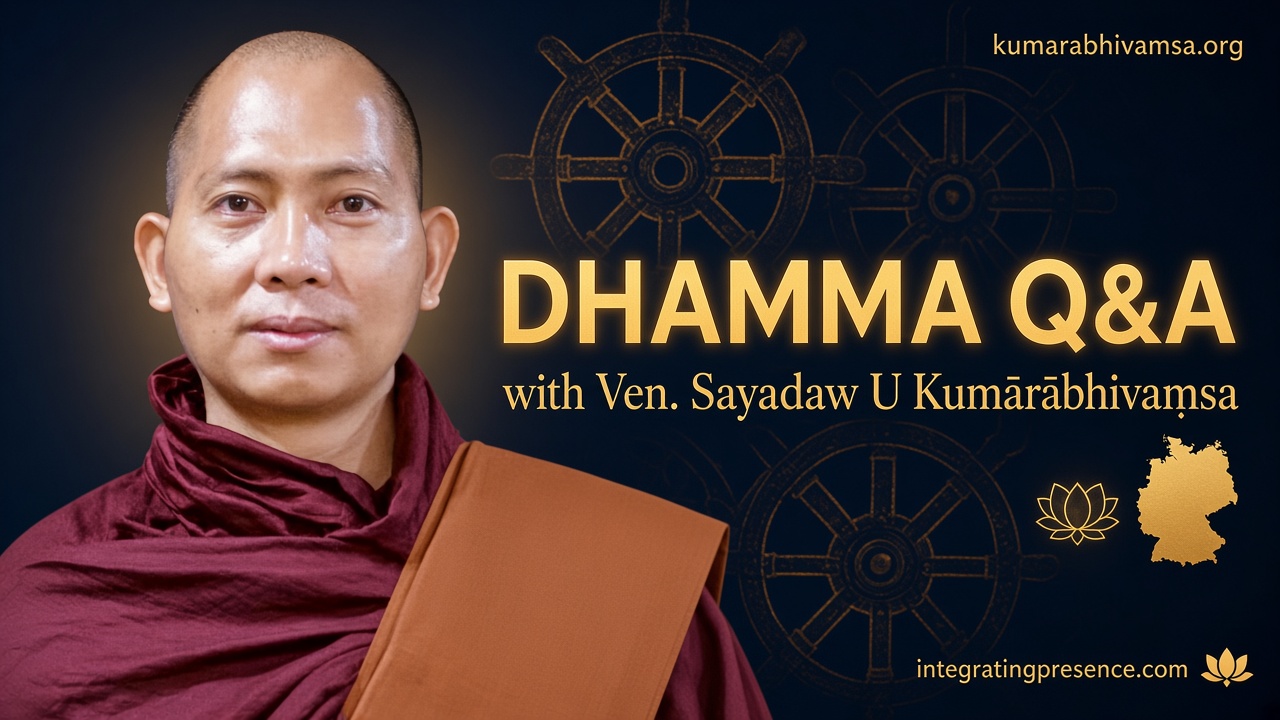
In this conversation recorded during a meditation retreat outside Berlin, Germany, Venerable Sayadaw U Kumārābhivaṃsa (senior meditation teacher at Pa-Auk Forest Monastery in Pyin Oo Lwin, Myanmar) talks about the practice of Samatha and Vipassanā meditation according to the Visuddhimagga.
We explore the practical and cultural aspects of establishing the Dhamma in the West, the five essential factors required for successful meditation progress, the distinctions between the Bodhisatta path and seeking awakening as a disciple, and the history and future of Pa-Auk Forest Monastery translations.
Approximate Timestamps
- [00:00] Introduction & Welcome
- [00:54] Who is Sayadaw U Kumārābhivaṃsa?
- [02:39] Advice for Establishing the Dhamma in Europe
- [09:08] Practical Support & Monastic Traditions in the West
- [16:02] The 5 Essential Factors for Meditation Progress
- [23:49] Seeing Nāmarūpa vs. Conceptual Understanding
- [24:38] The Bodhisatta Path vs. Awakening as a Sāvaka
- [31:28] Prophecies & Fulfilling Pāramī
- [34:30] Progress for Lay Practitioners vs. Monastics
- [36:38] Daily Life Practice & Setting Adhiṭṭhāna (Determination)
- [41:12] Patthāna & Abhidhamma Direct Practice
- [43:57] Pa-Auk Sayadaw’s Forest Practice & Lineage History
- [52:09] Preserving the Sāsana Across Realms
- [56:06] Status of English Translations of Pa-Auk Texts
- [58:54] Reflections on Retreats in the West & Closing Blessings
Detailed Topic Breakdown
Establishing the Dhamma in Europe
- Discusses the deep interest in Buddha-Dhamma and meditation across Europe and the UK.
- Emphasizes the need for systematic, step-by-step teachings according to the Buddha’s instructions and the Visuddhimagga (covering both samatha concentration and vipassanā insight).
Practical Support & Monastic Traditions in the West
- Explores the differences between running meditation centers in traditional Buddhist countries (where monastics rely on free alms and devotees fully support the four requisites) versus the challenges of modern Western livelihoods.
The 5 Essential Factors for Meditation Practice
- Outlines the five foundational qualities required to successfully realize Nibbāna: Saddhā (faith/confidence in the Buddha and his teachings), health (physical well-being), honesty and sincerity (maintaining moral precepts and accurately reporting practice), energy/diligence (energetic, regular practice), and paññā (wisdom developed through systematic samatha and vipassanā).
The Bodhisatta Path vs. Awakening as a Sāvaka
- Clarifies that liberation requires penetrating the Four Noble Truths regardless of path.
- Details the requirements and immense eons of time needed to fulfill the ten pāramī (perfections) for those aspiring to become a Sammāsambuddha, a Pacceka Buddha, or a chief/great disciple, contrasted with those ready to attain Nibbāna in the present life as a sāvaka (disciple).
Daily Life Practice & Setting Adhiṭṭhāna (Determination)
- Discusses how practitioners can cultivate pāramī in daily life through generosity (dāna), moral conduct (sīla), and strong determinations (adhiṭṭhāna) aligned with their spiritual aspirations.
Patthāna & Abhidhamma Direct Practice
- Touches upon the deep study of conditional relations (Patthāna) and the Abhidhamma, noting that genuine realization requires pairing deep textual study with practical meditation under qualified teachers.
Pa-Auk Sayadaw’s Forest Practice & Lineage History
- Shares the history of the Pa-Auk tradition, recounting how the original Pa-Auk Sayadaw spent decades studying scriptural commentaries (Visuddhimagga, mūla-ṭīkā, and anu-ṭīkā) and practicing intensively in solitude in the forest before establishing a center that now serves thousands of local and international yogis.
Status of English Translations of Pa-Auk Texts
- Addresses the progress and challenges of translating complex Pāli meditation manuals into English, noting the difficulties when translators lack practical meditation experience, and highlighting ongoing efforts by monastics, scholars, and modern tools.
Dhamma Questions and Conversation With Venerable Sayadaw U Kumārābhivaṃsa
Ai edited transcript of my interview with Sayadaw:
Hello and welcome internet land, I guess those watching us live now and into the future. Welcome. Joined by Sayadaw U Kumārābhivaṃsa, and this is the first time we’re speaking here too. I’m speaking with Sayadaw, just grateful to be here and practicing on retreat here in Berlin.
Sayadaw, I talk to quite a bunch of people here and there, and I have a standard question I ask them, and it can be answered on the most conventional standard level, or we can jump right into not-self. So, just leave it to you how we want to answer this: Who is Sayadaw, and what kind of work does he do?
Who is Sayadaw U Kumārābhivaṃsa? I am from Pa-Auk Meditation Center, Pyin Oo Lwin, Myanmar. I am one of the meditation teachers in the Pa-Auk Meditation Center in Pyin Oo Lwin. So, I am teaching meditation to many yogis from different countries. From time to time, I also go to other countries for short meditation retreats. Now, according to the invitation from the Buddhist community from Germany and Czechia, I came here for a short meditation retreat. So now, they provided this place for a short meditation retreat in Berlin, Germany.
It’s quite a privilege and honor to be here and practice on such a high level. Talking before about how I’d just be just as happy sitting in silence, but probably people watching, that wouldn’t be as interesting. So since you mentioned that, I’ve gotten asked by other people too. I have questions—kind of very basic, simple, straightforward ones, but also maybe deeper ones that I’m really underqualified to ask, but maybe I’ll ask anyway for the benefit of those listening, and for the benefit of where practitioners will eventually get, more and more practitioners will eventually get.
Advice for the European Dharma Community
Interviewer: Let’s just start off with Europe. Where do you, what kind of advice do you have for the European Dharma community at large? How maybe the Dharma can take deeper root in Europe, how it should be introduced, if we should maybe cater more or should adapt to Westerners, or how pure the Pa-Auk lineage should be introduced to Europe? So, kind of ideas and advice on what to do in Europe, or how we would like to see the Buddha-Dhamma brought to Europe, and advice for practitioners that want to come to the Dharma in Europe and practice, and then maybe get a taste here and then go practice in Asia too. So, anything to say about this?
Sayadaw U Kumārābhivaṃsa: The Buddha’s teachings, you know, the meditation practice is very brilliant in Asian countries, but not in European countries yet. That is why a few years ago, the Buddhist community from European countries and the UK invited me to come here for a short meditation retreat. Then I also came here for a short meditation retreat. Then I teach the Buddha’s teaching or meditation practice to the people in European countries and the UK. Then they are very interested. Actually, some Buddhists from European countries are also familiar with the Buddha’s teaching—for example, some meditation practice according to Goenka teachings, or Mahasi teachings, and other like Mahayana, Thai Forest teachings, etc.
Actually, our founder tradition, our Pa-Auk tradition, teaches meditation systematically, step by step, according to the Buddha’s instructions. And that is why the proper teaching or systematic teaching are still needed for people in European countries. That is why when I came here, I teach meditation to the people in European countries step by step, systematically, according to the Buddha’s instruction. Then, at other times, they are also very interested in the meditation method taught in the Visuddhimagga.
For example, the Buddha’s teaching briefly are the Noble Eightfold Path or the three trainings. You know, sīla is also very important to attain Nibbāna or to attain liberation. Later, they have to continue to practice samādhi concentration taught, for example, for these subjects of samatha meditation, and many suttas, many scriptures. But now, most meditation teachers don’t teach samatha meditation at their meditation center or their meditation retreat. That is why most of the people don’t have knowledge in samatha meditation practice.
But in our Pa-Auk Meditation Center, we teach all samatha meditations to the meditators according to the Visuddhimagga. So they can also practice samatha meditation successfully until they attain a higher level of concentration. Then, when they have a deeper level of concentration, then based on those concentration, they can continue to practice vipassanā. Then it will be easier for them to practice vipassanā with the deeper concentration and clear understanding like this. Then they can attain Nibbāna, the supreme peace of liberation, the supreme Nibbāna like this.
So briefly, the Buddha’s teaching—we are teaching according to the Buddha’s instructions in our meditation center. So we came to European countries to teach the Buddha’s teaching accordingly. Although it is very difficult for people in European countries to practice longer like in ancient countries like Myanmar, Thailand, or Sri Lanka, etc., we also teach according to the Buddha’s instruction. If they are interested in meditation practice later, they will also establish meditation centers in your country to be able to practice longer, or maybe if they have the opportunity to come to Myanmar, Sri Lanka, or Thailand—the Buddhist countries—then they can also come there to practice longer. And this way, they will obtain the benefits of meditation practice and the attainment of Nibbāna.
Supporting European Practice & Monastic Traditions
Interviewer: To follow up on that, is there anything from the monastic community—recommendations or support for working on getting a European center established here, for maybe donors and supporters worldwide? What do you see needs to happen, or guidance for that to come about and come to fruition? Is there any practical, spiritual level—anything that can be said if people are out there that want to help and support, to make this happen?
Sayadaw U Kumārābhivaṃsa: When we conduct short meditation retreats in those European countries, some meditators are very interested in the meditation practice, or they also wish to practice meditation successfully, if possible, until the attainment of Nibbāna. So because of their condition, their livelihood, etc., they had no opportunity to come to an ancient country like Myanmar, Thailand, or Sri Lanka, etc., to be able to practice there for a long time. That is why they also wish to have a meditation center here, and they wish to practice in their own country.
But European countries are a little bit different from Asian countries, especially Buddhist countries. In our Buddhist countries, for example, there are a lot of meditation centers. We just study the Buddha’s teaching, and we just practice samatha meditation taught by the Buddha full-time—no full-time work. That is why when we are practicing meditation in the monastery or in the meditation center, then the devotees automatically support us with the necessary requisites. We don’t need to do anything.
But in European countries, I think it is a little bit difficult, then they also need to work for their daily livelihood. Also, although there’s a meditation center, I think it will be difficult to run the meditation center with fees or charges. But in Myanmar or Sri Lanka, although many meditators come to the meditation center to practice meditation even for whole years, no problem—free of charge. They can come and practice meditation according to monastery rules and regulations, and then the devotees support them with the four requisites. They don’t need to worry about the four requisites: accommodation, food, everything like this, medicine, something like this.
Then in your country, maybe according to their system to run as a meditation center, to be able to practice meditation longer without working, then it might be a little bit difficult here.
Western Culture, Faith, and Monastic Life
Interviewer: I’ve practiced in the Thai Forest tradition of Ajahn Chah in the UK, and just so I’m an American in Europe right now, and what I’ve been told is there’s no memory of monasticism really in America because it’s only like 200 years old. But in Europe, some people say that because Europe is older, they still have memories of at least Christian monastics. So they recognize monastics more than they would in America. So to me—I’m just guessing here—it seems more possible to have it in Europe than it would be in America.
Those Thai Forest monks, they go on piṇḍapāta and they do get alms, right? But the challenges here, I think—maybe another challenge would be the cultural unknowns. We were just witnessing recitation or in the distance a little bit of part of the Pātimokkha, and I’ve never done afterwards where we lined up with the roses. So just as an example, could you explain for the Westerners just a little bit about the lay involvement in what we just did with lining up with the roses, and what we did there? And from there, what kind of cultural education that Westerners need that want to support that?
I know I felt a little bit awkward when I first visited a Thai monastery. In monasteries in general, there was just—I didn’t know how to act or behave, what was considered respectable, you know, if I felt authentic or not, if I felt like I was being fake or something like this. So there’s just some education, I think, as far as the everyday. And then I don’t know if I can speak for all Westerners, but we tend to be, I think, more on the wisdom side—not maybe not real wisdom, right, thinking we have wisdom—but lacking on the faith side, where maybe more in Asia the faith is stronger than the West. So I think us Westerners—and my teacher in this lineage, he talks about how important faith, confidence, and trust is in the Buddha, Dhamma, Saṅgha, and in the teacher, and the meditator’s own ability and faith in the meditation object too. So there’s I put a lot out there, sorry about that, a lot of stuff there. So yeah.
Sayadaw U Kumārābhivaṃsa: The Buddha taught the five essential factors for meditation practice. If someone wishes to practice meditation successfully—that means if they wish to attain final goal Nibbāna—then they need to have the five essential factors for meditation practice. If they practice based on those five essential factors for meditation practice, then they can be successful in meditation. That means they can attain Nibbāna, they can penetrate the Four Noble Truths. Without having these five factors, it is impossible to practice meditation successfully—that means they cannot attain up to the realization of Nibbāna.
The 5 Essential Factors for Meditation Practice
So what are the five essential factors for meditation practice?
- 1. Saddhā (Faith): Yes, faith in the Buddha’s enlightenment, the Buddha’s teaching. That is very important. Without believing in the Buddha’s enlightenment or the Buddha’s teaching, then it is impossible to practice according to the Buddha’s instruction. That is why number one, saddhā (faith), is very important—confidence or faith in the Buddha’s enlightenment or the Buddha’s teaching.
- 2. Health: If you wish to practice meditation successfully until you attain Nibbāna, then you must be healthy. You must be healthy. If you are suddenly sick, if you have a very serious disease in your body, etc., then it is also impossible to practice until the attainment of Nibbāna. That is why you must be healthy, briefly.
- 3. Honesty and Sincerity: As a Pāli term, you must be honest and sincere. For example, that means you should try to observe the five precepts not to break them. If you break one of the precepts, you should confess in front of the teacher or fellow practitioners like this, then observe the precepts not to break them in the future again. In this way, if they try again and again, they will be able to maintain the five precepts not to break them also regarding their practice. Then they should report their actual meditation experiences to the teacher without lying or something like this. Then in this way, the teacher also can guide their disciples correctly to be able to practice successfully. That is why honesty and sincerity is also one factor for the practice of meditation.
- 4. Energy and Diligence: You need to practice meditation diligently, without being lazy. For example, if someone is lazy to practice meditation, then it is also impossible to attain jhāna or magga-phala (path and fruition). Then when they practice, for example, like ānāpāna-sati meditation systematically, regularly, or like loving-kindness (mettā) meditation systematically, regularly according to the teacher’s instructions or the Buddha’s instructions, then their concentration will increase, their mindfulness will increase more and more, then they can stay with those kinds of meditation objects. At other times, they can abandon unwholesome consciousness or they can increase wholesome consciousness in their mind, then their mind will become more and more pure.
- 5. Paññā (Wisdom): They should be wise, they should have wisdom. Then when they practice samatha and vipassanā meditation systematically, sure, their mind becomes more and more pure. Then they have strong mindfulness and concentration. Later, because of mindfulness and concentration, they can also discern, they can also analyze nāma (mentality) and rūpa (materiality) to understand them as they really are. Then they have wisdom. Finally, they can reach up to, you know, the higher level of vipassanā knowledge. Then continue to practice insight meditation step by step systematically. Finally, they can realize Nibbāna with path and fruition knowledge (magga and phala), and this way they can penetrate the Four Noble Truths.
Then you know, remember: saddhā (faith), must be healthy, must be honest, must be energetic, must be wise. If they have these five factors, then they can be successful. If they don’t have these five factors, although they practice meditation, it will be only an artificial practice like this.
Conceptual Understanding vs. Direct Experience of Nāmarūpa
Interviewer: So does that list have a name? There’s a list of five that you just mentioned. Does it have a name?
Sayadaw U Kumārābhivaṃsa: Just as listed in that sutta, whether they are Buddhists or non-Buddhists, whether they are Westerners or Asians, they have to follow these five factors completely to be able to practice meditation successfully.
Interviewer: Very good. So while we’re on that, I just wanted to mention that you know, I just—my little familiarity in different traditions is all conceptual basically, and it’s helpful to a certain degree. Why I got drawn to this is the, you know, the training to eventually see nāmarūpa, because a lot of the Buddhist teachings in the West are just conceptual, right? So we’re not seeing the ultimate nature of reality. So that’s kind of what intrigued me the most about this. And I don’t normally have a systematic way of approaching life, which means that I need to do that—you know, that there’s something there that it’s just so vast, and so profound, and so thorough, and so comprehensive, and it like leaves no stone unturned, right, to see dukkha on all these levels. So it is just quite amazing.
The Bodhisatta Path vs. Awakening as a Sāvaka
Why we’re on this too, this is kind of a more rare question, but maybe it’s interesting to some. We hear, you know, in Mahayana they talk about the Bodhisattva path. But from what I understand, if we want to really practice in this tradition, we—most people want to let that go and dedicate to reaching awakening in this life or as soon as possible, right, to realizing Nibbāna as soon as possible. And so that precludes—not—however, I’m wondering for those rare individuals that do aspire to be a Bodhisatta, either a Sammāsambuddha or a Paccekabuddha, or maybe even a chief disciple or so, but and want to practice the real Theravada, the true teachings—what is normally recommended for those rare individuals, or would it just be advised to just let that go altogether? I know it’s kind of a specialty question, so it’s okay to let it go too.
Sayadaw U Kumārābhivaṃsa: Without penetrating the Four Noble Truths or without the realization of Nibbāna, no one can be free from sufferings. So if they wish to be free from sufferings, then they should try to penetrate the Four Noble Truths as it is. No problem, according to their desire, according to their choice, it will be possible to penetrate the Four Noble Truths—as a Sammāsambuddha, or Paccekabuddha, a private Buddha, it will also be possible to penetrate the truth. Then another one: a great disciple of the Buddha, it will also be possible to penetrate the truth as a great disciple.
Every stage is possible as to penetrate the Four Noble Truths. They can choose themselves according to their preference. For example, some, they wish to penetrate the Four Noble Truths, they want to attain the enlightenment as a Sammāsambuddha. Okay, it will be possible, but they will have to fulfill the ten pāramī (perfections) to become a Buddha. It will take, you know, at least four asaṅkheyya and 100,000 kappas (aeons) in world cycles, then they have to fulfill the ten pāramī to become a Sammāsambuddha. Then finally they can also penetrate the Four Noble Truths as a Buddha, a Sammāsambuddha.
Then another option: if they prefer to penetrate the Four Noble Truths or to attain the enlightenment as a Paccekabuddha (private Buddha), it will also be possible, but they have to fulfill the ten pāramī for at least two asaṅkheyya and 100,000 aeons, then after that they can become a Paccekabuddha (private Buddha), then they can attain the enlightenment.
Another option: if they wish to be, you know, chief disciples of the Sammāsambuddha, like Venerable Sāriputta or Venerable Moggallāna, it will also be possible. But they will have to fulfill the pāramī for one asaṅkheyya and 100,000 aeons to become chief disciples of the Buddha, then finally they can attain the enlightenment after fulfilling the ten pāramī.
And another great disciple of the Buddha, like Mahākassapa, Mahāmoggallāna, Ānanda, etc., great disciples of the Buddha—okay, they can, it will also be possible to attain the enlightenment as a great disciple of the Buddha, but they will have to fulfill the pāramī for 100,000 aeons. After that they can penetrate the truth and then they can also attain the enlightenment.
As a sāvaka disciple of the Buddha, then there’s no fixed time to fulfill the pāramī. For example, even in this present life, they practice meditation according to the Buddha’s instruction. If they have already fulfilled the pāramī for sometimes many lives, for example, in the past, then they are ready to attain the enlightenment even in this present life. So now, they practice meditation, it is very easy to attain concentration, to attain Nibbāna—that means they have already fulfilled their pāramī in past lives, something like this. But some, even they are not interested in meditation practice, that means they are lack of perfections and they still need to fulfill the perfections to attain enlightenment in the future like this.
Interviewer: Very good. I know. So just to follow up real briefly on this: Do we have accounts in any of the texts of—of course we know the prophecy for the next Sammāsambuddha, but do we have any accounts of other practitioners who have received a prophecy to be, or is it allowable within the Saṅgha to maybe know of these things? But then if it is, would such information be allowed to be shared with lay people—of those who have had prophecy? And I guess anything to say about that or not say?
Sayadaw U Kumārābhivaṃsa: We call the niyata-vyākaraṇa—definite prophecy to become a Buddha in the future, like Bodhisattvas. If they are really Bodhisattvas, they understand—for example, okay, the Aggamahāpaṇḍita from Sri Lanka or Myanmar, they are also fulfilling the pāramī to become a Sammāsambuddha in the future. Then when they practice meditation, then their concentration is very deep and very good, then they can also discern their past lives, etc. Then they also understand they have already received the definite prophecy to become a Buddha in the future from past Buddhas or something like this, or Sayadaw has such kinds of knowledge. But some, they cannot discern their past lives because of lack of concentration capability.
Fulfilling the pāramī to become a Buddha in the future—there are also many such kinds of Bodhisattvas. Paccekabuddhas, great disciples of the Buddha also—many. For example, now we are teaching meditation to many different students from different countries. They also, for example, they practice samatha meditation successfully up to a higher level of vipassanā stage. At that time, they also say, “One day I wish to be a Buddha in the future, that is why I cannot attain Nibbāna in this present life.” Why? Their wish is to become a Buddha in the future, and they stop in saṅkhāra-pekkhā stage. So they wish to be a great disciple of the Buddha like this. They have many different intentions.
But if they have already practiced with the five essential factors for meditation practice, they reach up to, for example, the sāvaka stage higher level or vipassanā knowledge, then they also wish to realize Nibbāna in this present life—they don’t want to go further longer, they don’t want to be a Sammāsambuddha or Paccekabuddha or chief disciple of the Buddha in the future, etc., then they are ready to realize Nibbāna in this present life as a sāvaka disciple of the Buddha.
Interviewer: So that stage is—is it translated as equanimity of formations? Is that where they can revoke the past vow and then go through with this very life, or where is that turning point where they have to stop their vipassanā knowledge? Could you say that?
Sayadaw U Kumārābhivaṃsa: Yeah, okay. Very good, thank you for sharing that.
Lay Practitioners vs. Monastics & Fulfilling Pāramī
Interviewer: Now, more a standard question again from one of the participants: They ask about those interested in ordaining as a monastic, and also if it’s possible to make significant progress as a lay person in this life, in this lifetime.
Sayadaw U Kumārābhivaṃsa: If they have already fulfilled the pāramī in the past to realize Nibbāna, they are ready to attain the enlightenment in this present life, then it will be easiest for them to attain the enlightenment even in this present life. Condition is very important. For example, during the Buddha’s time, they are laity—they have their family, their wife, their husband, their children, etc., but they also became sotāpanna. They attained the enlightenment, they penetrated the Four Noble Truths as a laity. Why? They have already fulfilled the pāramī in the past since long times ago.
So although they are laity in this present life, their condition is ready to attain the enlightenment. That is why when one listens to the Buddha’s Dhamma or practices meditation under the guidance of the Buddha, they became sotāpanna. So nowadays also the same way: if they are ready to attain the enlightenment, or the condition is ready to attain the enlightenment as a laity, no problem, they can attain Nibbāna. But although the condition is not ready yet for them to attain the enlightenment in this present life, or they also still need to fulfill the pāramī to be ready to attain the enlightenment in the future…
Interviewer: Very good. That leads to another thing—fulfilling pāramī, right? So from my understanding, every moment of life, whatever happens, is a potential right to maybe fulfill pāramī, especially on if we can establish the right—if the right view can be there, and then the right response, right? So in general, do you have advice and guidance for building pāramī, for fulfilling this through formal practice and in everyday life too perhaps, or any other thoughts on this as well?
Sayadaw U Kumārābhivaṃsa: Yeah, depends on the individual, depends on the person’s wishes, or what do you want to be in the future—want to be a Sammāsambuddha, or Paccekabuddha, or chief disciple of the Buddha, or great disciple of the Buddha, or sāvaka disciple of the Buddha? According to their wishes, they will have to fulfill the pāramī.
Then when they are fulfilling the pāramī, when their pāramī become mature, they also understand, or they are very interested in the Dhamma, they are very interested in fulfilling the pāramī, something like this. Then whatever pāramī they fulfill, their intention is to attain the enlightenment in the future, something like this. But some, for example, they have already fulfilled their pāramī in the past, now they are practicing meditation, they have good intention: “I will try to attain Nibbāna enlightenment even in this present life.” That means they have already fulfilled the pāramī in the past, they are practicing, they are very close to the enlightenment, but they don’t have such intention yet, but they are interested to do like dāna pāramī (generosity) with the intentions to become a Buddha or to become a great disciple of the Buddha in the future. Then okay, they are still fulfilling, they are still on the way.
Interviewer: Is there an adhiṭṭhāna you recommend for just about everybody, or any kind of recommendations for setting adhiṭṭhāna (determinations)?
Sayadaw U Kumārābhivaṃsa: Adhiṭṭhāna is also one of the pāramī, that is why it is also needed to fulfill. So for example, according to your wishes, what do you want to be in the future? You might know yourself. Then they determine, “I will try to fulfill the pāramī to become a Buddha in the future.” Some are our disciples, they are practicing meditation under our guidance, but they wish to be a Buddha in the future. Although we encourage them to practice meditation to attain Nibbāna in this present life, they don’t want to, but they are practicing, they are fulfilling in this way. Understand, there are many different kinds of yogis with many different kinds of wishes.
Abhidhamma, Patthāna, and Lineage History
Interviewer: Okay, so maybe a more advanced question here or topic anyway: the Patthāna—if I’m pronouncing it—the conditional relations in Abhidhamma. From what I understand, really in-depth Abhidhamma teachings are really rare in the West, even rarer are those who can teach it, maybe even to Westerners and make it understandable and relatable because it’s so vast and profound. But I was practicing with an advanced yogi, and he was wondering if he wanted to practice it, not just study it, but to see and know it for himself in direct practice. Does the Pa-Auk syllabus include Patthāna pretty comprehensively? And if not, could you recommend for those that will eventually get to that level other teachers or ways to take it on in study and practice?
Sayadaw U Kumārābhivaṃsa: They are studying the Abhidhamma, is it? We also study the Piṭaka, the Buddha’s teaching, for many scriptures for whole lives, but without practicing meditation practically, it is impossible to know the truth. Then after studying the Piṭaka, the Buddha’s teaching, for a long time, then we also approach the forest to practice meditation practically. Then if they wish to penetrate the Four Noble Truths, they will have to practice practically. So currently, sure, we recommend the Pa-Auk strategy, and the teachers from Pa-Auk are very skillful in the teaching, both samatha, vipassanā meditation, and the realization of Nibbāna.
Interviewer: Okay. A few more here, and this is within the Pa-Auk tradition here: the—you know, a lot of people starting off, they’re inspired by just regular stories, you know. From what I understand, if I’m understanding correctly, Pa-Auk Sayadaw, he went off into the forest and practiced on his own for years. Are there any stories that can be shared that will inspire people, arouse faith, give more of a history of maybe what happened during that time? And then I was wondering too, is it—do you feel it’s possible for someone today, given the circumstances today, maybe with AI and a lot of technology, to do something similar, to just leave it all behind and go into the forest and learn maybe from other teachers or from one’s own experience too? And is that—do you think that’s a—I’m sure it’s a rarity, but do you think something like this would be possible either today or in the future? But mainly, some inspirational stories or anything especially that hasn’t been shared publicly yet that can be shared publicly.
Sayadaw U Kumārābhivaṃsa: Actually, Sayadaw also studied the Piṭaka and Pariyatti school for a long time. But for example, at the age of 30 years—around his age—then he decided to practice meditation practically. Then he approached many meditation teachers, including Mahasi, Panditarama, and the other, etc. Then he also practiced meditation under their guidance until, then they are satisfactory, they are attained higher level of their teachings. But Sayadaw realized, Sayadaw understood: still need to continue to practice for attainment of Nibbāna, not enough practice yet with their practice. That is why although Sayadaw may have some sīla, samādhi (concentration) and some paññā (wisdom) what they are practiced, still need to continue to practice to penetrate the Four Noble Truths, etc.
That is why Sayadaw went to the forest and stayed in the forest monastery for a long time. Then he mainly focused on the Visuddhimagga together with many Pāli suttas and, you know, mūla-ṭīkā (root sub-commentary) and anu-ṭīkā (sub-sub-commentary), then mainly focused on Visuddhimagga together with the teacher’s instruction previously he practiced, then what are still needed, what should he practice currently, etc. Then he also practiced practically with the instruction of the Visuddhimagga based on concentration practicing, formal teacher something like this. And finally, he understood the correct practice taught in the Visuddhimagga right there in the Visuddhimagga.
Finally, Sayadaw stayed in the forest until around 30 years—sometimes even without going out, maybe continuously for six years or seven years like this, something like that. Then finally, for example, now Pa-Auk Monastery’s previous abbot, when he met the Sayadaw when he was young, then he knew Sayadaw’s pariyatti and patipatti (practice) ability. That is why when he nearly passed away, he went to transfer his monastery to Sayadaw. That is why he called: “Sayadaw, please come here, I am very sick or something like that,” then before he passed away, then he offered his monastery to Sayadaw. Sayadaw didn’t want to accept this monastery, but okay, he stayed there for sometimes, practicing meditation continuously.
At that time, disciples come to the monastery, and then they also learn some meditation practice from Pa-Auk—for example, four elements meditation, etc. Then finally, Sayadaw became famous, then he cannot avoid many students from different countries also came, including, you know, Ariyadhamma Mahathera from Sri Lanka. Then he also came to Pa-Auk, teaching meditation according to the Visuddhimagga. Actually, Mahathera, he also declared he is a Bodhisattva, then he want to practice samatha meditation according to Visuddhimagga instruction, but he was searching for the correct teacher, but he couldn’t find. Finally, he heard Pa-Auk’s teaching, he came to Pa-Auk together with some of his disciples, then they practice meditation there maybe at least a few years continuously. Later, they also brought this meditation teaching to Sri Lanka, then they established Pa-Auk meditation center, etc.—the Pa-Auk meditation centers in Sri Lanka like this. Then he, the Ariyadhamma Mahathera, he declared openly he is a Bodhisattva, then he will become a Buddha in the future, in the near future. He said maybe after reading his past life, something like this, you may also read Fruit of Buddha maybe written by the Mahathera Sri Lanka now, something like this.
Okay, so now for my story, for example: I was also studying Pariyatti and Pariyatti school for a long time, taking many examinations. One day suddenly I went to the Pa-Auk Meditation Center. I never been—I never heard about Pa-Auk. Then later, I listened to Sayadaw’s talk—very profound—and I understand, after studying I have to practice under Sayadaw’s guidance properly. Then finally, I also went to Pa-Auk to practice meditation according to Sayadaw’s guidance, maybe like near around 2000, around 2000 era, is it? Then that time, I went to Pa-Auk for shortly. Later I returned to Pariyatti school, then I went to Pa-Auk there for sometimes. In this way, finally 2004, 2005, I stayed there for two years continuously. Then later, beginning from 2010 until now, I’m staying in the Pa-Auk Meditation Center.
Preserving the Sāsana Across Realms & Translations
Interviewer: To follow up, I think—just a few more if we may, kind of on that note: This is maybe a little bit far out there question, but there’s kind of—I don’t know if it’s a mythology, there’s a story around the Visuddhimagga, right, that it was—the devas tested his knowledge by taking it away several times, right, and he was able to know it from memory and do it several times, right? So on that note, if I’m remembering right, I’ve heard some stories about different missions from heavenly realms. So that is—is there anything, like with the Visuddhimagga, to propagate or to prolong and maintain the Buddha’s dispensation? Are there certain beings in heavenly realms that, when the time comes for their life to expire, can they take on missions as humans to take a human life in order to preserve the Buddha’s dispensation, and to prolong it, to strengthen it? I don’t know, it’s so far removed from most people’s everyday life, but I don’t know, maybe it could be inspiring too. Any thoughts about things like this?
Sayadaw U Kumārābhivaṃsa: Some, for example, they make the aspirations to propagate the Buddha’s dispensation worldwide, etc. They wish to study the Buddha’s teaching, they wish to practice samatha meditation successfully, after that they wish to propagate the Buddha’s dispensation throughout the world profoundly and widely, something like this. According to their wishes, they also make many merits—especially like learning the Buddha’s teaching, teaching the Buddha’s teachings to others, something like this. Because of their aspiration, some—sometimes although they are in deva realm or Brahma realm, because of their wishes… many many Brahmas requested—for example, Moggaliputtatissa Thera during Asoka in India, is it? Then to take care of the Buddha’s dispensation during that period, then he was a Brahma, then many Brahmas, many arahants went to the Brahma realm and requested to return to the human world to take care of the Buddha’s dispensation. Then at that time, he was born as a human being. Then later when he became adult, he studied the Buddha’s teaching, finally he became an arahant, and he took care of the Buddha’s dispensation with his ability. There are many stories like this. Together with me again, or the same story—they had such kinds of wishes. Some stories may be correct or not correct, not sure.
Interviewer: Okay, very good. Okay, so I think to finish this up, ask about official translations for Pa-Auk. We have some material in English, but like his master work—the big five-volume work, if I’m understanding this right—there hasn’t been an agreement on an official translation. I don’t know, you have to give them the correct update if you know it, and then if you have any advice—cuz I think these are potentially really important works that would maybe—there’s not so many Westerners that are on that level, but there are some, I mean, that can benefit right away, but in the future too. So thoughts and feelings on like what’s the status or progress of that, if it’s okay to share? And then if you have any advice for coming to kind of a consensus or an agreement on translation? Because I was thinking one potential would just be to compromise on the main text and then have extensive footnotes for each translator on a team explaining why they chose, you know, one way, and then another translator that wanted to choose another word—you know, it can be lots of footnotes, now with the internet there’s no space requirements. But anyway, yeah, so these—the translation progress for translations for which book?
Sayadaw U Kumārābhivaṃsa: They actually have already translated into English by many scholars from universities in Myanmar. But they are also not so familiar with Pāli. Some—most of them haven’t practiced meditation practically. That is why although they are trying to translate meditation manual books into English, their translation is not accurate. That is why they didn’t publish as a book. But now, there are a lot of technology like AI or something like this, then they are trying to translate meditation manual books into many different languages—learning different languages, Myanmar now they also trying to translate into English.
Then, but one thing: Sayadaw’s books are also very old, we meditation teachers from Pa-Auk Meditation Center are also very busy. One thing, our English is also not so high level, that is why Sayadaw cannot confirm what the translation yet. Some are translated—you know, Ashin Ānanda, he was a monk at Pa-Auk before, then he also translated Knowing and Seeing into English, he also wrote, you know, books taught by Pa-Auk Sayadaw, something like this. Now Bhikkhu Subhūti, American monk—you know him, Subhūti is also one of my disciples—now he also translates the Pa-Auk books into English with meditation experience. Then he is still asking me whether they are accurate or not, something like this, but I cannot read, I cannot check yet.
Interviewer: Okay, all right. Thank you so much. To just leave on any final words that you would like to leave with the audience here from a retreat outside of Berlin?
Reflections on Retreats in the West & Closing Blessings
Sayadaw U Kumārābhivaṃsa: Now, actually, this retreat—this meditation is the second time. The first time, I also did one meditation, you know, Tin Hau Maha Monastery the first time last year, but this year they chose this place to conduct meditation retreat here because this place is convenient for meditators to come here from Berlin or something like this. That is why they conducted meditation retreat here. Last year I also did a short meditation retreat in the Mahayana temple nearby Berlin also, they are quite interested in meditation practice.
But for long-term practice according to Western culture or the system of European countries, it will be a little bit difficult. That is why when they understand the systematic practice or samatha, vipassanā meditation according to the Buddha’s teaching, then they also wish to practice, then they can come to Pa-Auk Meditation Center in Myanmar or Sri Lanka or Thailand like this, then they can practice there longer.
So many Westerners, many foreign yogis are also practicing meditation here—at our meditation center, for example. For our meditation center, there are more than 2,000 foreign yogis from different countries, including local yogis; there are more than 500 yogis in our meditation center. But in the other meditation center also like this—so many yogis are practicing samatha meditation at our Pa-Auk meditation centers in Myanmar. Very good. Yes, in Indonesia too, in Malaysia as well, right?
It’s just been so amazing to have you come and do this for the West, because yeah, like you’re saying, it’s a huge institution now in the East, and so it’s a very special treat that we get to have you here and the teachings and practices as well. So, appreciate that. And just I plan to perhaps apply to go to one of these centers when my time frees up, maybe in April next year. So I’m looking forward to get a chance to practice at an official Pa-Auk center and monastery. So thanks again for joining, and thanks everybody for listening and tuning in. Bye now. Sādhu, sādhu, sādhu!
Okay, yes, may all of you be well, happy, and peaceful.

