(Ai assist:) A short, unscripted solo reflection on some subtle patterns showing up at the intersection of Western Dhamma practice, language, and politics — especially in the California scene.
Topics touched on:
- How maybe sometimes “not taking practice too seriously” can quietly become a new form of spiritual conceit or complacency
- The strange silence around certain political issues in circles that used to be very vocal
- Affinity / identity-based groups in meditation centers: sincere intention, but does it sometimes create a new kind of segregation?
- The politics of peace (as far as I know it’s the only “side” the Buddha ever took)
- Small language shifts (“on land,” “self-paced,” pronoun introductions) and the way they can divide more than they unify
- A gentle reminder that language can liberate or it can confuse and separate — may we use it skillfully
No finger-pointing, no conclusions forced — just honest observations offered with metta


Ai cleaned transcript with some extra edits by me:
I’d been thinking about picking this up with Wendy again, continuing on from our last “Ask Us Anything” meditation Q&A, basically about balance in meditation and Dhamma and the lack thereof. I mentioned that this form of Dhamma on the West Coast has this particular sentiment in group of kind of making fun of awakening not being really achievable and then it kind of inadvertently turns into superiority conceit by belittling the notion of anyone taking it seriously — that it is even possible at all, and this becomes a type of distorted humility for those who buy into it and profess it. They bond around it, and all the while this normalizes and conditions being comfortable with complacency and resignation.
I don’t feel it’s really conducive to the practice. It’s understandable, though, because it’s the highest bar possible. I just want to point this out, not as blame or shame or anything.
I forgot to mention there’s the other extreme: politicians and powerful people pretending to be common and relatable for various reasons, a PR move to show they’re with the common man, that they’ve got it so hard and went through this and that, when maybe it’s not true or completely made up as a farce to make them appear something they’re not. That doesn’t really come into play so much in Dhamma circles. You see it in some other spiritual circles, and of course it speaks to spiritual ego. That’s another thing I’m working on too.
What I wanted to go into here is this notion—well, actually more the California political thing. There’s a paradox: to call something out as being overly political is in a way a political move too. I listened to a podcast the other day about how a certain branch of Dhamma in California is not mentioning the Israel-Palestine issue at all. I’m not calling for anyone to speak nor am I saying they shouldn’t. I just don’t feel personally called to get politically involved in that. But I am echoing (or bringing back up now) the sentiment of other politics they’ve done, and now they’re shying away from that, which is really interesting.
I don’t need to draw conclusions or say any more because then I would be getting politically involved, but I do want to draw attention to it. I noticed that they championed someone for a really long time, and as soon as it went against the agenda or she said something they didn’t like, they never mentioned her again. It’s just like they never championed her at all anymore. It’s interesting how these political climates can change and how things become yesterday’s news and get buried in the memory hole.
Another one is setting up special groups. I understand it because certain marginalized groups haven’t had a place or aren’t coming to certain organizations in the numbers that people would like. They’ve set up groups that self-identify and are color-coded so everyone knows these are affinity spaces. I don’t have good answers about whether this should be done or not. I just know that in a way it almost seems like segregating and using exclusivity. How does this work with inclusion? It’s including but also segregating at the same time because no one else in the organization is allowed in that exclusive group. I haven’t witnessed this dynamic in person and seen how it works and how it helps or hurts. I just find it really interesting the way this is being done.
On the Israel-Palestine thing again: I don’t choose sides or get politically involved other than to say what I think both sides can agree with, which is that the Buddha always calls for peace everywhere all the time. I care about all demographics. It’s always about peace all the time for me. That doesn’t have a monopoly on any label or group or identity. It’s universally applicable everywhere all the time. If we want to politicize peace or focus on peace, that’s what it should be about. I know it’s more complicated than that and I don’t want to downplay anything that happened in the past, but the ultimate aim should be peace for everyone all the time, everywhere. That’s where the heart should aim. No matter one’s politics, if I’m going to take a political side, it’s on the side of peace as much as possible. I don’t advocate any kind of violence or war for anything. ‘Hostility is never ended by hostility; only by non-hostility is hostility ended. That’s an ancient and eternal law.’ Some might call that a cop-out, but that’s okay.
Another interesting language thing I’ve seen is “on land / self-paced.” When I was in England, retreatants kept saying “I’ve landed.” Now we have “on land.” We don’t say “in-building” even though being in buildings are a big part of it. “Land” has this connotation of something that can be bought and sold. It reminded me—maybe too loosely—of the Buddhist enlightenment verses about finding the architect, tearing apart the rafters and ridge-pole of the house of self so no architect will build the Buddha another.
Not to pick on California too much, but another language thing: for instance some Theravada teachers switch between saying “Theravada tradition” and “our tradition” and “their tradition,” when referring to this which gets confusing—are you in it or outside it?
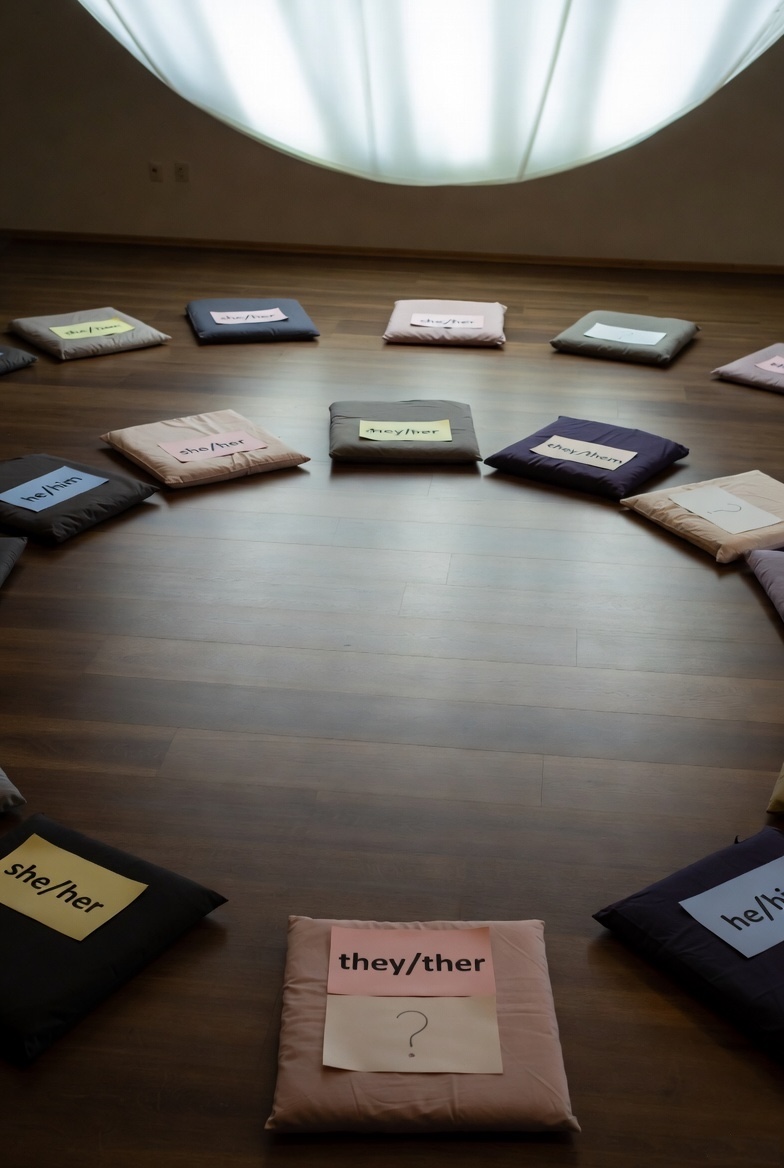
The big one is pronouns. I feel this is fortunately going by the wayside now. One thing I realized is that it functions as language control and division. All English speakers shared the same basic language, and suddenly introducing mandatory pronoun preferences front-loads every interaction and instantly sorts people into camps: those who comply and those who don’t. Divided people are easier to control than people unified by a common language. (Seems to promote self-censorship and walking on egg shells of sometimes seemingly arbitrary preferences while at times adding extra unneeded identifications.)
Language can be used to liberate or it can be used to confuse, mislead, divide, and deceive. May we all use language well and optimally, for genuine well-being and awakening.
 Integrating Presence