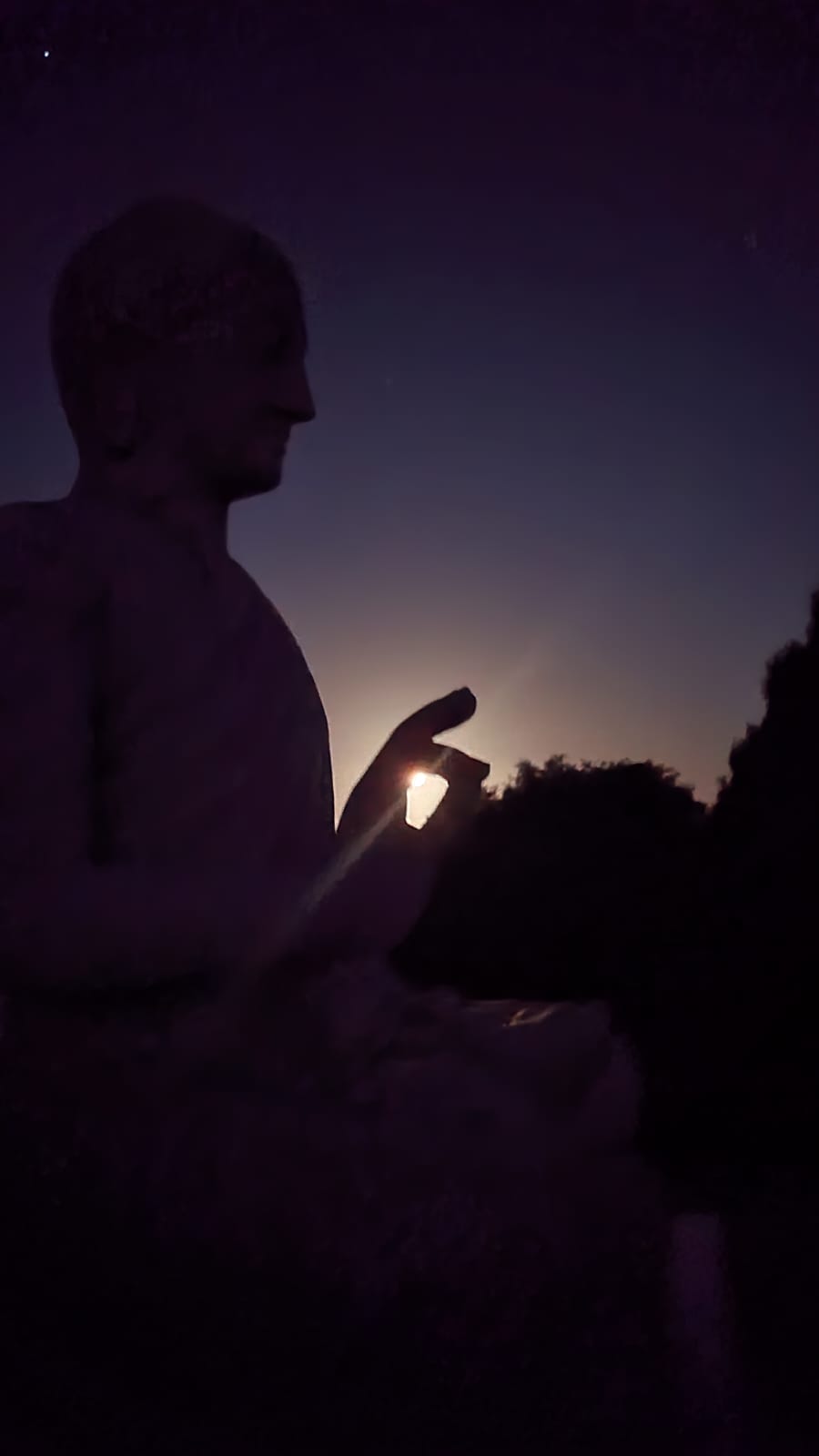
A while back I put this title question to Ajahn Sucitto via the comment form included in Ajahn’s mighty mite bite of the Dhamma Tracks newsletter [sign up at bottom of the page]. Such a delight today to learn of this answer:
Well, we’re alive. What does that mean? Animate, sensitive, growing, moving, participating in a context whereby we breathe what’s around us, consume it and are made conscious by it. Consciousness is an intelligence that serves the animate being (me) by reporting on what’s happening around and within it. So our experience has external and internal aspects, it’s viññāṇa, a dualistic awareness that presents experience as a ‘world’ (get to that later) and a ‘self’ experiencing it (better get to that later too). It separates into subject and object. Its program (saṅkhāra) is to maintain the life and coherence of a separate living being. That is – ‘see this so that you know what to do about it’. In the Buddha’s analysis, consciousness is dependent on ‘form’ (rūpa) – that is, something detected by a sense base. Because of the eye, we experience a visible world – if there’s nothing to see, visual consciousness is inert. But what that visible form looks like depends on the kind of consciousness we have – we don’t see what a butterfly sees. Furthermore, mental consciousness adds naming (nāma) – various programs that determine what we attend to and how we respond to form. What is New York like to a Congolese pigmy? And if I walk through a tropical forest with a native person, I just see trees, but she/he ‘sees’ something far more intricate and vivid. So nāma adds a further degree of subjectivity to ‘my world’ – in fact ‘naming’ shapes the ‘me’ bit of any experience.
Moreover, consciousness itself depends on a sensory form (aka body) as a platform. It seems separate, but actually it’s inextricably linked to name and form, self and world.
All this weave is further complicated by the fact that consciousness operates through not one but six senses – seeing, hearing, smelling, tasting, touching, and conceiving. That sequence presents an increasing sense of involvement and intimacy, but they all refer to the living body. Seeing places the world at a distance in front of our body, with hearing it’s around us, then we experience being entered (by smell and taste) and wrapped (by skin) and eventually tossed around in and creating a world that extends through time (by mind). These various sensory messages don’t add up to anything cohesive (and we need a coherent reality in order to function) but mind weaves a few aspects of sense-data and subjective impressions into a workable model – complete with preferences, assumptions, and blind-spots, and we are shaped by all this. Thus we ‘become’ (bhava) an individual self, constantly busy weaving and being bound to ‘my world’. But the self that is created has tunnel vision, it forms in the ‘ego-tunnel’ of ‘my world’ with its self-view.
This tunnel is largely mind-made. Mind-consciousness (mano-viññāṇa) both overrides the bodily sense with its receptivity and responsive energies, and holds the body to be a vehicle, a kind of donkey, or a robot with awkward pains and flushes. Thus mind extricates the ‘me bit’ into an autonomous self that pretends it’s separate from the body and indeed the rest of creation, while dominating and consuming it. Thinking depends on embodied energy, and just as we consume and devastate the planet because we assume we’re not part of it (and yet are affected by that devastation), so we ignorantly consume and devastate our bodily energies. Hence the domination and exploitation paradigm has dire consequences: externally there is climate-crisis, pollution, and bio-extinction – and internally there’s stress, anxiety, depression and mental illness. It’s an inextricable cosmos. We have to be touched by it and handle all of it (internal, external) with respect.
But … there is a way out of the world –in this very body. (see A.4:45). So be careful of exclusion. The way to where ‘my world’ ceases is through gaining perspective on and dispassion around nāma. You do this by sensing how nāma affects your body, through focusing and stimulating (or suppressing) the somatic energies that act as a basis for consciousness. Huh? For example, what does craving feel like in your body? And how about ill-will? Or gratitude, or joy? Two of these impulses twist you up, two give you openness and ease. Bad and good kamma. Like that, you’re going to feel craving and aversion for the poisons that they are, and work on reducing them. And you’re going to incline towards the good stuff. Your inner body can relax compulsive impulses and widen attention into a more receptive mode; it can step out of the ego-tunnel to the end of ‘my world’. That internal process has external consequences.
However, let’s avoid getting upset or excited about our internal stuff; it’s just conditioned by consciousness, don’t claim it. Let good and bad move through – and you can do that by tracking these energies in your body. So there’s no need to create an identity. Just be in a shared world with conscience and concern, and tune in to the gift and grace of that.
 Integrating Presence
Greetings. We do not see what a butterfly sees just as we do not see what the Buddha saw beyond the advance and the delay, but we are undoubtedly the perception that “this planet” has entered into resonance with our spirit that throws everything away the linear doctrine of one-way experiences except love (re-educational cardio-tec) discovers the unified and inclusive identity that breaks down the fear of diversity over time and the fear of the death of the servant myself, true death. Thanks from Italy
LikeLike
Thanks for this comment. It’s a little clunky because of the online translation tool but it’s much appreciated.
LikeLiked by 1 person
Perdona il mio inglese , solo l’amore mette tutti noi nei panni degli altri e così vinciamo. Grazie
LikeLike
❤️
LikeLike